
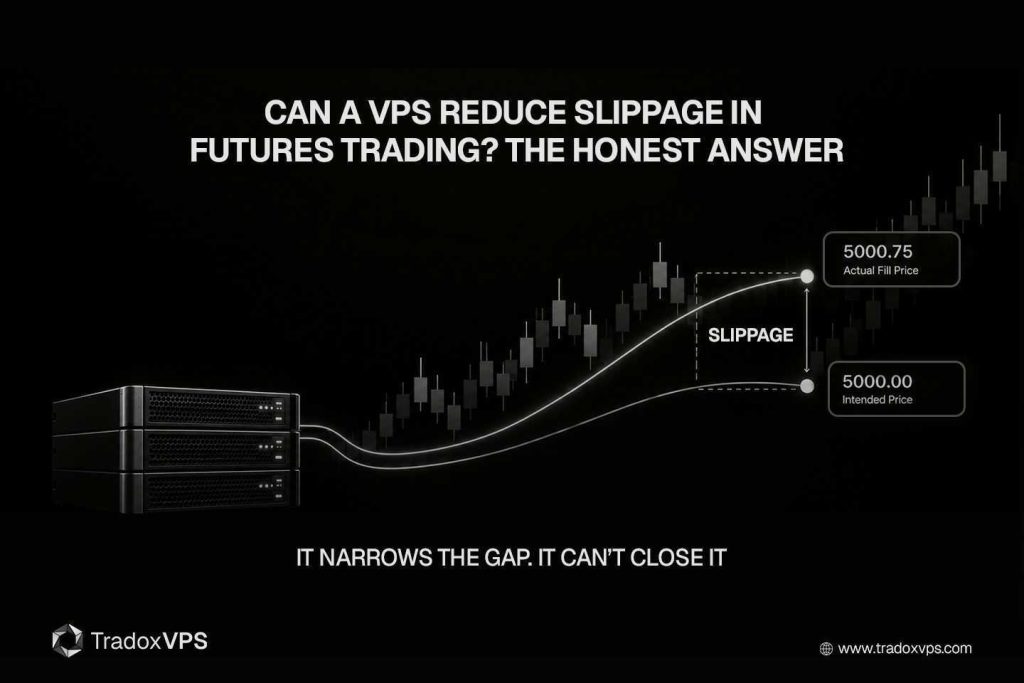
Short answer: yes, a VPS reduces slippage, but only one slice of it, and probably not the slice you’re picturing.
A VPS reduces the slippage that comes from your own infrastructure: latency, jitter, a CPU that falls behind during a fast move, a home connection that drops at the wrong moment. That’s real, and it matters most in exactly the moments trading gets hard. But most of the slippage that actually eats your P&L comes from things no VPS can touch, the market’s volatility, the depth of the order book, the spread, the size of your order, and the type of order you sent. Any provider promising to “eliminate slippage” is selling you a fantasy, because slippage cannot be eliminated, only managed.
So this is the honest breakdown: what slippage really is, the five things that cause it, exactly which one a VPS fixes and which four it doesn’t, and what actually moves the bigger number, so you put your money and your attention where they pay off.
What slippage actually is
Slippage is the gap between the price you expected when you placed a trade and the price you actually got. It can go against you, the usual case people complain about, or, less remembered, it can go in your favor, since fills sometimes come back better than expected. The useful way to think about it isn’t as a random hazard or a glitch in your platform, but as an inevitable, variable cost of transacting, a line item you budget for rather than a betrayal you rage at.
For futures traders that cost compounds quietly. A tick or two per trade sounds trivial until you run a tight-target or high-frequency strategy, where it quietly erodes the edge your backtest promised and distorts your risk-to-reward on every entry and stop. The question worth asking, then, is not how to get slippage to zero, which is impossible, but how to minimize the part of it you actually control.
The five things that cause slippage
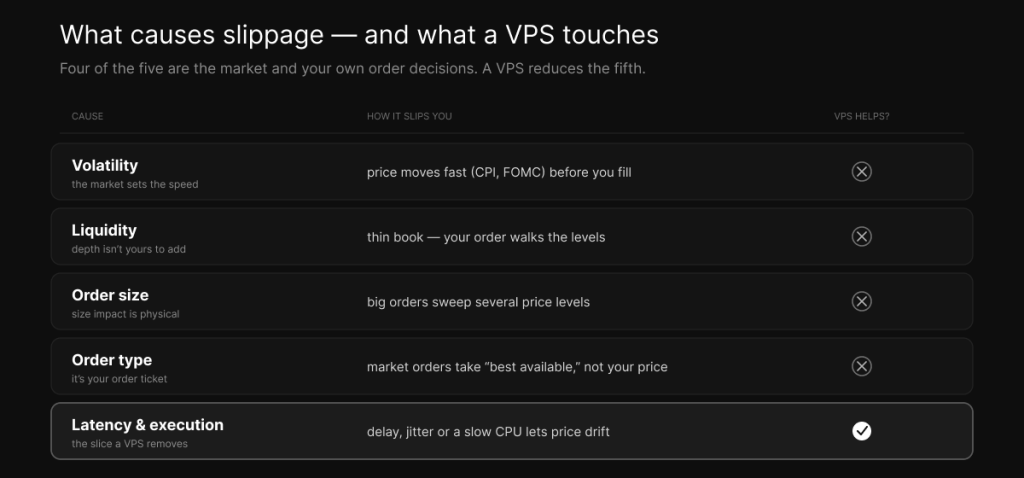
Slippage comes from five main sources, and keeping them straight is the whole game, because they don’t all have the same fix.
The first is volatility. When the market is moving fast, around a CPI print, an FOMC decision, a Non-Farm Payroll release, the price can move in the seconds, or fractions of a second, it takes your order to fill, so you land somewhere other than where you aimed. This is worst with market orders, which take whatever price is available when they arrive.
The second is liquidity. In a thin market, with few buyers and sellers, there isn’t enough resting size at your price, so your order walks up or down the book to find counterparties, filling at progressively worse levels. Liquidity is thinnest overnight, outside the main session, and during contract rollover, when volume fragments between the front month and the next.
The third is order size. A large order can exhaust the size available at the best price and sweep through several levels to complete, a market-impact cost that grows with how big you are relative to the book.
The fourth is order type, and it’s the one traders most underrate. A market order or a stop-market order guarantees you a fill but surrenders control of the price, you get the best available, which in a fast or thin market is often nowhere near ideal. A limit or stop-limit order does the reverse: it caps the price you’ll accept, but risks not filling at all if the market moves away.
The fifth, finally, is latency and execution. Network lag, broker routing delays, a slow platform, a processor that can’t keep up, or a connection that drops, any of these lets the market move before your order reaches the exchange. This is the slice everyone thinks of when they buy a VPS, and it’s worth being precise about how much of the problem it actually is.
There are a few aggravating factors layered on top, gaps when news hits while the market is closed, “phantom liquidity” where high-frequency traders flash large orders and pull them the instant yours arrives, wider spreads on less-liquid contracts, and exchange safeguards like the CME’s Velocity Logic that can briefly interrupt trading in extreme moves. But the five above are the core. So: which of them does a VPS actually change?
What a VPS does reduce
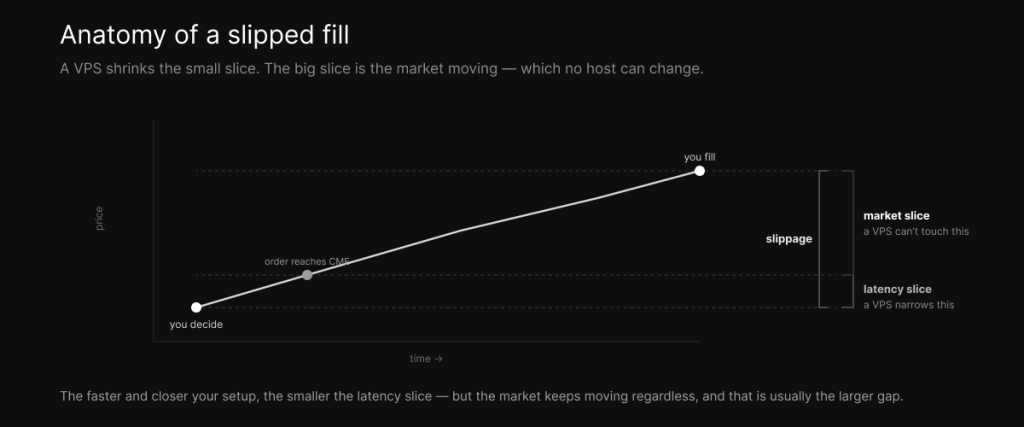
Exactly one of the five: latency and execution. And while that’s only a fifth of the list, it’s a genuine, worthwhile fifth, especially for fast and automated strategies.
A close, low-latency VPS shortens the path between your decision and your order reaching the exchange, so there’s simply less time for the price to drift before you fill. This is the legitimate, well-documented reason brokers and platforms recommend a VPS, to reduce latency, and through it the negative slippage that latency causes. There are really four mechanisms at work, and it’s worth separating them.
Lower latency to your broker and the exchange means the price has less time to move between your click and your fill. The honest scope here, consistent with everything else we publish: a VPS narrows this slice, but your order still travels through your broker’s gateway to the matching engine, so the round-trip stays in single-digit milliseconds, and true microsecond execution needs colocation inside the exchange, not a retail VPS. We lay that out in how a low-latency VPS improves trade execution, and the proximity case for futures specifically in the Chicago VPS argument.
Consistent latency, low jitter, matters as much as the raw number. Random spikes in your connection produce random, surprising fills, and they break the match between your backtest and your live results. A stable path makes your execution predictable, which is the network speed versus latency point applied directly to fills.
A fast CPU that doesn’t fall behind closes a slippage source most people never diagnose. During a volatility spike the tick rate jumps, and a slow processor builds a backlog, sending orders built on stale prices. A fast chip clears that queue so your order reflects the current market, which is the whole argument in why the Ryzen 9950X is the best CPU for a trading VPS.
And uptime with server-side orders prevents the worst slippage of all. If your stop lives on the server rather than on your laptop, it still fires when your home internet dies, sparing you the catastrophic slippage, or the unmanaged runaway position, that comes from a delayed manual reaction at the worst possible moment.
Add those up and you get what we’d call infrastructure slippage, and a VPS is precisely the right tool to remove it. It matters most for scalpers, automated strategies, and anyone trading the fast moments where milliseconds and stale data turn into ticks of cost.
What a VPS can’t fix, which is usually the bigger part
Now the honest core. The other four causes are the market and your own order decisions, and a VPS does nothing about any of them.
It can’t change volatility. The market moves at the speed it moves, and a faster connection doesn’t slow it down, it just delivers you to the moving price a little sooner. It can’t add liquidity. If the book is thin, your order walks it regardless of how fast you arrive, and arriving faster sometimes just means you walk a thin book faster. It can’t tighten the spread you have to cross, and it can’t shrink the market impact of a large order sweeping levels. And it absolutely cannot make a market order behave like a limit order, the choice of order type is in your ticket, not in your hosting, and it’s the single biggest controllable lever you have.
The blunt version is worth stating plainly, because it’s the thing the marketing won’t say. If you market-buy fifty contracts into a thin overnight book in the first second after a number, a VPS will get you a bad fill a few milliseconds sooner. The infrastructure was never the problem in that trade. Treating slippage as purely a latency problem, and a VPS as the cure, is how traders spend money on hosting while the actual leak, their order type and their timing, keeps draining the account.
What actually reduces the slippage a VPS can’t
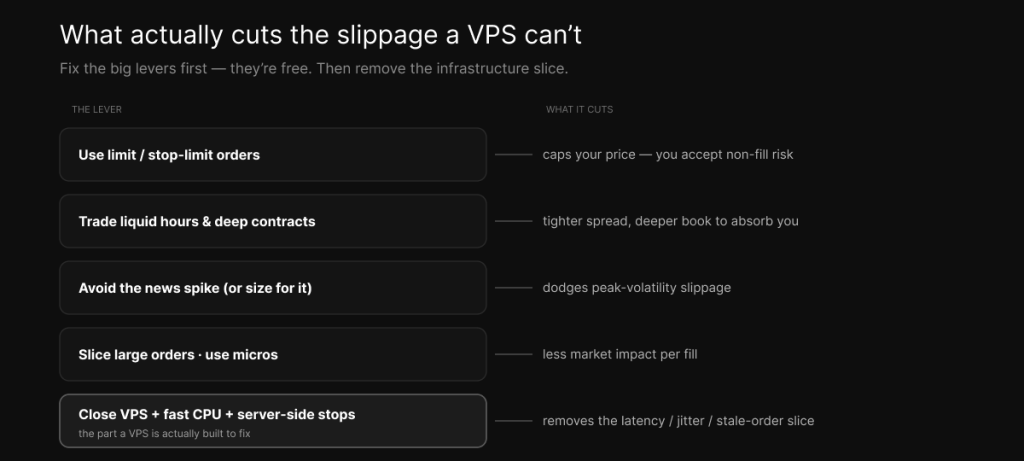
Here’s where the bigger number actually moves, and all of it is in your control rather than your wallet.
Use limit and stop-limit orders wherever your strategy allows. A limit order caps the price you’ll accept, which prevents negative price slippage outright, the trade-off being that it can go unfilled if the market runs away from you. For stops, a stop-limit applies the same control, with the same caveat. Where you genuinely must use a market order, some platforms let you set a maximum deviation or price bound that cancels the order if the price slips past it. The point is to stop handing the market a blank cheque on price.
Trade liquid hours and liquid contracts. The U.S. regular session for equity index futures like the E-mini S&P and Nasdaq is where the book is deepest and the spread tightest, a one-tick spread on the E-mini is normal, while the thin overnight hours and the rollover window are where spreads widen and fills slip. If you’re trading a contract with a chronically wide spread, that spread is your slippage, and no host changes it.
Avoid the news spike, or size for it. Market-ordering into the first seconds of FOMC, CPI, or NFP is volunteering for slippage. Either stand aside until the market settles or build the expected slippage into a strategy that’s designed for those conditions.
Slice large orders and use micros. Breaking a big position into smaller pieces reduces the market impact of any single fill, and the micro contracts, MES, MNQ and the rest, let you size precisely without sweeping levels. This matters even more if you run the same trade across multiple accounts, where size compounds, as we cover in the copy trading guide.
Measure your own slippage instead of guessing. No tool forecasts it perfectly, but you can estimate and track it: place small test orders at different times and log the gap between your intended and actual fills, watch the bid-ask spread on what you trade, and use a volatility gauge like ATR to anticipate when slippage will spike. Treat it as a budgeted cost, which, incidentally, is also the healthiest way to handle it psychologically, since unbudgeted bad fills are exactly what trigger hesitation and revenge trading, a trap we get into in day trading psychology.
The order of operations matters. Fix the order type, the timing, and the size first, because those are free and they move the bigger number. Then remove the infrastructure slice with a close VPS, a fast CPU, and server-side orders, the part a VPS is genuinely built to fix.
So, can a VPS reduce slippage?
Yes, and here’s the whole truth in one place. A VPS reduces the infrastructure-caused slice of slippage, the latency, the jitter, the stale orders from a slow CPU, the disasters from downtime, and that’s a real, worthwhile edge, particularly for fast and automated strategies and the volatile moments where it bites hardest. What it does not do is eliminate slippage, because nothing can, and it does not touch the larger, market-driven part that comes from volatility, liquidity, spread, size, and the order type you chose. Your biggest controllable lever is your order type and your timing, not your hosting.
So the honest way to spend here is to buy a VPS to remove the friction it’s actually built to remove, and to fix your order types, your timing, and your sizing to handle everything else. A provider that promises “zero slippage” is selling a fantasy. The real pitch, and the one we’ll stand behind, is that we remove the slippage your infrastructure is causing, and we’ll tell you straight that the rest is on your strategy. If you want to take the infrastructure slice off the table, our Chicago plans and pricing are where to start, and the VPS for automated futures bots guide covers sizing the rest of the machine.
Frequently asked questions
No. A VPS reduces only the slippage caused by latency, jitter, a slow CPU, or downtime. Volatility, liquidity, spread, order size, and order type cause the rest, and no VPS or any other tool removes slippage entirely. Anyone promising “zero slippage” is misleading you.
The portion caused by your infrastructure, the delay between your decision and your order reaching the exchange, the random spikes from an unstable connection, the stale orders from a processor that falls behind, and the disasters from a dropped connection. That slice matters most in fast markets and for automated strategies; the market-driven slice is unaffected.
Your order type and your timing, by a wide margin. Choosing limit over market orders where you can, and trading liquid hours instead of thin overnight or news-spike conditions, moves far more of your slippage than any hosting decision.
Yes, it’s one of the five causes, delay lets the price move before your order fills, but it’s usually a smaller slice than volatility and liquidity. A close, low-latency VPS reduces this slice, though it can’t beat the single-digit-millisecond round-trip through your broker or the movement of the market itself.
They prevent negative price slippage by capping the price you’ll accept, but at the cost of possibly not filling if the market moves away, which is its own risk to manage. Stop-limit orders apply the same price control to stops.
Partly. A faster, more consistent connection and a CPU that doesn’t fall behind do help during a spike, but the dominant causes during news are volatility and thinning liquidity, which a VPS can’t change. The bigger win is to avoid market-ordering into the spike or to size specifically for it.
Yes. Fills can come back better than your expected price as well as worse. Slippage is a two-way variable cost, not always a loss, which is one more reason to treat it as a budgeted expense rather than a personal affront.
We operate TradoxVPS and provide trading infrastructure, not financial advice. A VPS reduces the slippage caused by latency, jitter, processing delay, and downtime; it does not eliminate slippage, does not change market-driven slippage from volatility, liquidity, spread, or order size, and cannot guarantee fills or profitability. Trading futures and other leveraged products carries substantial risk, including the loss of more than your initial deposit.