

You already know the rules. Cut your losses, let your winners run, don’t oversize, don’t chase, don’t revenge trade. You could recite them in your sleep. And you still widened the stop. You still cut the winner at four ticks and watched it run forty. You still doubled up after a loss to “make it back,” and turned a bad ten minutes into a blown day.
The problem was never knowledge. If knowledge were enough, every trader who’d read a book would be profitable. The problem is that your brain is running software that was tuned over a few hundred thousand years for staying alive on a savanna, and almost every instinct that kept your ancestors breathing is actively wrong for trading. Willpower, in the moment, loses to that software almost every time.
So this is not a “stay disciplined” pep talk. It’s the actual mechanics of why disciplined, intelligent people break their own rules, grounded in the behavioral-finance research that measured it, and the mechanical systems that beat the wiring instead of relying on you to white-knuckle through it. It’s written with futures and prop traders in mind, because a funded account turns every one of these biases up to eleven.
The asymmetry that quietly runs your trading
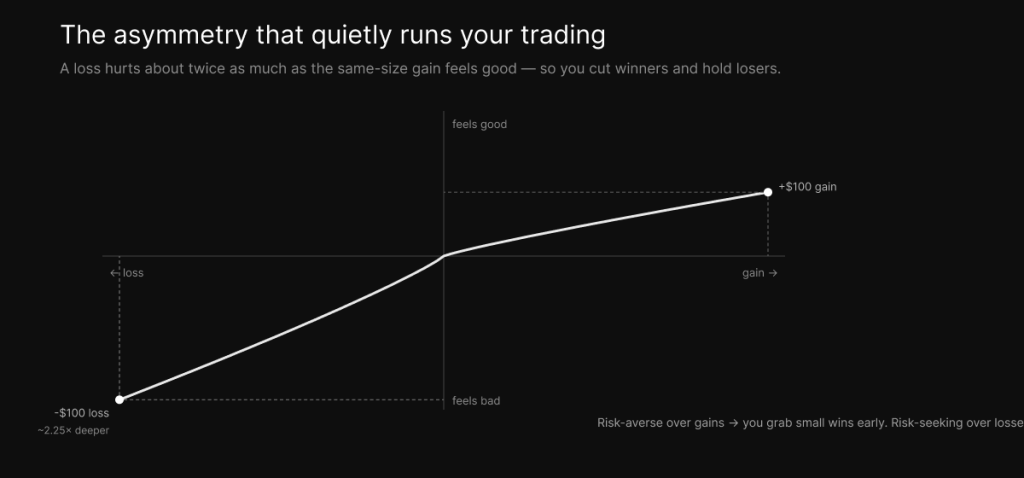
Start with the single most important finding in trading psychology, because almost everything else grows out of it. In 1979 Daniel Kahneman and Amos Tversky published prospect theory, and the core result is this: losses hurt roughly two to two and a half times as much as an equivalent gain feels good. A hundred-dollar loss lands with about the same emotional weight as a two-hundred-dollar gain. This isn’t a metaphor, brain-imaging work shows losses light up pain circuitry more strongly than matching gains light up reward circuitry.
That asymmetry bends the shape of your decisions. The prospect-theory value function is the curve in the image above, and its shape is the whole story: you become risk-averse when you’re in profit and risk-seeking when you’re in a loss. In plain terms, a gain in hand makes you want to grab it before it disappears, while a loss makes you willing to gamble, to hold and hope, rather than accept the certain sting of booking it. Read that again, because it’s the exact inverse of the only math that makes trading work. The edge requires you to cut losses small and let winners run. Your wiring pushes you to do precisely the opposite.
The disposition effect: the most expensive habit in trading
That inversion has a name. Shefrin and Statman called it the disposition effect in 1985, and Terrance Odean measured it at UC Berkeley in 1998 across ten thousand real brokerage accounts. Traders were about 1.5 times more likely to sell a winning position than a losing one, and the cruel part is that the winners they sold went on, on average, to outperform the losers they clung to. Across studies it costs something like three to five percent a year, it shows up in professional traders and fund managers as readily as in retail, and it has been documented specifically in futures markets. This is not a flaw in you. It is a flaw in the species, and you happen to be a member.
Why does it grip so hard? Because closing a loser forces you to admit you were wrong, and admitting a mistake is psychologically expensive, while an open loser is still just a “temporary setback that might bounce back.” So you hold, not to make money, but to avoid the moment of confirmation. Notice the trap inside the trap: your entry price is completely irrelevant to where the market goes next, but your brain treats it as the line between “winner” and “loser” and refuses to let go until price crawls back to break-even. For a day trader this is every stop you’ve ever slid down, every winner you’ve snatched too early, every “it’ll come back” that quietly metastasized into a maximum-loss day.
Why you revenge trade, and why it escalates
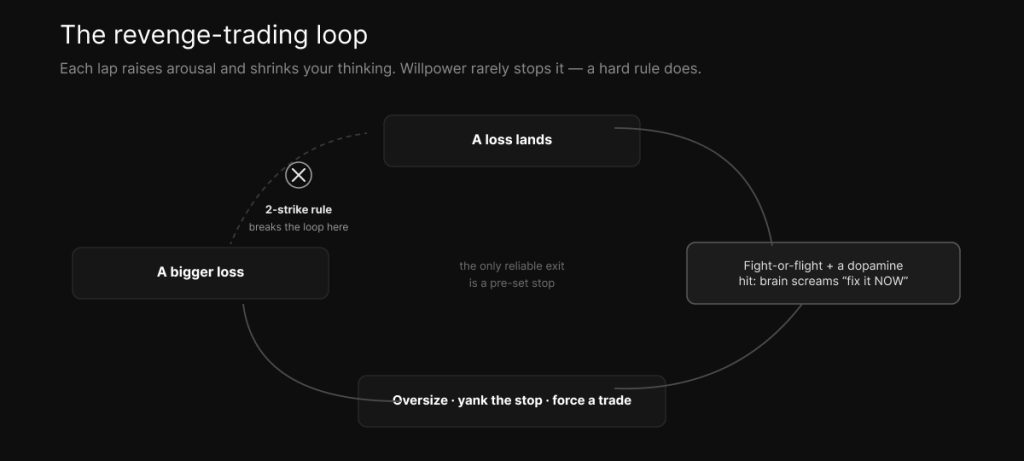
Now add a loss you’ve actually taken, and watch the machinery turn nasty. The instant you book it, loss aversion screams fix this now. Your amygdala fires the same fight-or-flight response it would for a physical threat, cortisol floods in, and stress hormones do what they’re built to do, narrow your focus and push you toward immediate action. This is tilt, the same state a poker player falls into when they abandon strategy and start playing their emotions. And there’s a chemical accelerant: neuroscientists at Cambridge found the brain releases dopamine after a loss, apparently to dull the pain, which creates a feedback loop where you chase riskier and riskier trades to get the hit. It’s hot sauce on a burnt tongue. It distracts from the original sting by adding more heat.
Stir in recency bias, where one loss convinces you you’ll lose forever, and the gambler’s fallacy, the conviction that a win is somehow “due,” and you get the recognizable signature of revenge trading: position sizes jump, stops get yanked, you average down into the loser, you fire off trade after trade with no real setup behind any of them. Underneath all of it sits the real driver, ego. The moment the goal silently switches from making money to being right, you’re finished, because a person defending their identity will hold a loser all the way to the floor rather than concede the mistake. One trading coach put it bluntly: an ego in overdrive would rather blow up the account than admit defeat. In the heat of the moment, plenty of traders have done exactly that.
The important thing about the loop in the image is that each lap makes the next one worse, more arousal, less thinking, bigger size. You will not reliably reason your way out mid-spiral, because the part of your brain that does the reasoning has been chemically sidelined. The only dependable exit is a rule you set before you ever sat down.
Winner’s tilt: the one that gets you when you’re winning
Here’s the trap almost nobody warns you about, and it’s the one that quietly ends funded accounts. A winning streak, or a single outsized gain, produces its own dopamine-fueled state of euphoria and overconfidence, and that state impairs your risk assessment exactly as much as anger does. The difference is that it feels wonderful, so nothing inside you raises an alarm. You size up beyond your rules, you get sloppy, you take the trade you’d normally skip, and you hand it all back. This is why prop firms watch the same movie on repeat: traders pass the evaluation with picture-perfect discipline, then blow the funded account through overconfidence weeks later. The legendary trader Paul Tudor Jones built a career on the opposite instinct, that the most important rule is to play great defense, not great offense. Overconfidence is what makes you forget it.
Why this is so hard to put down
There’s a deeper reason “just trade less” is such useless advice, and it’s worth naming plainly. Markets pay out on an intermittent, unpredictable schedule, the exact reinforcement pattern that makes slot machines the most compulsive object ever engineered. Your reward centers light up in anticipation of a trade whether or not it wins, which is why FOMO and overtrading feel less like choices and more like an itch you have to scratch. Behavioral economist Daniel Crosby notes that success in trading produces a dopamine release similar to addictive substances. Simply seeing the pull for what it is, a variable-reward hook rather than a real opportunity, takes some of its power away.
And here an honest aside, because it matters more than another tactic. If that pull has crossed the line from a discipline problem into genuine compulsion, if you’re trading money you can’t afford to lose, chasing losses in a way that’s hurting your finances or your life, that is a real and well-understood pattern, and there is real help for it. Problem-gambling support lines and counselors deal with exactly this, and reaching out is a sign of strength, not weakness. Trading is supposed to be a process you run, not a substance you chase.
Why willpower is the wrong tool, and what to use instead
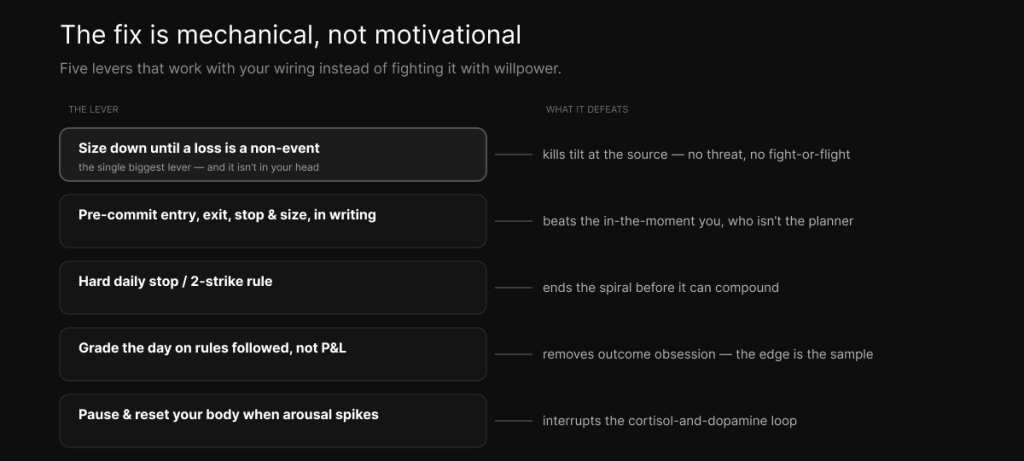
Every serious source converges on the same conclusion: the fix is to remove the in-the-moment decision, because in the moment you are not the same person who calmly wrote the plan. Behavioral scientists call it the hot-cold empathy gap, the calm “cold” you genuinely cannot imagine how the heated “hot” you will behave. So you build systems that don’t depend on the hot version having any self-control at all. Five of them carry most of the weight.
Position size is the master control, and it’s the one traders most stubbornly ignore. This is the single biggest lever you have, and it isn’t in your head, it’s a number in your order ticket. Here’s the test: if a normal, planned loss is enough to put you on tilt, you are trading too big. Full stop. Size down until a single loss is, emotionally, a non-event, because a loss your nervous system shrugs off never trips the fight-or-flight response, and tilt has nothing to grab onto. The professionals reduce size after a string of losses; amateurs increase it to “get it back.” Small size also quietly converts a rough patch from a high-pressure performance into a low-stakes observation phase, which is exactly the frame you want when conditions are against you.
Pre-commit your rules in writing, before the session. Your entry, your exit, your stop, your size, decided in the cold state and written down, because predetermined rules plus automated orders beat real-time judgment every single time. A rule as simple as “I risk the same fixed percentage on every trade regardless of my P&L” takes the most dangerous decision, how big to go after a loss, out of your emotional brain entirely.
Set a hard daily stop, and respect it like a circuit breaker. The cleanest version is the two-strike rule: two consecutive losses and you close the platform for the day, finished, no negotiation. It ends the spiral before it can compound, which is the whole point, because the spiral is precisely what you can’t stop once it’s running. On a funded account the firm’s daily drawdown limit is a built-in version of this, but set your own line tighter so you never even approach theirs.
Grade the day on whether you followed your rules, not on the number at the bottom. You control your process; you do not control any single outcome. Traders who make this switch, scoring themselves on rule-adherence rather than P&L, consistently report the spiral losing its grip, because the thing that was driving the emotion, the dollar figure, stops being the scoreboard. Hold onto the frame that any single trade is insignificant and any single day is insignificant. Your edge is a property of a large sample, not of this trade.
And regulate the body, not just the mind, because tilt is physiological before it’s psychological. When arousal spikes, a genuine pause, standing up, walking away, breathing slowly for a few minutes, lets the dopamine and cortisol settle enough for judgment to come back online. Build routines around the session, a pre-market checklist and a post-market review, so that you’re executing a workflow instead of reacting to every tick. And protect your sleep, because fatigue magnifies every emotional error you’re already prone to.
The prop-account layer: every bias, amplified
If you trade a funded account, understand that the structure itself adds stressors a personal account never had. A daily loss limit creates time pressure that simply doesn’t exist when the money is your own. A profit target creates goal-oriented thinking that quietly overrides your trading plan. A trailing drawdown produces a constant low-grade feeling of being chased, every loss nudging you toward a hard ceiling that ends the account. And the loss is permanent, breach the drawdown and the account is gone, there’s no depositing more funds to ride it out. The challenge fee you paid adds a layer of sunk-cost pressure on top, so every loss feels like you’re wasting the investment.
Two specific traps deserve names. The first is trading scared near a payout: you’ve built up a few thousand dollars in profit, and suddenly you’re terrified of giving it back, so you start cutting winners early and hesitating on clean setups, the disposition effect wearing a prop-firm costume. The second is the day-21 blowup. Most people don’t fail evaluations because they can’t trade, they trade fine for twenty days and then lose their mind on day twenty-one, turning a manageable drawdown into a terminal one. The skill was never the issue. The emotion was.
Which means the mechanical fixes above matter more here, not less. Fix your percentage risk and hold it regardless of P&L. Set a self-imposed daily stop tighter than the firm’s. Treat the account like a job, not a casino, follow the rules mechanically and let the target take care of itself. And if you run several accounts at once, remember that the same trade hits every drawdown simultaneously, so a tilt episode across a copied stack is catastrophic rather than survivable, which is its own argument for smaller size and a hard stop, as we cover in the piece on futures copy trading platforms. Even the consistency rule, as much as traders resent it, is really the firm forcing the exact discipline this whole article is about, no single home-run day allowed to carry your account.
The part of “psychology” that’s actually your setup
Here’s something the mindset coaches almost always miss, and we’ll say it plainly because it cuts against our own interest if we overstate it. A real chunk of what gets blamed on psychology is actually infrastructure friction producing genuine, repeated stress.
A trading coach tells the story of a veteran who had stayed ice-cold through flash crashes and major corrections, and who then completely came apart, frantic, account-wiping overtrading, after a single platform freeze caused him to miss a critical exit. The trigger wasn’t a character flaw or a discipline failure. It was a glitch at exactly the wrong moment. Execution failures are a documented tilt trigger, and once you’ve felt one you understand why: a platform that locks up mid-trade, an internet drop that strands an open position, fills that come back slipped and worse than you expected, each one is a real jolt of the threat response, stacked on top of the mental game you were already fighting. You cannot think clearly about your edge while you’re also fighting your tools.
So separate the two problems honestly, because they have different fixes. The discipline problems are yours, and the systems above are how you solve them. The reliability problems are solvable with infrastructure, and the single most important one is this: a stop that lives server-side, on a setup that stays online, executes even if your home internet dies, which directly prevents the most tilt-inducing event there is, watching helplessly while an unmanaged position runs against you and there’s nothing you can do. A stable, low-latency VPS that keeps your platform and your stops running does not fix your discipline, nothing external does, but it removes a whole category of external chaos so that the only thing left to manage is you. Consistent, low-jitter execution also means fewer of the ugly fill surprises that set you off in the first place, which is the network speed versus latency point applied to your nervous system.
Be clear about the size of this lever, though. It is smaller than your position size and your rules. Fix those first, they’re free and they matter most. But once you have, don’t leave a solvable source of tilt sitting unaddressed in your setup, bleeding into a mental game that’s already hard enough.
What actually works, in one breath
Size down until a loss is a non-event. Pre-commit your entry, exit, stop and size in writing. Set a hard daily stop, or a two-strike rule, tighter than your firm’s drawdown. Grade each day on the rules you followed, not the dollars. Keep a journal that records the state you were in right before each rule break, so your triggers become predictable. Pause and let your body reset when arousal spikes. And clear the infrastructure friction that’s adding tilt you don’t need to be carrying. Your edge plays out over hundreds of trades. Your only job is to still be there, calm and sized right, when it does. When you’re ready to take the controllable chaos out of your setup, the plans and pricing are here.
Frequently asked questions
Because it isn’t a knowledge problem. Loss aversion and the disposition effect are wired into human decision-making, and in the heat of a trade your reasoning brain is chemically sidelined, so willpower loses. The fix is mechanical: remove the real-time decision with pre-set written rules, smaller position size, and a hard daily stop.
A booked loss triggers loss aversion and a fight-or-flight response, and a dopamine loop pushes you to chase the next trade to dull the sting. It’s tilt, the same state as poker tilt. You can’t reason your way out mid-spiral, so the fix is a circuit breaker set in advance, the two-strike rule, a hard daily loss limit, and physically stepping away to let arousal settle.
For most traders who are struggling, yes. Prop firms find people fail on emotional discipline far more than on strategy. But “psychology” honestly includes removing controllable friction too, an unreliable platform or connection is a real, repeated stressor, not just a technical inconvenience.
Cap your trades per session, size down so each trade carries less emotional weight, and recognize the variable-reward pull for what it is rather than a real opportunity. A mandatory break after a set number of trades or losses lets the dopamine loop reset, the same way a gambler has to physically leave the slot machine.
Treat it like a job, not a casino. Use a fixed percentage risk regardless of your P&L, set a self-imposed daily stop tighter than the firm’s drawdown, and grade yourself on following your rules rather than on the number. Watch especially for trading scared as you approach a payout, and for overconfidence after a winning run.
Yes. Platform freezes and connection drops are documented tilt triggers, and an open position you can’t act on because your tools failed is the single most stressful situation in trading. Reliable, low-latency execution and server-side stops that survive a connection drop remove that category of stress, though they won’t fix discipline itself, that part is still on you.
They lean on systems, not willpower, small size, pre-defined written rules, hard loss limits, structured routines, and honest journals. Tellingly, they reduce risk after losses instead of increasing it, and they judge themselves on process rather than on any single outcome.
We operate TradoxVPS and provide trading infrastructure. This article is educational and is not financial, psychological, or medical advice. If trading is harming your finances or wellbeing, or feels compulsive, please consider speaking with a qualified professional or a problem-gambling support service, this content is not a substitute for that help. Trading futures and other leveraged products carries substantial risk, including the loss of more than your initial deposit.