
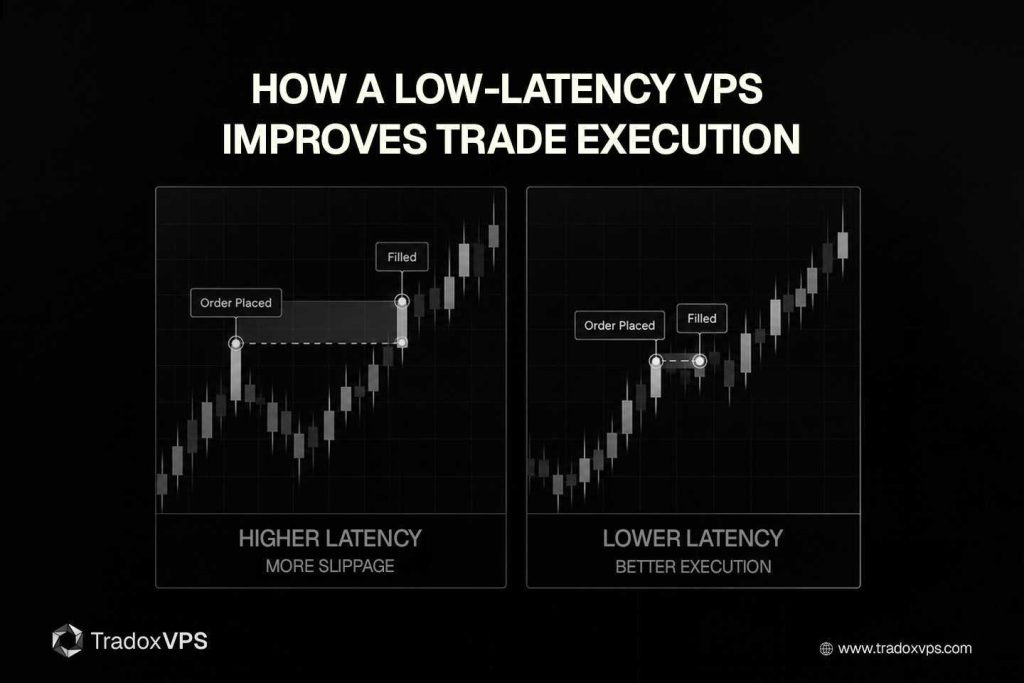
Every trading VPS on the internet promises “lower latency” and “better fills.” Most of them then print a number that’s physically impossible and skip the only thing that actually matters: how latency changes what you get filled at, and where a server can genuinely help versus where it can’t touch the problem at all.
Lower latency does improve your execution. But not the way the “1ms to the exchange” banners claim, and not by making slippage disappear. This is the real mechanism — where the milliseconds come from, how they turn into money lost or saved, the honest numbers a retail setup can actually hit, and a straight answer to whether any of it matters for the way you trade.
What “latency” actually means here
Latency is the round trip: the time from the moment your system decides to trade to the moment the exchange has acted on that order and told you so. It’s measured in milliseconds, and it’s the sum of several smaller delays stacked end to end.
One distinction matters more than any other, and it’s the one the marketing buries. A ping to a data center is not your order’s round trip. Ping is a bare network echo to a building. Your order has to travel through your trading platform, through your broker’s systems, into the exchange’s matching engine, and back. When a provider advertises “sub-1ms,” they’re almost always quoting you the ping and letting you assume it’s the fill. Those are different numbers, and the gap between them is where the truth lives.
Where the milliseconds come from
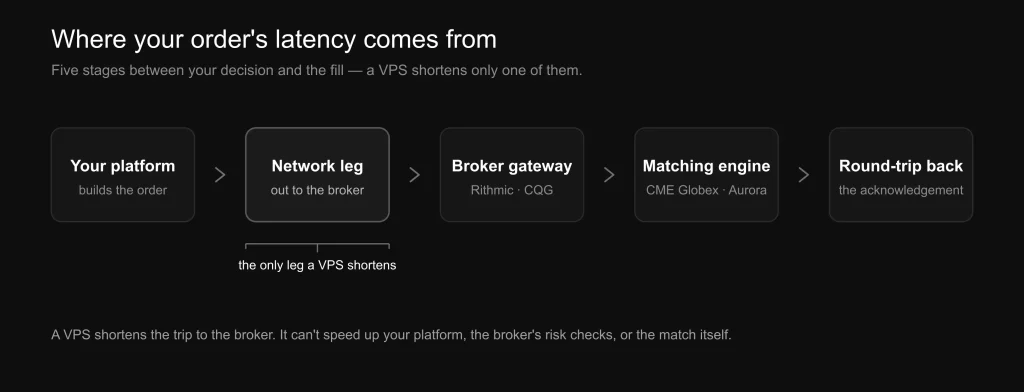
Picture the path a futures order actually takes. Your platform processes the signal and builds the order. Your network carries it out of your machine. Your broker’s gateway — Rithmic, CQG, or similar — receives it, runs its risk checks, and forwards it. CME’s matching engine, sitting in the Aurora data center west of Chicago, processes it against the book. Then the acknowledgement makes the return trip. Every one of those hops costs time.
Here’s the part most providers won’t say out loud: a VPS only shrinks one of those legs. By sitting physically closer to your broker and the exchange, it cuts the network travel time. It does nothing for how fast your platform builds the order, nothing for your broker’s internal processing, and nothing for the matching engine itself. So “our VPS gives you 1ms execution” isn’t a smaller version of the truth — it’s a category error. What a good VPS gives you is a shorter network leg and a machine that doesn’t get in its own way. That’s worth real money for the right trader, and we’ll get to who that is.
How latency turns into slippage
Slippage is the difference between the price you expected and the price you got. Latency feeds it through a simple mechanism: between the instant your strategy commits to a trade and the instant your order reaches the book, the market keeps moving. The longer that delay, the more room the price has to drift away from you before you arrive. In a fast tape or a thin book, even a few extra milliseconds widen the window for the price to move against you, and you fill worse.
So yes, trimming latency tightens your fills. But this is exactly where the honest version parts ways with the sales pitch. Slippage isn’t only a latency problem. It’s also driven by how much liquidity is resting at your price, how big your order is relative to that liquidity, and how violently the market is moving right now. A faster connection does nothing about any of those. Lower latency narrows slippage; it never removes it. Any page that promises “zero slippage” is describing something that does not exist in a live market — walk away from it.
Queue position: the part that genuinely rewards speed
This is the one place lower latency improves your fills directly and mechanically, and it’s worth understanding because it’s also the part nobody markets correctly.
For passive limit orders, CME’s busiest futures — the E-mini S&P 500 and crude oil among them — match on price-time priority, better known as FIFO. Among all the orders resting at the same price, the one with the earliest timestamp gets filled first. Get your order into the book sooner and you sit further forward in that queue, which means a higher chance of being filled at your price instead of having to cancel and chase a worse one. Lower latency literally buys you a better place in line.
It’s worth being precise about the nuance, because the precision is the point. Not every contract is pure FIFO. Some products — SOFR futures, grains and oilseeds, a handful of FX contracts — use pro-rata or hybrid algorithms where the size of your resting order matters as much as its timestamp. But even those reward speed: the first order to better the market is granted top priority and matches first regardless of size. And CME itself states the plain version of all this — a server closer to its matching infrastructure is faster to market than one further away. That’s not our marketing. That’s the exchange describing its own system.
The honest numbers
Here is what a retail setup can actually achieve, with no rounding in our favor.
From metro Chicago, where our servers sit, a network ping to the CME Aurora area lands in the sub-millisecond to roughly one-millisecond range. That number is real, and it’s also not your fill. Your actual order round trip through a broker gateway like Rithmic is typically single-digit milliseconds — call it a few milliseconds, not a fraction of one — because the broker’s processing and the matching engine are part of the path and a VPS can’t compress them.
True microsecond latency is a different world entirely. It belongs to firms that colocate their servers inside the exchange’s data center and connect to the matching engine through a direct cross-connect, bypassing the broker layer that retail orders must pass through. That’s a five-figure-a-month institutional arrangement, not a hosting plan. So when a retail VPS advertises “microseconds” or “sub-1ms execution,” it is either quoting you a ping or quoting you a fantasy. The right move is never to trust the number on the page — ours included. Run a latency check from the actual machine to the actual venue, and read how we benchmark latency honestly so you can hold any provider to the same standard.
Does latency even matter for the way you trade?
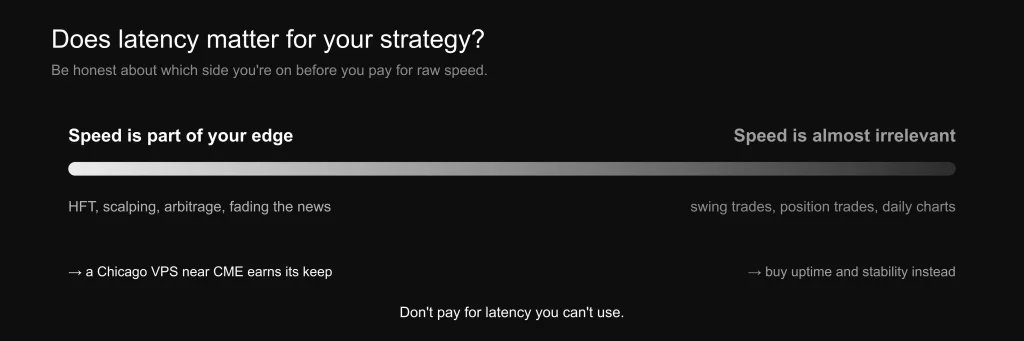
This is the question the rest of the industry hopes you won’t ask, because the honest answer costs them sales.
If you scalp, run high-frequency strategies, arbitrage related instruments, or react to scheduled news, milliseconds are part of your edge. You’re competing against other automated systems for the same fills, races are decided in the tail, and shaving latency directly protects your P&L. For you, a low-latency Chicago box near the exchange isn’t a luxury — it’s table stakes.
If you swing trade, hold positions for hours or days, or trade off higher-timeframe signals, shaving three milliseconds off your order changes nothing you’ll ever be able to measure. What matters for you is that the machine stays online through the trade, doesn’t drop its connection at the wrong moment, and runs your platform without freezing. That’s an uptime and stability question, not a speed one. Don’t pay for latency you have no way to use — and be suspicious of anyone trying to sell it to you.
What a VPS does, and doesn’t, do for execution
The honest summary. A good trading VPS shortens the network leg of your order’s journey by putting you close to your broker and the exchange. It gives you an always-on machine with stable, low jitter and a fast single-thread CPU for the decide-and-send loop — which is why we run high-clock Ryzen 9 9950X chips rather than slow many-core servers. For an automated futures strategy on a platform like NinjaTrader, that combination is the difference between a backtest’s assumptions and a live system that behaves.
What it does not do: eliminate slippage, match exchange colocation, rescue a losing strategy, or deliver “1ms execution.” Anyone claiming otherwise is counting on you not reading this far. If your strategy is genuinely latency-sensitive, a Chicago VPS near CME measurably improves your fills through a shorter path and better queue position. If it isn’t, save your money and buy stability instead. Our plans and locations are here when the honest version is what you’re after.
Frequently asked questions
Partly. By shortening the network leg of your order’s path, it narrows the window in which the price can move against you between your decision and your fill, which tightens execution. It cannot eliminate slippage, because slippage also depends on liquidity, order size, and volatility, none of which a faster connection changes. “Zero slippage” is not a real outcome.
It depends entirely on your strategy. For scalping, HFT, or arbitrage, you want your order round trip as low as possible and you should measure it. For swing or position trading, latency is largely irrelevant and uptime matters far more. The useful number is your real order round trip, not an advertised ping.
As a network ping to a nearby data center, a sub-millisecond figure can be genuine. As your order’s round trip, it is not — real order execution through a broker is single-digit milliseconds, because the broker’s processing and the matching engine are in the path. Microsecond execution requires colocation inside the exchange with direct market access, which is institutional, not retail.
No. Professional firms colocate inside the exchange’s data center and connect directly to the matching engine, bypassing the broker layer your orders pass through. A metro VPS shortens your path meaningfully, but it’s a different tier from in-building colocation, and any provider implying otherwise is misleading you.
No. If you hold positions for hours or days, the milliseconds a VPS saves on order routing won’t affect your results. Prioritize a stable, always-on machine with reliable uptime over raw speed.
We operate TradoxVPS and provide trading infrastructure, not financial advice. Trading futures carries substantial risk, including the loss of more than your initial deposit. Latency figures are environment-dependent — measure your own before relying on them.