
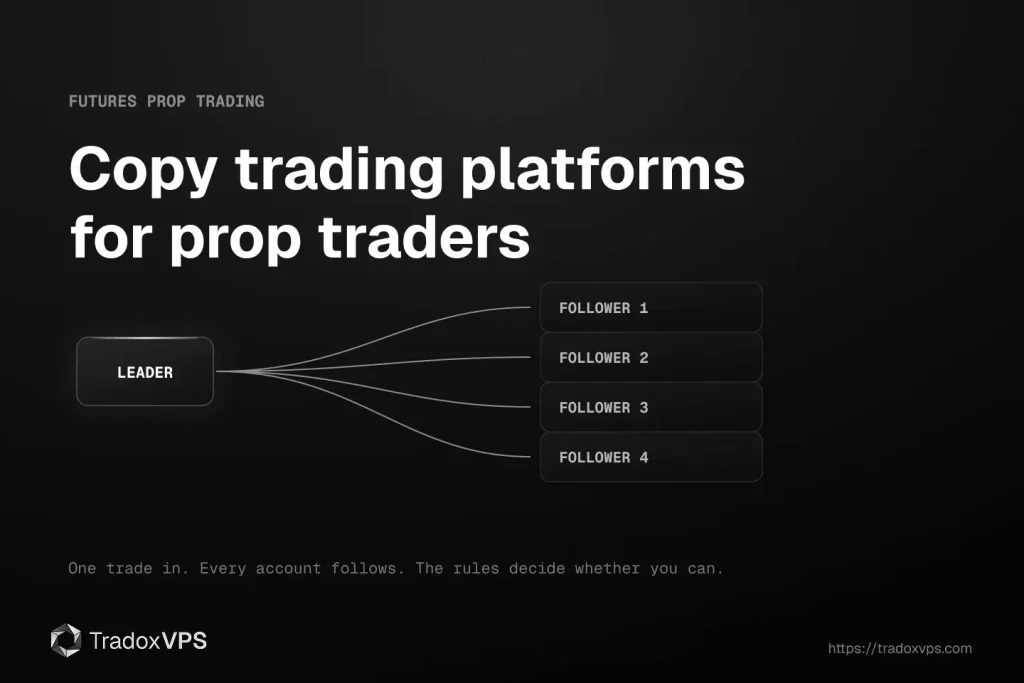
You’re running a stack of prop accounts. Maybe three Apex PAs, a couple of MyFundedFutures, a Topstep account you’re nursing toward a payout. A clean setup prints on ES, and now you’ve got to click the same entry into eight windows before the move is gone. That’s the problem a futures copy trading platform solves: you trade once on a leader account and every other account follows.
But here’s what the “top 10 copiers” lists won’t tell you, and it’s the thing that actually matters. The copier is the easy part. Which one you can use, and whether you’re even allowed to use one, is decided by your prop firm, and those rules differ wildly and change almost monthly. Topstep bans VPS, VPN, and every third-party copier outright. Apex lets you copy across up to twenty of your own accounts but bans copying anyone else’s, and requires a bracket on every order. FTMO-style firms don’t want you coordinating trades across your own accounts at all. Get this wrong and you don’t just miss a trade, you lose the account and the payout you were working toward.
So this guide is built for the person actually doing this: which copier fits your platform and firm, how to set it up without the classic blow-ups, and the per-firm rules that decide all of it. We host the infrastructure a lot of these run on, which also means we’ll tell you straight when a VPS is the right call and when it’s flatly against your firm’s rules.
First, what a futures copy trading platform actually is
In futures, “copy trading” almost never means the social, follow-a-guru model you see in forex and crypto. It means a trade copier: software that mirrors orders from one leader account (sometimes called the master) to one or more follower accounts in real time, with per-account sizing so a smaller account can trade fewer contracts. That’s the whole mechanism. Everything else is detail.
And the entire reason this is a category now is the prop-firm boom. The people buying copiers are overwhelmingly traders running multiple evaluation and funded accounts who want one strategy to hit all of them at once, plus a smaller group copying one strategy across their own accounts at different brokers. Copying a stranger’s fills into your account, or broadcasting yours to other people’s accounts, is a different thing entirely, and as you’ll see, almost every prop firm bans it.
The copiers that actually work, by how you trade
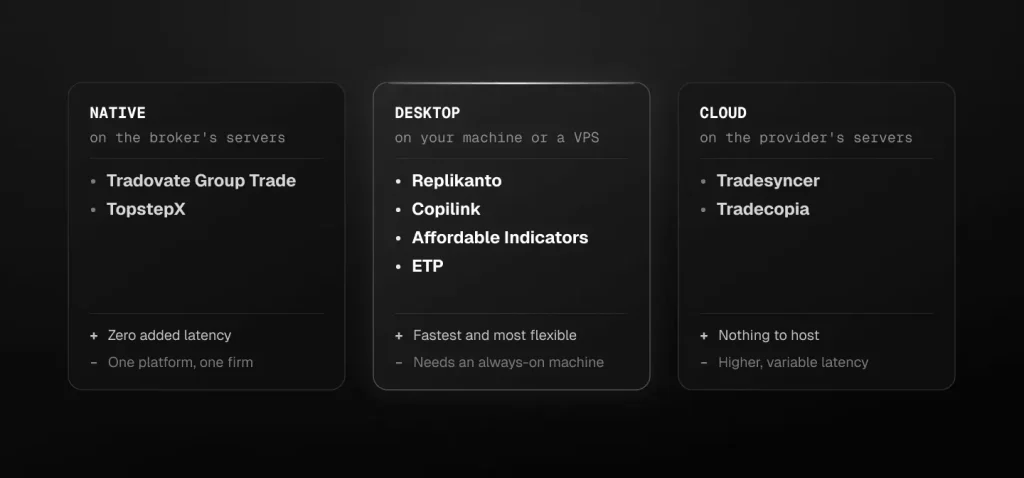
The useful way to sort the field isn’t a popularity ranking, it’s where the copier runs, because that decides your speed, your reliability, and what you have to maintain. Prices and specs below are accurate as of 2026 and worth re-checking before you buy.
Native, on the broker’s servers. Some platforms copy across accounts themselves, with no third-party tool at all. On Tradovate, Group Trade submits a single order across multiple prop accounts simultaneously, server-side, with effectively zero added latency and no software or VPS to run. The important 2026 addition is Group Trade ATM, which finally attaches your ATM bracket templates to each account as entries fill, with independent per-account OCO logic. This is the cleanest option if your accounts are all on Tradovate and your logic is relatively simple. Two gotchas decide whether it works for you. Plain Group Trade historically did not replicate brackets, you had to place stops and targets on each account by hand, which is exactly the gap Group Trade ATM closes, and it matters because Apex’s current rules require a bracket on every order, so plain group trading without ATM is a live compliance hole. And if you submit a quantity that isn’t evenly divisible by your account count, Tradovate fills your accounts unevenly, which creates sizing inconsistency that looks like manipulation to a risk desk reviewing your history. Confirm fills on every account before you place exits.
Native, on Topstep. TopstepX has its own built-in copier under Settings, Copy Trading, linking a master account to child accounts, with no third-party software and no extra license. It’s the only copy path Topstep allows, and it’s capped at five Express Funded Accounts. There’s a gotcha here too, and it’s a good one: while an Express Funded Account payout request is being processed, the copy connection is automatically disabled, then turned back on once the payout clears. Trades you place on the master during that one-to-two-day window do not propagate. Re-check the setting after a payout clears so you don’t discover the dark window the hard way.
Desktop, on your machine or a VPS. This is where the serious NinjaTrader tools live.
Replikanto, by FlowBots, is the de facto standard in the NinjaTrader ecosystem. It runs as an NT8 add-on and uses whatever accounts you’ve connected to NinjaTrader through Multi-Provider mode, including Tradovate accounts, which connect through NinjaTrader rather than through Replikanto directly. It offers seven copy methods, Exact Quantity and Ratio and Percentage Change among them, a Remote Mode that lets you copy across separate machines and test the tool for free before paying, and ATM copying. Pricing runs from zero to roughly $299 depending on tier.
Copilink is the newest of the NT8 add-ons and takes a different angle: it treats prop-firm rule enforcement as the primary feature rather than something bolted onto a copier. Per-account daily loss limits with configurable firing thresholds, so you can set your internal limit below the firm’s official one and keep a buffer. Apex consistency-rule tracking calculated per account in real time, with alerts as you approach the ceiling. Intraday drawdown monitoring, consecutive-loss detection that automatically reduces your ratio, and a portfolio-level kill switch. If you read the aggregate-drawdown and consistency-rule sections below and recognised your own situation, that combination is the specific gap it’s built for, and no firm gives you those controls natively. It also publishes a copy latency figure of roughly 1.6 ms alongside a stated methodology, which is more than most tools in this category do, though it is their measurement rather than ours. Pricing is a one-year or lifetime licence with a seven-day trial and no card required. The honest caveat is maturity: Replikanto has been around longer and has a larger community, so there are more third-party guides and forum threads when you hit an edge case, something Copilink’s own comparison pages acknowledge.
The Affordable Indicators copier (“Duplicate Account Actions”) also lives inside NinjaTrader but leans hard into a per-account risk manager, daily loss limits, profit goals, funded-account tracking and auto-liquidation, on a one-time license rather than a subscription, which is appealing if your priority is built-in compliance controls on a single payment.
ETP is a standalone Windows application rather than an NT8 add-on, so your copying keeps running even if NinjaTrader closes or crashes, which is the reason high-volume traders reach for it.
All of these are the fastest and most flexible third-party option, and all of them only run while your machine and platform are up, which is the catch we’ll come back to in the VPS section.
Cloud, on the provider’s servers. Tradesyncer and Tradecopia run in the cloud, so there’s nothing for you to host. They replicate in roughly under a hundred milliseconds, cover the major firms and platforms, Apex, MyFundedFutures, Tradeify, TakeProfitTrader, Lucid, on Rithmic, Tradovate, NinjaTrader, TradingView and ProjectX, and bake in per-account risk locks. The appeal is no infrastructure and easy cross-firm copying from one dashboard. The trade-offs are real: your orders route over the internet rather than from a box next to the exchange, so latency is higher and more variable, your broker credentials live with the provider, and Topstep compatibility is uncertain given the TopstepX-only migration. If your strategy depends on copying and you’re on Topstep, the cloud route probably isn’t open to you anyway.
The per-firm rules that decide everything
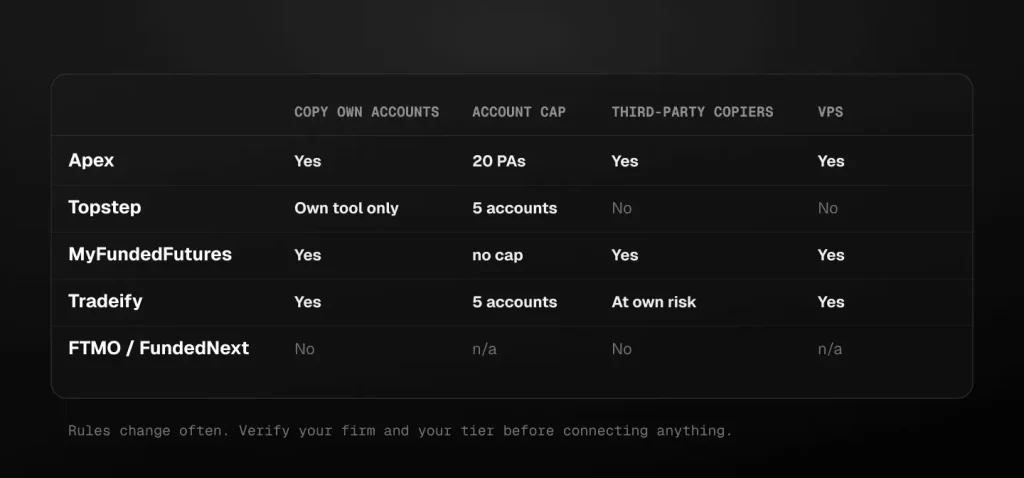
This is the section the listicles skip, and it’s the one that actually determines whether copy trading works out for you. The gating factor is not the software. It’s your firm’s rules, for your account tier, right now. Here’s where the major firms stand as of 2026, but treat every line as something to re-verify, because these change constantly.
Apex Trader Funding is the most copy-friendly of the big firms. Copying across your own funded Performance Accounts is explicitly allowed, under both your personal and business names, with one PA acting as leader and up to nineteen others following. The hard limit is twenty active PAs total per household, and that counts everything, personal accounts, business-entity accounts, a spouse’s accounts, every platform combined. Copying from another person’s account, or acting as a signal provider broadcasting to accounts you don’t own, is prohibited, and trade copying with other traders specifically can get your accounts closed and funds forfeited. Two operational details bite copy traders. New PAs start in a half-contract phase until the balance clears a threshold, so a follower still in that phase fills at its smaller maximum, not your full size. And Apex’s current rules require a bracket attached to every order, so whatever copier you use has to attach stops and targets reliably. Apex gives you no portfolio-level stop, each account’s drawdown is yours to watch.
Topstep is the strictest of the group on tooling. Copy trading is allowed only through the built-in TopstepX copier or the TopstepX API, capped at five Express Funded Accounts, and that’s it. No third-party copiers, no bots, no EAs, and critically, no VPS and no VPN, connecting through a VPN returns a flat 403 Forbidden. Everything must run from your personal device. As covered above, the copy connection also auto-disables while a payout is processing. If you’re a discretionary Topstep trader, none of this is a problem. If automation or a VPS is part of your setup, Topstep is simply off the table for that part of your workflow, and pretending otherwise is how accounts get closed.
MyFundedFutures sits closer to Apex. Copying across your own accounts is allowed, it runs on Rithmic with NinjaTrader, Tradovate and TradingView as platform options, and it supports automation, which means desktop copiers and a VPS are both on the table. It uses end-of-day trailing drawdown and carries a consistency rule, commonly around forty percent on its Core plan.
Tradeify runs on Tradovate, so its blessed path is Tradovate’s native Group Trading, supported for up to five accounts, with third-party copiers usable at your own risk and NinjaTrader bridges supported. TakeProfitTrader and Lucid Trading both allow copying across your own accounts.
The firms to be careful with are the FTMO and FundedNext lineage, which enforce “real market” or independent-decision rules. Even when you own all the accounts, coordinating trades across them or exploiting latency is prohibited, because their whole model is built around independent trading decisions. Copy trading is effectively not allowed there, regardless of what a copier’s marketing says it can connect to.
Two lines hold almost everywhere. Copying another person’s account, or selling signals into accounts you don’t own, is banned across the board. And using a copier to get around a firm’s hedging or consistency rules is banned even where copying itself is fine. Verify your firm and your tier before you connect anything.
The two traps that actually blow up multi-account traders
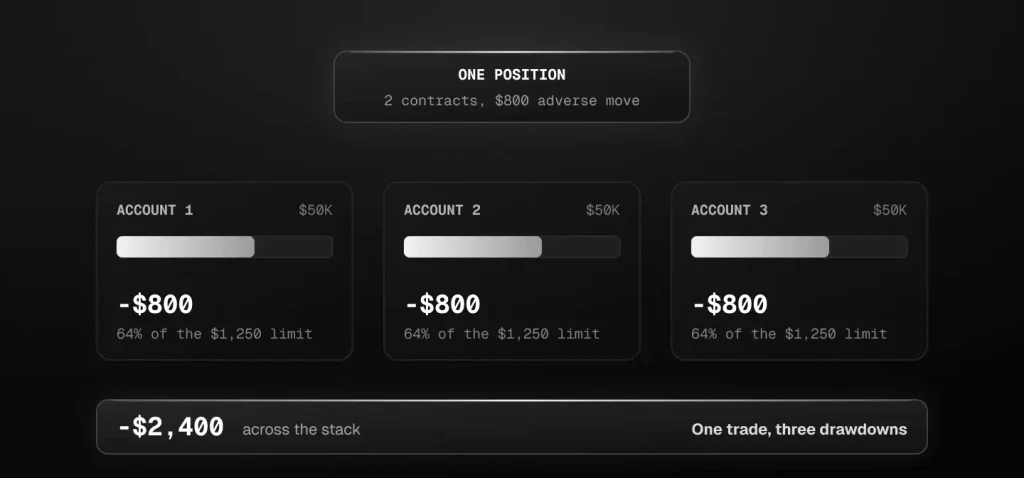
Most guides give risk two sentences. These two specific traps are how multi-account copy traders wreck themselves in the first few months, so they get real space here.
Aggregate drawdown. This is the big one, and it’s deceptively simple. When you copy the same position across several accounts, a single bad move doesn’t hit one drawdown, it hits all of them at once. Run three $50K accounts, go long the same two contracts on each, and a routine $800 adverse move before your stop is $2,400 of damage across three accounts that each might have a daily loss limit around $1,000 to $1,500. One ordinary bad morning and you’re near breach on all three simultaneously. The accounts aren’t diversified at that point, they’re one position with extra paperwork and extra fees. The fix is to size for the whole portfolio’s risk rather than per account, and to stop copying to any follower that’s approaching its limit, because no firm gives you a portfolio-wide stop, that monitoring is on you. If you want that enforced in software rather than watched by hand, it’s the one thing the newer risk-first copiers are built to do.
The consistency rule. Most firms run one, with the threshold commonly between thirty and fifty percent, around forty at Topstep and MyFundedFutures. It blocks a payout when any single day is too large a share of your total profit, the “home run” that’s supposed to be good news. Copy trading multiplies this problem, because one outsized day lands on every account running the same trades, so a single home run can freeze payouts across your whole stack at once. The discipline is to keep daily P&L relatively even across a payout cycle, which is harder, not easier, when you’re trading many accounts in lockstep.
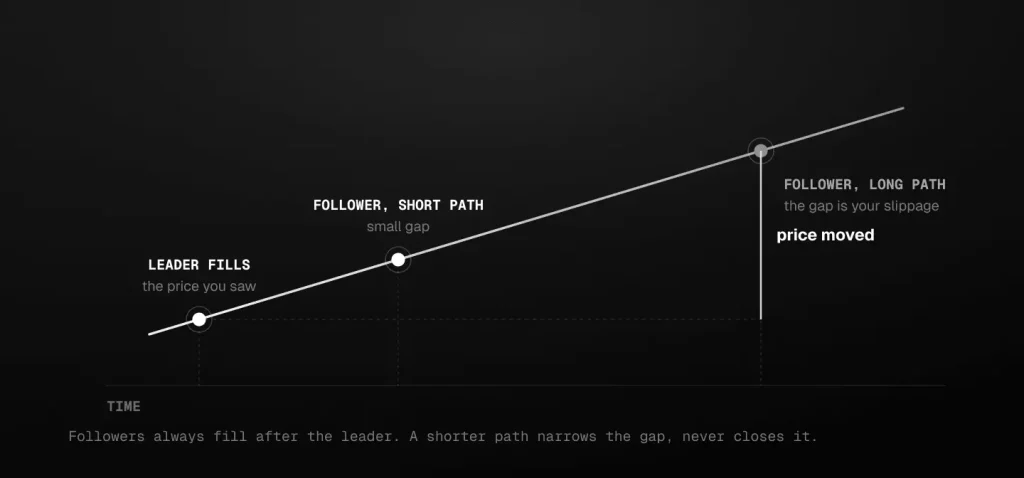
Two smaller things round out the risk picture. Followers always fill a moment after the leader, so in a fast market the price moves in between, which is the slippage we’ll address with the VPS section. And there’s the “stealth mode” and “jitter” question, features that disguise copied trades as manual or add small random delays so accounts don’t fill at the same millisecond. Be clear-eyed about these. Within a firm that allows copying, you don’t need to hide anything. Across firms that prohibit coordinated trading, using these features to make copying look independent is deception, not a workaround, and firms audit accounts, especially at payout. The durable way to earn on funded accounts is to stay inside the rules and keep clean records, not to disguise breaking them.
Setup: how to not blow it
The mechanics are where good setups quietly fail, so here’s the practical sequence for a desktop copier, using the NinjaTrader workflow most prop traders land on.
Connect your accounts to NinjaTrader first, with Multi-Provider mode enabled, since that’s the pool a tool like Replikanto draws from. When you pick a leader, choose an account on the same platform family as the copier, a NinjaTrader or Tradovate account rather than a Rithmic one, because mixing a Rithmic leader with Tradovate followers introduces a seam that causes problems. Choose a copy method that matches your accounts: Exact Quantity when your accounts are similar in size, Ratio when they differ, so each follower scales correctly. Handle the mini-versus-micro question deliberately, ten micro contracts equal one mini, so make sure a smaller-limit account gets micros, MES instead of ES, rather than getting over-leveraged into a full-size contract, either through the copier’s automatic conversion or by sizing it yourself. Make sure brackets actually attach, NinjaTrader’s ATM strategies are more reliable for this than Tradovate’s native bracket orders, and remember Apex requires a bracket on every order. After any group entry, confirm the fill on each account before you place exits, because a partial fill on one account quietly changes your sizing math and can push you past a drawdown limit. Turn on position-mismatch alerts, Replikanto’s Follower Guard, for example, will email you when a follower is auto-disarmed because its position drifted from the leader’s, which is how you catch the “ghost orders” that scaling produces. And test the whole thing in simulation during a genuinely busy session before a single funded account is live, so you see your real slippage and your real failure modes first.
Where a VPS fits, and where it’s banned
Here’s where our stake in this is direct, so we’ll be plain about it, including the part that costs us business.
Desktop copiers run continuously and are sensitive to latency, which is why they belong on a stable, always-on, low-latency environment rather than your home PC, for two separate reasons. The first is uptime, and it’s the one that hurts most. If your copier goes down mid-session, your followers stop receiving the leader’s actions, which can leave open positions sitting unmanaged across every account with no exit going through, the aggregate-drawdown trap working against you at the worst moment. A VPS keeps the copier running through a home internet drop, a power cut, or a forced Windows reboot. That’s the uptime case we make in detail in how a low-latency VPS improves trade execution. The second is the slippage in the diagram above: followers fill after the leader, and a shorter copy path means a smaller gap, so a desktop copier on a Chicago VPS near CME narrows the leader-to-follower difference versus reaching across a long retail route. Consistency matters as much as raw speed here, since erratic latency produces erratic fills, which is the network speed versus latency point applied to copying. There’s also a group this is non-negotiable for: Mac users, who can’t run NinjaTrader 8 desktop natively and so run Windows NinjaTrader on a VPS specifically to copy brackets correctly across their accounts.
Now the honest part. If your firm is Topstep, a VPS is against the rules, they ban VPS and VPN outright, so don’t. The VPS route applies to the firms that permit external platforms and automation, Apex, MyFundedFutures, Tradeify, TakeProfitTrader, Lucid, and not to Topstep. Native copying through Tradovate’s Group Trade and the cloud copiers don’t need a VPS at all, that’s part of their appeal. And if you do host a desktop copier, size the machine for your platform: NinjaTrader leans on single-core speed, so a fast CPU with enough RAM to keep multiple instances stable through a volatile session is the right spec, the same logic we lay out for any NinjaTrader VPS.
So what should you actually do?
Work in this order. Check your firm’s current copy-trading rules first, for your tier, because they decide what’s even possible. Then match the tool to your situation.
If all your accounts are on Tradovate at a copy-friendly firm, native Group Trade ATM is the simplest, fastest, and cheapest answer.
If you trade NinjaTrader on Rithmic or Tradovate and you’re scaling several accounts at Apex, MyFundedFutures, or Tradeify, run Replikanto for the largest ecosystem and the most copy methods, Copilink if enforcing firm rules automatically matters more to you than community maturity, or Affordable Indicators if you want per-account risk controls on a one-time licence, all of them on a Chicago VPS for the uptime and tighter fills.
If you’d rather not host anything and want cross-firm copying from one dashboard, a cloud copier is reasonable as long as you accept the latency and credential trade-offs.
If you’re on Topstep, use the built-in TopstepX copier and nothing else, no VPS, no third-party tools.
Whatever you choose, size for aggregate drawdown rather than per account, respect the consistency rule, test in simulation first, and don’t reach for stealth mode or jitter to dodge a rule, that’s the move that turns a good month into a closed account. When you want to match a server to your copier setup, the plans and pricing are here.
Frequently asked questions
Yes, across your own funded Performance Accounts, with one leader and up to nineteen followers, capped at twenty active PAs total per household across all platforms. Copying another person’s account or acting as a signal provider is prohibited, all accounts must trade the same direction, and Apex’s current rules require a bracket on every order, so your copier has to attach stops and targets.
Copy trading is allowed only through the built-in TopstepX copier or API, capped at five Express Funded Accounts. Third-party copiers, bots, EAs, a VPS, and a VPN are all prohibited, connecting through a VPN returns a 403 error, and the copy connection auto-disables while a payout is processing.
Replikanto is the ecosystem standard for desktop copying, with the widest set of copy methods and the largest community. Copilink is the pick if automatic prop-firm rule enforcement is your priority, since consistency-rule tracking, per-account loss limits and a portfolio kill switch are built in rather than added on. Affordable Indicators covers per-account risk management on a one-time licence, and ETP is the choice when you want copying that keeps running even if NinjaTrader closes. If all your accounts are on Tradovate, native Group Trade ATM may replace the need for a third-party tool entirely.
For desktop copiers, a VPS is strongly recommended for uptime and tighter fills, and it’s effectively required for Mac users who can’t run NinjaTrader 8 natively. But not on Topstep, which bans it, and not for native or cloud copiers, which don’t need one.
Two things. Aggregate drawdown, where copying the same position across accounts means one bad move hits every account’s drawdown at once, and consistency-rule violations, where a single home-run day lands on every copied account and blocks payouts across your whole stack.
Some cloud copiers can do it technically, by letting a leader at one firm drive followers at others. Whether your firms allow it varies, and the FTMO and FundedNext lineage prohibits coordinated or latency-exploiting trading even across your own accounts, so verify before relying on it.
They’re features that disguise copied trades as manual or add small random delays between accounts. If your firm allows copying you don’t need them, and if your firm prohibits coordinated trading, using them to hide it is deception that fails when the firm audits your account. Not recommended.
Ten micro contracts equal one mini, so a smaller-limit account should trade micros, MES rather than ES, to avoid over-leverage. Good copiers convert this automatically, or you size it manually per follower.
We operate TradoxVPS and provide trading infrastructure, not financial or legal advice. Tool names, specifications, prices, and prop-firm policies mentioned here are accurate to the best of our knowledge as of 2026 and change frequently, verify current details and your own firm’s rules directly. Latency figures quoted for third-party tools are those published by their makers, not our own measurements. Nothing here endorses circumventing any broker or prop-firm policy. Trading futures carries substantial risk, and copy trading amplifies both gains and losses; you could lose more than your initial deposit.