
When a trading platform freezes for a split second during a fast market and your fill comes back worse than the price you clicked, the culprit usually isn’t your internet. It’s the CPU falling behind on ticks. The chip that’s become the default fix for that is the AMD Ryzen 9 9950X, and the reason isn’t the thing the spec sheet shouts about. It isn’t the 16 cores. It’s one number most reviews bury near the bottom: single-core speed.
This is the complete version of that argument. It covers why that one metric decides your execution; how the 9950X compares with older Ryzens — the 7950X and 5950X — and with server-grade EPYC and Xeon; where its Zen 5 architecture, AVX-512, and chiplet layout genuinely help a trading workload; and the honest limits of what any CPU can do. The honest version is more useful than the marketing one.
The 9950X at a glance
The Ryzen 9 9950X is built on a 4 nm process with 16 physical cores and 32 threads. The base clock is 4.3 GHz, but for trading it’s the 5.7 GHz boost that matters — one of the highest clocks ever put in a consumer chip. It carries 80 MB of total cache (64 MB of it L3), supports DDR5-5600, and runs PCIe 5.0 for fast NVMe.
| Feature | Specification | Impact on trading |
|---|---|---|
| Architecture | Zen 5 (4 nm) | ~16% IPC gain over Zen 4 — faster calculations per cycle |
| Clock speed | 4.3 GHz / 5.7 GHz boost | Reduced execution micro-delays |
| Cores / threads | 16 / 32 | Headroom for multi-account and multi-bot setups |
| L3 cache | 64 MB | Faster data throughput for tick processing |
| AVX-512 | Native 512-bit datapath | Faster backtesting, simulation and ML inference |
| Memory / PCIe | DDR5-5600 (dedicated per VPS) / PCIe 5.0 | Your RAM is yours alone, fast NVMe I/O |
Those specs matter for trading in a specific way that core-count-focused reviews miss, and the rest of this explains exactly how.
Single-core speed is the trading metric
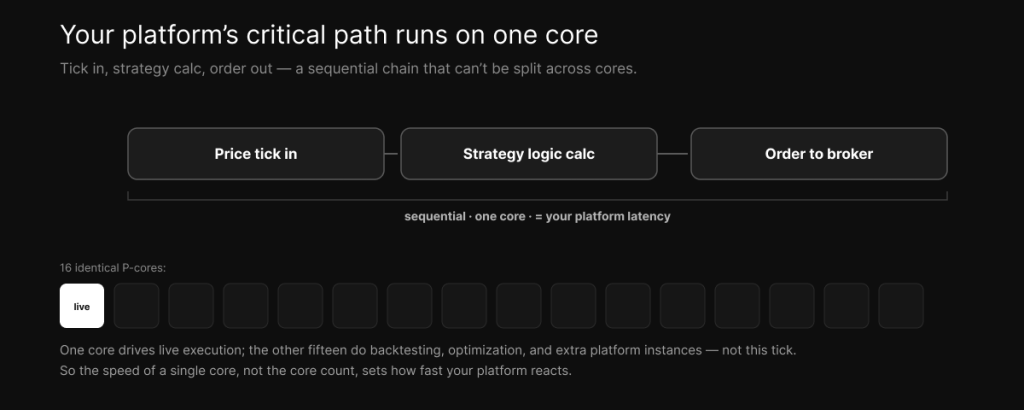
Here’s the fact that should drive your whole decision. Your platform’s critical execution path — receiving a price tick, running your strategy logic, and sending the order to the broker — happens sequentially, on a single core. It cannot be split across 16. Platforms like NinjaTrader 8, MetaTrader 4 and 5, and Tradovate are all architected this way, with the most time-critical work pinned to one core.
Which means the speed of that one core is your platform latency. If that core is slow, the platform waits, no matter how many other cores sit idle next to it. This is why a 16-core server chip at 2.5 GHz can be genuinely slower for live trading than a 6-core desktop chip at 5.5 GHz — a result that looks backwards until you remember the critical path can’t be parallelized. We unpack the mechanism in single-core performance for trading, explained. The headline: for live execution, single-core speed beats core count, full stop.
The tick queue: why clock speed matters most exactly when it matters most
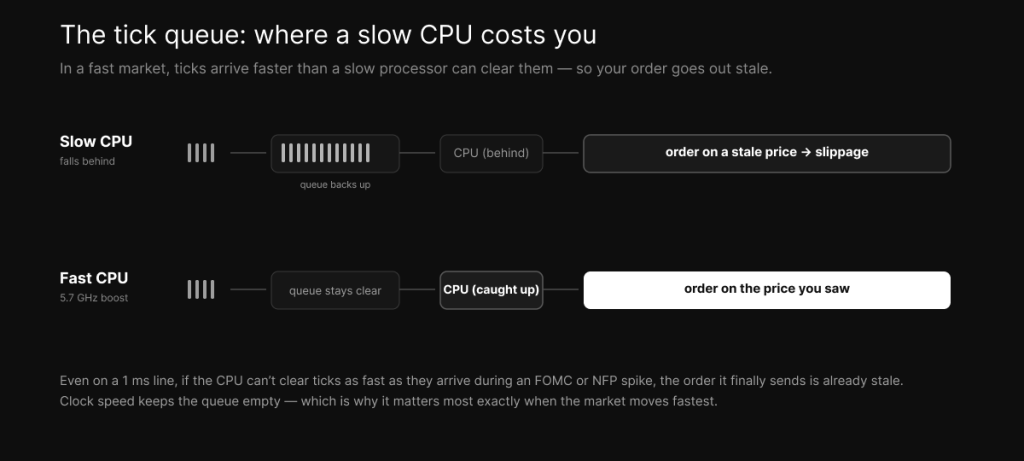
Now connect that to volatility. During an FOMC announcement or a Non-Farm Payroll release, the market doesn’t just move faster — it generates far more data, with the tick rate jumping to many times its normal level. If your CPU can’t finish processing tick one before tick two arrives, a backlog forms. Call it the tick queue.
That queue is the silent killer. Once it forms, your platform is working on stale data, calculating against prices that have already moved. Even with a 1 ms line to the exchange, if your CPU takes 10 ms to clear the queue, the order it finally sends is built on old information, and you get filled worse than the price you saw. The 5.7 GHz boost keeps that queue from forming, clearing each tick fast enough that the next never has to wait.
Be precise about the mechanism, because it’s the honest version. This is about the CPU not adding delay of its own. Your network round-trip through the broker is a separate cost, single-digit milliseconds regardless of processor, as covered in how a low-latency VPS improves trade execution and the network speed versus latency breakdown. A slow CPU stacks extra delay on top of that round-trip, worst during volatility — exactly when a wrong-price fill costs the most. The 9950X’s job is to make sure the processor is never that source of delay.
Ryzen 9950X vs 7950X vs 5950X: which generation should you run?
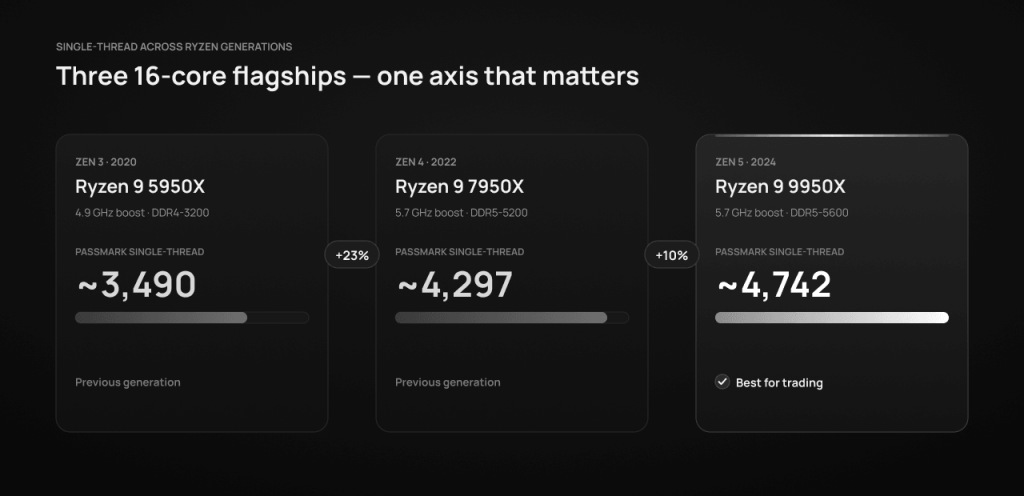
The 9950X is the third 16-core flagship in AMD’s run — the 5950X (Zen 3, 2020), the 7950X (Zen 4, 2022), and the 9950X (Zen 5, 2024). All three are 16 cores and 32 threads, so the headline core count is identical. What changed generation to generation is the one axis that matters for trading: single-core speed, driven by architecture (IPC), clock, and memory.
| Spec | Ryzen 9 5950X | Ryzen 9 7950X | Ryzen 9 9950X |
|---|---|---|---|
| Architecture | Zen 3 (7 nm) | Zen 4 (5 nm) | Zen 5 (4 nm) |
| Cores / threads | 16 / 32 | 16 / 32 | 16 / 32 |
| Base / boost clock | 3.4 / 4.9 GHz | 4.5 / 5.7 GHz | 4.3 / 5.7 GHz |
| Memory | DDR4-3200 | DDR5-5200 | DDR5-5600 |
| AVX-512 | none | 256-bit (double-pumped) | 512-bit (native) |
| PassMark single-thread | ~3,490 | ~4,297 | ~4,742 |
| Single-thread vs prior gen | — | +23% | +10% |
Read that bottom row, because it’s the whole story. Every generational gain landed on single-thread — exactly the axis that sets platform latency. Zen 4 added DDR5, PCIe 5.0, and a higher clock for roughly 23% more single-thread than the 5950X; Zen 5 added roughly 16% more IPC for another ~10% on top, completing more work per tick even at a similar frequency. End to end, the 9950X is about 36% faster on a single core than the 5950X — without changing the core count at all.
Should you upgrade? From a 5950X, yes if you see CPU spikes during volatility or sluggish backtests: Zen 5 brings DDR5, PCIe 5.0, native AVX-512, and ~36% more single-thread. From a 7950X the gain is smaller (~10%), worth it for a fresh build but not an emergency. Either way, the move is up the generations, never sideways into more cores.
Ryzen vs EPYC and Xeon: why server chips lose for live trading
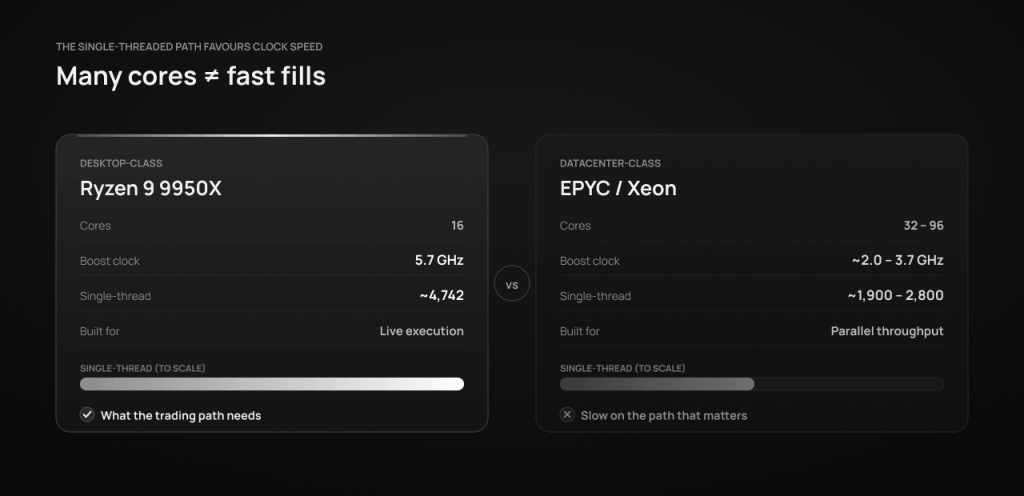
The other CPUs you’ll meet in the VPS market aren’t older Ryzens — they’re server chips: AMD EPYC and Intel Xeon. They look formidable (32, 64, even 96 cores), and a lot of “trader” VPS plans quietly run on them, often older recycled datacenter silicon. For live trading they’re the wrong tool, and the reason is the single-thread argument turned up to full volume.
Server CPUs are engineered for throughput, not latency — many cores at modest clocks (datacenter EPYC and Xeon often boost in the 2.0–3.7 GHz range) to serve thousands of parallel requests inside a tight power envelope. Ideal for web servers, databases, and virtualization. The opposite of what a single-threaded trading path wants.
| Ryzen 9 9950X (desktop-class) | Datacenter EPYC / Xeon | |
|---|---|---|
| Cores | 16 | 32–96 |
| Boost clock | 5.7 GHz | ~2.0–3.7 GHz |
| PassMark single-thread | ~4,742 | ~1,900–2,800 |
| Built for | Live, single-threaded execution | Massively parallel throughput |
Look at the single-thread row. A 64-core EPYC posts a huge multi-thread score, but its single-thread sits roughly half the 9950X’s. On the one path that decides your fill, the “lesser” 16-core desktop chip is nearly twice as fast. Why do generic providers use server chips anyway? Economics — datacenter parts are built for dense multi-tenant hosting and are cheap to run at scale. But it means your trading thread runs on a core tuned for the wrong thing: many cores built for parallel throughput, when your fills depend on one fast core. We run the desktop-class 9950X for exactly that reason, and publish the real PassMark scores and hardware spec so you can check.
When do server chips win? When your workload is genuinely parallel — sweeping thousands of backtest permutations, training models. That’s batch research, not live execution. One honest nuance so the comparison stays accurate: AMD’s newer EPYC 4004 (AM5) parts are essentially server-branded Ryzens and do post high single-thread numbers — so “EPYC” isn’t automatically slow. It’s the many-core datacenter EPYC and Xeon chips, the kind that fill cheap VPS plans, that fall down on the single-threaded path that matters here.
How the 9950X compares across the field
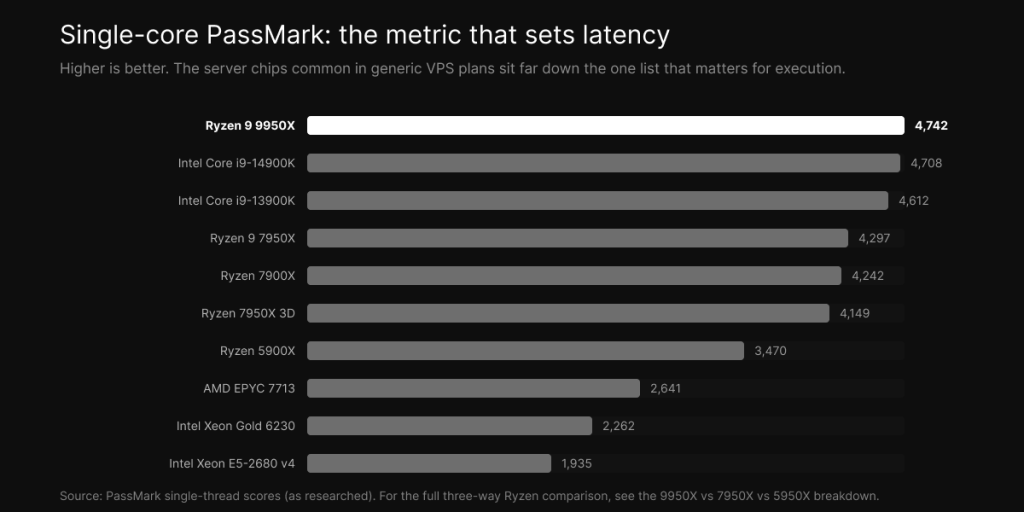
Here’s the single-core PassMark picture across recent desktop chips and the server CPUs common in the VPS market — the metric that maps directly onto platform latency.
| CPU model | Class | PassMark single-thread |
|---|---|---|
| Ryzen 9 9950X | Desktop (Zen 5) | ~4,742 |
| Intel Core i9-14900K | Desktop | ~4,708 |
| Intel Core i9-13900K | Desktop | ~4,612 |
| Ryzen 9 7950X | Desktop (Zen 4) | ~4,297 |
| Ryzen 9 7900X | Desktop (Zen 4) | ~4,242 |
| Ryzen 9 7950X3D | Desktop (Zen 4 + V-Cache) | ~4,149 |
| Ryzen 9 5950X | Desktop (Zen 3) | ~3,490 |
| Ryzen 9 5900X | Desktop (Zen 3) | ~3,470 |
| AMD EPYC 7713 | Server (64-core) | ~2,641 |
| Intel Xeon Gold 6230 | Server | ~2,262 |
| Intel Xeon E5-2680 v4 | Server | ~1,935 |
A fair note: Intel’s 14900K is close to the 9950X on raw single-core, so the case for the 9950X over a top Intel desktop chip is less about that number and more about the next two points — consistency and core uniformity.
Every core is a performance core — and the two-chiplet nuance
This is where the 9950X separates from Intel’s recent chips. It uses 16 identical high-performance cores. Intel’s current designs are hybrid, mixing faster P-cores with slower efficiency E-cores, and the OS scheduler can — to save power — park a thread on an E-core. If it parks your latency-sensitive trading thread there, your execution slows at random: a spike you can’t predict. With the 9950X there are no efficiency cores to land on, so your execution thread is never demoted. For a 24/7 automated system, that determinism matters more than a few points of headline benchmark.
One honest nuance, because it complicates the lazy “more cores is always better” story: the 9950X’s 16 cores aren’t one block. They’re two 8-core chiplets (CCDs) joined by AMD’s Infinity Fabric. Talking to a core on the same chiplet is fast; reaching across to the other chiplet costs more latency. (At launch, that cross-CCD hop was unusually high — around 180 ns — but an AMD microcode/AGESA update brought it down to roughly 75 ns, in line with the previous generation.) For a single-threaded trading path this is mostly a non-issue — your critical thread lives on one core, on one chiplet, and never makes the trip. It matters when work is split across many cores, which is why AMD’s own thread-targeting keeps a latency-sensitive thread on a single CCD rather than letting it bounce between chiplets. The takeaway: more cores help parallel work, but for live execution it’s clock and locality that count, not raw core count.
Beyond single-core: AVX-512 and where the 9950X’s parallel muscle pays off
The single-core argument governs live execution. But plenty of real trading work is the opposite — heavily parallel and compute-bound — and here the 9950X has a second, less-discussed advantage: a native, full-width AVX-512 implementation.
AVX-512 is a set of instructions that crunch large batches of numbers at once. Zen 5 is the first AMD architecture with a full 512-bit datapath for it; the previous Zen 4 generation “double-pumped” two 256-bit units, and Intel removed AVX-512 from its consumer chips entirely. In AMD’s and independent testing, AVX-512-heavy workloads run roughly 27% faster on the 9950X than the 7950X, with a larger gap over older or AVX-512-less chips. It can also sustain full clocks on AVX-512 code given thermal headroom, without the heavy clock drop early Intel implementations suffered.
For a trader, that pays off wherever you process data in bulk rather than tick by tick. The honest way to think about the whole chip is to split your work in two:
| Trading task | What it stresses | The 9950X advantage |
|---|---|---|
| Live order execution (NinjaTrader / MT / Tradovate tick path) | One core · latency | 5.7 GHz single-core boost, all-P-cores |
| One chart’s indicators / strategy logic | One core | High IPC + clock |
| Order-flow tools (Bookmap, Jigsaw) | Real-time, mostly per-instrument | Fast cores + headroom |
| Backtesting & optimization sweeps | Many cores | 16 cores + AVX-512 |
| Monte-Carlo / scenario simulation | Many cores + vectors | Full 512-bit AVX-512 |
| Local ML inference (signal generation) | Vectors / cores | Native AVX-512, higher bf16 throughput |
| Multiple bots / accounts | Many cores + RAM | 16C/32T + DDR5 headroom |
The split is clean: single-core speed wins your fills; cores plus AVX-512 win your research. The 9950X is unusual in sitting near the top of both lists, which is why it suits a trader who runs live and backtests heavily — and it’s the real reason to step up to the higher-core tiers, even though they don’t change your live fill speed.
What about the X3D chips? Clock versus cache
A fair question, since the 9950X has a sibling — the 9950X3D — with extra “3D V-Cache” stacked under one chiplet (128 MB total L3 versus 64 MB). Isn’t more cache always better?
Not for the path that sets your fills. The 9950X3D carries the same 5.7 GHz boost and the same 16 Zen 5 cores, so its single-thread speed essentially ties the standard 9950X — the live tick path runs the same on both. What the extra cache buys is performance on cache-bound workloads: large working sets that spill out of normal cache, like deep order-book reconstruction, very large lookback windows, or certain simulations (the same reason V-cache helps scientific and fluid-dynamics software).
So the honest rule is clock for compute-bound, cache for cache-bound. If your edge is live execution and ordinary backtests, the cache doesn’t change your fills. If you routinely work with unusually large in-memory datasets, the X3D can help those specific jobs. For most futures and forex workloads, the standard 9950X is the right tool — which is what we run. (Worth noting the older 7950X3D actually clocked lower and could trail its non-3D sibling in multi-threaded work; the 9950X3D’s second-gen cache placement fixed that, but it still doesn’t beat the 9950X on the single-threaded path.)
Zen 5 and sustained boost: the honest version
Two things make the chip hold up when it counts. First, Zen 5’s ~16% IPC gain means it completes more work per cycle even at the same frequency — your indicators and strategy logic resolve faster. Second, the 4 nm process runs cooler, and that isn’t trivia: a CPU that thermally throttles backs off its clock exactly during a long, hot, volatile session — the worst time to lose performance.
One honest clarification on “it holds its boost,” because the number deserves context. 5.7 GHz is the single-core boost — the opportunistic peak one or two cores hit when there’s thermal headroom. That’s the figure your live, single-threaded execution thread uses, and the one worth protecting. Under a heavy all-core load (a big optimization sweep lighting up all 16 cores), sustained clocks settle lower — typically around 5.0–5.3 GHz with good cooling — because 16 cores at full tilt draw the chip’s full power budget (around 170 W, 230 W peak) and heat up. The single-core boost your live thread relies on stays available as long as the chip has thermal headroom, which is the case for the high-clock 9950X chips we run rather than the slow, hot, many-core server parts a budget host leans on.
What a fast CPU does not do
A 9950X removes the CPU as a bottleneck. It ensures your processor isn’t the thing slowing you down or injecting jitter of its own. That’s genuinely valuable, and it’s the most you can ask of a CPU.
What it does not do is beat physics. Your order still travels to the exchange through your broker’s gateway, so the real round-trip stays single-digit milliseconds, and true microsecond execution requires colocation inside the exchange’s own data center — not a faster desktop chip. And no CPU turns a losing strategy into a winning one. The right frame: a fast CPU means your execution is limited by the network and the speed of light rather than by your hardware. That’s the ceiling worth buying up to, and it’s an honest one.
It’s only an edge if the rest of the setup matches
The fastest processor in the world is wasted if it sits 500 miles from the exchange, so location matters as much as silicon — a Chicago box near the CME for futures, the right hub for your venue otherwise, which is the argument behind our Chicago VPS. The CPU is one of several specs to get right, alongside enough RAM to avoid paging, fast NVMe, the platform you actually run — see the NinjaTrader VPS setup — and whether your prop firm even permits a VPS.
Plans
| Plan | Cores (Ryzen 9 9950X) | RAM (DDR5) | Storage (NVMe) | Monthly |
|---|---|---|---|---|
| Starter Trader | 2 cores | 6 GB | 75 GB | $39 |
| Active Trader | 4 cores | 12 GB | 150 GB | $69 |
| Advanced Trader | 6 cores | 18 GB | 250 GB | $99 |
| High Performance | 8 cores | 24 GB | 300 GB | $129 |
| Ultra Low Latency | 12 cores | 36 GB | 500 GB | $179 |
| Max Performance | 16 cores | 48 GB | 750 GB | $249 |
One honest, money-saving point. Every plan runs the same Ryzen 9 9950X with dedicated RAM, so the single-core speed of the underlying chip — the thing that drives live execution — is the same on the $39 plan and the $249 plan. The reason to step up is more cores, RAM, and storage for backtesting, AVX-512 simulation, multiple bots, or a copy-trading farm — not faster live fills. If you run a single live strategy, the entry tier already gives you the chip’s execution speed; scale up when your workload genuinely needs the headroom. All plans include 3 Gbps-plus network with burst up to 10 Gbps and Path.net DDoS protection. When you’re ready, pricing is here.
Frequently asked questions
For live execution, no — that path is single-threaded. For backtesting, Monte-Carlo simulation, options math, and local ML inference, yes: Zen 5’s native 512-bit AVX-512 runs those roughly 27% faster than the previous generation, and Intel removed AVX-512 from its consumer chips, so it’s an AMD-side advantage.
For live fills they tie — same 5.7 GHz boost, same 16 Zen 5 cores. The X3D’s extra V-cache only helps cache-bound jobs like very large in-memory datasets or deep order-book reconstruction. For typical futures and forex workloads, the standard 9950X is the right pick.
Most datacenter EPYC and Xeon chips are built for multi-threaded server work at modest clocks, while trading’s critical path is single-threaded. The 9950X’s far higher single-core score — roughly 4,742 against the ~1,900–2,800 typical of those server parts — is what reduces platform latency. Core count doesn’t help the one path that decides your fill. (The exception is AMD’s high-clock EPYC 4004 desktop-socket parts, which behave like Ryzens.)
It removes the slippage caused by the CPU falling behind on ticks during volatility, by clearing the tick queue before it forms. It can’t remove slippage from the network round-trip or thin liquidity. One specific, controllable cause — not all of them.
Not for a single live strategy, which is bottlenecked by single-core speed — identical across every plan since they all use the 9950X. Extra cores earn their keep with backtesting, AVX-512 simulation, multiple platform instances, and multi-account management.
Yes. The 4 nm process is efficient, and in a properly cooled environment it holds its single-core boost without thermal throttling, so it stays responsive around the clock.
No. It removes execution friction and keeps your platform responsive under load, but it can’t fix a strategy that lacks an edge, and it can’t beat the physical distance to the exchange. It raises your ceiling; it doesn’t create an edge.
We operate TradoxVPS and provide trading infrastructure, not financial advice. CPU specifications and benchmark figures are as researched and current to 2026; verify current details directly. A faster CPU improves platform responsiveness and execution consistency but does not guarantee profitability, and it does not overcome the network latency inherent in routing orders through your broker to the exchange. Trading futures and other leveraged products carries substantial risk, including the loss of more than your initial deposit.