
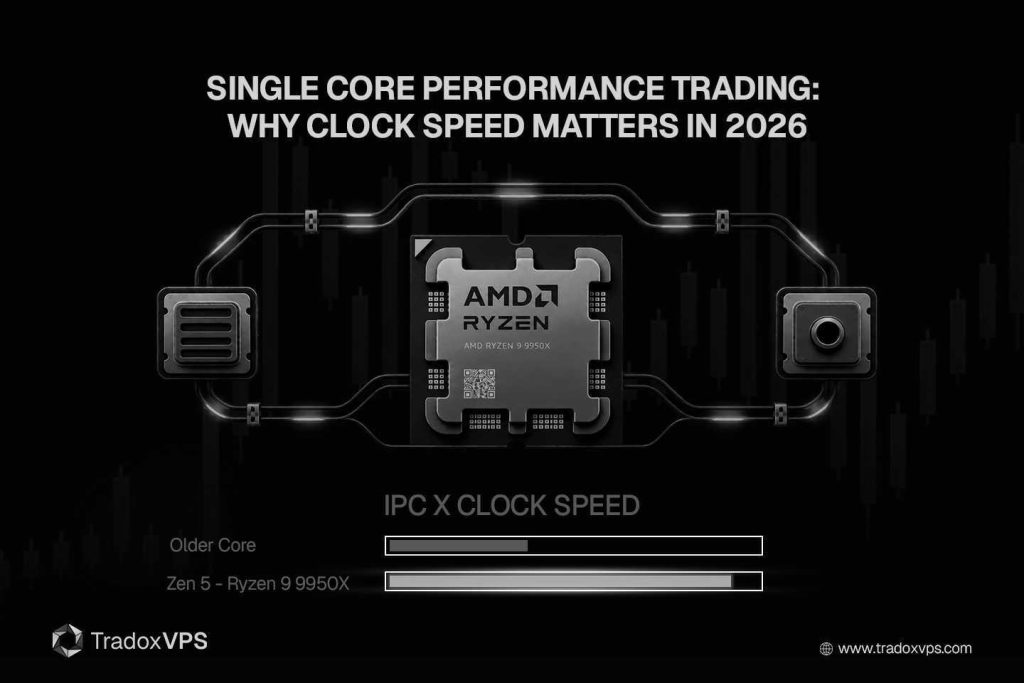
Most trading platforms fail the volatility test because they serialize execution on a single thread while the market moves in parallel. We benchmarked the Ryzen 9950X against legacy server Xeons; the results show that raw core count is a distraction from what actually decides your fills — single-core speed and a low-latency path to the exchange. The technical differentiator, and why serialization dominates your fills, below.
The “more is better” philosophy usually works in computing, but in the world of high-frequency and algorithmic trading, it is a dangerous oversimplification. While your home PC or a standard office server might benefit from 64 or 128 cores for multitasking, a trading bot is only as fast as its slowest sequential step. If your VPS has dozens of slow cores but lacks the raw speed to process a single “hot thread,” you are effectively trading with a hand tied behind your back.
Understanding the relationship between hardware and execution is what separates profitable algorithms from those that get eaten by slippage. In 2026, the bottleneck is rarely your internet speed; it is the time your CPU takes to calculate the next move after a tick arrives.
The physics of execution: Why core count fails in fast markets
Trading is fundamentally a sequential game. When a price update (a tick) hits your platform, a very specific chain of events must occur in a precise order: the tick is received, indicators are updated, the strategy logic evaluates the new data, and if a condition is met, an order is sent to the exchange. This chain is known as a serial process. It cannot be split across multiple cores because Step 4 (Order) depends entirely on the outcome of Step 3 (Logic).
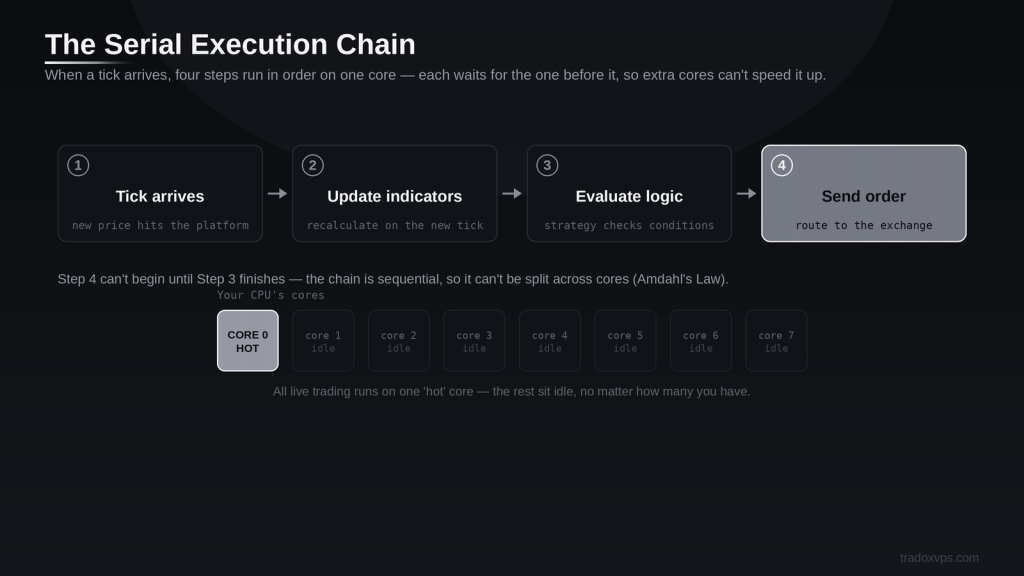
This brings us to Amdahl’s Law, which states that the speedup of any program is limited by the sequential portion of its task. Even if 90 percent of your trading platform is multi-threaded (like the user interface or historical data loading), the 10 percent that handles live execution is usually single-threaded. If that single thread is running on a slow CPU core, your entire strategy is capped by that core’s speed, regardless of how many other cores are sitting idle.
Furthermore, moving data between cores introduces synchronization overhead. In a multi-core environment, different cores must “talk” to each other to ensure they are looking at the same data. This communication happens in nanoseconds, but in a fast market where every microsecond counts, these nanoseconds add up. When volatility spikes, the “jitter” caused by this synchronization can lead to massive execution variance.
We have seen that how low latency trading VPS improves trade execution is not just about the network path, but about how quickly your CPU can cycle through that sequential logic before the price moves away from your fill.
IPC vs. clock speed: The Zen 5 advantage over legacy Xeons
Many traders make the mistake of looking only at the “GHz” number on a spec sheet. However, clock speed alone is not the full story. You must also consider IPC, or Instructions Per Clock. Think of clock speed as how fast a person can run, and IPC as how much they can carry with each step. A modern processor like the Ryzen 9950X can process significantly more data per cycle than an older Intel Xeon, even if they are both “running” at the same 4.0 GHz.
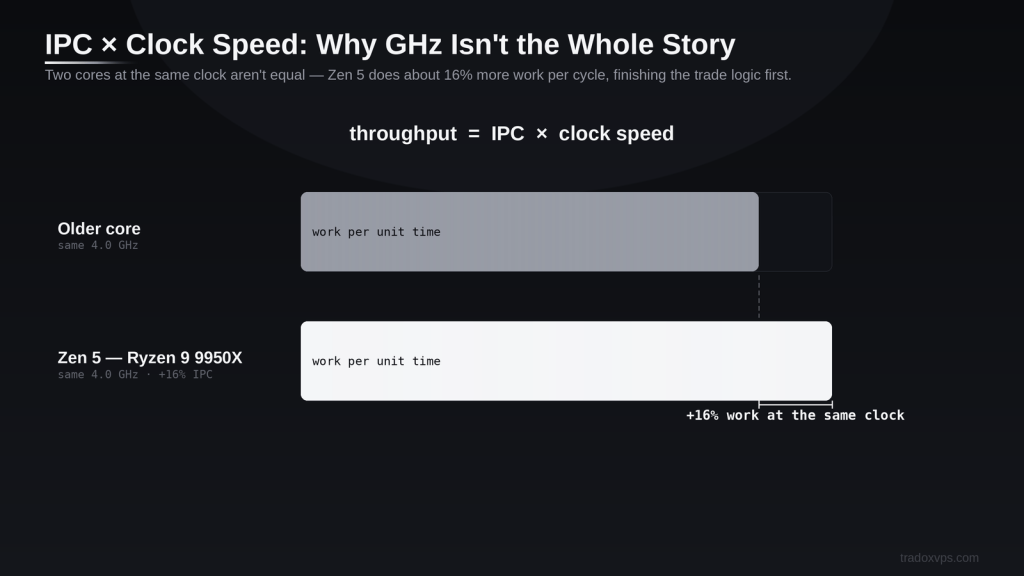
The Ryzen 9950X is built on the Zen 5 architecture using a cutting-edge 4nm process. This architecture delivers an average of 16 percent IPC improvement over the previous generation. For a trader, this means that even at the same clock speed, the 9950X is fundamentally more efficient at crunching numbers. When you combine that efficiency with a boost clock of up to 5.7 GHz, you get a machine that is purpose-built for single core performance trading.
Another critical factor is cache latency. The L3 cache is the high-speed memory located directly on the CPU. The faster the CPU can access this data, the faster it can process rapid-fire ticks. Legacy server-grade CPUs like the Intel Xeon Gold series were designed to handle many users doing simple tasks simultaneously. They have massive core counts but relatively low single-thread ratings, which is why they often struggle with the heavy indicator load of a modern futures trader.
We have detailed these differences in our hardware specification guide, but the table below illustrates the raw performance gap:
| CPU Model | Architecture | Boost Clock | Single Thread Rating (PassMark) |
|---|---|---|---|
| Ryzen 9 9950X | Zen 5 (4nm) | 5.7 GHz | 4,742 |
| Intel Core i9-14900K | Raptor Lake | 6.0 GHz | 4,708 |
| Ryzen 9 7950X | Zen 4 (5nm) | 5.7 GHz | 4,297 |
| AMD EPYC 7713 | Zen 3 (7nm) | 3.67 GHz | 2,641 |
| Intel Xeon Gold 6230 | Cascade Lake | 3.9 GHz | 2,262 |
As you can see, the Ryzen 9950X is currently the king of single-thread trading, outperforming even the fastest Intel desktop chips and leaving traditional server CPUs in the dust.
Platform mechanics: NinjaTrader 8 vs. Sierra Chart thread handling
Different trading platforms utilize CPU resources in very different ways. Understanding these nuances is key to optimizing your setup.
NinjaTrader 8
NinjaTrader 8 is a powerful, event-driven platform. While it uses multi-threading for its user interface and market data distribution, the actual NinjaScript execution is serialized on a single thread to maintain state integrity. This means that if you are running complex indicators or automated strategies, they are all fighting for time on that one “hot” core.
To get the most out of a NinjaTrader VPS, you need the highest possible clock speed to process those scripts before the next tick arrives. Without it, you will experience “UI lag” or, worse, delayed order submissions.
Sierra Chart
Sierra Chart takes a different approach. Developed entirely in C++ for maximum native performance, it is significantly lighter on resources than platforms built on Java or .NET. While Sierra Chart is highly multi-threaded for background tasks like data management and file operations, its main processing loop remains single-threaded for deterministic execution.
Sierra Chart is incredibly efficient, often “feeling” faster on lower-end hardware than other platforms. However, it scales linearly with single-core speed. If you are using advanced features like “Numbers Bars” or MBO (Market by Order) data, the raw single-thread power of the Ryzen 9950X becomes indispensable.
Below is the current pricing structure for Sierra Chart, which we fully support on our infrastructure:
| Plan | Monthly Price | Annual Price | Key Features |
|---|---|---|---|
| Service Package 3 | $26 | $16.90/mo | Standard features, no external connectivity |
| Service Package 11 | $46 | $29.90/mo | Advanced features + external connectivity |
| Service Package 12 | $56 | $36.40/mo | All features + MBO data support |
Bottom line? Whether you prefer the flexibility of NinjaTrader or the raw efficiency of Sierra Chart, both platforms are ultimately limited by the speed of a single CPU core during live execution.
OS-level bottlenecks: Jitter, DPC latency, and the “micro-stutter” problem
Even with the best hardware, your Operating System (OS) can still be a bottleneck. Most traders focus on their “ping” (average network latency), but “jitter” is often the real killer. Jitter is the variance in latency. If your ping is normally low but occasionally spikes to 10ms, your strategy cannot be deterministic.
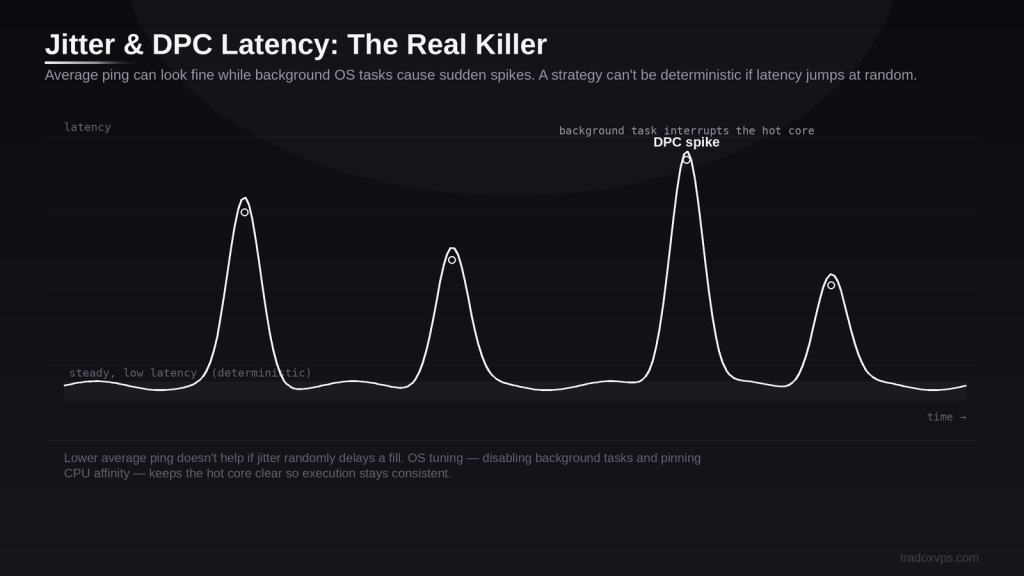
A major cause of jitter is DPC (Deferred Procedure Call) latency. This occurs when background Windows tasks (like search indexing, telemetry, or driver updates) interrupt the CPU while it is trying to process your trading data. These “micro-stutters” can cause your trading platform to freeze for a fraction of a second, exactly when you need it most.
To combat this, point the anchor to Microsoft’s official “Performance Tuning Guidelines for Windows Server” on learn.microsoft.com. By disabling unnecessary services and background telemetry, we ensure the CPU stays focused on your trades. For power users, we recommend tools like Process Lasso to set “CPU Affinity,” manually isolating your trading platform onto its own dedicated high-speed cores, away from OS-level noise.
You can find a complete guide on how to optimize your NinjaTrader VPS for lightning fast trading in our knowledge base, which covers these OS tweaks in detail.
The Ryzen 9950X edge: Benchmarking for the Chicago CME hub
For futures traders, location is everything. But proximity to the exchange only matters if your hardware can keep up. Our Chicago hub is strategically located near the CME (Chicago Mercantile Exchange) data centers in Aurora, IL, which keeps the network path between your platform and the exchange short.
When you combine that proximity with the 5.7 GHz boost clock of the Ryzen 9950X, you address the two biggest controllable sources of slippage: network delay and processing delay. (Proximity helps, but your actual round-trip also depends on your broker’s routing — it’s one factor, not a guarantee.)
The 9950X also brings other technical advantages to the table:
- DDR5 memory: high-bandwidth DDR5 (5600 MT/s native on the 9950X) for high-frequency tick streams.
- Fast NVMe storage: high-throughput NVMe SSDs on a PCIe Gen5-capable platform, for rapid backtesting and log writing.
- Branch Prediction: Improved accuracy in the Zen 5 architecture means the CPU can “guess” the next instruction more effectively, reducing wasted cycles.
By choosing a high-performance Ryzen 9950X Trading VPS, you are ensuring that your infrastructure is never the reason you missed a fill.
Optimizing your execution stack for 2026
The market in 2026 is faster and more competitive than ever. To maintain an edge, you must optimize every layer of your execution stack:
- Hardware Selection: Prioritize single-core boost clock and modern IPC (Zen 5) over core count.
- OS Tuning: Use Windows Server 2022 and disable background “bloat” to reduce DPC latency.
- Platform Configuration: Match your platform’s threading model (NinjaTrader vs. Sierra Chart) to the right hardware affinity.
- Network Proximity: Ensure your VPS is physically located near the exchange (e.g., Chicago for CME).
At TradoxVPS, we provide premium hardware without the premium markup. We have built our entire infrastructure around the Ryzen 9 9950X and a CME-proximal Chicago network path because in professional trading, consistent low-latency execution is the difference between catching a fill and chasing it.
Start with a high-performance VPS built for serious traders today.
Frequently Asked Questions
Most trading platforms process market data and strategy logic in a single sequential thread. A higher clock speed allows the CPU to finish these calculations faster, reducing the time between a price update and your order submission.
While more cores help with background tasks and running multiple instances of a platform, each individual chart or strategy is still usually limited by the speed of the single core it is running on.
Yes, for trading. Server-grade Xeons are optimized for handling many low-intensity tasks at once (multi-threading), whereas the Ryzen 9950X is optimized for maximum speed on a per-core basis, which is what trading platforms require.
IPC (Instructions Per Clock) determines how much work the CPU can do in a single cycle. A higher IPC means that even at the same GHz, a modern chip like the Ryzen 9950X will be faster than an older CPU, directly improving your execution speed.
Absolutely. By reducing DPC latency and background jitter, you ensure that the CPU is always available to process your trading thread. This results in more consistent execution and fewer platform freezes during high-volatility events.
The AMD Ryzen 9 9950X is currently the top-tier choice. Its combination of the 5.7 GHz boost clock and Zen 5 architecture provides the highest single-thread performance available for trading VPS environments.
You can use benchmarks like PassMark to check the single-thread rating of your CPU. At TradoxVPS, we benchmark our Ryzen 9950X nodes regularly to ensure they maintain their status as the fastest trading hardware on the market.