
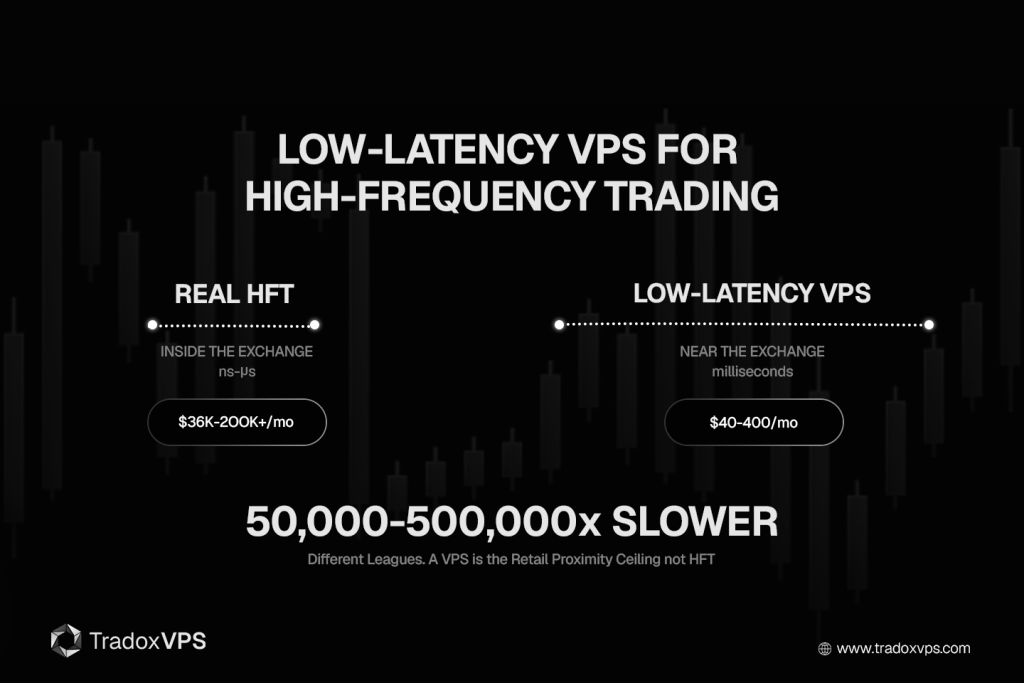
Let’s answer the real question before anyone sells you anything: can you do high-frequency trading on a VPS? Honestly, no.
Real HFT runs on servers colocated inside the exchange’s own data center, on FPGA hardware with kernel-bypass networking, at latencies measured in nanoseconds — and it costs tens of thousands of dollars a month before you write a line of code. A retail VPS, however good, operates roughly 50,000 to 500,000 times slower than that. So if you mean literal, institutional, sub-microsecond HFT, a VPS isn’t your tool, and a provider who tells you otherwise is selling a fantasy.
But here’s the honest other half: “high-frequency trader” gets used loosely. If what you actually run is fast, scalping, or high-turnover automated strategies, a low-latency VPS is exactly the right tool — it just isn’t HFT, and being clear about that difference is what saves you from overpaying for the wrong thing or expecting something a VPS can’t deliver. Here’s the real line between the two.
What real HFT actually requires
Real HFT isn’t clicking buy and sell faster than other people, and it isn’t “a fast VPS.” It’s a specific and expensive stack. It needs colocation — your server physically inside the exchange’s data center, in Aurora for the CME, sometimes meters from the matching engine. It needs FPGA hardware, which gets tick-to-trade times under 500 nanoseconds, plus kernel-bypass networking, microwave or hollow-core fiber links, and direct multicast data feeds in binary protocols like CME’s MDP 3.0 rather than a retail feed, usually over a direct FIX API connection. The latency target is microseconds down to nanoseconds, and at that level even a few microseconds of jitter loses the race. This is the world described in the best high-frequency trading algorithms breakdown, and it’s a different planet from retail hosting.
What it costs, which is where most of these conversations end
The price tag is the honest reality check, so here are the real numbers.
A CME Globex colocation handoff costs $12,000 a month plus a $2,000 setup fee, just for the connection at Aurora. A colocation cabinet runs $1,000 to $3,000 a month, plus $275 to $350 a month per cross-connect. Step up by latency tier and it escalates fast: a 1-to-5-millisecond bare-metal colocated setup runs around $3,000 to $5,000 a month plus $10,000 to $30,000 upfront; sub-millisecond trading starts at roughly $200,000 upfront and $36,000 a month; and sub-100-microsecond infrastructure reaches into the millions. A full HFT operation costs $1 to 5 million to build and $50,000 to $200,000 a month to run, before the quant salaries. This is why HFT is institutional. It’s not gatekeeping, it’s physics and economics.
Real HFT vs a low-latency VPS
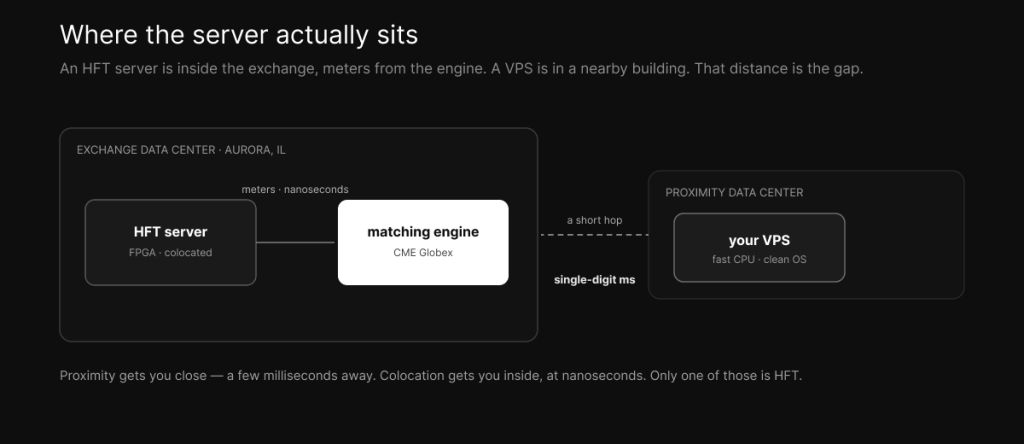
Side by side, honestly, so the difference is impossible to miss.
| Real HFT (colocation) | Low-latency VPS (proximity) | |
|---|---|---|
| Latency | Nanoseconds to single-digit microseconds | ~1 ms ping; ~3–5 ms round-trip |
| Where it sits | Inside the exchange data center | A nearby data center, near the exchange |
| Hardware | FPGA, kernel bypass, custom NIC | Fast single-core CPU, NVMe, clean OS |
| Data feed | Direct multicast (MDP 3.0, ITCH) | Broker feed via the gateway |
| Cost | $36k–200k+/mo, six-to-seven figures upfront | ~$40–400/mo |
| Who it’s for | Institutional HFT firms | Active retail, scalpers, prop, fast bots |
| Realistic use | Sub-microsecond market-making, latency arbitrage | Fast, high-turnover retail strategies |
The number to sit with: a retail VPS is roughly 50,000 to 500,000 times slower than an institutional HFT system. These aren’t competing tools that one is a budget version of — they’re built for different traders. A VPS gives you what one honest provider calls the retail proximity ceiling, which is the best a retail trader can realistically reach without going fully institutional. And the sub-millisecond figures you’ll see advertised are network ping, not your order’s round-trip, a distinction we make in how a low-latency VPS improves execution and in the full latency tiers breakdown.
So who is a “low-latency VPS for high-frequency trading” actually for?
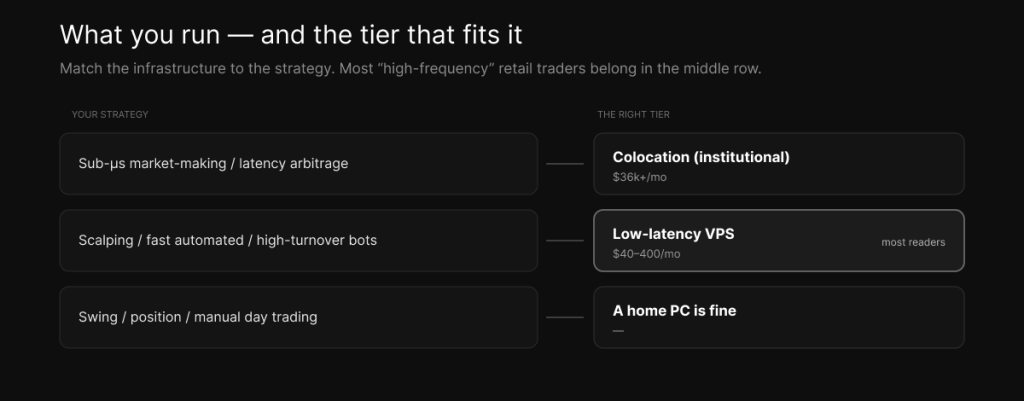
Here’s the reframe that matters, because almost nobody typing that phrase is building a sub-microsecond market-making desk. The real reader is an active retail or prop trader running scalping, fast automated strategies, or high-turnover bots — high-frequency by retail standards, not by institutional ones. For that trader, a low-latency proximity VPS is genuinely the right tool, because it delivers four things a home setup simply can’t.
Proximity, a single-digit-millisecond round-trip to the exchange instead of the tens to hundreds of milliseconds you get from home — the Chicago VPS argument. Consistency, meaning low jitter, which matters most for fast strategies where unpredictable fills break the edge. A CPU that keeps up, so the platform doesn’t fall behind on ticks during volatility, which is the single-core clock point. And uptime, so a fast bot runs 24/7 without your home internet as a single point of failure, the case made in the automated futures bots guide. That’s not HFT. It’s the realistic, honest tier for retail speed trading, and it’s a real edge over trading from home.
What a low-latency VPS can’t do for you
Being clear-eyed here saves you money and disappointment, so three honest limits.
It won’t let you win latency-arbitrage races against colocated HFT firms. They are inside the building with FPGAs and direct feeds, and you are not, so any strategy whose entire edge is being faster than the fastest players will lose. It won’t deliver microseconds — single-digit milliseconds is the ceiling, full stop. And it won’t make a high-turnover strategy profitable if the edge isn’t there to begin with, because faster execution of a losing system simply loses faster, which is the whole point of the HFT strategies piece: speed is a multiplier on an edge, not a substitute for one. The honest framing is that a VPS removes the infrastructure friction so your strategy competes on its merits at the retail tier — it doesn’t promote you to the institutional one.
How to get the most low-latency out of a VPS, realistically
If you’re the active or scalping reader this is actually for, the levers that move real latency are simple and worth doing in order. Location first — be near your venue’s matching engine, Chicago and Aurora for the CME, because the wrong city adds 15 to 25 ms and wipes out the entire point. Single-core clock next, since NinjaTrader and MetaTrader run their critical path on one thread, so that core’s speed is your platform latency. Consistency over peak — ask a provider about jitter and worst-case, not just the best-case ping. A clean OS with server-side orders, so a tuned image and broker-side stops mean nothing strands you. And measure your real round-trip to your broker’s gateway rather than trusting the advertised number.
The honest bottom line
If you mean literal institutional HFT, the microsecond market-making and latency arbitrage that the term technically describes, a VPS cannot do it, and the honest answer is colocation at $36,000 a month and up, not a hosting plan dressed up as one. If you mean fast, scalping, or high-turnover retail trading, which is what most people calling themselves “high-frequency” actually do, a low-latency proximity VPS is exactly the right tool and a genuine edge over a home connection — as long as you expect the retail proximity ceiling rather than HFT. We’d rather you buy the right tool for your tier than overpay for a fantasy, and if that tier is yours, the Chicago plans and pricing are where to look.
Frequently asked questions
Not real, institutional HFT. That requires colocation inside the exchange, FPGA hardware, and microsecond latency costing tens of thousands of dollars a month, and a retail VPS is roughly 50,000 to 500,000 times slower. For fast, scalping, or high-turnover retail strategies, though, a low-latency VPS is the right tool.
Around 1 ms network ping to the exchange and a single-digit-millisecond order round-trip through your broker — the retail proximity ceiling. True HFT runs in nanoseconds to single-digit microseconds, which a VPS cannot reach.
A CME colocation handoff alone is $12,000 a month plus setup. Sub-millisecond setups start around $200,000 upfront and $36,000 a month, and full HFT operations run $1 to 5 million to build and $50,000 to $200,000 a month to operate. A VPS is roughly $40 to $400 a month for a fundamentally different tier.
No. Colocation puts your server inside the exchange’s own data center, sometimes meters from the matching engine. A VPS is proximity hosting in a nearby facility — close, at single-digit milliseconds, but not the microseconds of being inside.
Because they are colocated inside the exchange with FPGAs and direct feeds, operating five to six orders of magnitude faster than you. Don’t build a strategy whose edge is pure speed against them; build one where the VPS’s consistency and uptime support your actual edge.
Usually scalping, fast automated strategies, or high-turnover bots — fast by retail standards, not the sub-microsecond market-making of institutional HFT. A low-latency VPS serves the former well and can’t touch the latter.
No. It removes execution friction and gives you consistency and uptime, but it cannot create an edge. Faster execution of a losing strategy just loses faster.
We operate TradoxVPS and provide trading infrastructure, not financial advice. A VPS is proximity hosting, not exchange colocation; it cannot deliver microsecond, HFT-grade latency, let you compete with colocated high-frequency firms on speed, or guarantee profitability. Trading futures and other leveraged products carries substantial risk, including the loss of more than your initial deposit.