
“Chicago VPS” reads like a marketing label until you find out where CME’s matching engine actually lives. It isn’t in the Chicago skyline. It’s in a 428,000-square-foot data center in Aurora, Illinois, about 35 miles west of the Loop, and every E-mini S&P 500 and crude oil contract on the planet matches there. That one fact is the entire case for hosting your futures trading in the Chicago area — and it’s also why most of the “1ms to CME” banners you’ll read are nonsense.
Here’s the honest version. Where your trades really match, why distance is the one thing you can’t engineer around, how close a retail setup can actually get, what that proximity buys you and what it doesn’t, and whether your strategy even needs it.
Where CME actually matches your trades
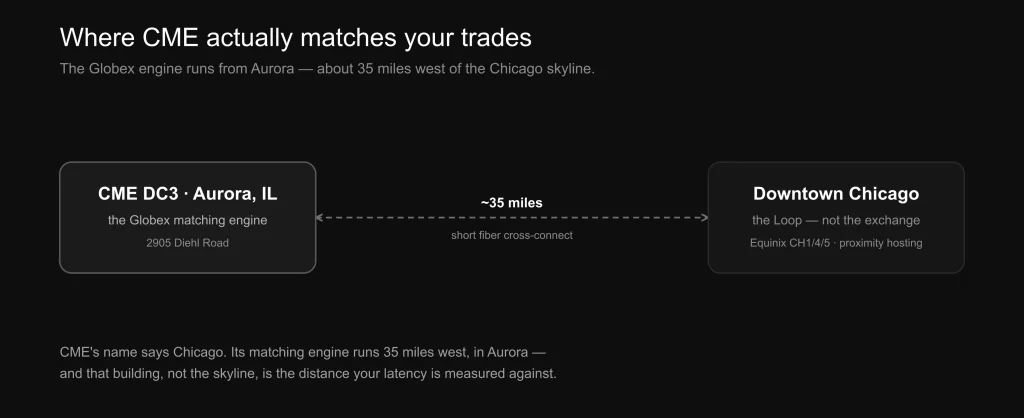
CME Group is so tied to Chicago that almost everyone assumes the exchange runs from a tower downtown. It doesn’t. The CME Globex matching engine — the software that accepts every buy and sell order, pairs them on price and time priority, and broadcasts the result to the world — runs from CME’s own data center in Aurora, at 2905 Diehl Road, roughly 35 miles west of downtown Chicago. CME’s own co-location page says it plainly: the facility houses the trade matching engines for all Globex products. That building, not the skyline, is the place your latency is actually measured against.
The distinction matters because it’s where the marketing gets sloppy. You’ll see providers claim CME’s engine sits in “Equinix in Aurora.” That’s wrong on both counts. The Equinix CH1, CH4, and CH5 facilities are the carrier hotel at 350 E Cermak in downtown Chicago — they are not the exchange. They’re where firms that don’t pay for in-building colocation host their servers and cross-connect to Aurora over short, fast fiber routes. The exchange is in Aurora. The proximity-hosting hub is downtown. Get those two backwards and every latency claim built on top of them is wrong too.
So when someone says “Chicago,” what actually matters for futures is your distance and network path to a specific building in Aurora.
Why distance is the thing you can’t engineer around
Network latency is dominated by physical distance, and that’s not a tuning problem — it’s physics. Signals in fiber travel at roughly two-thirds the speed of light, about 200,000 kilometers per second. That sets a hard floor on how fast your order can reach Aurora that no CPU, no kernel tweak, and no clever code can get under. The further your server sits from the matching engine, the further behind you start every single trade.
The most famous proof of this is the New York–Chicago corridor, and it’s worth knowing because it’s the clearest illustration in all of trading. For years, firms paid fortunes to shave milliseconds off the route between CME in the Chicago area and the equity markets near New York. A purpose-built straight-line fiber cable cut the round trip to about 13 milliseconds, down from roughly 16 on older, more winding routes. Then high-frequency firms built line-of-sight microwave networks and pushed it to around 8 to 9 milliseconds, because microwave through air is faster than light through glass. Hundreds of millions of dollars, all to move data across that one stretch a few milliseconds quicker.
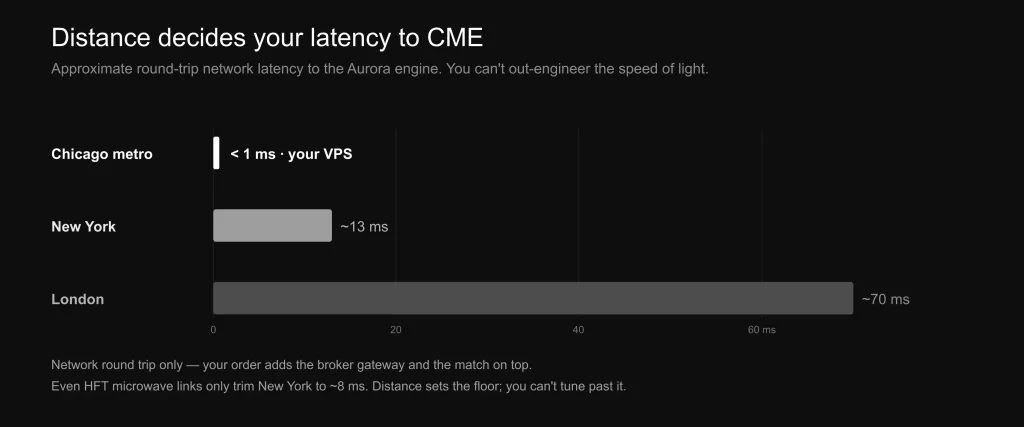
Now put your server on that map. From the Chicago metro, a network ping to Aurora is sub-millisecond. From New York, the round trip is about 13 milliseconds. From London, it’s roughly 70 milliseconds across the Atlantic. Those aren’t small differences you can optimize away — they’re the speed of light over distance. If your strategy is racing anyone on a CME fill and your box is in New York or your home country, you’ve already lost the race at the network layer before your code even runs.
What that proximity actually buys you
Two concrete things, and it’s worth being precise because the benefit is real but smaller than the ads imply.
First, a shorter network leg narrows the window in which the price can move against you between the instant your strategy decides and the instant your order reaches the book. That tightens your fills. It does not eliminate slippage — slippage also depends on liquidity, your order size, and how violently the market is moving, none of which a faster connection touches. Lower latency narrows the gap; it never closes it. Anyone promising “zero slippage” is describing something that doesn’t exist.
Second, and this is the part that genuinely rewards being close, is queue position. CME’s busiest futures — the E-mini S&P 500 and crude oil among them — match on price-time priority, also called FIFO: among all the limit orders resting at the same price, the earliest timestamp gets filled first. Reaching the book sooner means a better place in that queue and a higher chance of being filled at your price instead of chasing a worse one. Some products, like SOFR and the grains, use pro-rata or hybrid algorithms where order size matters too, but even those grant priority to the first order to better the market. CME itself states that a server closer to its matching infrastructure is faster to market. Proximity is the one lever that mechanically improves your fills, and we cover the full mechanism in how a low-latency VPS improves trade execution.
The honest numbers, and the ones to distrust
From the Chicago metro, a network ping to Aurora lands somewhere in the sub-millisecond to roughly one-millisecond range. That number is real, and it is not your fill. Your actual order round trip — through a broker gateway like Rithmic, whose infrastructure happens to be concentrated in the Chicago and Aurora area, which helps — is typically single-digit milliseconds. The broker’s risk checks and the matching engine itself are part of that path, and a VPS can’t compress them. Ping is the network echo to a building; the round trip is the whole job.
True microsecond latency is a different category entirely. It belongs to firms that colocate their servers inside the Aurora data center and connect to Globex through CME’s GLink cross-connect with direct market access, bypassing the broker layer that retail orders must pass through. That’s a five-figure-a-month institutional arrangement, not a hosting plan. So when a retail VPS advertises “sub-1ms execution” or “microseconds to CME,” it is quoting you a ping and calling it a fill, or it’s quoting you nothing at all. The right move is never to trust the number on anyone’s page — including ours. Run a latency check from the actual machine to the actual venue, and read how we benchmark latency honestly so you can hold every provider to the same standard.
The tiers, and where a VPS realistically sits
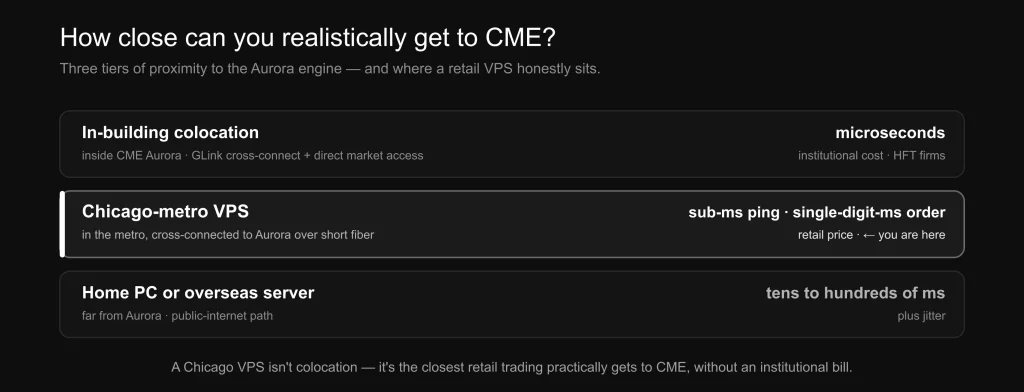
It helps to see the whole ladder honestly. At the top, in-building colocation inside Aurora gets you microsecond access to the engine — and it costs institutional money, which is why it’s the domain of HFT firms and market makers, not retail traders. At the bottom, your home PC or a server overseas reaches CME in tens to hundreds of milliseconds, with public-internet jitter on top.
A Chicago-metro VPS sits in the middle, and that’s exactly the point. Sub-millisecond network ping to Aurora, single-digit-millisecond order round trip through a broker, at a retail price — it’s as close to CME as ordinary futures trading practically gets without paying for a cabinet in the exchange’s data center. A good Chicago VPS isn’t pretending to be colocation. It’s the retail-accessible sweet spot that captures most of the proximity benefit without the institutional bill.
Does your strategy even need it?
Be honest with yourself here, because the answer decides whether you should care. If you scalp CME futures, run automated strategies, arbitrage related instruments, or trade scheduled news, proximity to Aurora is part of your edge and a Chicago VPS pays for itself in better fills and queue position. If you swing trade or hold positions for hours or days off higher-timeframe signals, the milliseconds a Chicago box saves won’t change your results — what matters for you is that the machine stays online through the trade without dropping its connection. A Chicago VPS is still a fine home for that, but you’d be buying uptime and stability, not speed, and you shouldn’t overpay for latency you have no way to use.
Why Chicago, specifically
Because that’s where CME matches your trades. A server in the Chicago metro is physically closest to the Aurora engine of any major hosting hub, cross-connected to it over short fiber, and far ahead of New York, London, or a connection from home. Our Chicago VPS sits in the metro near the interconnect that feeds Aurora, on fast single-thread Ryzen 9 9950X hardware built for the decide-and-send loop, ready for platforms like NinjaTrader. If you trade CME futures and latency is part of your game, this is the location that matters — and the honest version is the one worth buying. Plans and pricing are here.
Frequently asked questions
In Aurora, Illinois, roughly 35 miles west of downtown Chicago — at CME’s DC3 facility, also known as CyrusOne Aurora I, at 2905 Diehl Road. It houses the Globex matching engines for all CME products. The downtown Equinix carrier hotel is a proximity-hosting hub, not the exchange itself.
No. Colocation means renting space inside the Aurora data center and connecting directly to Globex through CME’s cross-connect, which delivers microsecond access and costs institutional money. A Chicago-metro VPS sits near the exchange and is far closer than a remote server, but it’s a different and much more affordable tier.
Sub-millisecond to about one millisecond for a network ping to Aurora, and typically single-digit milliseconds for a full order round trip through a broker, because the broker and the matching engine are in the path. Microsecond execution requires in-building colocation, which is not a retail product. Measure your own number rather than trusting an advertised one.
Distance. The round trip from New York to the Chicago area is about 13 milliseconds, and from London it’s roughly 70 milliseconds across the Atlantic. That gap is set by the speed of light over distance and can’t be tuned away, so a far-away server starts every CME trade behind a local one.
No. If you hold positions for hours or days, the milliseconds proximity saves won’t affect your results. Prioritize a stable, always-on machine with reliable uptime over raw speed, and don’t pay for latency your strategy can’t use.
We operate TradoxVPS and provide trading infrastructure, not financial advice. Trading futures carries substantial risk, including the loss of more than your initial deposit. Latency figures are environment-dependent and network-only unless stated — measure your own before relying on them.