
Twice a year, every trading schedule built on US clocks moves for everyone outside the US. CME publishes its hours in Central Time. The Federal Reserve, the US statistics agencies and the New York Stock Exchange work in Eastern Time. Polymarket titles its crypto markets in Eastern Time, and Kalshi writes its maintenance window in Eastern Time. When US clocks change, all of those events stay where they are on a US clock and move by one hour in UTC, in London, in Singapore, and on any server that does not follow US rules.
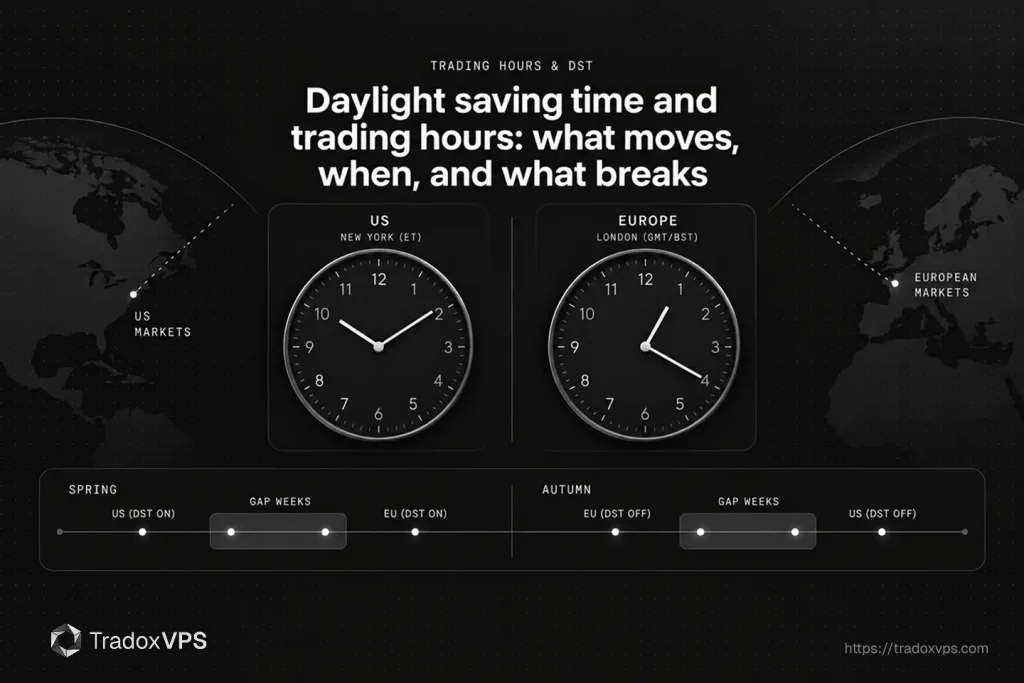
The US and Europe also change on different Sundays. For one week in autumn and two or three weeks in spring, US markets open, publish data and settle an hour earlier than usual for anyone on European time.
This guide sets out the rules, the dates through 2031, and what each change does to CME futures, US data releases, prediction markets, trading platforms and the servers that run them. US local times are written the way US exchanges publish them (5:00 p.m. CT). UTC and non-US times use the 24-hour clock.
The short answer
- US market times are fixed to US clocks. CME’s trading hours page says its hours are “in U.S. Central Time unless otherwise stated”. NYSE, the Bureau of Labor Statistics, the Energy Information Administration and the Fed publish in Eastern Time.
- When US clocks change, those events move by one hour in UTC and in every country that does not change on the same day.
- The US changes on the second Sunday in March and the first Sunday in November. The EU and the UK change on the last Sunday in March and the last Sunday in October.
- During the gap weeks, US events arrive an hour earlier than usual in London and Frankfurt. That covers the CME open, US data and Fed decisions.
- Japan, Singapore, Hong Kong, China, India and the UAE do not change their clocks. They see one shift on each US date. Sydney changes in the opposite season, so it sees four shifts a year.
- Two habits cause the trouble in automated trading: schedules written as fixed UTC offsets, and fixed clock times in a zone that changes on different dates from the exchange.
Current status
Checked 2 October 2026. This is the only part of the guide that depends on pending decisions.
- United States: the Sunshine Protection Act (H.R. 139) would make daylight saving time permanent. It passed the House on 14 July 2026 by 308 votes to 117. On the check date it had not passed the Senate, and a bill that has not passed both chambers when the 119th Congress ends on 3 January 2027 lapses. Until it becomes law, the US rules in this guide apply. If it becomes law, US clocks would stop changing, and the US dates in the table below would no longer apply.
- European Union: the Council of the EU says no final decision has been taken on ending seasonal clock changes, and no timeline has been set. The current twice-yearly changes remain in force.
Who changes clocks, and when
| Region | Clocks go forward | Clocks go back | Time of change | Source |
|---|---|---|---|---|
| United States (except Hawaii, most of Arizona and the US territories) | Second Sunday in March | First Sunday in November | 2:00 a.m. local time | NIST |
| European Union | Last Sunday in March | Last Sunday in October | 01:00 UTC | Directive 2000/84/EC |
| United Kingdom | Last Sunday in March | Last Sunday in October | 01:00 UTC (2:00 a.m. BST in autumn) | Royal Observatory Greenwich |
| Australia: NSW, Victoria, ACT, Tasmania, South Australia | First Sunday in October | First Sunday in April | 2:00 a.m. local standard time | NRMA |
| Japan, Singapore, Hong Kong, China, India, UAE | No change | No change | Not applicable | IANA time zone database |
Two details matter later. First, the EU and the UK change at the same moment, 01:00 UTC, so London and Frankfurt always stay one hour apart. Second, each US time zone changes at 2:00 a.m. local time, so Eastern Time changes one hour before Central Time in absolute terms. Queensland, Western Australia and the Northern Territory do not observe daylight saving time.
Clock-change dates, 2026 to 2031
| Year | US forward | Europe forward | Spring gap | Europe back | US back | Autumn gap |
|---|---|---|---|---|---|---|
| 2026 | 8 March | 29 March | 3 weeks | 25 October | 1 November | 1 week |
| 2027 | 14 March | 28 March | 2 weeks | 31 October | 7 November | 1 week |
| 2028 | 12 March | 26 March | 2 weeks | 29 October | 5 November | 1 week |
| 2029 | 11 March | 25 March | 2 weeks | 28 October | 4 November | 1 week |
| 2030 | 10 March | 31 March | 3 weeks | 27 October | 3 November | 1 week |
| 2031 | 9 March | 30 March | 3 weeks | 26 October | 2 November | 1 week |
All dates are Sundays, computed by TradoxVPS from the IANA time zone database under current law. “Europe” means the EU and the UK.
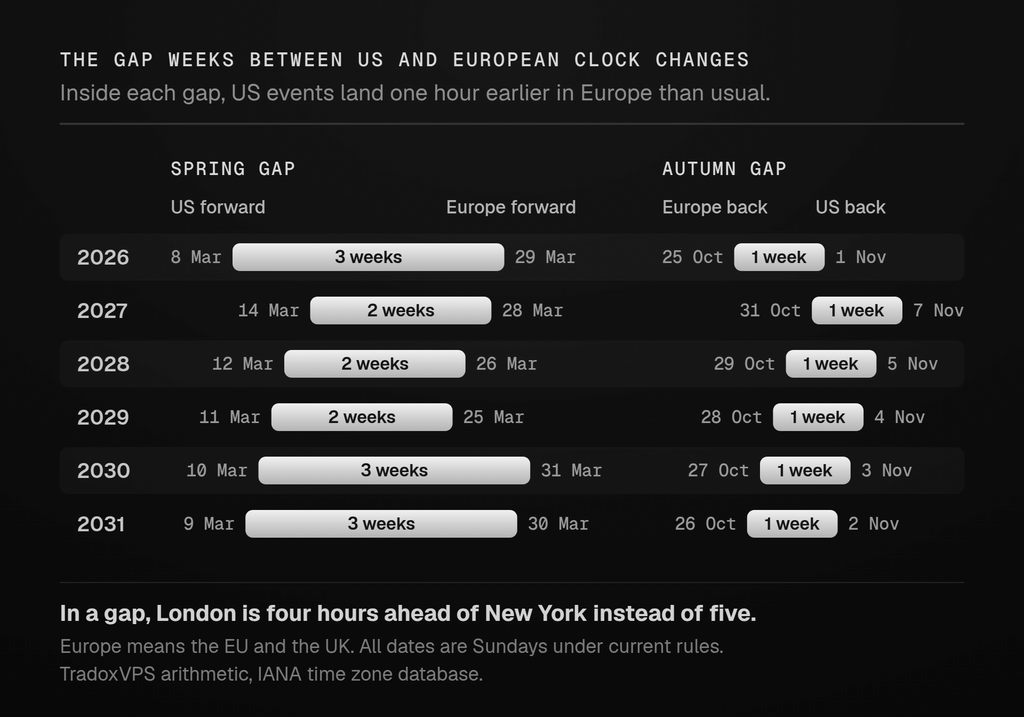
The autumn gap is always exactly one week, because the last Sunday in October always falls seven days before the first Sunday in November. The spring gap is two or three weeks, depending on where the second Sunday in March lands.
Why US market times move for everyone else
A schedule fixed to a clock that changes will move against every clock that does not. US market infrastructure fixes its schedules to US clocks:
- CME publishes its hours in Central Time unless stated otherwise. Its product pages often quote Eastern Time instead. CME’s Micro E-mini FAQ gives the hours as Sunday to Friday, 6:00 p.m. to 5:00 p.m. ET. Its Micro WTI FAQ gives the same hours, with a trading halt from 5:00 p.m. to 6:00 p.m. ET. In Central Time, that is 5:00 p.m. to 4:00 p.m. with the halt from 4:00 to 5:00 p.m.
- CME’s E-mini S&P 500 has a daily settlement window from 14:59:30 to 15:00:00 CT, according to CME’s client systems wiki.
- NYSE runs its core trading session from 9:30 a.m. to 4:00 p.m. ET.
- The BLS publishes the Employment Situation report at 8:30 a.m. ET.
- The EIA releases its Weekly Petroleum Status Report after 10:30 a.m. ET on Wednesdays.
- The Fed released its September 2026 statement at 2:00 p.m. Its October 2026 calendar lists the press conference at 2:30 p.m.
Eastern and Central Time change on the same date, so the gap between them stays one hour all year, apart from the transition night itself (covered below). A trader on US clocks sees no change at all. Anyone whose clocks follow different rules does.
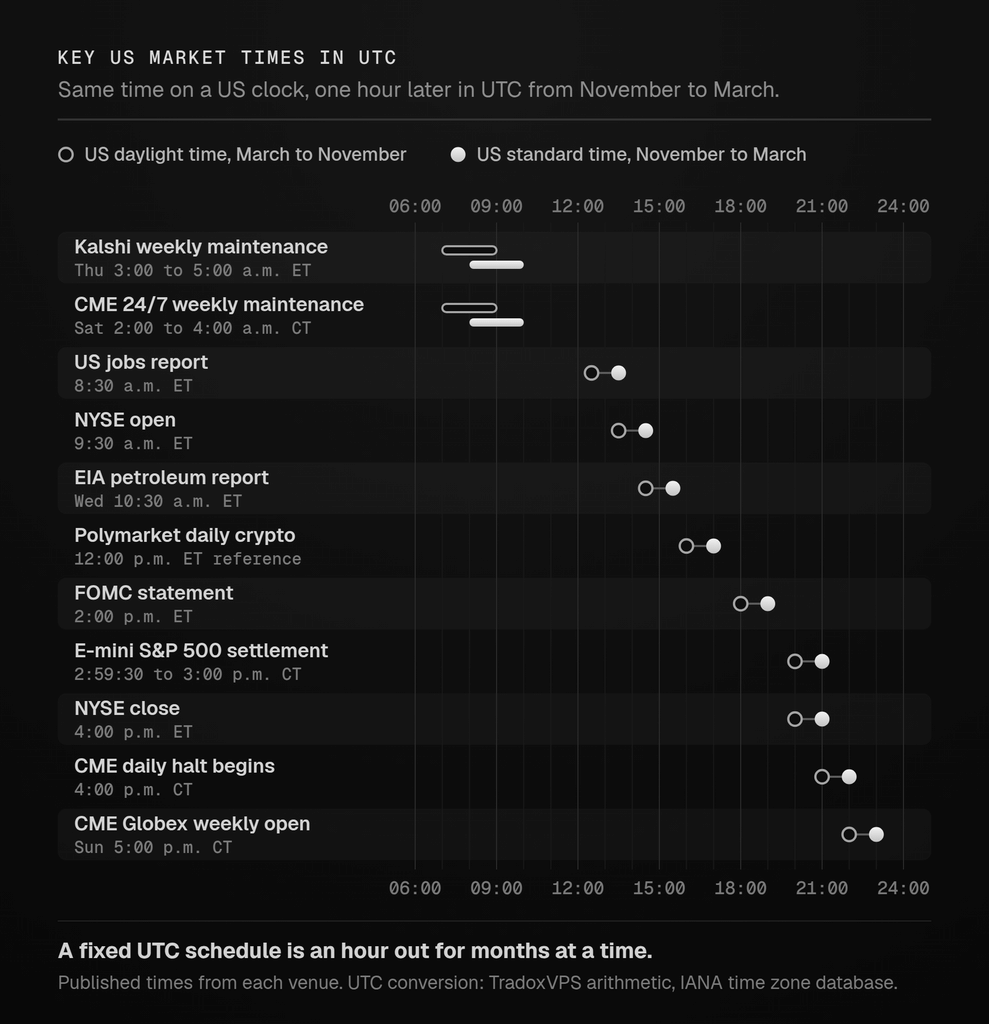
US market times in UTC, summer and winter
“US daylight time” runs from the second Sunday in March to the first Sunday in November. “US standard time” covers the rest of the year.
| Event | Published time | UTC, US daylight time | UTC, US standard time |
|---|---|---|---|
| CME Globex weekly open | Sunday 5:00 p.m. CT | Sunday 22:00 | Sunday 23:00 |
| CME daily halt begins | 4:00 p.m. CT | 21:00 | 22:00 |
| CME 24/7 daily maintenance | 4:00 to 4:02 p.m. CT, Monday to Friday | 21:00 to 21:02 | 22:00 to 22:02 |
| CME 24/7 weekly maintenance | Saturday 2:00 to 4:00 a.m. CT | Saturday 07:00 to 09:00 | Saturday 08:00 to 10:00 |
| E-mini S&P 500 settlement window ends | 3:00 p.m. CT | 20:00 | 21:00 |
| US jobs report | 8:30 a.m. ET | 12:30 | 13:30 |
| NYSE open | 9:30 a.m. ET | 13:30 | 14:30 |
| EIA petroleum report | Wednesday 10:30 a.m. ET | 14:30 | 15:30 |
| Polymarket daily crypto reference | 12:00 p.m. ET | 16:00 | 17:00 |
| FOMC statement | 2:00 p.m. ET | 18:00 | 19:00 |
| FOMC press conference | 2:30 p.m. ET | 18:30 | 19:30 |
| NYSE close | 4:00 p.m. ET | 20:00 | 21:00 |
| Kalshi weekly maintenance | Thursday 3:00 to 5:00 a.m. ET | Thursday 07:00 to 09:00 | Thursday 08:00 to 10:00 |
Published times from each venue’s own documentation, linked in this guide. UTC conversions are TradoxVPS arithmetic using the IANA time zone database.
Every row moves by exactly one hour, and every row moves on the US dates. A bot that schedules any of these events on a fixed UTC clock is an hour out for months at a time. Set in summer, it is wrong for roughly four months of every year. Set in winter, it is wrong for roughly eight.
The gap weeks: when Europe and the US are out of step
London is normally five hours ahead of New York and six hours ahead of Chicago, in summer and in winter alike. The relationship only breaks while one side has changed and the other has not:
- Autumn: Europe goes back on the last Sunday in October, and the US follows a week later. For that week, London is four hours ahead of New York.
- Spring: the US goes forward on the second Sunday in March, and Europe follows two or three weeks later. For those weeks, London is again four hours ahead of New York.
Either way, US events arrive one hour earlier than usual in London:
| Event | Published time | London, both on summer time | London, autumn gap | London, both on standard time | London, spring gap |
|---|---|---|---|---|---|
| CME Globex weekly open | Sunday 5:00 p.m. CT | Sunday 23:00 | Sunday 22:00 | Sunday 23:00 | Sunday 22:00 |
| US jobs report | 8:30 a.m. ET | 13:30 | 12:30 | 13:30 | 12:30 |
| NYSE open | 9:30 a.m. ET | 14:30 | 13:30 | 14:30 | 13:30 |
| E-mini S&P 500 settlement window ends | 3:00 p.m. CT | 21:00 | 20:00 | 21:00 | 20:00 |
| FOMC statement | 2:00 p.m. ET | 19:00 | 18:00 | 19:00 | 18:00 |
| CME daily halt begins | 4:00 p.m. CT | 22:00 | 21:00 | 22:00 | 21:00 |
TradoxVPS arithmetic using the IANA time zone database. Frankfurt, Paris and Amsterdam are one hour later than London in every column.
The gap weeks catch people because nothing looks different on a European calendar. The 2026 autumn gap, 25 October to 1 November, contains the FOMC decision of 28 October. That decision lands at 18:00 London and 19:00 Frankfurt, not the usual 19:00 and 20:00. The Fed’s published calendar also puts the 16 to 17 March 2027 meeting inside the 2027 spring gap, although the Fed treats each date as tentative until the meeting before it confirms it.
European exchanges do not move against a European trader, because they change with the local clock. Only the US side shifts.
Asia, the Gulf and Australia
Traders in Japan, Singapore, Hong Kong, China, India and the UAE have no clock change of their own, so they see a single one-hour shift on each US date and nothing on the European dates.
| Event | Published time | Singapore and Hong Kong | Tokyo | India | Dubai |
|---|---|---|---|---|---|
| CME Globex weekly open | Sunday 5:00 p.m. CT | Monday 06:00 / 07:00 | Monday 07:00 / 08:00 | Monday 03:30 / 04:30 | Monday 02:00 / 03:00 |
| US jobs report | 8:30 a.m. ET | 20:30 / 21:30 | 21:30 / 22:30 | 18:00 / 19:00 | 16:30 / 17:30 |
| NYSE open | 9:30 a.m. ET | 21:30 / 22:30 | 22:30 / 23:30 | 19:00 / 20:00 | 17:30 / 18:30 |
| FOMC statement | 2:00 p.m. ET | 02:00 / 03:00 next day | 03:00 / 04:00 next day | 23:30 same day / 00:30 next day | 22:00 / 23:00 same day |
First time: US daylight time. Second time: US standard time. TradoxVPS arithmetic using the IANA time zone database.
Sydney is the most complicated case, because it changes clocks in the opposite season to the US. The CME weekly open, at Sunday 5:00 p.m. CT, lands on Monday morning in Sydney:
- 08:00 from the first Sunday in April, when Sydney leaves daylight saving time and the US is on daylight time.
- 09:00 from the first Sunday in October, when Sydney moves forward.
- 10:00 from the first Sunday in November, when the US moves back.
- 09:00 from the second Sunday in March, when the US moves forward.
- 08:00 again from the first Sunday in April.
TradoxVPS arithmetic using the IANA time zone database.
That is four shifts a year. Every one of them changes when a Sydney-based trader can watch the CME open or a US data release.
CME’s 24/7 markets on the night the clocks change
CME now runs some products around the clock. CME’s 24/7 page lists two maintenance windows, both in Central Time:
- a two-minute window from 4:00 to 4:02 p.m. CT, Monday to Friday
- a two-hour window on Saturdays, from 2:00 to 4:00 a.m. CT
Our CME 24/7 trading hub tracks which contracts are on that schedule.
CME’s 24/7 trading began with cryptocurrency futures and options on 29 May 2026, after that year’s March change. So the first US clock change with CME’s 24/7 products trading falls on Sunday 1 November 2026. Here is what the clocks do on a change night:
- Autumn: at 2:00 a.m. Central Daylight Time, Central clocks go back to 1:00 a.m. Central Standard Time. The hour from 1:00 to 2:00 a.m. CT happens twice, first from 06:00 to 07:00 UTC and again from 07:00 to 08:00 UTC. CME’s published schedule has no maintenance window at that hour, so the 24/7 markets are scheduled to trade throughout.
- Spring: the hour from 2:00 to 3:00 a.m. CT does not exist. On 14 March 2027, Central clocks jump from 2:00 to 3:00 a.m. at 08:00 UTC.
- Eastern and Central Time briefly break their one-hour relationship. Eastern Time changes an hour before Central Time. Between 06:00 and 07:00 UTC on 1 November 2026, both zones read the same clock time. Between 07:00 and 08:00 UTC on 14 March 2027, Eastern Time runs two hours ahead of Central. Any code that converts between ET and CT by adding or subtracting a fixed hour is wrong for that hour.
TradoxVPS arithmetic using the IANA time zone database.
The CME 24/7 documents we reviewed, its 24/7 page and its crypto client document, define every window in Central Time and do not describe the clock change. CME’s weekend rule does settle one question: all weekend and holiday trading from Friday evening to Sunday evening carries the next business day’s trade date. A Sunday fill during the repeated hour still clears as Monday business.
What moves is the maintenance schedule in UTC. The Saturday window on 31 October 2026 runs from 07:00 to 09:00 UTC. From 7 November 2026 until the March 2027 change, it runs from 08:00 to 10:00 UTC. The weekday window moves from 21:00 to 22:00 UTC from Monday 2 November 2026. A bot that handles the windows with fixed UTC times is an hour out after every change. It either treats the real window as an unexpected outage or tries to reconnect while maintenance is still running. Three habits avoid that:
- schedule the windows with the America/Chicago zone, not with fixed UTC times
- key every trade and log line to UTC timestamps
- do not build hourly bars from local Central Time labels on the change night, where one hour repeats in autumn and one is missing in spring
Prediction markets: Polymarket and Kalshi work in Eastern Time
Prediction markets run around the clock, but their schedules are written in Eastern Time, so those schedules move in UTC whenever US clocks change.
Kalshi
Kalshi trades 24/7 apart from a weekly maintenance window. Its help centre and API documentation both put that window on Thursdays from 3:00 to 5:00 a.m. ET, with a trading pause in effect. The API documentation tells clients to expect disconnections and to reconnect after 5:00 a.m. ET. In UTC, the window runs from 07:00 to 09:00 during US daylight time and from 08:00 to 10:00 during US standard time.
Polymarket
Polymarket titles its crypto up-or-down markets in Eastern Time, and each market type handles the clock differently:
- 5-minute, 15-minute and 4-hour markets. These carry a Unix timestamp in their web address, which is UTC-based and immune to daylight saving time. The 4-hour windows follow the Eastern clock, so their start times move in UTC.
- The 4:00 PM to 8:00 PM ET market on 4 February 2026 started at 21:00 UTC.
- The 4-hour market that started at 8:00 a.m. ET on 30 September 2026 started at 12:00 UTC, on a grid one hour earlier in UTC.
- The grid moved with the spring 2026 change. The market labelled 4:00 to 8:00 AM ET on 8 March 2026 started at 08:00 UTC, an hour earlier in UTC than the same label a week before.
- On a change day, that means one window does not last four real hours. While the grid follows the Eastern clock, the window covering midnight to 4:00 a.m. ET runs three real hours in spring and five in autumn.
- Hourly markets. These settle on the Binance BTC/USDT 1-hour candle that begins at the stated Eastern hour. On the spring change day there is no 2 AM ET hour. On the autumn change day, 1 AM ET happens twice.
- Daily markets. These compare the Binance BTC/USDT 1-minute close at noon ET with the close at noon ET the day before. On a change day, that interval is not 24 hours. The market for 1 November 2026 measures 25 hours, from 16:00 UTC on 31 October to 17:00 UTC on 1 November. The market for 14 March 2027 measures 23 hours. TradoxVPS arithmetic.
These are not theoretical risks:
- 8 March 2026: on the spring change day, Polymarket’s site displayed a market labelled “March 8, 1-1 AM ET”, Odaily reported the next day. Odaily quoted a trader who said automated programs that relied on the API’s end times crashed. When Odaily published, Polymarket had not responded through official channels.
- 19 September 2026: an open-source Polymarket bot fixed exactly the daily-window bug. It had found the reference price by subtracting 86,400 seconds from the market’s end time, which reads the wrong candle on both change days.
For bots, the safe pattern has three parts:
- Read UTC timestamps from the market itself. Use the timestamp in the market’s address, or the ISO 8601
eventStartTimeandendDatefields in Polymarket’s market API. Check which field your code reads: on recurring markets,startDatecan reflect when the market was listed rather than when its window opens. - Compute Eastern-time references with zone-aware code using America/New_York, not with fixed offsets.
- Check every window’s real length on change days before trading it.
How these markets settle is covered in our Polymarket TWAP settlement guide. Keeping a bot online through events like these is covered in our guide to running a Polymarket bot 24/7.
Trading platforms
NinjaTrader
NinjaTrader shows every time in the time zone chosen under Control Center > Tools > Options > General, whatever the computer’s own clock says. NinjaTrader support staff explain how this works on its forum:
- Each trading hours template carries the time zone its session is defined in, and the platform converts that into your selected zone.
- Daylight saving time is handled automatically, as long as the zone you select observes it.
- Historical and replay data are converted into the configured time zone. That setting starts as the computer’s own time zone when NinjaTrader is installed.
That conversion is where automated strategies can go wrong. NinjaScript reads bar times in the platform’s time zone, so a strategy that compares bar times with fixed clock values depends entirely on that setting:
- Platform set to London: a filter that starts trading at 14:30 matches the US cash open for most of the year, and starts an hour late during every gap week.
- Platform set to a zone without daylight saving time, such as UTC or Singapore: a fixed filter drifts against CME by an hour on every US change.
There are two clean fixes. For CME strategies, set NinjaTrader’s time zone to Central Time, so clock values in your code match CME’s own schedule all year. Or derive session times from the instrument’s trading hours template with NinjaScript’s SessionIterator, instead of hard-coding clock numbers. Either way, replay a week that contains a clock change before trusting the strategy live. Our NinjaTrader strategies guide covers testing in more depth.
TradingView alerts and Pine Script
TradingView’s Pine Script documentation says session functions use the exchange’s time zone when no time zone is specified. It accepts two notations:
- IANA names, such as “America/New_York”, which adjust automatically for daylight saving time.
- UTC offsets, such as “UTC-5”, which stay fixed all year.
A New York session filter written with “UTC-5” is right only during US standard time, about four months of the year, and an hour out for the other eight. If your alerts trigger webhooks into an automation tool, that error travels with them. You can change the time zone a chart displays from the clock at the bottom of the chart or in chart settings, according to TradingView’s support page.
MetaTrader
MetaTrader charts run on the broker’s server time, and each broker decides whether that clock changes on US dates, European dates or not at all. MetaQuotes’ own MQL5 documentation notes that working out a server’s daylight saving behaviour is not straightforward and suggests confirming it with the broker. A practical check is to compare the Market Watch clock with UTC on a winter date and a summer date. Base expert advisor logic on UTC (TimeGMT) rather than on server hours. In the Strategy Tester, TimeGMT returns the simulated server time, so check daylight saving handling on a demo account rather than in a backtest.
Prop firm cutoffs
Futures prop firms typically write their flat-by times and daily loss resets in Central or Eastern Time, as our guide to prop firm weekend and cutoff rules shows. Those cutoffs move in your local time on the US dates. If you trade from Europe, they arrive an hour earlier during the gap weeks, which is easy to miss with an open position.
Your server’s clock
Windows. Two switches control the clock, under Settings > Time & language > Date & time: “Set time zone automatically” and “Adjust for daylight saving time automatically”, as Windows Central’s guide describes. Microsoft no longer issues standalone daylight saving updates. Rule changes arrive in the monthly cumulative updates, so a server that falls behind on Windows Update can miss them.
The rules themselves change. The IANA time zone database, which most operating systems and programming languages rely on, recorded several such changes in 2026:
- British Columbia: permanent UTC-7 (release 2026b).
- Alberta: permanent UTC-6. Morocco: permanent UTC (2026c).
- Northwest Territories: permanent UTC-6 (2026d).
- Manitoba: permanent UTC-5 from 31 October 2026 (2026e).
A machine without current updates can show the wrong local time for places like these.
Linux. Cron handles daylight saving changes in its own way, and the details depend on which cron your distribution ships. The cronie daemon used on Red Hat-family systems behaves like this, according to its manual page:
- When the clock jumps forward, jobs that fell in the skipped hour run immediately.
- When the clock goes back, cron avoids running the same job twice.
- Both rules apply only to jobs at specific times or with intervals longer than an hour. More frequent jobs run normally.
Debian and Ubuntu’s cron applies the same two rules only to jobs with a fixed minute and hour. The simplest way around all of this is to run servers on UTC and convert in code.
In code, three rules prevent most problems:
- Store timestamps in UTC.
- Name time zones with IANA identifiers, such as America/Chicago, America/New_York or Europe/London, never fixed offsets. Abbreviations are worse still: “CST” is used for both US Central Standard Time and China Standard Time.
- Use the
foldattribute for the repeated autumn hour. Python’s zoneinfo module uses the system’s IANA data, or the tzdata package when the system has none.foldselects the first or second occurrence of a repeated time.
A UTC server and an exchange-time server both work, as long as you choose one deliberately. A UTC server’s logs never jump, and NinjaTrader can still display Central Time, because its time zone setting is separate from Windows.
A checklist for the week before each change
- Check the next US and European dates in the table above, and mark the gap weeks in your calendar.
- List every scheduled job, alert, session filter and reconnect routine that uses a clock time. Write down which zone each one uses.
- Replace fixed UTC offsets with IANA zone names wherever you find them.
- Open NinjaTrader’s time zone setting, then review any strategy that compares bar times with fixed clock values.
- Work out your prop firm’s cutoff and daily reset in your own local time for the gap weeks.
- Confirm the server’s time zone and automatic daylight saving settings, and install pending operating system updates.
- For CME 24/7 bots, check that maintenance handling follows America/Chicago and that the Saturday window moves with it.
- For Polymarket and Kalshi bots, read UTC timestamps from the market data, check window lengths on the change day, and allow for the 23-hour and 25-hour daily windows and the Thursday Kalshi pause.
- On the change night, avoid grouping data by local hour.
- After the change, compare one known event, such as the CME daily halt, against your logs to confirm the hour is right.
Where hosting fits
A trading server does not solve daylight saving time. It only takes one variable out of the picture. The settings that matter are the same on any machine: the server’s time zone, automatic daylight saving adjustment, current operating system updates, and code that uses IANA zone names.
What an always-on machine changes is continuity. Both clock changes happen in the early hours of a Sunday, and the 24/7 markets keep trading straight through them. A strategy running on a home PC depends on that PC being awake and connected at that hour. A hosted machine removes that dependence, but its clock still needs the same deliberate configuration. If you run NinjaTrader or CME automation that way, our NinjaTrader VPS and Chicago VPS pages explain the setup.
Frequently asked questions
Not on a US clock. CME publishes its hours in Central Time, so the Sunday open stays at 5:00 p.m. CT all year. Outside the US the hours do move: the open is 22:00 UTC during US daylight time and 23:00 UTC during US standard time, and every other CME time shifts the same way on the US dates.
The US moves forward on the second Sunday in March and back on the first Sunday in November, at 2:00 a.m. local time. The EU and the UK move forward on the last Sunday in March and back on the last Sunday in October, at 01:00 UTC. The table in this guide lists every date from 2026 to 2031.
Because the US and Europe change on different Sundays. For one week in autumn and two or three weeks in spring, London is four hours ahead of New York instead of five. US opens, data releases and settlements all arrive an hour earlier on European clocks until the other side changes too.
The FOMC statement comes at 2:00 p.m. ET, which is normally 19:00 in London and 20:00 in Frankfurt. During the gap weeks it arrives at 18:00 in London and 19:00 in Frankfurt. The press conference follows half an hour later.
Yes, once on each US date. Japan, Singapore, Hong Kong, China, India and the UAE do not change their own clocks. So CME, the Fed and US data move by one hour in local time when US clocks change, and the European dates make no difference. Sydney is different, because it has its own clock changes in April and October.
Not according to CME’s published schedule, which has no maintenance window at that hour. On the autumn change, the hour from 1:00 to 2:00 a.m. CT happens twice, and in spring the hour from 2:00 to 3:00 a.m. CT does not exist. CME’s maintenance windows stay at the same Central times, so they move by an hour in UTC.
Its crypto markets are titled and scheduled in Eastern Time. The 4-hour windows follow the Eastern clock, hourly markets use the Binance candle that starts at the stated Eastern hour, and daily markets compare noon ET with noon ET the day before. The Unix timestamp in the address of each 5-minute, 15-minute and 4-hour market is UTC-based, which makes it the safest value for bots to use.
In UTC it does. Kalshi publishes the window as Thursday 3:00 to 5:00 a.m. ET. That is 07:00 to 09:00 UTC while the US is on daylight time and 08:00 to 10:00 UTC while it is on standard time.
Yes, as long as the time zone selected under Tools > Options > General observes daylight saving time, according to NinjaTrader support. Strategies are the risk: a NinjaScript filter written as a fixed clock time is measured in the platform’s time zone. If that zone does not follow US clock rules, the filter drifts against CME for weeks or months.
Either works if you choose deliberately and stay consistent. UTC gives logs that never jump or repeat. Exchange time makes clock values in code match the exchange’s own schedule. Platforms such as NinjaTrader can display a different time zone from the server, so you can run the server on UTC and still chart in Central Time.
Store every timestamp in UTC, name zones with IANA identifiers such as America/Chicago rather than fixed offsets, and compute exchange-time events with zone-aware libraries. On change days, check that any window you trade has the length you expect. Never assume a day is 24 hours: a daily window that spans a change lasts 23 or 25.