
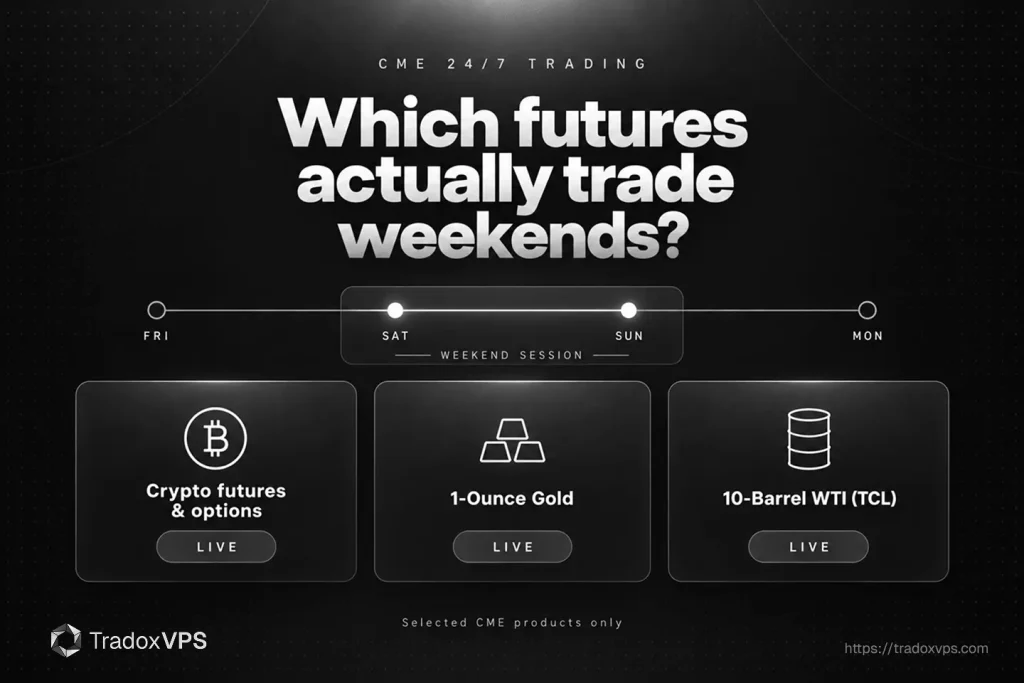
CME 24/7 trading is live, and it is smaller than the headlines suggest. As of today, two product areas trade continuously: cryptocurrency futures and options since 29 May 2026, and the 1-Ounce Gold futures contract since 24 July. A third, 100-Ounce Silver, is scheduled for 11 September. A fourth, the 10-Barrel WTI crude oil contract, was supposed to be trading by now and is not.
The thing to understand before anything else is that CME is not moving asset classes to weekends. It is moving one small contract at a time, and leaving the benchmark contracts closed.
Standard Gold (GC) and Micro Gold (MGC) do not trade weekends. Only the 1-Ounce contract does. Standard Silver (SI) and Micro Silver (SIL) will not trade weekends when the 100-Ounce contract moves next week. No crude oil contract trades weekends at all yet. If you read that CME gold is going 24/7, open your platform and reach for the symbol you already trade, you will find the market closed.
This page is the current map: what trades continuously today, what does not, the exact maintenance windows, the trade-date rule that quietly breaks reconciliation, and what an automated system has to change. Where a figure is published, it is attributed. Where something is not published, we say so rather than estimating.
Which CME futures trade 24/7 right now
| Asset class | Continuous contract | Code | Exchange | Status on 4 September 2026 | Same family, still Sunday to Friday |
|---|---|---|---|---|---|
| Cryptocurrency | Crypto futures and options | BTC, ETH and others | CME | Live since 29 May 2026 | Spot-Quoted crypto futures (QBTC, QETH, QSOL, QXRP) |
| Gold | 1-Ounce Gold | 1OZ | COMEX | Live since 24 July 2026 | Gold (GC), Micro Gold (MGC) |
| Silver | 100-Ounce Silver | SIC | COMEX | Scheduled 11 September 2026, pending regulatory review | Silver (SI), Micro Silver (SIL) |
| Crude oil | 10-Barrel WTI | TCL | NYMEX | Not listed, pending regulatory review | WTI (CL), Micro WTI (MCL), E-mini WTI (QM) |
| Equity index | None | No weekend product exists | E-nano (NES, NNQ, N2K, NDOW), Spot-Quoted (QSPX, QNDX, QRTY, QDOW) |
Two rows in that table are worth pausing on.
The crypto row contains the trap in miniature. Cryptocurrency futures and options trade continuously, but CME’s Spot-Quoted crypto futures, a separate product line quoted at the spot price rather than the futures price, stay on a five-day schedule. Two crypto products, same exchange, different weeks.
The equity index row is the one people get wrong in the other direction. CME has been shrinking equity index contracts aggressively, and we covered that in our post on E-nano equity index futures. But shrinking contracts and extending hours are two separate programmes. No CME equity index product trades weekends. If you want weekend exposure to the S&P, CME does not currently offer it.
How the CME 24/7 rollout has actually gone
Cryptocurrency, 29 May 2026. Announced on 19 February and delivered on schedule. CME reported that more than 7,200 cryptocurrency futures and options contracts traded over the inaugural weekend, roughly $50 million in notional value. This was the first CME product area to go continuous.
1-Ounce Gold, 24 July 2026. Announced on 11 June alongside crude. Worth a note on the date: the June press release said 26 July, while the Globex Notice of 13 July, the results release of 27 July and the silver announcement of 11 August all use 24 July. Operational documents describe what the system actually did, so 24 July is the date we use. The migration happened first, with 1OZ moving to a new market data channel and the 1-Ounce Gold TAS contract delisted, before weekend trading began.
100-Ounce Silver, scheduled 11 September 2026. Announced on 11 August, pending regulatory review. SIC is CME’s smallest silver contract, listed on COMEX, cash settled to the 5,000-ounce Silver (SI) futures contract, with contract months on the March, May, July, September and December cycle within a 24-month window. It only launched in February 2026 and averaged 17,800 contracts a day in the first half of the year, against a record $50 billion in average daily notional across all CME silver futures over the same period.
Jin Hennig, CME’s Global Head of Metals, framed the silver decision around what gold had already shown, saying silver bridges the precious and industrial metals worlds and responds to both macroeconomic news and real-world demand.
10-Barrel WTI, scheduled 30 August 2026, did not happen. This is the part of the story most coverage has wrong.
The 24/7 crude oil contract that did not launch
TCL was announced on 11 June for a 30 August listing, with weekend trading due to begin on 4 September. Neither happened.
CME’s client systems documentation for TCL was revised on 27 August with a note that the launch date was postponed pending regulatory review, and both the production launch and the start of weekend trading now read as to be determined. CME’s product page describes the contract as coming soon, carries a pending regulatory review footnote, and still refers to TCL in future tense. CNBC reported on 1 September that the contract remained pending regulatory approval, and issued a correction to an earlier version of its story that had not stated the regulatory status.
Some coverage published since 30 August states that TCL launched on that date and is now trading. CME’s own materials do not support that. If you have been searching your platform for the symbol, that is why it is not there.
We cover the contract itself, including the specifications, the still-unpublished tick value and the cost arithmetic, in our 10-Barrel WTI (TCL) post.
The delay matters beyond crude, because it tells you something about the rollout. Crypto and gold cleared review. A physically-anchored energy benchmark, even in a tiny cash-settled wrapper, did not clear on the same timetable. Whatever the reason, and CME has not published one, the pattern suggests these approvals are product by product rather than programme-wide.
The CME 24/7 maintenance windows
Continuous does not mean uninterrupted. There are two scheduled pauses, and one of them is much more disruptive than it looks.
The daily window is two minutes, Monday through Friday, from 4:00 p.m. to 4:02 p.m. Central Time. The sub-steps are close from 4:00:00 to 4:01:00, pre-open from 4:01:00 to 4:01:30, a no-cancel period from 4:01:30 to 4:02:00, then open at 4:02:00. Compared with the traditional one-hour daily halt, that is nearly five extra hours of market time each week.
The weekly window is two hours, Saturday from 2:00 a.m. to 4:00 a.m. Central. The sub-steps are close from 2:00 to 3:45, pre-open from 3:45 to 4:00, a no-cancel period from 3:59:30 to 4:00:00, then open at 4:00.
Each product’s first day of weekend trading uses a one-time thirty-minute daily window instead of two minutes. Crypto did this on 29 May and gold did it on 24 July, with all subsequent Friday sessions reopening at the regular 4:02 p.m. time. Expect the same on 11 September for silver. This is the source of a persistent misunderstanding, because the thirty-minute figure appears in launch documentation and gets quoted as if it were the steady state. It is not.
CME has also temporarily extended the Saturday window on at least one occasion before reverting. Treat the Saturday schedule as subject to change and watch the Globex Notices rather than hard-coding it.
The weekend trade date rule
This is the rule most likely to break something quietly, and it applies to every 24/7 product.
All activity from Friday evening through Sunday evening, and on exchange holidays, is assigned the trade date of the following business day. Clearing, settlement and regulatory reporting are all processed on that following business day.
So a fill you take at ten in the morning on a Saturday does not carry a Saturday trade date. It carries Monday’s, or Tuesday’s if Monday is a holiday.
Holidays follow the same logic in both directions. When Monday is a holiday the market does not close, and activity continues to carry the next business day’s date. When Friday is a holiday, the trade date after the Thursday maintenance rolls straight to Monday.
The practical consequence is that the market never closes but the clearing calendar still runs on weekdays. That gap is where the operational risk lives, and it is the reason regulators have paid attention, which we come back to below.
Good Till orders disappear on Friday unless weekend trading is enabled
If weekend trading is not enabled for you in CME Globex Credit Controls, all Good Till orders are eliminated at Friday 4:00 p.m. Central. CME advises clients who are not enabled to cancel their Good Till futures and options orders before that time rather than be surprised.
The mechanism is worth understanding because it is not your decision alone. Globex Credit Controls were updated in May 2026 to include weekend exposure limits, and the default weekend limit is zero, which means weekend trading is off unless your clearing firm explicitly turns it on and sets limits for you.
So whether a resting order survives into Saturday depends on your futures commission merchant, not on the exchange schedule. If you intend to leave orders working over a weekend, confirm weekend enablement with your clearing firm in writing before you rely on it.
The CME Saturday session reset, and why reconnect logic breaks
The daily two-minute pause is a pause. The Saturday window is a full shutdown and restart, and systems written for a market that closes once a week on Friday will not expect what happens.
At the start of the Saturday window, CME Globex disconnects all sessions, resets sequence numbers, and cancels resting day orders and mass quotes. Client systems receive a security status close message, then order elimination messages, then disconnections across market data, order entry and Drop Copy. CME’s own guidance is that clients and vendors should restart their applications at this point and run their own restart process to reset their order books.
At the Saturday startup, order entry, Drop Copy and market data sequence numbers all reset to one. On the market data side, snapshot messages on the recovery feed are removed for the affected channel and the book sequence resets to one for each instrument. Pre-registered administrative information is cleared during the window, so party details have to be re-submitted after the Saturday pre-open.
There is one more change that catches legacy systems: the Sunday startup that CME systems have relied on for years is gone for these products. The startup now happens on Saturday morning.
If your reconnect handler assumes sequence numbers only increase, or assumes the weekly restart happens on Sunday evening, it will misbehave at four in the morning on a Saturday, which is exactly when nobody is watching.
Clearing routes, tooling and the API flag
A few operational details that differ by product and are easy to get wrong.
Clearing routes are not uniform. ClearPort supports the 24/7 crypto products, operating continuously except during the Saturday window. For 1-Ounce Gold, the position is different: 1OZ trades on Globex only, ClearPort submission is not supported, and block trades are not supported. The 100-Ounce Silver FAQ describes SIC as available on Globex with submission for clearing via ClearPort, so do not assume the gold arrangement carries across. Check the product.
CME Direct does not support weekend trading. CME DataMine does support it. FirmSoft has a separate weekend access point for order and trade views.
Weekend order entry requires a seven-day enabled gateway session. Five-day sessions can only send orders between Sunday 4:05 p.m. and Friday 4:00 p.m. Central, so a system connected on a five-day session will simply be unable to trade on a Saturday regardless of what the exchange is doing.
The most useful detail for anyone building systems: CME’s Reference Data API exposes a seven-day trading indicator, a yes or no flag on the instrument record that tells you whether an instrument trades continuously, and it is filterable. Because this rollout is happening contract by contract, any hard-coded list of continuous symbols will be wrong the next time CME adds one. Query the flag instead.
What the weekend actually looks like
The only published weekend figures come from CME itself, so treat them as the exchange’s own reporting rather than independent measurement.
For gold, CME reported nearly 15,000 1-Ounce Gold contracts traded over the inaugural weekend, roughly $60 million in notional, with the bid and offer frequently less than a dollar apart and at times narrowing to twenty-five cents. By 11 August, CME reported more than 53,000 contracts traded in weekend sessions since the 24 July start, around $219 million in notional, which it described as the largest weekend liquidity pool in gold futures. Taking those two published figures, roughly $159 million of that notional came in the weekends after the first, which is our own subtraction rather than a CME figure.
For crypto, the only weekend-specific number CME has published is the inaugural weekend: more than 7,200 contracts, roughly $50 million. CME’s later crypto disclosures are monthly average daily volumes across all sessions, not weekend breakouts. As of today there is no published cumulative weekend crypto figure, and we are not going to derive one from monthly averages, because you cannot separate weekend activity from a blended daily number.
Two things follow. Weekend gold liquidity has been real rather than nominal, which is the strongest evidence available for what silver might look like next week. And a market being open is still not the same as a market being deep. Spreads that hold within a dollar during a quiet weekend say little about what happens when a genuine weekend shock arrives and the usual market makers are not at their desks.
Your broker may not be open even when CME is
This is the gap most traders discover the hard way. Exchange availability is not broker availability.
CME maintains a broker directory on its 24/7 hub page, listing firms for crypto and for metals separately, with a disclaimer that the list is informational rather than an endorsement. The useful exercise is comparing that list against what the brokers themselves have published, and the comparison is not flattering.
Charles Schwab has published the clearest weekend statement, confirming that futures-approved accounts could use the new hours from launch, and restating CME’s maintenance windows. Robinhood was a named launch partner for both crypto and gold, with executives quoted in CME’s releases, although some of Robinhood’s own support documentation still describes futures in the older near-24/5 terms.
Several platforms named on CME’s list have not updated their own documentation to describe Saturday and Sunday trading, weekend hours, weekend margin treatment or weekend support coverage. We found no published weekend-support statement from TradeStation, Rithmic or CQG. That is not evidence that they do not support it. It is evidence that they have not said, which for an operational question is nearly as awkward.
Three questions to put to your broker before you rely on weekend access, none of which the exchange can answer for you. Is weekend trading enabled on my account, including the weekend credit limits discussed above? What are your own maintenance windows, which may differ from CME’s? And who answers the phone at three in the morning on a Sunday if something goes wrong?
Prop firms have not written weekend trading rules yet
If you trade a funded account, the exchange schedule is not your schedule. Your firm’s rules are, and as of early September we could not find a major futures prop firm that has published rules written specifically for the 24/7 products.
What is published is each firm’s general posture, and that still governs. Topstep requires positions flat by the daily close and does not permit overnight or weekend holding. Apex permits weekend holding on evaluations, with funded-account rules that have changed more than once, and uses a trailing threshold that ratchets up with unrealised profit and does not come back down. Other firms vary.
The unanswered questions are specific and they matter. Does the daily loss limit reset at the usual boundary on a Saturday, while the market is still trading? Does a trailing high-water mark update on weekend prints? Is a Sunday position an overnight hold, a weekend hold, or neither?
That second question is the dangerous one. If your firm computes drawdown from the highest point your account reaches, and a thin weekend session prints a spike you would never have traded, your high-water mark can move while you sleep. Until a firm publishes explicit rules for continuous products, assume your existing flat-by-close and weekend-holding rules apply, and get the answer in writing.
Why the regulator is part of the 24/7 story
Continuous trading with weekday clearing creates a specific problem, and it explains both the pace of the rollout and the crude oil delay.
The Commodity Futures Trading Commission opened a formal consultation on trading and clearing derivatives on a 24/7 basis in 2025, and issued staff guidance in 2026 setting out expectations for exchanges, clearinghouses and brokers considering continuous operations. The substance is directly relevant to what a trader experiences.
The core concern is the gap between trading and settlement. If a market trades all weekend but customer collateral cannot be collected until Monday, a sharp weekend move can leave customer accounts undermargined with no mechanism to top them up. That is not a theoretical risk for the exchange, it is a real constraint on the broker holding your account, and it is why weekend credit limits default to zero.
The guidance also notes that not all products suit continuous trading equally, with crypto the most natural fit given a global spot market that already runs around the clock, and cautions against contracts that settle during illiquid weekend windows. Read alongside the crude oil delay, that is a reasonable frame: the closer a product sits to a physically anchored benchmark, the more scrutiny the continuous version attracts.
Where CME sits in the wider move to longer hours
CME is not alone in extending hours, but it is doing something different from most of the market.
The equities moves in 2026 are all 24/5 extensions rather than weekend trading. Nasdaq received approval to extend to twenty-three hours a day, five days a week, with a launch scheduled for late 2026. NYSE Arca is extending toward twenty-two hours. A new entrant, 24X, was approved on a twenty-three hour, five-day basis. Cboe received approval for pre-market and post-market sessions in a set of equity options, with the launch date pushed back more than once. The clearing infrastructure is moving in parallel, with DTCC working toward extended hours.
All of those still close for the weekend. CME’s rollout is the first case of a major US derivatives exchange running regulated futures on a true seven-day basis.
Meanwhile the venues our prediction-market readers already use have always worked this way. Kalshi and Polymarket have never closed. For a trader who moves between prediction markets and futures, the interesting part of 2026 is not that continuous trading exists, it is that the regulated futures world is finally catching up to a schedule the crypto and prediction-market venues have always had.
Nine things to change in a bot before weekend trading
If you run anything automated against these products, this is the concrete list. Most of it follows from the mechanics above.
Stop keying anything off the calendar date. Weekend and holiday fills carry the next business day’s trade date. Any reconciliation, profit and loss attribution or reporting logic that joins fills to a calendar date will misassign every weekend fill. Read the exchange trade date off the fill record.
Rewrite anything that assumes a daily or weekly close. Session-based indicators, daily bars and calculations that run “since the open” all need explicit session definitions when the market only pauses for two minutes.
Treat the maintenance windows as scheduled events, not failures. Your monitoring must tell the difference between a two-minute scheduled disconnect and a real outage, or the alert that fires at the same time every day becomes the alert everyone ignores.
Make reconnect logic survive the Saturday reset. Sequence numbers go back to one across order entry, Drop Copy and market data. Books must be cleared and rebuilt, sessions re-established, and party details re-submitted after the pre-open. Code that assumes monotonically increasing sequence numbers will break.
Handle the Friday Good Till elimination deliberately. Either confirm weekend enablement with your clearing firm, or have your system cancel and re-place resting orders around the Friday boundary on purpose.
Make risk limits live all weekend. A position held into Saturday sits in a continuously trading market with no intervening settlement, and in many setups no ability for your broker to make a weekend margin call. Your automated limits are the only thing awake.
Fix bar building and storage. If your data layer assumes one settlement per calendar day, weekend data will corrupt your bars. Store the exchange trade date alongside the timestamp and decide explicitly how continuous activity maps to sessions.
Check roll logic against the right calendar. The continuous contracts have their own listing cycles. SIC runs March, May, July, September and December within a 24-month window, which is not the benchmark contract’s calendar.
Query the seven-day trading indicator instead of hard-coding symbols. It is the only approach that stays correct as CME adds products, and CME is clearly going to add more.
Does 24/7 trading change your infrastructure needs?
Our honest read, as a company that hosts trading platforms for automated traders.
If you trade during ordinary weekday hours and you are flat by the close, no. Nothing here changes what you need, and a hosted setup would solve a problem you do not have. We would rather say that plainly than sell you something.
The narrow case is real though, and this is the one topic where it is real without stretching. A market that never closes cannot be supervised from a laptop on a home connection that gets switched off at night. If you hold positions into a weekend, or you run automation that has to survive the Saturday reset and reconnect cleanly on the other side, then something needs to stay online and connected when you are not at the keyboard. The supervision gap has moved from overnight to all weekend, and a machine that installs an operating system update on Saturday morning will miss both the reset and the reconnect.
Now the limits, which matter more than the pitch. Hosting keeps your software online and connected. It cannot prevent CME’s maintenance windows, it cannot make your broker support weekend trading if they have not enabled it, it cannot create liquidity in a thin Sunday session, it cannot stop orders being rejected by a credit control you did not set, and it cannot fix bad strategy logic. That is the whole list of what it does and does not do.
If the narrow case describes you, our NinjaTrader VPS page covers the platform side and our Chicago location is the relevant one for CME products. Measure your own path rather than taking anyone’s number, ours included: the latency checker gives a zero-install read and our benchmarks page publishes the method so you can reproduce it. If you are comparing providers, our futures VPS comparison ranks the field and discloses that we are one of the entries in it.
How we checked this
Rollout dates, product scope and volume figures come from CME Group press releases: the crypto announcement of 19 February 2026, the crypto launch release of 1 June, the gold and crude announcement of 11 June, the gold results release of 27 July, and the silver announcement of 11 August. Silver contract details come from CME’s 100-Ounce Silver FAQ.
The operational detail, meaning the maintenance windows, the weekend trade-date rule, the Saturday sequence reset, the Good Till elimination, the gateway session requirements, the clearing routes and the seven-day trading indicator, comes from CME’s client systems documentation and from Globex Notices dated 13 July, 27 July and 17 August 2026.
The crude oil delay comes from CME’s product page as it stands today, from the client systems page for TCL revised on 27 August, and from CNBC’s report and correction of 1 September.
Broker and prop firm positions come from those firms’ own published materials, and where we say something is unpublished, it means we looked and did not find it rather than that it does not exist.
Where CME’s own documents disagreed, we used the operational document over the press release. The gold start date is the example: the June release says 26 July, the Globex Notice and later releases say 24 July, and operational documents describe what the system actually did.
One figure on this page is ours rather than CME’s: the roughly $159 million of weekend gold notional after the inaugural weekend, which is simply CME’s cumulative figure minus CME’s first-weekend figure.
We have not traded these products at weekends ourselves. What we bring beyond the reading is the adjacent part: we host trading platforms for automated traders, and we spend a lot of time on what breaks when a schedule changes underneath a running system. That is where the automation section comes from.
Frequently asked questions
Cryptocurrency futures and options, continuously since 29 May 2026, and the 1-Ounce Gold futures contract (1OZ), continuously since 24 July 2026. The 100-Ounce Silver contract (SIC) is scheduled to join on 11 September 2026 pending regulatory review. The 10-Barrel WTI crude oil contract (TCL) has not listed.
One CME gold contract does. The 1-Ounce Gold contract (1OZ) has traded continuously, weekends included, since 24 July 2026. Standard Gold (GC) and Micro Gold (MGC) remain on the traditional Sunday to Friday schedule and do not trade weekends.
No CME crude oil contract trades weekends today. The 10-Barrel WTI contract (TCL) was designed to be the first energy product on the continuous schedule, but it has not listed and remains pending regulatory review. Benchmark WTI, Micro WTI and E-mini WTI all keep the traditional energy schedule.
11 September 2026, pending regulatory review. SIC is CME’s smallest silver contract, listed on COMEX and cash settled to the 5,000-ounce Silver futures contract. Standard Silver and Micro Silver are not moving to the continuous schedule.
Two minutes daily, Monday through Friday, from 4:00 p.m. to 4:02 p.m. Central Time, and two hours on Saturday from 2:00 a.m. to 4:00 a.m. Central. Each product’s very first day of weekend trading uses a one-time thirty-minute daily window instead of two minutes.
All activity from Friday evening through Sunday evening, and on exchange holidays, is assigned the trade date of the following business day, and clearing, settlement and regulatory reporting are processed then too. A Saturday fill normally carries Monday’s trade date.
CME has not published a reason. The client systems page for TCL was revised on 27 August 2026 to say the launch was postponed pending regulatory review, the product page still shows the contract as coming soon, and CNBC reported on 1 September that it remained pending regulatory approval.
No. Spot-Quoted crypto futures stay on a five-day schedule even though standard cryptocurrency futures and options trade continuously. They are a separate product line quoted at the spot price rather than the futures price.
No. Neither the E-nano contracts nor the Spot-Quoted equity index contracts are on the continuous schedule. CME has been shrinking equity index contract sizes, but that is a separate programme from extending hours.
If weekend trading is not enabled for you in CME Globex Credit Controls, all Good Till orders are eliminated at Friday 4:00 p.m. Central. The default weekend limit is zero, so weekend trading is off unless your clearing firm has explicitly enabled it and set limits for your account.
Yes. At the Saturday maintenance window, CME disconnects sessions and resets order entry, Drop Copy and market data sequence numbers to one, and the book sequence resets to one for each instrument. Systems must clear their books, reconnect, and re-submit party details after the Saturday pre-open.
CME lists brokers on its 24/7 hub page, separately for crypto and metals. Charles Schwab and Robinhood have published weekend statements. Several other named platforms have not updated their own documentation, and we found no published weekend-support statement from TradeStation, Rithmic or CQG. Confirm with your own broker rather than relying on the exchange list.
No major futures prop firm appears to have published rules written for the continuous products. Existing rules still apply, and they vary: Topstep does not permit weekend holding, while Apex permits it on evaluations. Ask your firm directly, particularly about whether weekend prints move a trailing drawdown high-water mark.
CME reported nearly 15,000 1-Ounce Gold contracts over the inaugural weekend, roughly $60 million in notional, and more than 53,000 contracts worth about $219 million across weekend sessions by 11 August. For crypto, the only published weekend figure is the inaugural weekend, more than 7,200 contracts and roughly $50 million.
No. CME runs true seven-day trading on selected contracts, including weekends. The 2026 equities extensions from Nasdaq, NYSE Arca and 24X are twenty-two or twenty-three hour, five-day schedules that still close for the weekend.
Not if you trade during weekday hours and go flat at the close. The narrow case is holding positions into a weekend or running automation that has to survive the Saturday reset while you are asleep. Even then, hosting keeps your software online and connected; it cannot prevent exchange maintenance, broker outages, thin weekend liquidity or rejected orders.
Facts on this page come from CME Group’s press releases, product and FAQ pages, Globex Notices and client systems documentation, from CNBC’s reporting on the crude oil delay, and from brokers’ and prop firms’ own published materials. Several details remain unpublished as of 4 September 2026, including any revised launch date for the 10-Barrel WTI contract, the full mechanics of weekend settlement, and any cumulative weekend cryptocurrency volume beyond the inaugural weekend; these are described as unpublished rather than estimated. The weekend gold notional after the first weekend is our own arithmetic from two CME figures. This is infrastructure and educational content, not trading or financial advice.