
E-nano futures, often shortened to nano futures, are CME Group equity index futures on the S&P 500, Nasdaq-100, Russell 2000 and Dow Jones Industrial Average. Each contract is one tenth the size of the matching Micro E-mini and one hundredth the size of the E-mini. CME listed them on 24 August 2026.
The size is the headline, but the tick decides how they trade. When CME cut the multiplier by ten, it doubled the tick in index points. As a result, each E-nano tick is worth one fifth of a Micro tick, not one tenth. That one design choice shapes:
- what a trade costs, counted in ticks;
- where your stops can sit;
- what an automated strategy has to change before it trades these contracts.
This guide covers:
- the full contract specifications, from CME’s own documents;
- how margin and fees work out per tick;
- how E-nano differs from CME’s Spot-Quoted futures;
- what to check on NinjaTrader before the first trade.
Disclosure: TradoxVPS is not a broker and has no relationship with CME Group. We host trading platforms, including NinjaTrader, for automated traders. Broker figures in this guide are examples taken from each broker’s own published pages, not recommendations.
E-nano futures at a glance
- What they are: cash-settled futures on four US stock indices, listed on CME and CBOT. Each is one tenth the size of a Micro E-mini.
- Symbols: NES (S&P 500), NNQ (Nasdaq-100), N2K (Russell 2000) and NDOW (Dow Jones Industrial Average).
- Tick value: $0.25 on NES and $0.10 on the other three. That is one fifth of the Micro E-mini tick.
- Trading hours: Sunday 6:00 p.m. to Friday 5:00 p.m. ET, with a daily break from 5:00 to 6:00 p.m. ET.
- Expiry: quarterly, normally on the third Friday of March, June, September and December. Only the nearest two months are listed at any time.
- Size against the larger contracts: ten E-nanos carry the exposure of one Micro E-mini, and 100 carry the exposure of one E-mini.
- Margin: CME sets E-nano margins in proportion to the Micro E-mini schedule, so the exchange margin is about one tenth of the Micro’s. Brokers set their own day-trade margins.
- Commission on NinjaTrader: charged at the Micro rate on every plan, with exchange, clearing and NFA fees on top.
- What they are best for: sizing a position in smaller steps. With fees included, a round turn costs several ticks, which makes small-target scalping hard to justify.
E-nano futures contract specs
| Contract | Symbol | Exchange | Multiplier | Tick size | Tick value |
|---|---|---|---|---|---|
| E-nano S&P 500 | NES | CME | $0.50 × index | 0.50 index points | $0.25 |
| E-nano Nasdaq-100 | NNQ | CME | $0.20 × index | 0.50 index points | $0.10 |
| E-nano Russell 2000 | N2K | CME | $0.50 × index | 0.20 index points | $0.10 |
| E-nano Dow Jones Industrial Average | NDOW | CBOT | $0.05 × index | 2.00 index points | $0.10 |
NES, NNQ and N2K are listed on CME, and NDOW is listed on CBOT. That is the same split as the Micro and E-mini versions. CME and CBOT are separate exchanges within CME Group, which matters when you look up fees, margins or market data by exchange.
The rest of the contract terms come from CME’s E-nano FAQ and from the self-certification CME and CBOT filed with the CFTC before launch:
- Listed months: the nearest two quarterly months in the March, June, September and December cycle. You never have more than two E-nano expiries to choose from.
- Trading hours: Sunday 6:00 p.m. to Friday 5:00 p.m. ET, with a daily maintenance break from 5:00 to 6:00 p.m. ET. These are the same hours as the E-mini and Micro E-mini.
- Last trading day: the third Friday of the contract month, or the business day before if US stock markets are closed that Friday. Trading in the expiring contract ends at 9:30 a.m. ET that day, when the US stock market opens. The holiday rule applies in June 2027: the third Friday, 18 June, is the observed Juneteenth holiday, so the June 2027 contracts expire on Thursday 17 June.
- Final settlement: in cash, against the Special Opening Quotation (SOQ). This is a value of the index worked out from the opening prices of its component stocks on the expiry day. It is the same print that settles the E-mini and Micro E-mini, and the final settlement price is set to the nearest 0.01 index points.
- Daily settlement: the E-nano starts from the E-mini’s daily settlement price, which the Micro E-mini also uses. For the lead month, CME takes that price from a 30-second volume-weighted average of E-mini trades between 3:59:30 and 4:00:00 p.m. ET. The E-nano then settles to the nearest E-nano tick, so the S&P 500 contract settles to a whole or half point and can sit a quarter point away from the E-mini’s settlement.
- Price limits: the same price limit and circuit breaker rules as the Micro and E-mini contracts.
- Calendar spreads: these trade in smaller increments than the contracts themselves:
- NES: 0.10 index points ($0.05);
- NNQ: 0.05 index points ($0.01);
- N2K: 0.10 index points ($0.05);
- NDOW: 1.00 index point ($0.05).
- Block trades and BTIC: E-nano futures are not eligible for block trading or Basis Trade at Index Close.
- Fee discounts: E-nano volume does not count towards CME’s volume-based fee discounts.
- Offsets: ten E-nanos offset one Micro E-mini, and 100 offset one E-mini on the same index. The rule is CME Rule 855, or CBOT Rule 855 for the Dow. If you hold one Micro long and ten E-nanos short in the same account, your clearing broker can, with your consent, offset the two positions against each other. NinjaTrader’s E-nano contract page notes that offsets are requested through your clearing broker.
E-nano vs Micro E-mini vs E-mini
| E-nano | Micro E-mini | E-mini | |
|---|---|---|---|
| S&P 500 | NES, $0.50 × index | MES, $5 × index | ES, $50 × index |
| Nasdaq-100 | NNQ, $0.20 × index | MNQ, $2 × index | NQ, $20 × index |
| Russell 2000 | N2K, $0.50 × index | M2K, $5 × index | RTY, $50 × index |
| Dow Jones | NDOW, $0.05 × index | MYM, $0.50 × index | YM, $5 × index |
| S&P 500 tick | 0.50 points, $0.25 | 0.25 points, $1.25 | 0.25 points, $12.50 |
| S&P 500 exposure at 7,000 | $3,500 | $35,000 | $350,000 |
| Final settlement | SOQ, third Friday | SOQ, third Friday | SOQ, third Friday |
A contract’s exposure, or notional value, is its multiplier times the index level, so these figures move with the market. The S&P 500 level of 7,000 is a round, hypothetical figure. CME uses the same level in its own comparison.
Ten E-nanos carry the same exposure as one Micro, but they do not cost the same to trade, because fees are charged per contract. The cost section below works through what that means.
E-nano tick value: one tenth the size, one fifth the tick
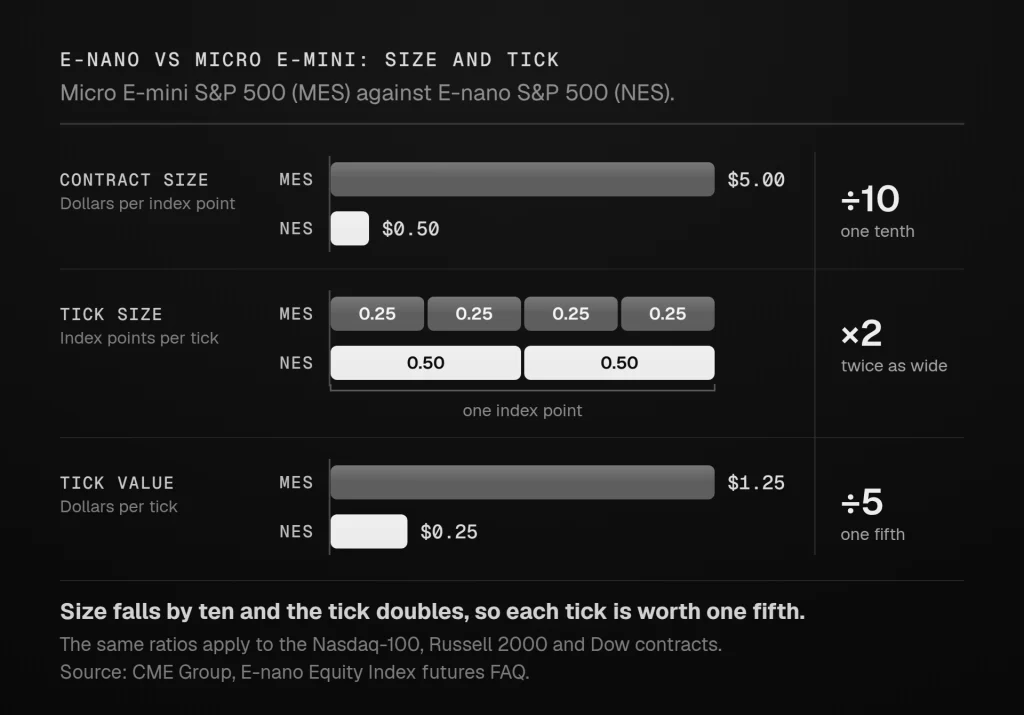
CME cut the multiplier by ten and doubled the tick size in index points. Together, those two changes divide the dollar value of a tick by five, not ten. The ratio is the same on all four contracts.
| Index | E-nano tick | Micro E-mini tick | E-mini tick | E-nano tick as a share of the Micro tick |
|---|---|---|---|---|
| S&P 500 | 0.50 points = $0.25 | 0.25 points = $1.25 | 0.25 points = $12.50 | one fifth |
| Nasdaq-100 | 0.50 points = $0.10 | 0.25 points = $0.50 | 0.25 points = $5.00 | one fifth |
| Russell 2000 | 0.20 points = $0.10 | 0.10 points = $0.50 | 0.10 points = $5.00 | one fifth |
| Dow Jones | 2.00 points = $0.10 | 1.00 point = $0.50 | 1.00 point = $5.00 | one fifth |
CME’s FAQ ties the design to settlement. E-nano futures settle each day to the nearest E-nano tick, which CME says “simplifies the process and prevents rounding complications related to the fractional multiplier”.
The missing factor of two shows up as price resolution. On NES, entries, stops and targets sit on half-point steps instead of quarter points. NDOW moves in two-point steps instead of one, N2K in 0.20-point steps instead of 0.10, and NNQ in half points instead of quarter points. If your method needs an S&P 500 stop at a price ending in .25 or .75, the E-nano cannot place it.
CME has paired a smaller contract with a coarser tick before. Our post on why CME futures contracts keep shrinking covers that history.
What the wider tick does to a stop
Measured in index points, dollar risk scales by exactly ten. Measured in ticks, it does not.
| Stop of 5 S&P 500 points | E-mini | Micro E-mini | E-nano |
|---|---|---|---|
| Number of ticks | 20 | 20 | 10 |
| Risk per contract | $250 | $25 | $2.50 |
| Stop of 10 ticks | Micro E-mini | E-nano |
|---|---|---|
| Distance in S&P 500 points | 2.5 | 5.0 |
| Risk per contract | $12.50 | $2.50 |
The second table is the one that catches people. A ten-tick stop on an E-nano is twice as far from your entry as a ten-tick stop on a Micro. Hold ten E-nanos to match one Micro’s exposure, keep the same ten-tick stop, and you are risking $25 instead of $12.50. Set the stop in ticks and it lands in the wrong place. Set it in index points and the numbers line up.
E-nano margin
CME has said how it sets E-nano margins. In an article published on 3 September 2026, it wrote that “E-nano margins will be set proportionally to the Micro E-mini (MES) schedule given the contract multiplier”. The multiplier is one tenth of the Micro’s, so the exchange margin on an E-nano is about one tenth of the Micro margin on the same index. The same article put the initial margin for NES at “approximately $230 to $250” per contract, at a time when the Micro’s was around $2,300 to $2,500.
Those dollar figures will not hold for long. CME adjusts margins with market volatility and with the level of the index, and its FAQ says plainly that margins “are subject to change”. The ratio is the part that lasts: take the current Micro E-mini margin, divide by ten, and you have a close estimate of the exchange margin on the E-nano. CME’s margin lookup, linked from its E-nano FAQ, gives the exact current figure.
Your broker’s margins are a separate matter. Brokers set their own day-trade margins, and these do not have to follow the exchange’s one-to-ten ratio. We checked AMP Futures’ margin table in October 2026:
- its maintenance margin on NES was one tenth of its MES figure, as CME’s schedule implies;
- its day-trade margin on NES was one fifth of its MES day-trade margin;
- NNQ against MNQ showed the same pattern.
So check your broker’s margin page for the E-nano symbol itself. Dividing a Micro figure by ten can give you the wrong answer.
Margin decides how many contracts a small account can hold, but it is not what makes E-nano cheap or expensive to trade. Fees are.
What E-nano futures cost to trade
Three charges apply to every contract you trade, on each side of the trade:
- Your broker’s commission.
- The exchange fee (CME’s, or CBOT’s for NDOW), plus clearing fees where your broker passes them on.
- The NFA assessment fee. This regulatory fee is the same on every futures contract, whatever its size, according to the NFA’s own guidance: $0.01 per side until 30 June 2027, and $0.02 per side from 1 July 2027.
NinjaTrader commission on E-nano futures
In October 2026, NinjaTrader’s pricing page listed a single “Micro & e-Nano” commission on each plan, charged per side:
- Free plan: $0.39;
- Monthly plan ($99 a month): $0.29;
- Lifetime plan ($1,499 one time): $0.09.
Exchange, clearing and NFA fees are charged on top. So an E-nano carries the same commission as a Micro, with one tenth of the exposure.
Here is what that commission alone amounts to, counted in ticks of each contract:
| NinjaTrader plan | Per side | Round turn | NES | MES | NNQ, N2K or NDOW | MNQ, M2K or MYM |
|---|---|---|---|---|---|---|
| Free | $0.39 | $0.78 | 3.1 ticks | 0.6 ticks | 7.8 ticks | 1.6 ticks |
| Monthly, $99 a month | $0.29 | $0.58 | 2.3 ticks | 0.5 ticks | 5.8 ticks | 1.2 ticks |
| Lifetime, $1,499 one time | $0.09 | $0.18 | 0.7 ticks | 0.1 ticks | 1.8 ticks | 0.4 ticks |
A round turn is one buy and one sell. The table shows commission only, at NinjaTrader’s October 2026 rates, before exchange, clearing and NFA fees.
In index points the gap is ten to one. On the free plan, an NES trade has to move 1.56 S&P 500 points before the commission is covered. An MES trade needs 0.156 points.
Exchange and NFA fees on top
Exchange fees are charged per contract, and the smaller contract does not get a fee one tenth the size:
- In October 2026, Interactive Brokers’ CME fee table listed the same non-member exchange fee for E-nano futures as for Micro E-minis.
- Topstep Brokerage’s fee table for the four contracts, published on 23 August 2026, did the same. It listed the E-nano fees as “the same as those charged on Micro E-mini contracts”.
Topstep’s table is a useful worked example, because it gives a complete per-side figure for all four contracts:
- $0.25 commission;
- $0.35 exchange fee;
- $0.01 NFA fee.
That is $0.61 per side, or $1.22 for a round turn.
| Contract | All-in round turn | In ticks | In index points |
|---|---|---|---|
| NES | $1.22 | 4.88 | 2.44 |
| NNQ | $1.22 | 12.20 | 6.10 |
| N2K | $1.22 | 12.20 | 2.44 |
| NDOW | $1.22 | 12.20 | 24.40 |
| MES, for comparison | $1.22 | 0.98 | 0.24 |
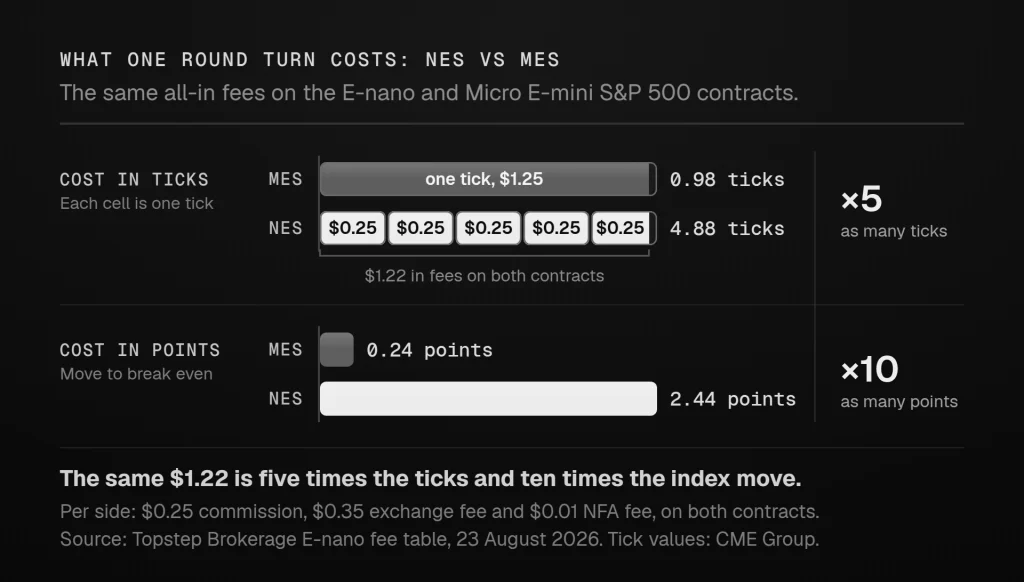
At those fees, an NES trade has to move ten times as far in S&P 500 points as an MES trade just to pay its costs.
Work out the cost for your own broker
The arithmetic is the same for any broker:
ticks needed to cover costs = all-in round-turn cost ÷ tick value
Ask your broker for the all-in round turn on the exact symbol you will trade, with commission and every fee included. Then divide by $0.25 for NES, or by $0.10 for NNQ, N2K and NDOW. To see the cost in index points, divide the round turn by the multiplier instead.
Why a lower commission cannot close the gap
For costs to match the Micro’s per dollar of exposure, an E-nano round turn would have to cost one tenth of a Micro round turn. The fees underneath the commission rule that out. The NFA fee is the same on every contract, and the exchange fee is not cut to a tenth for the E-nano. Even with a commission of zero, the exchange and NFA fees in the Topstep example above come to $0.72 per round turn, which is 2.9 ticks on NES.
At the same per-contract cost, a contract with one tenth of the exposure costs ten times as much per dollar of exposure. That is the price of finer sizing, and a lower commission alone cannot remove it.
What this means in practice
E-nano futures are a sizing tool, not a scalping tool. Suppose you aim for moves of 20 S&P 500 points or more. Then the 2.44-point all-in cost in the example above is about an eighth of the target, or less. If your target is two or three ticks (one to one and a half points), the costs are larger than the target, so the trade loses money even when the target is hit.
When E-nano futures make sense
Good fits:
- An account too small for one Micro’s risk. A 10-point S&P 500 stop costs $50 on one MES and $5 on one NES. If $50 is more than you want to risk on a trade, the E-nano lets you take it at a size you can afford.
- Scaling in and out. Ten E-nanos make up one Micro’s exposure, so you can build or reduce a position in tenths of a Micro instead of all at once.
- Hedging a small portfolio. At an S&P 500 level of 7,000, one NES covers $3,500 of exposure. Three NES, about $10,500, roughly match a $10,000 portfolio that tracks the index. A single MES, at $35,000, would hedge three and a half times the portfolio’s value.
- Taking a strategy live for the first time. Running a strategy on real fills at one tenth of the Micro size shows how it behaves in a live market. Keep in mind that E-nano costs and fills will not match what you would see on a Micro.
- Funded and evaluation accounts, where the firm allows them. Finer steps make it easier to stay inside a daily loss limit. Read the prop firm section below first.
Poor fits:
- Scalping small targets. The costs above make it hard to come out ahead.
- Large positions. Fifty E-nanos carry the exposure of five Micros, but you pay fees on ten times as many contracts.
- Strategies that need fine price placement. Quarter-point stops on the S&P 500, or the finer Micro ticks on the other three indices, are not available.
- Block trades or BTIC. Neither is available on E-nano futures.
E-nano and Spot-Quoted futures are different contracts
CME has two families of equity index futures that are smaller than the Micro E-mini, and their symbols are easy to mix up.
Spot-Quoted futures launched on 30 June 2025 on six markets: the S&P 500, Nasdaq-100, Russell 2000, Dow Jones Industrial Average, Bitcoin and Ether. CME has since added XRP and SOL. They trade at the spot price of the underlying index or cryptocurrency rather than at a futures price. CME then adds a financing adjustment when it clears and settles them. They also have an extended expiry, which CME describes as removing the need for monthly or quarterly rolls.
| E-nano | Spot-Quoted | |
|---|---|---|
| S&P 500 | NES, $0.50 × index | QSPX, $1 × index |
| Nasdaq-100 | NNQ, $0.20 × index | QNDX, $0.10 × index |
| Russell 2000 | N2K, $0.50 × index | QRTY, $1 × index |
| Dow Jones | NDOW, $0.05 × index | QDOW, $0.10 × index |
| Price you trade at | the futures price | the spot index level, with a financing adjustment added at clearing |
| Expiry | quarterly, with the nearest two months listed | extended expiry, with no monthly or quarterly rolls |
| Daily settlement | the E-mini settlement price, rounded to the E-nano tick | the cash index settlement, plus the financing adjustment |
The Spot-Quoted codes and sizes come from CME’s Spot-Quoted futures FAQ.
Which family is smaller depends on the index:
- on the S&P 500, Russell 2000 and Dow, E-nano is half the size of the Spot-Quoted contract;
- on the Nasdaq-100 it is the other way round: QNDX, at $0.10 times the index, is half the size of NNQ.
Search carefully. NES and QSPX are both small S&P 500 contracts, and NNQ and QNDX are both small Nasdaq-100 contracts. But they price, settle and expire differently. A strategy or risk tool pointed at the wrong one will not warn you.
Nano Bitcoin futures are a separate product
On NinjaTrader’s site, “nano” also appears in Nano Bitcoin futures. These are a Coinbase Derivatives contract sized at one hundredth of a bitcoin, which NinjaTrader announced in June 2022 it was among the first to offer, under the code BIT. They trade on a different exchange and have no connection with CME’s E-nano family.
Expiry and rolling
Only two E-nano months are listed at a time, so a position you want to keep for the long term has to be rolled: every quarter if you hold the nearest month, or at least every six months if you hold the second.
- Expiry day: trading in the expiring contract stops at 9:30 a.m. ET on the third Friday of March, June, September or December, or on the business day before if US stock markets are closed that Friday. Any position still open is settled in cash against that morning’s Special Opening Quotation.
- Rolling with a calendar spread: a calendar spread buys one month and sells the other in a single order, so you avoid the risk of one leg filling without the other. E-nano spreads trade in finer increments than the contracts themselves, as listed in the specs above.
- Rolling with two separate trades: closing the expiring month and opening the next one works too, but you cross the bid-ask spread in each month separately.
- Fees: either way, every contract you roll trades once in each month, so you pay commission and fees twice. Ask your broker whether calendar spread legs are charged at the outright rate.
- Charts: E-nano price history starts with the first session, which opened on the evening of Sunday 23 August 2026 for trade date 24 August, so continuous charts start there too. On NinjaTrader, the merge policy setting decides how charts join expired months to the current one.
E-nano futures on NinjaTrader: what to check
NinjaTrader was part of the launch. CME’s launch announcement quoted Martin Franchi, CEO of NinjaTrader Group. NinjaTrader also publishes an E-nano contract page, charges its Micro commission rate on the contracts, and appears in the broker list on CME’s E-nano page. Even so, check these points before the first trade.
The instrument and the month. Search for NES, NNQ, N2K or NDOW and choose the contract month you mean to trade. Only two months exist at any time.
Market data for both exchanges. NDOW is listed on CBOT and the other three on CME. If you trade NDOW, make sure your market data covers CBOT as well as CME.
The right family. Make sure you have NES rather than QSPX, and NNQ rather than QNDX. The two families behave differently, as the section above explains.
ATM strategy templates. ATM templates can set stops and targets in Ticks, Currency, Percent, Pips or Price. A template in ticks carries over its tick count, not its distance: an 8-tick stop is 2 points on MES and 4 points on NES. A template in currency carries over its dollar amount: a $10 stop is 2 points on one MES and 20 points on one NES. Build separate templates for E-nano, worked out in index points.
The simulator. Check that simulated E-nano instruments carry the real tick value: $0.25 on NES and $0.10 on the other three. Also apply a realistic commission in simulation. Results without costs flatter an E-nano strategy far more than a Micro one, because costs are a much larger share of each tick.
Margin on your own account. Check the day-trade and overnight margin your account shows for the E-nano symbol itself, rather than estimating it from a Micro figure.
Order quantity. If you switch a chart from MES to NES and keep the same quantity, you hold one tenth of the exposure. That may be exactly what you want. Make it a deliberate choice.
What changes for automated traders
A new contract size touches more of an automated setup than it first appears. Some of the failures are silent.
Read tick size and point value from the instrument. In NinjaScript, Instrument.MasterInstrument.TickSize and Instrument.MasterInstrument.PointValue return the correct values for whatever instrument the strategy runs on. Code with fixed values breaks in two directions:
- Micro values on an E-nano. Code that assumes $1.25 per tick thinks each E-nano is five times riskier than it is. If it sizes positions from a dollar risk budget, it buys one fifth of the position you intended, and it reports profit and loss five times too large.
- E-nano values on a Micro. This direction is dangerous. If it sizes from a dollar risk budget, code that assumes $0.25 per tick buys five times too many MES contracts. Moving up to Micros once a strategy works on E-nano is a natural step, so this is the mistake to guard against.
Hard-coded point values do more damage. The Micro point value ($5 on the S&P 500) is ten times the E-nano’s ($0.50), so code that uses it sizes positions and reports profit and loss off by a factor of ten, not five. A hard-coded Micro tick size causes a different failure: it produces order prices between E-nano ticks, and the exchange rejects those orders.
Convert tick-based stops and targets. As the stop tables above show, a ten-tick stop is twice as far away on an E-nano. At equal exposure, ten E-nanos against one Micro, it risks twice as many dollars. Work out stops and targets in index points, then convert them to ticks for each contract.
Rewrite contract-count limits. A limit of five contracts means half a Micro of exposure in E-nanos, but five Micros of exposure in MES. A risk rule written as a contract count means something different on each size. Express limits in dollars per index point instead: the multiplier times the number of contracts.
Remember where settlement comes from. E-nano daily settlement comes from E-mini trades, not from E-nano trades. If any reconciliation step assumes an instrument settles from its own trading, that step needs changing.
Model costs explicitly in backtests. On a Micro, a round turn costs about a tick or less, and many backtests ignore it. On an E-nano, the all-in round turn can be several ticks. Use the full figure for the exact symbol, not zero.
Treat short history with care. E-nano history begins with the first session, on the evening of Sunday 23 August 2026. Some traders backtest on MES history to get more data. If you do, round every entry, stop and target to the E-nano tick grid and apply E-nano costs. Even then, the fills assume Micro liquidity. Our guide to why a NinjaTrader strategy works in backtest but not live covers the wider gap between backtest and live results.
E-nano futures for prop firm traders
The appeal for funded and evaluation accounts is easy to see. These accounts run inside fixed daily loss limits and drawdowns, and contract size decides how finely you can scale inside them. A contract one tenth the size of a Micro lets you adjust risk in $0.50-per-point steps on the S&P 500 instead of $5-per-point steps.
Whether you can use them depends on the firm. Each firm writes its own rules, and rules written for Micros and E-minis do not always say how E-nanos count. Before you trade them in a funded or evaluation account, get answers to these questions from the firm’s rules or its support team:
- Are E-nano contracts allowed in evaluation accounts, funded accounts or both?
- How do they count against contract limits? Ten E-nanos to one Micro is one possibility, and counting each E-nano as a full contract is another.
- What fees does the account charge per E-nano contract, and are they deducted from the balance that your loss limits measure?
- Do any other rules treat a contract as a contract regardless of size?
The fee question matters more than it looks. Firms pay per-contract costs on the trades in their accounts, just as you do. If each E-nano counts as a full contract against your limit, or carries full Micro fees, much of the benefit of the smaller size disappears.
How to judge E-nano liquidity
New contracts often open with thinner order books than established ones. To support the launch, CME and CBOT filed a market maker programme for the four contracts with the CFTC in August 2026:
- Term: an initial term from the listing date to 31 March 2027, which the exchanges can change, extend or end.
- Participants: up to twelve firms.
- Obligations: quote continuous two-sided markets during set hours, within maximum spreads and minimum sizes, for a required share of the time.
A programme like this can help, but it does not tell you what the book looks like at the hours you trade. Check these yourself:
- daily volume and open interest, which CME publishes for each contract and most platforms display;
- the bid-ask spread in ticks at your own trading times, in the day session and overnight;
- the depth at the first few price levels on the order book.
Remember the tick when you read the spread. A one-tick spread on NES is 0.50 S&P 500 points wide, twice the width of a one-tick spread on MES. Crossing it costs twice as much per dollar of exposure, even when both books look equally tight.
Where hosting fits
A smaller contract does not change how quickly an order reaches the exchange. E-nano futures solve a sizing problem. If you trade a few contracts by hand, nothing about them calls for a server.
The reasons to host a platform are the same as for any CME future:
- a strategy that has to keep running while you are away from your computer;
- positions that run through the overnight session;
- a connection that should not drop in the middle of a trade.
Those apply equally to E-nanos, Micros and E-minis.
Location follows the exchange. Until CME moves its equity index markets to Google Cloud, E-nano orders are matched in Aurora, Illinois. CME’s notices say its markets will begin moving to a private Google Cloud region in the Chicago area in late 2027, with the migrations due to finish in 2028. Our guide to the CME Google Cloud migration sets out the timeline.
If you run NinjaTrader on a server for automated E-nano trading:
- a Chicago VPS keeps it close to CME and to the broker gateways that connect to it;
- our NinjaTrader VPS page covers the platform setup;
- our latency checker shows how your current connection performs before you decide.
How this guide was checked
Contract terms come from CME Group’s own documents:
- the E-nano FAQ;
- the launch announcement of 3 August 2026;
- the self-certification that CME and CBOT filed with the CFTC on 6 August 2026 (Submission No. 26-297). This filing is the source for:
- the Rule 855 offset ratios;
- the daily and final settlement increments;
- the calendar spread increments;
- the 9:30 a.m. ET end of trading.
The market maker programme comes from Submission No. 26-377, filed by CME and CBOT on 7 August 2026.
Margin. CME’s margin approach and its example figures come from its article “The Goldilocks of Equity Futures: Why Contract Size Matters in Today’s Markets” of 3 September 2026.
Spot-Quoted details come from CME’s Spot-Quoted FAQ, its Spot-Quoted product page and its clearing notice for the 30 June 2025 launch.
Broker figures come from each broker’s own pages, checked in October 2026:
- NinjaTrader’s pricing page and E-nano contract page;
- Topstep Brokerage’s E-nano fee table;
- Interactive Brokers’ CME fee table;
- AMP Futures’ margin table.
The NFA fee and its scheduled increase come from the NFA’s assessment fee FAQ.
Our own arithmetic. The tick comparisons, the cost-in-ticks tables, the stop examples and the hedging example are our own arithmetic from those published figures, checked across all four contracts. The S&P 500 level of 7,000 is hypothetical, and matches the level CME uses in its own comparison.
Our own experience covers the automation side. We host NinjaTrader and other platforms for traders who run automated strategies. The checks in the NinjaTrader and automation sections are the ones that matter when a contract’s size or tick value changes under a running strategy. We are not a broker, and this guide is not trading advice.
Frequently asked questions
E-nano futures are CME Group futures on the S&P 500, Nasdaq-100, Russell 2000 and Dow Jones Industrial Average, listed on 24 August 2026. Each contract is one tenth the size of the matching Micro E-mini and one hundredth the size of the E-mini. They are cash settled, trade from Sunday evening to Friday afternoon US Eastern time, and are often called nano futures.
NES for the S&P 500, NNQ for the Nasdaq-100, N2K for the Russell 2000 and NDOW for the Dow Jones Industrial Average. NES, NNQ and N2K are listed on CME, and NDOW is listed on CBOT.
$0.25 per tick on NES, and $0.10 per tick on NNQ, N2K and NDOW. That is one fifth of the Micro E-mini tick value, not one tenth, because CME made the E-nano tick twice as wide in index points as the Micro’s.
Ten E-nanos carry the same exposure as one Micro E-mini, and 100 carry the same exposure as one E-mini. Under Rule 855 (CME Rule 855, or CBOT Rule 855 for the Dow), your clearing broker can offset E-nano positions against opposite positions in the Micro or E-mini at those ratios, when they are held in the same account. The exposure matches, but the costs do not: you pay per-contract fees on all ten E-nanos.
CME sets E-nano margins in proportion to the Micro E-mini margin schedule, so the exchange margin is about one tenth of the Micro margin on the same index. In September 2026, CME put the initial margin for NES at approximately $230 to $250. Margins change with volatility and index levels. Brokers set their own day-trade margins, which do not always follow the one-tenth ratio, so check your broker’s figure for the E-nano symbol itself.
NinjaTrader charges its Micro commission on E-nano contracts. In October 2026 that was $0.39 per side on the free plan, $0.29 on the Monthly plan and $0.09 on the Lifetime plan. Exchange, clearing and NFA fees come on top. On the free plan, the commission alone on an NES round turn equals about 3.1 ticks, against about 0.6 ticks on an MES.
Fees are charged per contract and do not shrink with the contract. The NFA fee is the same on every futures contract, and the broker fee tables we checked in October 2026 listed the same exchange fee for E-nano futures as for Micro E-minis. Because an E-nano tick is worth one fifth of a Micro tick, the same fees add up to five times as many ticks.
Not for small targets. With commission and fees included, a round turn on NES cost about five ticks at the broker fee levels we checked. A two- or three-tick target loses money even when it is hit. E-nano futures suit trades that aim for larger moves, and traders who need smaller position steps.
Sunday 6:00 p.m. to Friday 5:00 p.m. ET, with a daily maintenance break from 5:00 to 6:00 p.m. ET. These are the same hours as the E-mini and Micro E-mini. E-nano futures do not trade on Saturdays.
On the third Friday of the contract month, in March, June, September and December, or on the business day before if US stock markets are closed that Friday. Trading in the expiring contract ends at 9:30 a.m. ET on that day. Open positions are settled in cash against the Special Opening Quotation of the index, the same price that settles the E-mini and Micro E-mini.
CME lists only the nearest two quarterly months from the March, June, September and December cycle. You can only trade the two nearest expiries, so a position you want to keep for longer has to be rolled at least every six months, and every quarter if you hold the nearest month.
No. NNQ is the E-nano Nasdaq-100 future, a quarterly contract at $0.20 times the index. QNDX is the Spot-Quoted Nasdaq-100 future. It trades at the spot index level, has an extended expiry with no quarterly roll, and is half the size of NNQ at $0.10 times the index.
It depends on the index. On the S&P 500, Russell 2000 and Dow, E-nano is half the size of the Spot-Quoted contract. For example, NES is $0.50 times the index and QSPX is $1. On the Nasdaq-100 the Spot-Quoted contract is smaller: QNDX is $0.10 times the index, against $0.20 for NNQ.
Yes. Under Rule 855 (CME Rule 855, or CBOT Rule 855 for the Dow), ten E-nano contracts offset one Micro E-mini and 100 offset one E-mini on the same index, when the positions are held in the same account. Offsets are requested through your clearing broker.
Yes. NinjaTrader lists E-nano futures in its commission schedule at the Micro rate, publishes an E-nano contract page, and appears in CME’s list of brokers for the contracts. Before trading, check that you have the right instrument and contract month, that your market data covers CBOT if you trade NDOW, and that any ATM templates built for Micros have been rebuilt for E-nano.
CME keeps a list of brokers on its E-nano product page. When we checked in October 2026, it included Robinhood, Interactive Brokers, NinjaTrader, Plus500, Webull and tastytrade. Topstep Brokerage also offers all four contracts on TopstepX. Before you open an account for E-nano trading, confirm the full cost on the exact symbol you will trade.
Each firm decides. Check with your firm whether E-nano contracts are allowed in evaluation and funded accounts, how they count against contract limits, and what fees the account charges per contract. Rules written for Micros and E-minis do not always say how E-nanos count, so ask the firm directly if its rules leave it open.
No. CME’s FAQ states that E-nano futures are not eligible for block trading or for Basis Trade at Index Close (BTIC).
No. CME states that E-nano volume does not count towards its volume-based fee discounts.
No. Nano Bitcoin futures are a Coinbase Derivatives contract worth one hundredth of a bitcoin. E-nano futures are CME equity index futures. The two share only the word “nano”.
Not because of the contract. E-nano futures change position size, not order speed, and a few contracts traded by hand need no server. A VPS helps for the same reasons as with any CME future. The usual case is an automated strategy that has to keep running while you are away, through a week that starts on Sunday evening and runs overnight.
Confirm the symbol and contract month, so that you trade NES rather than QSPX and NNQ rather than QNDX. Make sure your market data covers CME, plus CBOT if you trade NDOW. Ask your broker for the all-in round-turn cost and convert it into ticks, and check the broker’s margin on the E-nano symbol itself. Convert tick-based stops and ATM templates into index points, and replace any code that hard-codes tick size or point value.
Contract terms come from CME Group’s published documents and its filings with the CFTC. Broker commissions, fees and margins are examples from each broker’s published pages, checked in October 2026, and they change over time, so confirm current figures with your broker before trading. This is educational content, not trading or financial advice.