
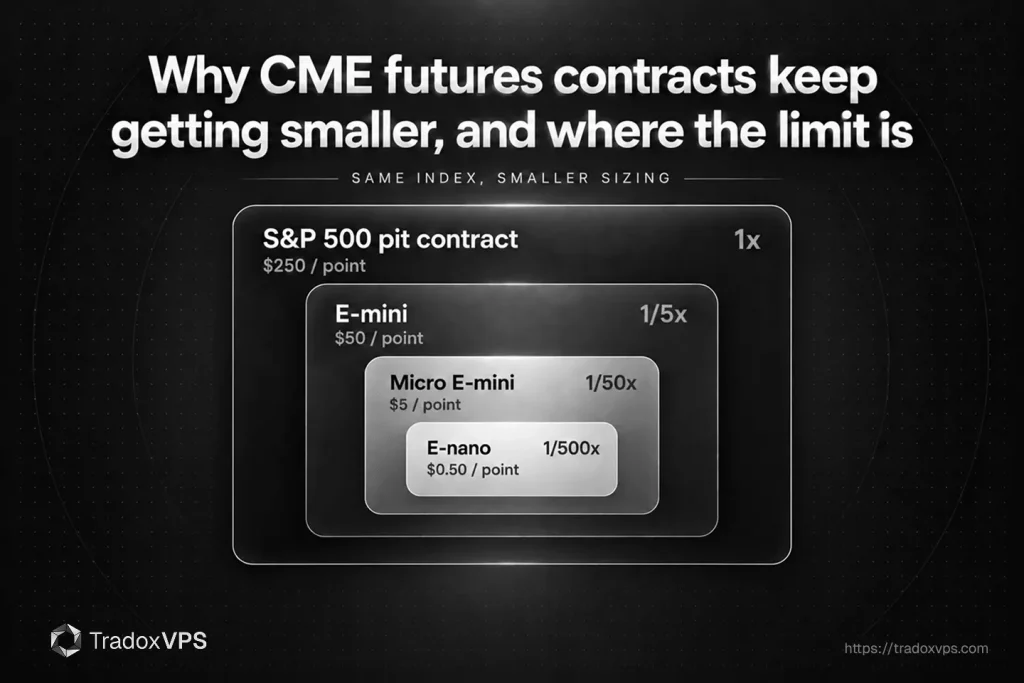
The short answer to why futures contracts keep shrinking is that the market keeps making them bigger. A futures contract is a fixed multiplier times a moving price. When the underlying rises, the exposure inside one contract rises with it, so a contract that was retail-sized at launch stops being retail-sized a few years later. CME does not shrink contracts because it has a new idea. It shrinks them because the old ones inflated.
That has a consequence nobody writes about. Contract shrinking is a treadmill rather than a destination. Today’s smallest contract is a temporary state, and the arithmetic that produced it will produce the next one.
The second answer is the more useful one. There is a floor, and it is set by fees rather than by demand. Exchange fees do fall as contracts get smaller, but they fall by less than the contract does. So the cost per unit of exposure rises at every step down the ladder, and at some point the fixed costs are worth more than a tick and the contract stops being tradeable no matter how many people want it.
This post is the layer underneath the product guides. If you want the specifications for one contract, CME publishes them and so do we. What follows is the mechanism, the arithmetic against published fee schedules, and an honest account of where it stops.
Are smaller futures contracts actually cheaper? The short answer
If you only want the practical part, it is four points. The rest of this page is why they are true, and why CME keeps shrinking contracts anyway.
A smaller contract is almost never cheaper per unit of exposure. Ten E-nanos and one Micro E-mini carry the same S&P 500 exposure, but you pay the exchange fee, the regulatory fee and your broker commission ten times instead of once. Equivalent on exposure, not on cost.
It is a sizing tool, not a savings tool. The reason to trade the smaller contract is that one Micro is too large a position for your account, so the nano lets you take a trade you could not otherwise size, with a stop in dollars you can afford. That is a real benefit. It is just not a cost benefit.
Compare the fee against the tick, not against the dollar price. On the standard Gold contract the exchange fee is about a sixth of one tick. On the 1-Ounce Gold contract it is five times one tick, so the price has to move five ticks in your favour to cover one side of the fee. Same metal, same exchange, opposite economics.
If you automate, re-model the fee per contract before porting a strategy down. An edge that clears its costs on a Micro may not clear them on a nano, because the fee per unit of exposure is higher and the tick is coarser.
Why futures contracts keep shrinking: the treadmill, with real numbers
The equity index family has the cleanest history, so start there.
The original S&P 500 futures contract launched in the Chicago pit in 1982, valued at $500 times the index. By 1997 the index had risen far enough that a single contract controlled more than half a million dollars, which CME itself described as too large for many smaller traders.
So CME shrank the exposure twice in the same autumn. On 9 September 1997 it listed the E-mini S&P 500 at a $50 multiplier, one tenth of the pit contract as it then stood. On 3 November it split the pit contract itself two for one, halving the multiplier to $250, which is what left the E-mini at the one fifth ratio people quote today.
That second move deserves a pause, because CME did something in 1997 that it repeated in 2026. When it halved the pit contract’s multiplier it also doubled the minimum tick, from 0.05 to 0.10 index points. The contract got smaller and its price resolution got coarser at the same moment. Twenty-nine years later CME did precisely that to the E-nano, cutting the multiplier by ten while doubling the tick increment. Widening the tick as the contract shrinks is not a new decision. It is how CME has handled this since the first time it faced the problem.
Then the E-mini inflated in turn. CME’s own Micro E-mini FAQ states the notional value of the E-mini S&P 500 rose from roughly $47,000 at launch to roughly $145,000 by April 2019. Nothing about the contract changed. The index rose, and the contract inflated with it.
So in May 2019 CME did it again, launching the Micro E-mini suite at one tenth of the E-mini, a $5 multiplier on the S&P 500. The reason given in the launch announcement was accessibility for active traders.
Now watch the Micro inflate. At an S&P 500 level of 3,000, a $5 multiplier is $15,000 of exposure. At a level of 7,000 the same unchanged contract carries $35,000. That is our own arithmetic on round hypothetical levels rather than a published figure, but the mechanism is exact: the contract did not change, and the position it represents more than doubled.
On 24 August 2026 CME stepped onto the next stair with the E-nano suite at one tenth of the Micro, a $0.50 multiplier on the S&P 500, which is one hundredth of the E-mini and one five-hundredth of the original pit contract. The reason CME gave was, almost word for word, the reason it gave in 2019. Tim McCourt, Global Head of Equities, FX and Alternative Products, said that as equity markets reach record highs the barrier to entry has risen for retail investors, creating a need for smaller contracts.
Read those launches together and they are not separate product decisions. They are one decision, made repeatedly, forced each time by the same arithmetic. CME has come close to saying so itself: its Spot-Quoted Futures FAQ explains that since the Micro E-mini launched in 2019 it has watched notional values increase, which is what generated demand for something smaller again.
The same shrinking story in gold, and an honest exception in oil
Gold shows the treadmill more starkly than equities, because gold ran harder.
Micro Gold represents 10 troy ounces, one tenth of the 100-ounce standard contract. At $1,900 an ounce a Micro Gold carries $19,000. At $4,000 an ounce the same contract carries $40,000. Round numbers and our own arithmetic, but the direction is not in doubt: gold roughly doubled across the period and the Micro doubled with it.
So CME shrank gold too, launching the 1-Ounce Gold contract in January 2025, cash settled on COMEX at one hundredth of the standard. Jin Hennig, Global Head of Metals, tied it explicitly to surging retail interest. Silver followed in February 2026 with a 100-Ounce contract, one fiftieth of the 5,000-ounce standard, again citing retail demand.
Crude oil is the exception, and it is worth stating because a thesis you cannot break is not a thesis. Oil did not compound the way equities and gold did. It spent the period broadly range-bound, so the notional inside a Micro WTI contract did not balloon. Yet CME still announced a 10-Barrel WTI contract at one hundredth of the standard. The driver there was not inflation. It was continuous trading and parity with the sizes retail now expects. CME’s June 2026 announcement frames the new crude and gold contracts around round-the-clock access, and reports Micro WTI average daily volume reaching 272,000 contracts in May 2026, up 317 percent year on year.
So the treadmill is real, and strongest where the underlying rose most. Where price stayed flat, competition does the shrinking instead.
One correction on that contract, because it matters and most coverage has it wrong. The 10-Barrel WTI contract has not listed. It was scheduled for 30 August 2026 and did not go ahead, and CME’s product page still describes it as coming soon and pending regulatory review. We cover the delay and the still-unpublished tick in our post on 10-Barrel WTI futures.
Every generation of CME contract shrinking
The full lineage, sized and dated. Ratios are to the immediate parent unless noted.
| Contract | Listed | Size against parent |
|---|---|---|
| S&P 500 pit contract | 1982 | $500 multiplier, later $250 |
| E-mini S&P 500 | September 1997 | $50, one tenth of the pit contract at launch, one fifth after the November 1997 split |
| E-micro FX suite | 2009 | one tenth of standard FX |
| E-micro Gold | 2010 | 10 oz, one tenth of Gold |
| Micro E-mini equity index | May 2019 | one tenth of the E-mini |
| Micro Bitcoin | May 2021 | one tenth of one bitcoin |
| Micro WTI Crude Oil | July 2021 | 100 barrels, one tenth of WTI |
| Micro Treasury Yield | August 2021 | quoted in yield |
| Micro Ether | December 2021 | one tenth of one ether |
| Micro Copper | May 2022 | one tenth of standard |
| Micro MidCap 400 and SmallCap 600 | March 2023 | one tenth of the E-mini |
| Micro Bitcoin Euro and Micro Ether Euro | March 2024 | one tenth of underlying |
| 1-Ounce Gold | January 2025 | 1 oz, one hundredth of Gold |
| Spot-Quoted Futures | June 2025 | one fifth to one twentieth of a Micro |
| 100-Ounce Silver | February 2026 | 100 oz, one fiftieth of Silver |
| E-nano equity index | August 2026 | one tenth of the Micro, one hundredth of the E-mini |
| 10-Barrel WTI | announced 2026, not listed | 10 barrels, one hundredth of WTI |
Two structural notes. The Spot-Quoted family is a slightly different animal, quoted at the cash index level with a single long-dated expiry rather than quarterly rolls. And the crypto micros are sized against the coin rather than against a parent futures contract.
The demand is real, and most of these contracts worked
Before arguing about the floor, be fair to the demand side, because it is not marketing.
The Micro E-minis were, by CME’s own account, the most successful new product launch in its history, with more than 310,000 contracts trading on day one in May 2019. By the E-nano announcement CME reported roughly 4.5 billion Micro E-mini contracts traded since launch. The metals micros tell the same story, with CME reporting record average daily volumes in Micro Gold and Micro Silver across 2024 and 2025, and the 1-Ounce Gold contract trading over six million contracts in its first year. Micro WTI became CME’s most successful commodities launch.
So demand is not in question. The question the product guides skip is whether the next contract down is actually cheaper to trade. That is a fee question, and it has a clear answer.
The fee arithmetic that sets the floor
Futures fees are charged per contract, per side. Three matter to a retail trader: the exchange fee CME charges, the NFA regulatory fee, and the broker’s commission. Only the first varies by product, so it decides whether shrinking helps.
The critical question is whether CME scales its exchange fee down in proportion to the contract. It does not. It scales the fee down, but by less than the contract shrinks.
Non-member Globex exchange fees per side. The two equity figures come from CME’s own fee schedule dated 29 June 2026. The metals and energy figures match across multiple broker fee tables and CME’s own fee-change notices, but CME now publishes its NYMEX and COMEX schedule as a spreadsheet rather than a readable page, so treat those as consistent with CME rather than quoted from it.
- E-mini S&P 500: $1.38. Micro E-mini S&P 500: $0.35.
- Gold: $1.65. Micro Gold: $0.60. 1-Ounce Gold: $0.50.
- Silver: $1.65. Micro Silver: $1.00. 100-Ounce Silver: $0.50.
- WTI Crude Oil: $1.50. Micro WTI: $0.50. 10-Barrel WTI: not published.
Now do the arithmetic the guides skip. Gold runs 100 ounces, 10 ounces, one ounce, against fees of $1.65, $0.60 and $0.50. Expressed per ounce of exposure that is 1.65 cents, 6 cents and 50 cents (our own arithmetic). The standard contract costs under two cents an ounce to trade. The 1-Ounce contract costs fifty cents an ounce. Roughly thirty times the cost per unit of exposure, for the same metal, at the same price, on the same exchange.
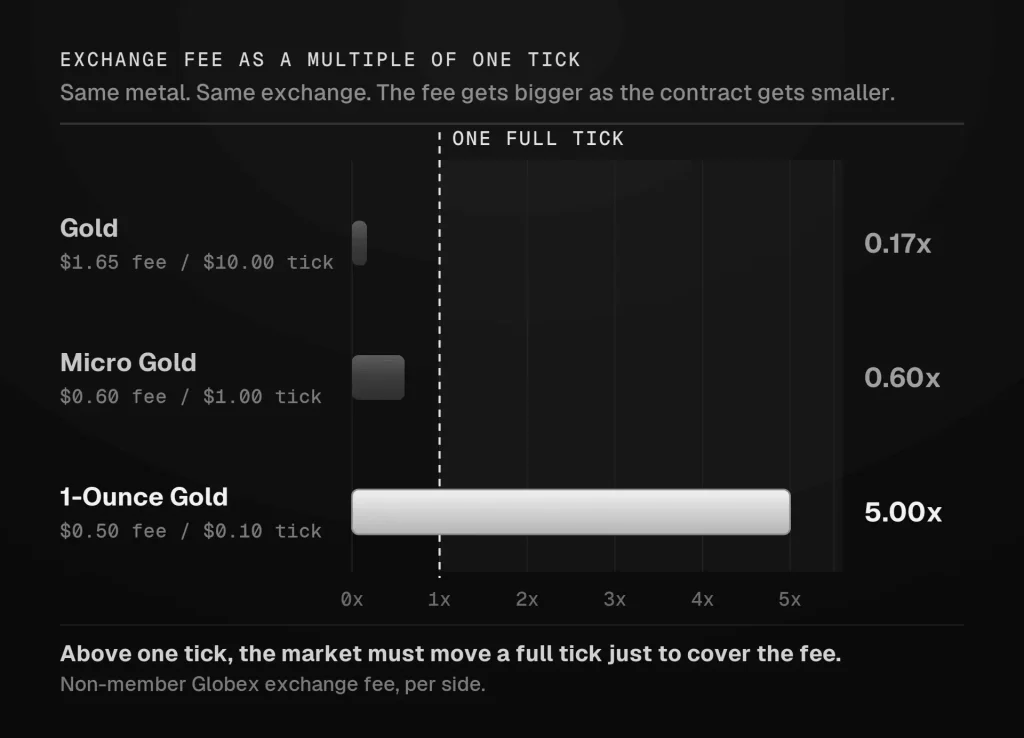
The clearest way to see it is against the tick, because the tick is what you have to earn.
| Contract | Size | Tick value | Exchange fee | Fee as a multiple of one tick |
|---|---|---|---|---|
| E-mini S&P 500 | $50 multiplier | $12.50 | $1.38 | 0.11x |
| Micro E-mini S&P 500 | $5 multiplier | $1.25 | $0.35 | 0.28x |
| E-nano S&P 500 | $0.50 multiplier | $0.25 | not published | see below |
| Gold | 100 oz | $10.00 | $1.65 | 0.17x |
| Micro Gold | 10 oz | $1.00 | $0.60 | 0.60x |
| 1-Ounce Gold | 1 oz | $0.10 | $0.50 | 5.0x |
Read the last column down. On the standard Gold contract the exchange fee is about one sixth of a tick. On the 1-Ounce contract it is five times a tick, meaning the price has to move five ticks in your favour to cover one side of the exchange fee alone, before commission and the regulatory fee. Same metal. Same exchange. Opposite economics.
The regulatory fee makes it worse, because it does not scale at all. The NFA assessment fee is flat per side, currently one cent and scheduled to rise to two cents in July 2027, and the NFA states plainly that it is the same for every futures contract regardless of size. On a standard Gold contract a penny is a rounding error. On a 1-Ounce Gold contract the same penny is a meaningful share of the total cost. Every fixed per-contract cost becomes a larger fraction of the trade each time the contract shrinks.
The fees on small contracts have been going up
There is a second movement inside this that almost nobody tracks, and it runs against the retail story.
CME has raised the exchange fee on its small contracts more than once. Micro Gold went from $0.30 to $0.50 in February 2021, and from $0.50 to $0.60 in February 2025. The Micro E-mini equity contracts went from $0.20 to $0.25 in February 2021 and stand at $0.35 today, which is three quarters higher than where they started. Micro Silver was set at $1.00 in 2021 and has stayed there.
So the contract stays exactly the same size while the fee charged on it rises. That is the treadmill running in the opposite direction, and it compounds everything above. A small contract already carries a worse fee-to-tick ratio than its parent on day one. That ratio has then been getting worse over time rather than better, without the contract changing at all.
It also tells you something about how CME views these products. If small contracts were purely a growth play, you would expect the fee to fall as volume built. It has not.
The E-nano fee is the whole argument in miniature
The E-nano is where the floor becomes visible, because its exchange fee decides which way CME jumped.
CME has now answered half the question, and the half it answered is not encouraging.
Its E-nano FAQ states that the contracts sit inside the Equity Index futures suite according to its fee schedule, and CME publishes no separate per-contract figure for them anywhere. So there is no smaller fee rung sitting under the smaller contract. The same FAQ adds something sharper: E-nano volume does not count toward the volume-based fee discounts available to members. The contract is excluded from the mechanism that would otherwise reduce its cost as you trade more of it.
What CME has not said is which existing rate applies. If the E-nano is charged like the Micro at $0.35, then a contract one tenth the size carries the same exchange fee as its parent, and at a tick worth $0.25 that is 1.4 times a tick, against 0.28 times on the Micro. Five times worse relative to what you have to earn (our own arithmetic). Given that CME created no separate rung and excluded the volume from discounts, the generous reading is difficult to sustain.
The tick design compounds it, and that part is deliberate. CME set the E-nano tick at double the index-point increment of the Micro, so the multiplier fell by ten while the dollar value of a tick fell by only five. Your position got ten times smaller and your price resolution got twice as coarse at the same moment. We work through what that does to a trader in our post on E-nano futures.
There are sound reasons an exchange widens the relative tick on a small contract. Fewer price levels means less quote churn and less message traffic, and it protects market maker economics on a contract whose tick is already near the smallest amount worth quoting. The effect on the trader is still that the smallest contract carries the widest relative spread and the highest fee against its own tick.
Where shrinking has already failed
The floor is not theoretical. CME has pulled small contracts before, and the reason was always volume.
The clearest recent case is FX. CME delisted its Micro USD/JPY, Micro USD/CAD and Micro USD/CHF futures with a final listed contract month of March 2024. These were micro-sized products aimed squarely at retail, and they did not draw enough interest to survive. The nuance matters: several other E-micro FX pairs kept trading. The exchange did not abandon small FX, it abandoned the specific small contracts that failed, which is exactly what a floor looks like in practice. Earlier, the E-mini Nifty lineage was discontinued for lack of open interest.
The lesson is that smallness alone does not create a market. A contract has to be small enough to be reachable and large enough that the fixed per-contract costs do not swamp the tick. Below that line, retail demand cannot rescue it, because the demand cannot overcome the per-contract economics.
The competition driving smaller futures contracts
Index inflation explains why CME must shrink existing contracts. It does not explain why it shrank metals, crude and equities within eighteen months while also adding continuous trading. For that, look at who is competing for the retail trader.
The most visible fight is with prediction markets. At the CFTC’s Innovation Advisory Committee meeting in August 2026, CME chief executive Terry Duffy and Kalshi’s leadership clashed openly, with Duffy reported as saying his firm is not a bunch of carnival barkers. The commercial point underneath the theatre is simple: Kalshi and Polymarket let a retail user take a sub-dollar position on the same macro events CME sells futures on. When the smallest futures position is thousands of dollars of notional and a prediction market offers the same view for a few dollars, the pressure to get smaller is direct.
The second front is crypto perpetual futures, which offer very small continuously rolling positions. This became a legal dispute rather than just a commercial one. The CFTC approved a Bitcoin perpetual futures contract in May 2026, CME sued the CFTC in June arguing perpetuals are legally swaps rather than futures, and in early September the CFTC moved to dismiss, noting that CME could list such products itself but has said its customers have not asked for them.
The third front is the brokers. The retail platforms CME depends on for distribution have themselves moved into futures, and their executives now appear quoted directly in CME’s small-contract launches. When zero-commission equity brokers add futures, CME’s audience grows, but so does the expectation that a futures position can be as small and as cheap as a few shares of an ETF.
The cost that does not shrink at all
There is one more cost that never scales down, and it points at where CME eventually stops: messages.
Ten small contracts carry the same exposure as one large one, but they are not one order. Sizing the same risk in E-nanos rather than E-minis means more orders, more modifications and more cancellations to reach the same position, and every one is a message the matching engine processes. CME manages this through its messaging efficiency programme, which measures each firm’s ratio of messages to traded volume against a per-product benchmark and applies a surcharge when it is breached.
That is a surcharge regime rather than a per-contract messaging fee, and CME did not introduce a new messaging charge for the 2026 launches. But the direction is clear. Smaller contracts multiply messages without multiplying cleared value, and the exchange’s own economics do not improve as the contract shrinks. The coarser tick on the E-nano is one lever CME pulled to hold that traffic down. It is unlikely to be the last.
How to run the numbers on a smaller contract
The four points above are the conclusions. Here is how to reach them yourself for any contract, including ones that do not exist yet.
The test is the round turn against the tick. Add the exchange fee, the regulatory fee and your broker’s commission, double it for a round turn, and divide by the tick value. That gives you how many ticks the market has to move before you are even. Below about half a tick, the contract supports active trading. Above one tick, it does not, whatever the marketing says. On the 1-Ounce Gold contract the exchange fee alone is five times a tick before commission, which is why active scalping there is close to hopeless while the same strategy on the standard contract is viable.
Watch for the tick widening as well as the fee. The fee is only half the cost. When CME shrinks a contract it has repeatedly widened the tick at the same time, which widens your effective spread. The E-nano’s multiplier fell by ten while its tick value fell by only five, so the contract is proportionally twice as coarse as its parent. A wider tick costs you on every entry and exit whether or not you ever look at the fee schedule.
For automation, model the three costs separately. The exchange fee varies by product, the regulatory fee is flat per contract, and the commission is your broker’s. A backtest that scales a Micro strategy down by dividing position size, without re-modelling all three plus the wider tick, will overstate the edge. The failure is quiet: the strategy still runs, the numbers still look plausible, and the edge is gone.
And size the message load, not just the position. Holding the same exposure in ten small contracts instead of one large one means roughly ten times the orders, modifications and cancellations. That is not a cost in the fee schedule, but it is a cost in reconciliation, in fill handling, and in what happens when a connection drops mid-sequence.
There is one case where the smaller contract wins outright, and it is worth stating clearly because the rest of this page reads as a warning. If the alternative is not trading at all, because one Micro is more risk than your account can carry, then the fee arithmetic is irrelevant. A trade you can size correctly at a poor fee ratio beats a trade you cannot take. That is the contract doing exactly the job CME built it for.
Where the shrinking ends
The mechanism predicts the direction, so it is worth separating what is announced from what merely follows.
Announced: the 10-Barrel WTI contract, which has not listed and whose tick CME has still not published. That missing tick is worth watching, because on a contract that small the tick is what decides whether it is tradeable at all.
Implied but not announced: if the index keeps rising, the E-nano will inflate the way the Micro did, and the same arithmetic will point at something smaller. That is a prediction of the treadmill, not a product roadmap, and should be read as one.
The more interesting question is not whether CME can go smaller but whether it should, because the E-nano already sits close to the floor the fees describe. On the current schedule, a contract much smaller than an E-nano would carry an exchange fee worth more than its own tick, which is the definition of uneconomic for active trading. CME can only go further if it also cuts per-contract fees, and cutting fees on a contract that generates more messages per cleared dollar runs against its own infrastructure economics. That tension, rather than demand, is what sets the limit.
Do smaller contracts change your infrastructure needs?
One narrow point, and only one, because most of this changes nothing about hosting.
A smaller contract is a position-sizing development, not an execution-speed one. Shrinking a contract does not make a fill arrive sooner. If you are placing a few E-nanos or a couple of 1-Ounce Gold contracts by hand, none of this is a reason to think about a server, and anyone telling you a smaller contract is a reason to buy latency is selling something.
The one real connection is message count. If you run automation and you move from one large contract to ten small ones to hold the same exposure, you have multiplied your order count, modifications and cancellations by roughly ten. That is a connection-stability and reconciliation concern rather than a speed one: more messages to send reliably, more fills to reconcile, and more exposure to a dropped connection at the wrong moment.
If that describes your setup, our NinjaTrader VPS page covers the platform side and our Chicago location is the relevant one for CME products. Measure your own path rather than taking anyone’s number, ours included: the latency checker gives a zero-install read and our benchmarks page publishes the method. If you are comparing providers, our futures VPS comparison ranks the field and discloses that we are one of the entries in it.
For everyone trading these contracts by hand, the honest answer is that this is a sizing tool and your existing setup is fine.
How we checked this
Contract sizes, launch dates and the reasons CME gave come from CME Group’s own press releases and FAQs, including the Micro E-mini FAQ for the E-mini notional inflation figures, the 2019 Micro E-mini launch announcements, the 2025 and 2026 metals releases, the June 2026 crude and gold announcement, the E-nano FAQ for the multiplier and tick design, and the Spot-Quoted Futures FAQ.
The two equity index exchange fees are non-member Globex rates taken from CME’s own fee schedule dated 29 June 2026. The metals and energy rates are consistent across multiple broker fee tables and CME’s own fee-change notices, but CME publishes its NYMEX and COMEX schedule as a spreadsheet rather than a readable page, so we describe them as consistent with CME rather than quoted from it. The fee history for Micro Gold and the Micro E-minis comes from CME’s dated fee-change notices. The regulatory fee, its scheduled increase and its size-independence come from the NFA’s own assessment fee guidance, which states directly that the fee is the same for every futures contract regardless of size. The E-nano fee position and the exclusion of E-nano volume from fee discounts are quoted from CME’s E-nano FAQ. The Micro FX delisting is documented in CME’s own Special Executive Report.
Everything expressed as a ratio, a percentage or a per-ounce figure is our own arithmetic on top of those published fees and specifications, and is labelled that way in the text. Notional figures use round hypothetical price levels rather than live prices, deliberately, so the arithmetic stays true as markets move. Where a real price is needed, use the current one and redo the sum.
What we could not confirm, and did not estimate: which existing rate CME applies to the E-nano, since it publishes no separate figure. The 10-Barrel WTI tick and fee were unpublished at the time of writing, the contract having not listed. The 100-Ounce Silver tick value is reported inconsistently across sources including CME’s own web copy, so no single figure is stated here.
Frequently asked questions
Because the underlying markets keep rising, which inflates the dollar value inside a fixed-multiplier contract. A contract that was retail-sized at launch becomes a much larger position over time purely because the index or commodity rose. CME shrinks the contract to bring the notional back down, which is why the Micro E-mini of 2019 was followed by the E-nano of 2026.
In equity index, the E-nano at a $0.50 multiplier on the S&P 500, one tenth of the Micro E-mini and one hundredth of the E-mini. In metals, the 1-Ounce Gold contract represents a single ounce, one hundredth of the standard Gold contract. CME’s Spot-Quoted futures go smaller still against their Micro counterparts.
Not per unit of exposure. Micros cost fewer dollars per contract, but the exchange fee does not fall in proportion to the size, so the cost per unit of exposure is higher on the smaller contract. Ten micros carry the same exposure as one mini and cost roughly ten times the fees.
A Micro E-mini is one tenth the size of the E-mini on the same index. The E-mini S&P 500 has a $50 multiplier and the Micro has a $5 multiplier. They track the same index and settle to the same prices. Only the size, the margin and the per-contract cost differ.
Non-member rates per side are $1.38 on the E-mini S&P 500 and $0.35 on the Micro E-mini, from CME’s own equity fee schedule. In metals the rates run about $1.65 on Gold, $0.60 on Micro Gold and $0.50 on 1-Ounce Gold, and in energy about $1.50 on WTI and $0.50 on Micro WTI. Members pay less, and a flat regulatory fee applies on top of all of them.
No. It is a flat rate per side, currently one cent and scheduled to rise to two cents in July 2027, and it is the same for every futures contract regardless of size. Because it is fixed, it becomes a larger share of the cost as the contract shrinks.
Yes. It delisted three Micro FX pairs with a final contract month of March 2024, and earlier discontinued the E-mini Nifty lineage for lack of open interest. Low volume was the driver each time, which is the evidence that smallness alone does not sustain a market.
On exposure, yes. Ten E-nanos carry the same directional exposure as one Micro E-mini on the same index. On cost, no. You pay the exchange fee, the regulatory fee and your commission once on the Micro and ten times across the nanos, so the nano route is more expensive for an identical position.
It has not announced one. The mechanism implies it could if markets keep rising, but the fee schedule sets a practical floor. A contract much smaller than an E-nano would carry an exchange fee worth more than its own tick, which is uneconomic for active trading unless CME also cuts per-contract fees.
Not for most traders. A smaller contract changes position sizing, not execution speed, so trading a few by hand gains nothing from hosting. The only real infrastructure angle is that automation trading ten small contracts instead of one large one sends far more orders, which is a connection-stability and reconciliation concern rather than a speed one.
Contract specifications, launch dates and the reasons given for each launch come from CME Group’s own press releases, product pages and FAQs. Equity index exchange fees are non-member rates from CME’s own fee schedule dated 29 June 2026; metals and energy rates are consistent across broker fee tables and CME fee-change notices, since CME publishes that schedule as a spreadsheet. The regulatory fee comes from the NFA’s own guidance. Fee schedules change, and CME has further changes scheduled, so confirm current rates before relying on them. Every ratio, percentage and per-unit figure on this page is our own arithmetic on those published inputs, and notional values use round hypothetical price levels so the arithmetic remains valid as markets move. The E-nano per-contract exchange fee, the 10-Barrel WTI tick and fee, and the 100-Ounce Silver tick value were unpublished or inconsistently reported at the time of writing and are described as such rather than estimated. This is infrastructure and educational content, not trading or financial advice.