
Current status
Last checked: 11 September 2026. TCL has not listed.
CME’s product page describes the contract as coming soon, carries a “pending regulatory review” footnote, and refers to TCL in future tense. The contract was scheduled to list on 30 August 2026, with continuous weekend trading due to begin on 4 September. Neither happened, and CME has not published a revised date.
Still unpublished: the tick increment and tick value, the initial and maintenance margin, the listed contract months, the last trading day, and price limits. There is no TCL contract-specification page.
Some coverage states the contract launched on 30 August. CME’s own materials do not support that. If you are searching your platform for the symbol, that is why it is not there.
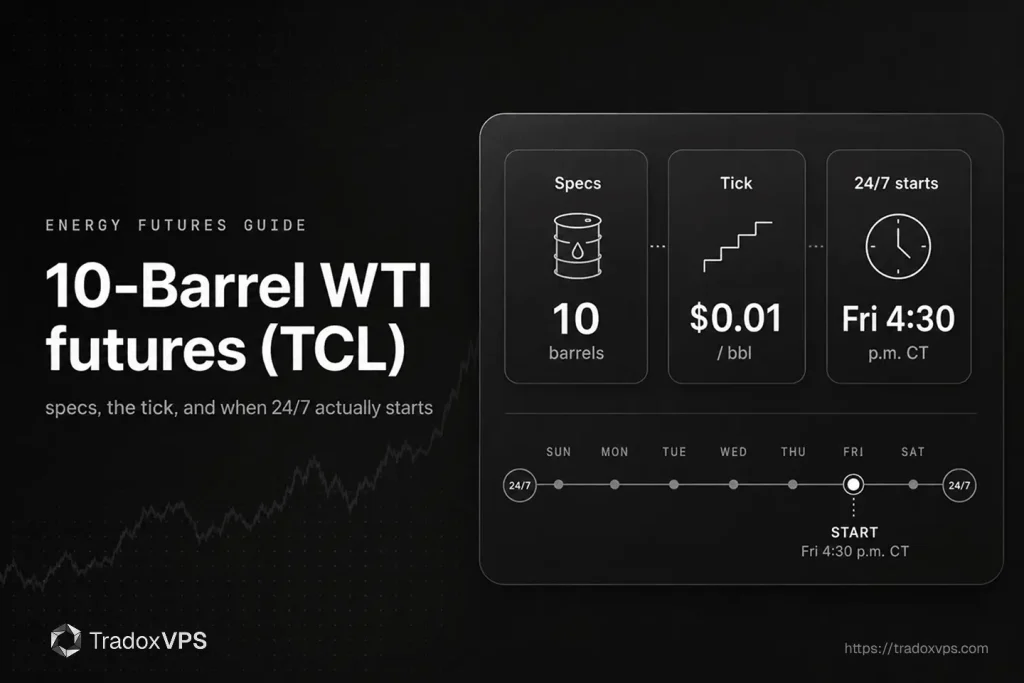
CME Group has announced 10-Barrel WTI Crude Oil futures for NYMEX under the product code TCL. At 10 barrels it would be the smallest crude oil futures contract CME has listed, one tenth the size of Micro WTI and one hundredth the size of the benchmark contract. It is designed to be the first CME energy contract to trade continuously, weekends included.
Whether you can trade it yet is a separate question, answered in the block above. What follows is everything that does not depend on the answer: what CME has actually published, the one number it has not, what the 24/7 schedule does to an automated system, and why a smaller contract is not a cheaper one.
What CME has published about 10-Barrel WTI futures
The contract is 10 barrels, financially settled, listed on NYMEX, and quoted at one hundredth of the benchmark WTI contract and one tenth of Micro WTI. CME describes it as a cash-settled lookalike to Micro Crude Oil futures.
The Globex Notice assigns it the product code TCL, security group CS, a Standard Calendar spread type, and market data on MDP 3.0 channel 325, market segment 74. At listing it is to be Globex only, with no ClearPort submission.
None of this is in question. What is missing is the tick.
The TCL tick value, and why it decides everything
On a contract this small, the tick is the whole cost story, so its absence matters more than it might sound.
The WTI complex has held the per-barrel increment constant, which makes the tick value scale cleanly with size:
| Contract | Size | Minimum tick | Tick value |
|---|---|---|---|
| WTI (CL) | 1,000 barrels | $0.01 per barrel | $10.00 |
| Micro WTI (MCL) | 100 barrels | $0.01 per barrel | $1.00 |
| E-mini WTI (QM) | 500 barrels | $0.025 per barrel | $12.50 |
| 10-Barrel WTI (TCL) | 10 barrels | not published | not published |
If TCL keeps the one-cent-per-barrel increment used by CL and MCL, one tick on a 10-barrel contract would be worth ten cents. That is our own arithmetic from the published pattern, not a CME figure. It is the only assumption on this page.
Two things support the inference without confirming it. The Globex Notice lists TCL’s calendar spread as Standard Calendar, which is not one of the reduced-tick spread types CME uses where a different increment applies. And every other WTI contract except the E-mini sits at one cent. Neither is proof.
Why a smaller contract is not a cheaper one
This is the part that survives whatever the tick turns out to be, and it is the part most coverage skips.
Exchange, clearing and regulatory fees are charged per contract, and they do not fall in proportion to contract size. They fall by less. So the cost per barrel of exposure rises every time the contract gets smaller.
Gold shows the pattern cleanly, because all three sizes are published. The standard 100-ounce contract carries an exchange fee of about 1.65 cents per ounce. The 10-ounce Micro is about 6 cents. The 1-ounce contract is 50 cents. Roughly thirty times the cost per unit of exposure for the same metal on the same exchange (our arithmetic from published non-member fees).
Crude will behave the same way. Micro WTI carries a non-member exchange fee of about $0.50 per side against a $1.00 tick, so the fee is half a tick. If TCL were charged at a similar rate against a ten-cent tick, the fee would be several times a tick, meaning the market has to move several ticks in your favour before you are even.
The regulatory fee makes it worse because it does not scale at all. The NFA assessment fee is flat per side regardless of contract size. On a 1,000-barrel contract that is a rounding error. On a 10-barrel contract it is a meaningful share of the cost.
So the honest framing, once the tick is published, is this. TCL is a precision instrument, not a cheap one. It lets you size a position you could not otherwise take. It does not let you take the same position more cheaply. We work through the economics of this across CME’s whole product range in our post on why CME futures contracts keep getting smaller.
The single number to ask your broker for is the all-in round turn on TCL, commission and exchange fees together. Set that beside the tick and the answer is immediate.
The 24/7 schedule, and what it actually involves
TCL is designed as the first CME energy contract on the continuous schedule. CME has published the mechanics in full, and they are worth understanding before the contract lists rather than after.
The maintenance windows. For participants trading seven days a week, a two-minute window runs from 4:00 to 4:02 p.m. Central on weekdays, and a two-hour window runs on Saturday from 2:00 to 4:00 a.m. Central. Participants who stay on the five-day schedule keep the existing Globex hours, Sunday 5:00 p.m. to Friday 4:00 p.m. Central with the usual hour break.
The first day is different. On the first day of continuous trading, the daily maintenance window is extended from two minutes to thirty. Crypto and gold both did this when they moved. It is a one-time event, and it is the source of a persistent misunderstanding, because the thirty-minute figure appears in launch documentation and gets quoted as though it were the normal schedule.
The weekend trade date. Activity from Friday evening through Sunday evening, and on exchange holidays, is assigned the trade date of the following business day, with clearing, settlement and regulatory reporting processed then too. A fill taken at ten on a Saturday morning does not carry a Saturday trade date.
Resting orders. Good Till orders are supported for TCL under the continuous schedule, but weekend trading is off by default at the credit-control level unless a clearing firm enables it. Whether your orders survive the weekend is not only your decision.
Our post on the CME 24/7 rollout covers which products are on the continuous schedule and which are not, since only one contract per family has moved.
Three things that will break a bot on TCL
Each is documented, and each fails quietly rather than throwing an error. The delay is free time to handle them.
Reconciliation that assumes trade date equals calendar date. Read the trade date off the fill record, not the wall clock. Any weekend fill will disagree with a calendar-derived date, every weekend.
The Saturday session reset. At the Saturday window, sessions disconnect and sequence numbers reset to one across order entry, Drop Copy and market data. Books must be cleared and rebuilt and party details re-submitted after the pre-open. A reconnect handler written for a market that closes once a week, on Friday, will not expect this at four on a Saturday morning.
Good Till orders cancelled on Friday. By default these are eliminated at Friday 4:00 p.m. Central for seven-day products unless the clearing firm has enabled weekend credit settings. Confirm the setting with your broker rather than assuming.
Beyond those, the ordinary new-instrument work applies. Do not hard-code a tick value from an assumption, including ours. Re-derive position sizing from the confirmed tick rather than reusing tick counts from an MCL strategy, because the same tick count is a different dollar risk. And check that your data vendor carries channel 325 and that your symbol map points at exactly TCL.
Which WTI contracts trade weekends
Worth stating plainly because it catches people. TCL is the only WTI contract designed for the continuous schedule. Benchmark WTI, Micro WTI and E-mini WTI all keep the traditional Sunday-to-Friday hours with the daily break at 4:00 p.m. Central, and that does not change when TCL lists.
So a trader who reads that CME crude is going 24/7, opens a platform and reaches for the Micro they already trade will find the market closed at the weekend. The 24/7 schedule belongs to one contract, not to the asset class.
CME also lists other WTI financial products, including Daily WTI Financial futures and WTI Trade Month futures, which are neither TCL nor on the continuous schedule. Match the code letter for letter.
Why continuous crude matters: the weekend gap
This is the case for the contract, and it is the reason the delay is worth watching rather than shrugging at.
Oil does not respect the trading calendar. OPEC+ has a long habit of meeting and announcing on Sundays. Geopolitics runs on no schedule at all, and disruption in the Strait of Hormuz has repeatedly moved crude while the market was shut. The Congressional Research Service records that roughly a quarter of global oil, and about a third of global crude oil trade, moved through that strait in 2025.
When that kind of news breaks on a Saturday, a WTI trader can do nothing until the Sunday evening reopen, and the contract reopens at a price that can sit several percent away from Friday’s close. A gap is not an abstraction. It is the price your stop actually fills at, which can be far worse than where you placed it.
Continuous trading changes the shape of that risk rather than removing it. Price discovers through the weekend, so instead of one large gap on Sunday evening there is a live market on Saturday and Sunday. Better, because you can act on Saturday news on Saturday. Worse, because a thin weekend book can move a long way on a modest order, and you can be stopped out at three in the morning while asleep. The gap risk becomes a liquidity risk.
There is also a wider point behind the product. A 10-barrel contract puts crude within reach of accounts that could never carry a 1,000-barrel position, which is the direction CME has been moving across every asset class. Making a market reachable is not the same as making it cheap to trade, which is what the cost section above is about.
What day-one liquidity is likely to look like
TCL will have no price history and no book on its first day. Early spreads will be wider and depth thinner than the established Micro, and that is true of every new listing rather than a criticism of this one.
The best available read comes from the products already running continuously. CME reported that its 1-Ounce Gold contract traded nearly 15,000 contracts over its inaugural 24/7 weekend, roughly $60 million in notional, with buyers and sellers frequently within a dollar of each other. By mid-August it reported more than 53,000 contracts across weekend sessions since launch.
Two caveats on reading that across. Gold is not crude, and a crude weekend book will start from zero. And a market being open is not the same as a market being deep. Spreads that hold during a quiet weekend say little about what happens when a genuine weekend shock arrives and the usual market makers are not at their desks.
For a longer view, Micro WTI is the closest analogue. CME reported its average daily volume reaching 272,000 contracts in May 2026, up 317% year on year. A right-sized crude contract can build real liquidity. It took years.
Prop firms, funded accounts and weekend crude
If you trade a funded account, the exchange schedule is not your schedule.
Most evaluation and funded programs require positions flat by a daily cutoff, and many prohibit holding over a weekend at all. Those rules were written for a market that closes daily and shuts all weekend, and a contract that trades continuously does not fit them cleanly.
The open questions are specific. Does the daily loss limit reset at the usual boundary on a Saturday while the market is still trading? Does a trailing drawdown high-water mark update on weekend prints you never traded? Is a Sunday position an overnight hold, a weekend hold, or neither?
Until your firm publishes rules for seven-day products, assume the conservative reading and get the answer in writing. We cover where those rules break in detail in our post on prop firm weekend trading.
Does 10-Barrel WTI change your infrastructure needs?
Our honest read, as a company that hosts trading platforms for automated traders.
If you place a few contracts by hand during ordinary hours, no. A 10-barrel contract does not require special infrastructure, and anyone telling you otherwise is selling something.
The narrower argument is about the schedule rather than the size. A market that trades continuously through weekends and holidays cannot be supervised from a laptop on a home connection that you turn off to sleep. If you hold a position over a weekend, or run automation that has to survive the Saturday reset and reconnect cleanly, the thing that fails is rarely the strategy. It is the power, the connection, or the machine sleeping at three in the morning during the thinnest book of the week.
The limits matter more than the argument. Hosting keeps your software online and connected. It cannot prevent exchange maintenance, make your broker support weekend trading, create liquidity in a thin session, stop orders being rejected by a credit control you did not set, or fix bad strategy logic.
If that describes your setup, our NinjaTrader VPS page covers the platform side and our Chicago location is the relevant one for NYMEX products. Measure your own path rather than taking anyone’s number, ours included: the latency checker gives a zero-install read and our benchmarks page publishes the method.
How we checked this
Contract facts come from CME Group’s own materials: the TCL product page, the June 2026 announcement, the Globex Notice, the client systems documentation on seven-day trading, and the Micro WTI fact card for the CL, MCL and QM tick values. The status block is rechecked against CME’s product page on the date it shows.
Exchange fee figures are non-member rates from published fee schedules, and the gold comparison uses CME’s own published rates for the three contract sizes. Every ratio and per-unit figure is our own arithmetic on those published inputs, and the ten-cents-per-tick TCL figure is an inference from the published pattern rather than a CME number. We deliberately do not state a live oil price anywhere, so the arithmetic on this page stays valid as the market moves.
Where CME’s own materials disagree with each other, we say so rather than picking. Where something is unpublished, we say it is unpublished rather than estimating.
We have not traded this contract, because it has not listed. What we bring beyond the reading is the adjacent part: we host trading platforms for automated traders and spend a lot of time on what breaks when a schedule changes underneath a running system.
Frequently asked questions
Check the status block at the top of this page, which carries the date it was last verified. As of that date the contract had not listed, and CME’s product page still described it as coming soon and pending regulatory review.
Because the contract has not listed. No platform carries it for live trading, and there is no CME contract-specification page for it yet. TCL has been available in CME’s New Release test environment, which is a certification environment rather than a live market.
TCL. It is announced as a NYMEX-listed, cash-settled crude oil futures contract of 10 barrels, a lookalike to Micro WTI at one tenth the size.
CME has not published it. If TCL keeps the one-cent-per-barrel increment used by benchmark WTI and Micro WTI, one tick would be worth ten cents, but that is an inference from the published pattern rather than a CME figure. Check the contract-spec page when it appears.
Ten barrels, which is one tenth the size of Micro WTI and one hundredth the size of the benchmark contract. The notional moves with the oil price, so multiply ten by the current price per barrel.
Almost certainly not, per unit of exposure. Exchange, clearing and regulatory fees are charged per contract and do not scale down in proportion to size, so the cost per barrel rises as the contract shrinks. TCL is a sizing tool rather than a savings tool.
That is the design. TCL is intended to be the first CME energy contract on the continuous schedule, with a two-minute weekday maintenance window and a two-hour Saturday window. Whether it is trading yet is in the status block above.
Only TCL is designed for the continuous schedule. Benchmark WTI, Micro WTI and E-mini WTI all keep the traditional Sunday-to-Friday hours, and that does not change when TCL lists.
Activity from Friday evening through Sunday evening, and on exchange holidays, is assigned the trade date of the following business day, with clearing and settlement processed then. A Saturday fill does not carry a Saturday trade date.
Unpublished. Your broker will also set its own intraday and maintenance requirements on top of whatever the exchange minimum turns out to be, and the broker figure is the one that liquidates you.
Three things: reconciliation that assumes trade date equals calendar date, reconnect logic that is not expecting the Saturday sequence reset, and Good Till orders being cancelled every Friday unless your clearing firm enables weekend credit settings.
No major futures prop firm appears to have published rules for seven-day products. Most require positions flat by a daily cutoff and prohibit weekend holding, so assume weekend positions are not permitted until your firm confirms otherwise in writing.
Not for placing a few contracts by hand during the day. The narrower case is the schedule: if you eventually hold a position over a weekend or run automation that must survive weekend sessions, the failure point is usually power, home internet or a sleeping machine rather than the strategy.
Contract facts on this page come from CME Group’s product pages, press releases, Globex notices and client systems documentation, together with published broker fee schedules for the exchange fee comparisons. The status block at the top carries the date it was last verified against CME’s own materials. The tick, margin, listing cycle, last trading day and price limits were unpublished at that date and are described as such rather than estimated; the ten-cents-per-tick figure and the cost comparisons built on it are our own arithmetic. No live oil price is stated, deliberately, so the arithmetic here remains valid as the market moves. This is infrastructure and educational content, not trading or financial advice.