
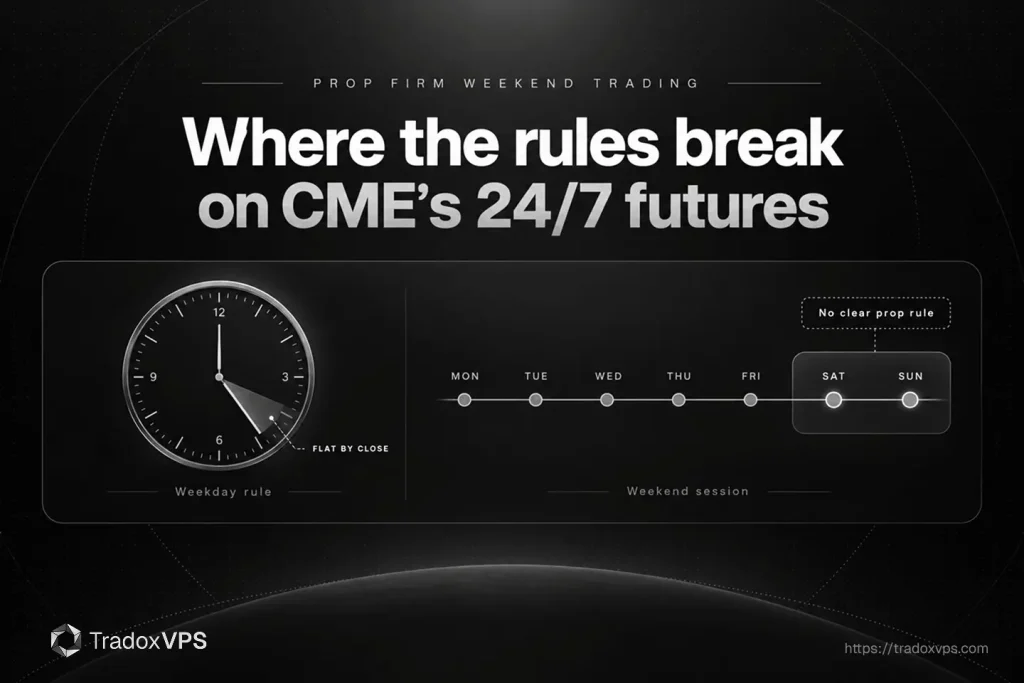
CME now runs some futures contracts through the weekend. Every prop firm rulebook was written for a market that closes every afternoon and shuts completely from Friday until Sunday evening. Nobody has reconciled those two facts, and prop firm weekend trading currently sits in the gap between them.
The short answer for most people is simple. If you trade a funded account, you almost certainly cannot hold a position through a weekend session, and the reason may have nothing to do with your firm’s rulebook. It may be switched off two layers below, at the clearing firm, by a default that nobody has changed.
This page is about the gap rather than the answer, because with narrow exceptions the answer has not been published. It covers what changed at CME, the four specific places a continuous contract breaks a rulebook designed for a market that closes, what the firms whose rules we read actually say, and the exact questions to send your firm before you risk a funded account on a Saturday.
Where a firm has not published something, this page says so rather than guessing. People risk money on these details.
What actually changed at CME
Two CME product areas trade continuously today. Cryptocurrency futures and options have since 29 May 2026, and the 1-Ounce Gold contract has since 24 July 2026. A 100-Ounce Silver contract is scheduled to follow, and a 10-Barrel WTI crude contract was scheduled for late August but has not listed and remains pending regulatory review. We cover that contract separately in our post on 10-Barrel WTI futures.
One detail matters more than the rest and catches people constantly. CME is not moving asset classes to the weekend. It is moving one small contract per family. Standard Gold and Micro Gold do not trade weekends. Only the 1-Ounce contract does. So a funded trader who reads that CME gold went 24/7, opens their platform and reaches for the gold symbol they already trade will find a market that closed on Friday exactly as it always did.
The other detail that matters is how CME books weekend activity. Trading from Friday evening through Sunday evening, and on exchange holidays, is assigned the trade date of the following business day, with clearing and settlement processed then too. A fill at ten in the morning on a Saturday is, to the exchange, a Monday trade. Hold that thought, because it collides with something later.
Why every prop firm rulebook assumes a market that closes
Prop firm risk management is built on a daily boundary. The daily loss limit resets on it. The trailing drawdown recalculates on it, or is measured against it. The auto-liquidation engine fires just before it. The weekend is treated as a longer version of the same thing: a period when nothing can happen, so nothing needs watching.
That is a reasonable design for a market that closes. It is not a design that survives contact with a contract that does not.
Take the two largest firms as worked examples, using their own published rules.
Topstep describes itself as “a day trading program.” Its published rules require positions closed by 3:10 p.m. Central every weekday, with trading resuming at 5:00 p.m. Central and reopening on Sunday at 5:00 p.m. Central. Risk managers begin flattening at 3:08. There is no swing trading and no holding from one session into the next or into the weekend. It is a futures-only program.
Apex Trader Funding requires all trades closed and pending orders cancelled by 4:59 p.m. Eastern. Its own wording is direct: “Holding trades through the close is not permitted.” Apex offers an auto-close safeguard but describes it as a final resort that should not be relied upon.
Neither rulebook contemplates a Saturday. Neither has to, because neither firm permits a position to survive to one.
Alpha Trader Futures is the exception among firms whose pages we read. Its FAQ states: “We have no restrictions on holding trades overnight or the weekend.” It adds that weekend crypto trading is allowed. That is the clearest published permission found. What its FAQ does not say is which specific products carry a weekend session on its platform, which is the question that decides whether the permission is usable.
Those are the three firms whose rules were read directly for this article. We are not publishing a comparison table of every firm, because prop firm rules changed repeatedly through 2026 and a table assembled from third-party summaries is exactly the kind of thing that gets a trader into trouble. Check your own firm’s rules page, and read the section below on what to ask.
The four places a 24/7 contract breaks a prop firm rulebook
This is the part worth reading slowly. Each of these is a mechanical conflict, and in each case the general mechanic is published while the weekend behaviour is not.
One: a trailing drawdown against a thin weekend print
Several firms use a drawdown that follows the account’s high-water mark. Apex publishes the mechanic precisely for its intraday model: the threshold follows the account’s highest balance in real time, including unrealised profit, it never moves down, and if the balance touches it every position is liquidated and the account closes.
Now imagine that mechanic running during a Saturday session in a thin book. An open position’s unrealised profit spikes on a single print and comes straight back. On a threshold that follows unrealised peaks and never retreats, the spike ratchets your floor up permanently and the reversal is now measured against the higher floor. You never traded the spike. It happened while you slept.
Whether that mechanic runs during a CME weekend session, and whether the calculation is even fed live weekend prices, is unpublished at every firm. That is not a claim that your floor does move on a weekend print. It is a statement that no firm has said whether it does, and the difference between those two is your account.
For Apex specifically the question is currently moot, because Apex does not permit holding through the close at all. It becomes live the moment any firm with a real-time trailing model permits a weekend hold.
Two: the daily loss limit reset against CME’s trade date
This is the subtlest conflict and the most likely to produce a dispute you cannot win.
Firms reset the daily loss limit on their own clock. CME assigns weekend activity the following business day’s trade date. Those are two different calendars, and on a Saturday they disagree.
So if you take a loss on a Saturday, does it count against Saturday, against Monday because that is the exchange trade date, or against nothing at all because your firm’s platform has no concept of a Saturday trading day? Whether a firm computes its limits on its own wall clock or on the exchange trade date is not published by any firm we could find. The two can clearly diverge, because CME has said plainly that the weekend books forward.
The scenario worth picturing: a Saturday loss lands on Monday’s trade date, and you open Monday morning already part-way through a daily loss limit you have not knowingly used.
Three: flat-by-cutoff on a market that does not close
Firms enforce their daily cutoffs with automated flattening. Topstep’s risk managers begin at 3:08 p.m. Central. Apex runs a safeguard at 4:59 p.m. Eastern.
Those engines were written for a market that then closes. On a Saturday in a continuously trading contract, the market is open. Does the engine run at all on a Saturday? Does it fire at the usual weekday clock time on a day the market never closes? Is a flat-by-Friday rule enforced by software, or merely stated and enforced by consequence after the fact?
None of the firms we read publishes weekend behaviour for its liquidation engine. Both Topstep and Apex describe their auto-flatten as a courtesy or last resort rather than something to rely on, which is worth noting: even on a weekday, the responsibility is explicitly yours.
Four: whether weekend trading is switched on below your firm at all
This is the one that may make the other three academic, and it is the least discussed.
Prop firms do not connect to CME directly. They sit on a stack: your platform, a connectivity provider, a clearing firm, then the exchange. CME’s Globex Credit Controls include a separate weekend exposure limit, and the default for that limit is zero. Weekend trading is therefore off unless the clearing member explicitly sets a weekend limit for the execution firm.
Read that again in terms of who decides. Not your prop firm. The clearing firm sitting underneath it. If nobody there has changed a default, weekend trading is unavailable on your funded account no matter what any rulebook says, and no matter what the exchange is doing.
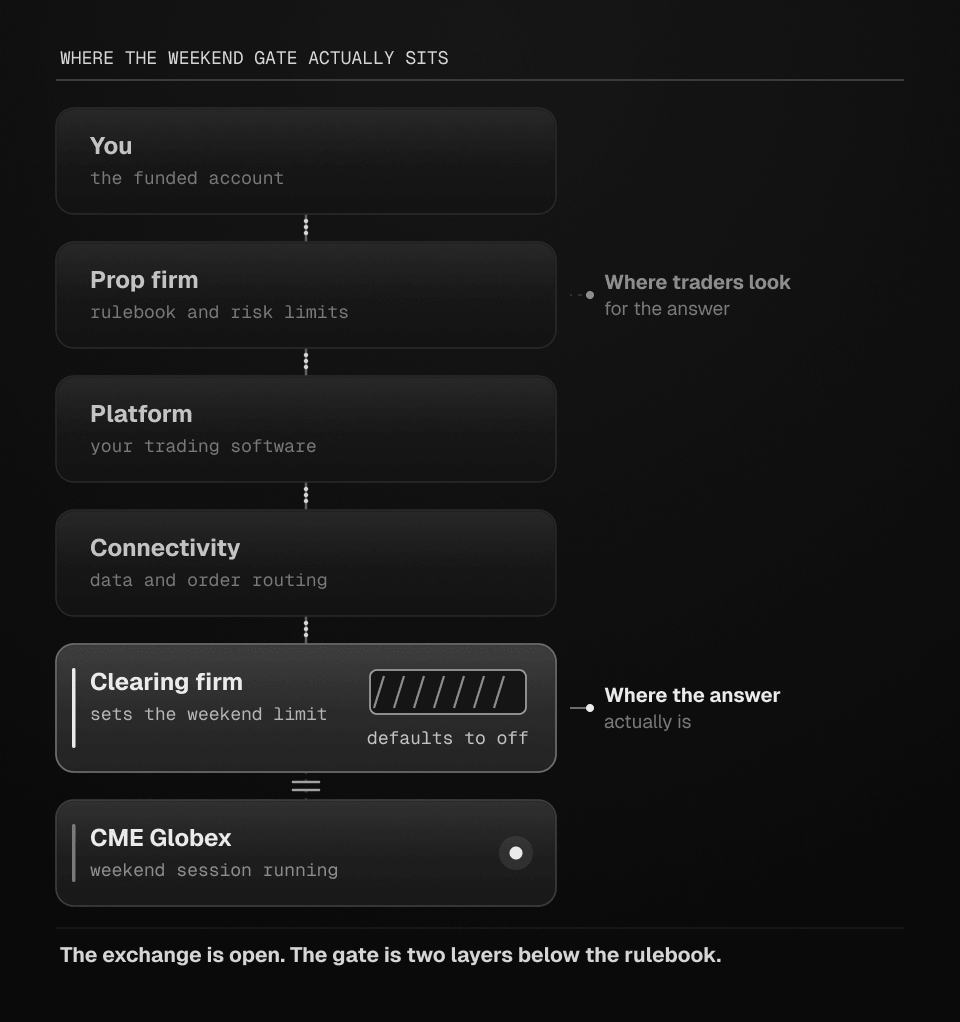
No clearing firm behind the major prop firms appears to have published a weekend trading policy. That is a confirmed absence rather than a rule, and it is the single most likely practical explanation for why funded weekend trading in these contracts does not visibly exist yet.
Why prop firms may be slow to enable weekend trading
Two reasons beyond simple caution, both worth understanding because they suggest this will not resolve quickly.
The economics run against small contracts. Exchange, clearing and NFA fees are charged per contract and do not scale with contract size. A trader taking ten small contracts instead of one larger contract for the same exposure costs roughly ten times as much to clear. That multiple is our own arithmetic from how per-contract fees work, not a figure any firm publishes. The 24/7 contracts are deliberately small, which means more contracts per unit of exposure, which means more cost for whoever clears them.
The regulatory framework is not settled. The CFTC opened a formal consultation on trading and clearing derivatives on a 24/7 basis, and the questions it raised are precisely the ones a prop firm would need answered: how margin is collected when participants cannot make deposits on non-business days, what happens to an undermargined account over a weekend, and whether positions should be liquidated when a counterparty cannot meet a call during off-hours. Those are the firm’s problems to solve before it can responsibly let a funded trader hold a weekend position.
There is a third point that changes your position as a trader. Prop firm funded accounts are generally simulated accounts rather than regulated brokerage accounts. Apex describes its Performance Account as a simulated funded account. That means the protections a customer has at a regulated futures broker do not map onto a funded account, and if something goes wrong on a Sunday you are a participant in a program governed by its own terms, which as this page has shown do not currently address the weekend.
What a funded trader should do about weekend trading
Start with the part that applies to almost everyone. Most funded traders are flat by the daily close and never go near a weekend session. If that is you, nothing here changes anything and you do not need to act. This is a narrow problem affecting a specific trader: one who wants to hold a continuously trading contract through a weekend inside a funded account.
If that is you, work through three stages.
Before you trade the product at all, get written confirmation that it is enabled on your account and that a weekend hold is permitted on your account type. Do not infer this from the symbol appearing in a platform search box. A symbol being visible is not the same as a weekend session being tradable, and neither is the same as a weekend position being permitted.
Prove the mechanics in an evaluation account, never a funded one, first. Check whether your platform displays the weekend session and streams live weekend prices at all. Watch how the stated drawdown figure behaves across a Friday-to-Sunday hold. If the platform does not show a weekend session, you have your answer regardless of what any rule says.
If you cannot get a clear answer, treat the weekend as closed. Be flat by the Friday cutoff exactly as if the contract still shut for the weekend. An unclear answer about an auto-liquidation engine, a trailing floor and a reset boundary is not worth a funded account.
The threshold that would change this advice is specific. When your firm confirms three things in writing, weekend trading becomes a considered decision rather than a gamble: that the product is enabled with a live weekend session, that a weekend hold is permitted on your account type, and that the trailing drawdown, the daily limit reset and the auto-liquidation engine each behave in a stated way over the weekend. Until all three are answered, the answer is no.
The questions to send your prop firm
Copy this into a support ticket unedited.
I want to understand your rules for CME’s continuously trading products, specifically 1-Ounce Gold and the CME cryptocurrency futures, before I trade them. Please answer each point in writing.
- Are the CME 24/7 products enabled on my account, including during Saturday and Sunday sessions?
- Am I permitted to hold a position in these products through a weekend session on my account type? If it depends on the account type, which of yours permit it?
- What is my daily loss limit, and at what clock time and time zone does it reset? Does that reset follow your platform’s clock or the CME trade date? CME books Friday-evening through Sunday activity to the following business day. Which day does a Saturday result count against on your system?
- Does my trailing drawdown high-water mark update during weekend sessions? Is it calculated on unrealised equity during the weekend, and does that calculation run continuously over the weekend?
- Does your auto-liquidation run during weekend sessions? If I hold a position into Saturday, will it be closed at a cutoff time even though the market is open, and if so exactly when?
- Is weekend trading enabled for my account at the clearing level? CME’s Globex Credit Controls default the weekend exposure limit to zero unless the clearing firm sets one.
- Who do I contact if something goes wrong with a position on a Saturday or Sunday, and is support staffed at weekends for these products?
Question six is the one to watch. If a firm cannot answer it, that alone is reason to stay flat, because it means nobody has confirmed the trade is even possible below the rulebook.
Does this change your infrastructure needs?
Our honest read, as a company that hosts trading platforms for automated traders.
For almost everyone reading this, no. If you are flat by the daily close, which is what nearly every funded trader is required to be, nothing about weekend trading changes what you need.
The narrow case is this. If your firm does permit a weekend hold, and you take one, then the firm’s automated risk systems are running against your position while you are asleep. Your own monitoring has to be running too, and a home computer that sleeps on Saturday afternoon cannot watch a position that a liquidation engine can act on at any moment. That is the entire argument, and it only applies once the firm has said yes.
The limits matter more than the argument. Hosting keeps your own platform and monitoring running. It cannot enable a product your firm has not enabled. It cannot change a rule. It cannot create weekend liquidity. It cannot stop a trailing drawdown breach when the market moves against an open position, and it cannot stop your firm’s auto-liquidation. It does one thing, and that thing is only useful in a situation most funded traders will never be in.
If you are in it, our NinjaTrader VPS page covers the setup and our Chicago location is the relevant one for CME products. Measure your own path rather than taking anyone’s number, ours included: the latency checker gives a zero-install read and our benchmarks page publishes the method. If you are comparing providers, our futures VPS comparison ranks the field and discloses that we are one of the entries.
How we checked this
Firm rules on this page come from three firms’ own published pages, read directly: Topstep’s help centre for its day-trading structure and cutoff times, Apex Trader Funding’s help centre for its close requirement, its intraday trailing threshold mechanics and its description of Performance Accounts as simulated, and Alpha Trader Futures’ FAQ for its statement on overnight and weekend holding.
We deliberately did not publish a comparison table of every prop firm. An earlier draft of this article carried one, and checking it against the firms’ own pages turned up material errors, including a firm’s overnight rule stated as the opposite of what the firm publishes. Prop firm rules changed repeatedly during 2026, and a table built from third-party summaries is precisely the sort of thing that costs a reader an account. If a rule matters to you, read it on your firm’s own page, and note the date you read it.
CME facts come from CME’s own press releases and product pages: the 24/7 launch dates for cryptocurrency and 1-Ounce Gold, the fact that only the small contract in each family moves, and the rule assigning weekend activity to the following business day’s trade date. The Globex Credit Controls weekend exposure default comes from CME’s credit controls documentation.
One figure is our own arithmetic rather than a published number: that ten small contracts cost roughly ten times as much to clear as one larger contract for the same exposure, which follows from per-contract fees not scaling with contract size.
What could not be confirmed, and is described as unpublished throughout: whether any firm’s trailing high-water mark updates on weekend prints, whether any firm computes its daily limit on its own clock or the exchange trade date, whether any firm’s auto-liquidation runs at weekends, and whether weekend exposure is enabled at the clearing level for any specific prop firm. Each of these has to be answered by your firm.
We have not held a position through a weekend session in a funded account, because we have not found a firm that permits it in these products. What we bring beyond the reading is the adjacent part: we host trading platforms for automated traders and spend a lot of time on what breaks when a schedule changes underneath a running system.
Frequently asked questions
At most firms, no. Topstep’s published rules require positions closed by 3:10 p.m. Central every weekday with no swing trading and no holding into the weekend. Apex requires everything closed by 4:59 p.m. Eastern and states that holding through the close is not permitted. Alpha Trader Futures states it has no restrictions on overnight or weekend holding. Check your own firm’s rules page rather than assuming.
Cryptocurrency futures and options since 29 May 2026, and the 1-Ounce Gold contract since 24 July 2026. A 100-Ounce Silver contract is scheduled to follow. Standard Gold, Micro Gold, standard Silver and Micro Silver do not trade weekends, and no crude oil contract does yet.
No firm publishes this for the 24/7 products. The general mechanics are published, for example Apex states that its intraday threshold follows the account’s highest balance in real time including unrealised profit and never moves down. Whether that calculation runs on live weekend prints is unpublished everywhere we looked.
Apex’s own help centre states that all trades must be closed and pending orders cancelled by 4:59 p.m. Eastern, and that holding trades through the close is not permitted. Its auto-close safeguard is described as a last resort rather than something to rely on.
No. Topstep describes itself as a day trading program, requires positions closed by 3:10 p.m. Central every weekday, resumes at 5:00 p.m. Central, reopens Sunday at 5:00 p.m. Central, and does not permit swing trading or holding into the weekend.
It varies by firm and runs on the firm’s own clock. The unresolved question for weekend trading is whether a Saturday result counts against the firm’s clock day or against CME’s next-business-day trade date, which no firm we could find publishes. Ask directly.
Not by default. CME’s Globex Credit Controls carry a separate weekend exposure limit that defaults to zero, so weekend trading is off unless the clearing member sets a limit for the execution firm. That decision sits below your prop firm, and no clearing firm behind the major prop firms appears to have published a weekend policy.
Generally no. They are typically simulated. Apex describes its Performance Account as a simulated funded account. That matters for weekend trading because the protections available at a regulated futures broker do not map onto a funded account governed by a program’s own terms.
Three things stack up. The clearing-level weekend gate defaults to off and sits below the firm. The regulatory framework for weekend margin and clearing is still being consulted on. And the small 24/7 contracts multiply per-contract clearing costs, which runs against the firm’s economics. None of these is a rule, but together they explain the silence.
This is unpublished. Firms publish weekday cutoffs and the engines that enforce them, but none publishes whether those engines run during a weekend session or at what time. Both Topstep and Apex describe their automated flattening as a courtesy or last resort even on weekdays, so do not assume it will save you and do not assume it will not close you.
Some firms enable CME crypto futures, typically the micro-sized contracts. Whether any firm permits holding them through a weekend session is unpublished. Ask before trading, and ask specifically about the weekend session rather than the product in general.
Only if your firm confirms in writing that the product is enabled with a live weekend session, that a weekend hold is permitted on your account type, and that the trailing drawdown, daily limit reset and auto-liquidation each behave in a stated way over the weekend. If any of those is unanswered, be flat by the Friday cutoff.
No. Hosting keeps your own platform and monitoring running. It cannot enable a product, change a firm’s rules, create weekend liquidity, or stop a trailing drawdown breach or an auto-liquidation. It is only relevant once your firm already permits a weekend hold and you need your own monitoring running alongside theirs.
Send the seven questions above to your firm’s support desk and keep the written reply. Pay particular attention to the answer on clearing-level enablement, because a firm that cannot answer that one has not confirmed the trade is possible at all.
Firm rules on this page come from the published pages of Topstep, Apex Trader Funding and Alpha Trader Futures, read directly and dated to publication. CME facts come from CME Group’s press releases, product pages and credit controls documentation. Several of the details that matter most, including whether trailing drawdowns update on weekend prints, whether daily loss limits reset on the firm’s clock or the exchange trade date, whether auto-liquidation runs at weekends, and whether weekend exposure is enabled at the clearing level, are unpublished at every firm we checked and are described as such rather than estimated. Prop firm rules and product lists change frequently, and several changed during 2026, so confirm the current position with your own firm in writing before acting. This is infrastructure and educational content, not trading or financial advice.