
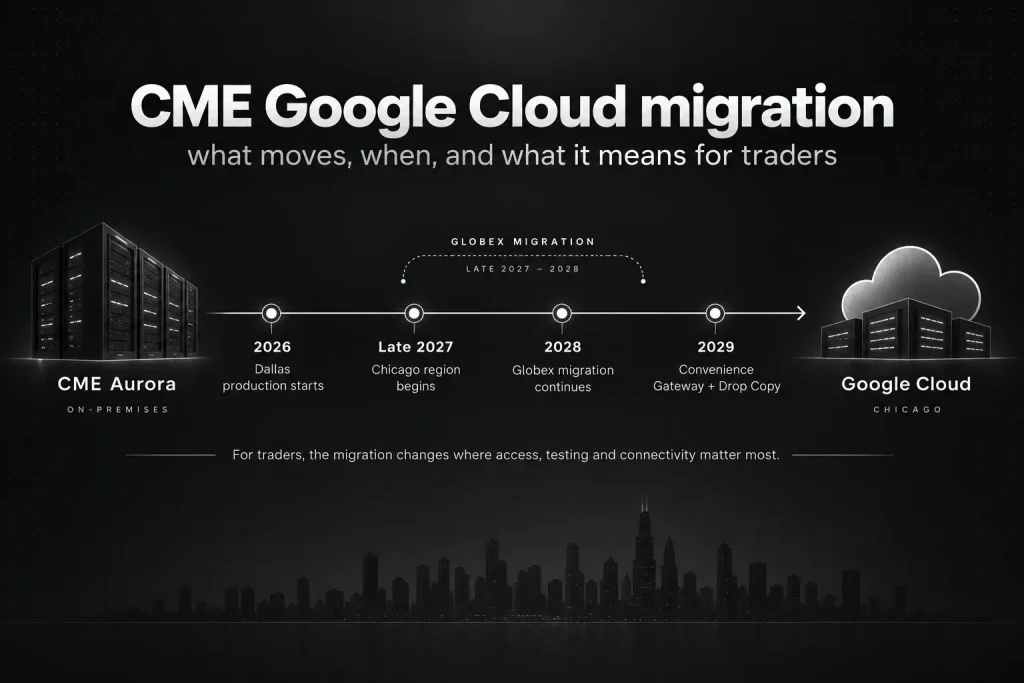
CME Group is moving CME Globex, the system that matches orders in its futures and options markets, out of its data centre in Aurora, Illinois and into Google Cloud. The move runs in stages from 2026 to 2029. CME publishes the plan on its client systems wiki and in its weekly Globex notices.
Most coverage of the move is written for exchanges, banks and trading firms that connect to CME directly. This guide is for traders who reach CME through a broker. It sets out CME’s own timeline and answers the question many traders ask first: is CME moving to Dallas? It also explains what changes, and what stays the same, for anyone trading CME futures from a platform at home or on a server.
Disclosure: TradoxVPS has no relationship with CME Group or Google Cloud. We run trading servers in the Chicago area, which is why we follow where CME’s matching engines sit. Every fact about the migration below comes from CME’s own documents unless another source is named.
The short answer
- What is moving: CME Globex, from CME’s data centre in Aurora, Illinois to Google Cloud.
- Where it is going: a private Google Cloud region that CME calls its Chicago region. CME and Google Cloud announced in 2024 that it would be built in Aurora. Every market ends up there.
- The stop in Dallas: livestock futures and options. They move to live trading in Google Cloud’s Dallas region in the fourth quarter of 2026, then move again to the Chicago region in the second half of 2028.
- When everything else moves: gradually, between late 2027 and 2028. CME says all markets will be on Google Cloud by the end of 2028, and it decommissions the old production environment in Aurora in 2029.
- What a trader who uses a broker has to do: very little. Your broker or data provider handles the connection to CME. Read their notices, keep your platform updated, and if you trade livestock, ask how they will route those orders.
- Contract specifications and trading hours: CME’s migration documents do not announce a change to either.
Where CME’s matching engines run today
CME moved CME Globex to a new data centre in Aurora, Illinois in August 2010. Its co-location service went live there on 29 January 2012. Co-location means trading firms rent space for their own servers inside the exchange’s data centre, next to the matching engine. CME’s co-location page puts the site about 35 miles from CME’s headquarters in Chicago.
In 2016, CME sold the building to CyrusOne, a data centre company, and leased it back. CME’s questions and answers on the sale say it would enter into a 15-year lease to keep operating CME Globex there, and that it would carry on providing co-location services to its customers itself.
CME’s migration documents call the site DC3, and the trading environment inside it Production-Aurora. In CME’s words: “All Listed Derivatives trading currently occurs in the Production-Aurora environment on-premise in the Aurora, IL data center.” If Aurora fails, CME’s plan is to fail the whole platform over to a disaster recovery site in New Jersey.
The cooling failure that halted CME’s markets
On 27 November 2025, the Aurora site suffered what CyrusOne called “a chiller plant failure affecting multiple cooling units”. CME halted its markets, saying: “Due to a cooling issue at CyrusOne data centers, our markets are currently halted” (DatacenterDynamics).
The outage lasted more than 10 hours and disrupted markets from Tokyo to London on 28 November, Bloomberg reported. CyrusOne later blamed onsite staff and contractors who did not follow standard procedures for draining cooling towers before freezing weather. CME did not switch to its backup site, because the information it had pointed to a brief outage.
CME planned the move to Google Cloud long before this outage, and announced it in 2021. The new design does change how a failure is handled. In Google Cloud, CME Globex will “alternate activity in two isolated zones (active and inactive)”, and from 2029 the disaster recovery site moves to Dallas.
Why CME is moving to Google Cloud
In November 2021, CME announced a 10-year partnership with Google Cloud. Google made “a $1 billion equity investment in a new series of non-voting convertible preferred stock of CME Group”. CME said it would start by moving data and clearing services, “eventually moving all of its markets to the cloud.”
In June 2024, the two companies announced a private Google Cloud region and co-location facility in Aurora to support trading in CME’s futures and options. Two points from that announcement matter to traders:
- Firms will be able to run their own equipment in the co-location facility or use Google Cloud’s infrastructure, with “equal network latency to the exchange” either way.
- CME said it expects to give clients “at least 18 months advance notice” of the migration.
CME Google Cloud migration timeline
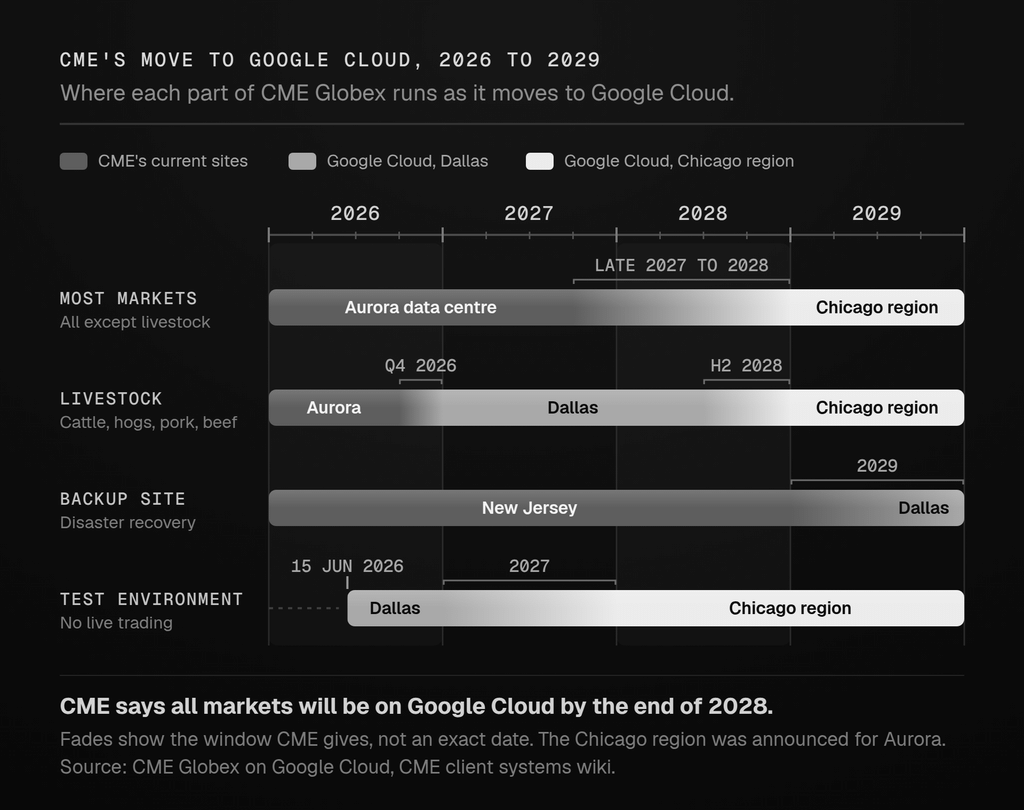
CME splits the move into seven phases, numbered 0 to 6. This table follows its CME Globex on Google Cloud page.
| Phase | When | What happens |
|---|---|---|
| 0 | Starting point | All listed derivatives trade in Production-Aurora, on-premise in CME’s Aurora data centre. The backup is a disaster recovery site in New Jersey. |
| 1 | 15 June 2026 | Sandbox-Dallas, a test environment, opens in private zones of Google Cloud’s Dallas region. Live trading stays in Aurora. |
| 2 | Q4 2026 | Livestock futures and options move to live trading in Production-Dallas. |
| 3 | 2027 | The test environment moves to the private Chicago region, and Production-Chicago opens for client testing. Live trading stays in Aurora, plus livestock in Dallas. |
| 4 | Late 2027 to 2028 | The other listed markets move gradually from Aurora to Production-Chicago. Once they have all moved, livestock moves from Dallas to Chicago, in the second half of 2028. |
| 5 | 2029 | The production moves finish. Firms using Convenience Gateways switch to new ones in the Chicago region, CME removes the old gateways from Aurora, and Production-DC3 is decommissioned. |
| 6 | 2029 | Disaster recovery moves to Google Cloud’s Dallas region, and the New Jersey site is decommissioned. |
Two things are not published yet: the exact date livestock goes live in Dallas, and the order in which the other markets will move. CME confirms each step in its Globex notices, so check there for current dates.
Names you will see in CME’s notices
| Name | What it means |
|---|---|
| DC3 | CME’s name for its data centre in Aurora |
| Production-Aurora | The live trading environment that every market starts in, on-premise in DC3 |
| Production-DC3 | The production environment in DC3, which CME decommissions in 2029 |
| DR-Coresite, DR-NYDC | Names CME uses for its current disaster recovery site. CME’s plan describes it as being in New Jersey and decommissions it in 2029 |
| Sandbox-Dallas | Test environment in Google Cloud’s Dallas region, open since 15 June 2026 |
| Production-Dallas | Live trading in Google Cloud’s Dallas region, for livestock only, from Q4 2026 |
| Sandbox-Chicago | Test environment in the private Chicago region, from 2027 |
| Production-Chicago | Live trading in the private Chicago region from late 2027, the long-term home of CME Globex |
| DR-Dallas | Disaster recovery in Google Cloud’s Dallas region, from 2029 |
Is CME moving to Dallas?
Not for most markets. Only livestock futures and options are scheduled to trade in Dallas, and only until the second half of 2028.
CME’s livestock migration page lists the products in scope:
- Live Cattle futures and options
- Feeder Cattle futures and options
- Lean Hog futures and options
- Pork Cutout futures and options
- 50% and 90% Lean Beef Trim futures and options
The list also covers their spreads, combinations and Trade at Settlement contracts.
These markets move to “private zones” of Google Cloud’s Dallas region in the fourth quarter of 2026. In the second half of 2028, after every other market has reached the Chicago region, they move there too.
From 2029, Dallas has a second role: CME plans to run its disaster recovery environment there, in place of the current site in New Jersey. From then on, Dallas is where CME’s markets would run in an emergency, not where they normally trade.
CME says the Dallas launch is meant “to provide clients with a real-world production environment on Google Cloud prior to the Chicago region launch”. It does not say why it chose livestock for that role.
Is CME moving out of Chicago?
Its live trading is not leaving. Apart from the livestock stop in Dallas, CME Globex moves to the private region announced for Aurora, so the Chicago area stays the centre of CME’s markets. This guide covers where CME’s trading systems run, not CME Group’s offices.
What changes for traders who use a broker
How your orders reach CME
To trade CME futures, you need an account with a futures broker. CME’s guide to getting started says “you must have an account with a registered futures broker”.
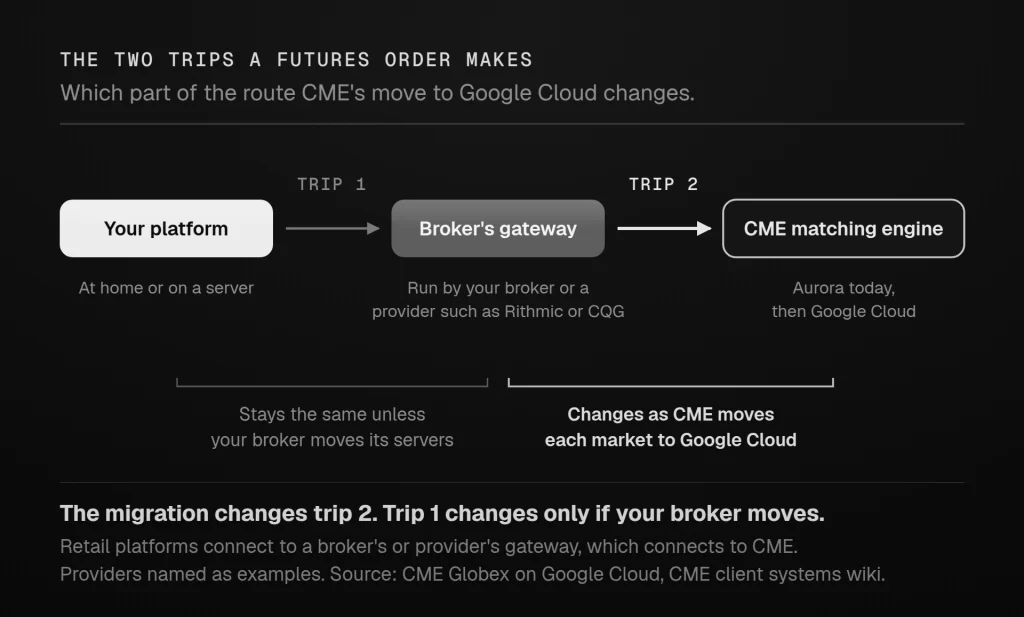
Your trading platform does not connect to CME Globex itself. It connects to servers run by your broker, or by a technology provider your broker uses, such as Rithmic or CQG. Those servers connect to CME. If your broker or prop firm offers both Rithmic and Tradovate connections, our comparison of Rithmic and Tradovate explains how they differ.
So every order makes two trips: first from your platform to your provider’s gateway, then from that gateway to CME’s matching engine.
What the migration changes
The migration changes the second trip. As markets move, your provider’s systems have to connect to CME’s new environments. CME says Production-Dallas “will be accessible via all current connectivity solutions”, alongside new Google Cloud connections, so providers can reach Dallas over the links they already have.
The first trip, from you to your provider, changes only if your provider moves its own servers.
What you may notice
- Notices from your broker or platform about new connection settings, platform updates or weekend tests as markets move.
- From Q4 2026, your livestock orders travel on from your provider’s gateway to Dallas instead of Aurora.
What does not change
CME’s migration pages describe infrastructure and connectivity. They do not announce any change to contract specifications or trading hours. CME has moved some products, including its cryptocurrency futures and options, to 24/7 trading, but that is a separate programme, covered in our guide to CME 24/7 trading.
What to do
- You do not need to act on CME’s migration notices yourself. They are written for firms that connect to CME directly.
- Read the notices from your broker, your prop firm if you trade with one, and your platform, and update your platform when they ask.
- If you trade livestock futures or options, ask your broker how it will route those orders once they trade in Dallas, and whether resting orders will carry over the move.
- If you run an automated strategy, plan around any weekend tests or connection changes your provider announces, and check that the strategy is running again before the next session opens.
Does the move change where you should host a trading server?
For most CME markets, no.
A trading server helps by sitting close to the gateway it connects to. Brokers and data providers usually keep their CME gateways in the Chicago area, close to CME Globex. CQG, for example, co-located “its exchange gateway servers” in CME’s Aurora data centre when co-location opened there. CME’s plan keeps the Chicago area at the centre after the move. The new private region was announced for Aurora, and CME says its existing co-location service, GLink Aurora, “will offer the most performant access to markets hosted in the Chicago region through the end of the market migrations in 2028.”
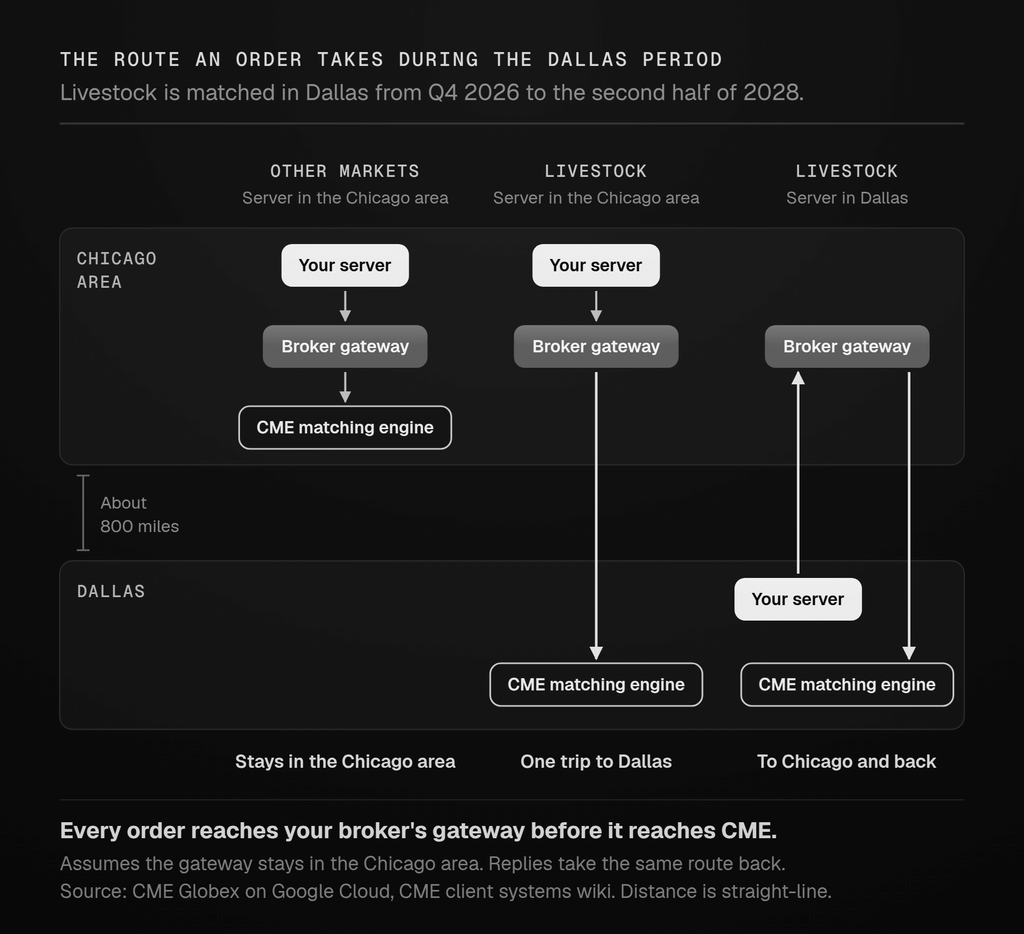
Livestock is the one case to think through. From Q4 2026 to the second half of 2028, livestock orders are matched in Dallas, but each order still goes to your provider’s gateway first. If that gateway stays in the Chicago area, a server in Dallas would add a trip to Chicago before the order heads back to Dallas. Ask your broker where its gateway for those markets will be before you move anything.
For choosing a server near CME in general, see our guide to a VPS near the CME data centre. If you run your platform on a hosted server for CME markets, our Chicago VPS page explains the setup.
How to check where your orders go
- Open your platform’s connection settings and note the server or gateway it connects to.
- Ask your broker or data provider which data centre that gateway is in, and whether that will change as CME moves.
- Trace the route from your computer or server. On Windows, run
tracertfollowed by the gateway’s host name. On Linux or macOS, usetraceroute. Some servers do not answer these probes, so a trace can stop short even when the connection works.
What changes for co-located firms and developers
This section is for firms that connect to CME directly. If you trade through a broker, you can skip it.
- Physical co-location: throughout the migration, CME’s existing GLink Aurora service in DC3 remains its only physical co-location service. CME says it is “committed to continuing to offer physical co-location market access to the Chicago region”, and that it will announce “a definitive decision regarding the physical co-location site” no later than the end of 2028. Custom Hardware Co-location in the Chicago region “will launch, contingent on client demand”, in 2028 or later.
- No physical co-location in Dallas: Production-Dallas is reachable through CME’s existing connectivity services, the new GLink ULL-Dallas and GLink Premium-Dallas, Google Cloud instances, and Google Cloud interconnects, including from the Aurora data centre.
- Google Cloud access: GLink ULL connects U4C bare metal instances to Google Cloud’s Ultra Low Latency network, which carries the Market Segment Gateways and MDP 3 multicast market data. GLink Premium connects U4S virtual machines through Google Cloud’s Premium Tier network. CME says “U4S Virtual Machine instances will have higher network latency to CME Globex than U4C Bare Metal instances”, and that GLink ULL-Dallas with U4C bare metal will be the lowest-latency way to reach the markets in Dallas.
- Testing: the sandbox environments are reachable only through GLink ULL and GLink Premium. Sandbox-Dallas opened on 15 June 2026, and the sandbox moves to the Chicago region in 2027.
- Gateways: in 2029, after all markets have moved, firms that route orders through Convenience Gateways (CGWs) switch to new CGW and Drop Copy for CGW instances in Google Cloud’s Chicago region. CME then removes the old CGWs, and Drop Copy for CGW, from the Aurora data centre.
- Two zones: CME Globex in Google Cloud alternates between two isolated zones, one active and one inactive. CME offers two related tools, both described in its CME Globex Notice dated 28 September 2026. The Zone Schedule API shows which zone is active and when the next zone swap is due. The Configuration API returns the IP addresses of the MDP channels, MSGW and Drop Copy gateways in the sandbox.
How this guide was checked
Every date, phase and quote about the migration was checked in October 2026 against CME’s CME Globex on Google Cloud page, its livestock migration page, its Globex notices, and its press releases from 2021 and 2024. Facts about the Aurora data centre come from CME’s own pages and advisories. The account of the November 2025 outage comes from DatacenterDynamics and Bloomberg. Where CME has not published something, such as the order in which markets will move, this guide says so rather than guessing.
Frequently asked questions
Yes. CME is moving CME Globex, the platform that matches its futures and options orders, from its data centre in Aurora, Illinois to Google Cloud. It announced the partnership in 2021. Markets move between 2026 and 2028, and CME decommissions the old production environment in Aurora in 2029.
Livestock futures and options go first, to Google Cloud’s Dallas region in the fourth quarter of 2026. The other markets move gradually to a private Google Cloud region in the Chicago area between late 2027 and 2028. CME says all markets will be on Google Cloud by the end of 2028. The old gateways in Aurora are removed in 2029.
Only livestock futures and options, and only for a while. They trade in Google Cloud’s Dallas region from Q4 2026 until the second half of 2028, then move to the Chicago region. From 2029, CME also plans to run its disaster recovery site in Dallas, but that is a backup, not where markets normally trade.
Its live trading is staying in the Chicago area, apart from the livestock stop in Dallas from Q4 2026 to the second half of 2028. After the move, CME Globex runs in a private Google Cloud region that CME and Google Cloud announced for Aurora, Illinois, the same city as its current data centre.
Today, CME Globex runs in a data centre in Aurora, Illinois, about 35 miles from CME’s Chicago headquarters. CME sold the building to CyrusOne in 2016 and leases it back. During the migration, livestock trades in Google Cloud’s Dallas region from Q4 2026 to the second half of 2028. After it, every market runs in a private Google Cloud region announced for Aurora.
No. CME’s plan sends only livestock futures and options to Dallas for live trading. Equity index futures stay in Aurora until they move to the private Chicago region, between late 2027 and 2028. CME has not yet published the order of those moves. The Dallas test environment opened with some CME and CBOT equity futures, excluding E-mini S&P, but that is a sandbox for testing, not live trading.
Not with CME directly. Your broker or data provider connects to CME and handles the move. Read their notices, update your platform when they ask, and if you trade livestock, ask how those orders will route once they trade in Dallas.
CME’s migration documents do not announce a change to either. They cover infrastructure and connectivity. CME’s move of some products to 24/7 trading is a separate programme.
For firms in the new co-location facility, CME’s 2024 announcement said self-managed equipment and Google Cloud’s infrastructure would both have “equal network latency to the exchange”. CME’s current migration pages add that U4S virtual machines will have higher latency than U4C bare metal instances. For a trader who uses a broker, the bigger factor is usually the path from your platform to your broker’s gateway. The migration does not change that path unless your broker moves its servers.
A chiller plant failure at the Aurora data centre, which CyrusOne owns and operates, in November 2025. CME’s markets were halted for more than 10 hours. CyrusOne later blamed onsite staff and contractors who did not follow standard procedures for draining cooling towers before freezing weather, according to Bloomberg.
GLink is CME’s connection service for equipment in its co-location facility. CME’s co-location page describes it as “equidistant, low-latency access to Globex”. The move adds two Google Cloud versions: GLink ULL, which connects to Google Cloud’s Ultra Low Latency network, and GLink Premium, which connects through Google Cloud’s Premium Tier network.
CME plans to decommission Production-DC3, its production environment there, in 2029, once every market has moved. Throughout the migration, GLink Aurora co-location there remains CME’s only physical co-location service. CME says it will offer the most performant access to the markets in the Chicago region until the market migrations end in 2028. CME says it will announce a definitive decision on its physical co-location site no later than the end of 2028.