
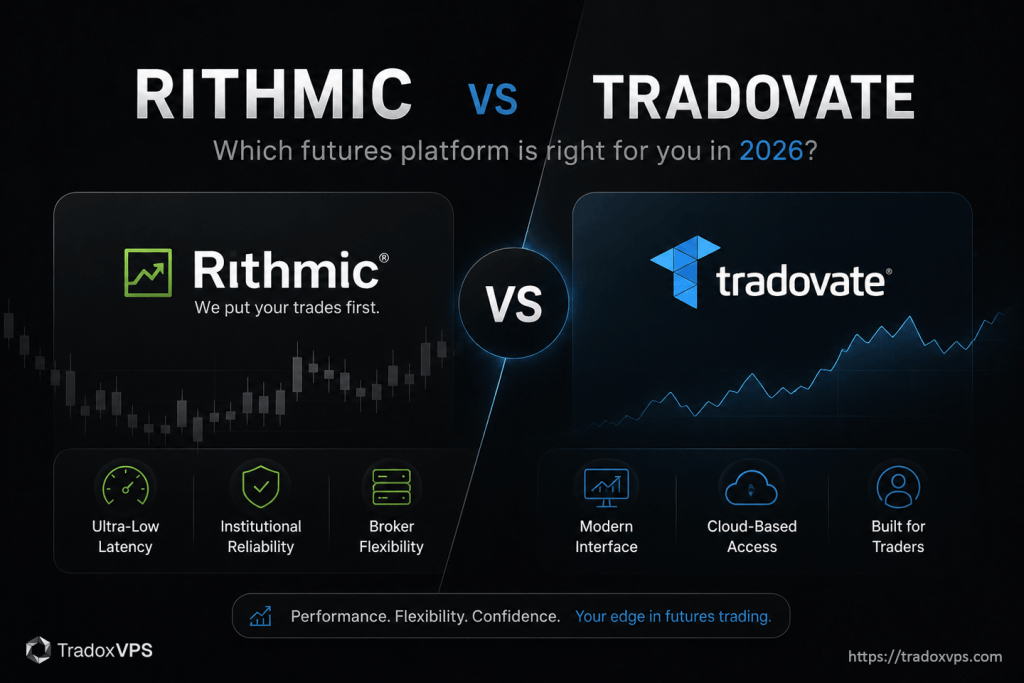
Rithmic and Tradovate aren’t direct competitors — they serve different traders. Rithmic is execution and market-data infrastructure marketed for ultra-low (sub-250µs tick-to-trade) latency, accessed through a broker; Tradovate is a retail futures broker with transparent commission pricing ($0.09–$1.29 per contract). Pick Rithmic if you’re a pro or developer who needs institutional-grade execution; pick Tradovate if you’re a retail day trader who wants an all-in-one platform with 40+ built-in tools. Many serious traders use both.
What they actually are
This comparison confuses a lot of traders because Rithmic and Tradovate aren’t the same type of product.
Rithmic: execution infrastructure, not a broker
Rithmic is a direct market access (DMA) execution infrastructure provider founded in 2006. Think of it as the plumbing: order routing, market-data distribution, and risk management. Rithmic doesn’t onboard retail traders directly — you access it through a broker, FCM, or prop firm that uses its infrastructure.
The core product is the R | Trade Execution Platform™, written in C from the ground up. It handles three functions:
- Order routing — ultra-low latency, with sub-250µs (under a quarter-millisecond) tick-to-trade on co-located servers via the Diamond API
- Market data — un-throttled feeds with MBO (market-by-order) data and full depth
- Risk management — server-side enforcement of loss limits, position limits, and auto-liquidation
Rithmic powers 30+ compatible trading platforms including NinjaTrader, ATAS, Quantower, Bookmap, Sierra Chart, and R | Trader Pro (Rithmic’s own platform).
One important caveat on latency: the sub-250µs figure is what Rithmic’s co-located infrastructure can do for a program running on a server in its data center. If you’re a retail trader connecting through a broker over the public internet, your real end-to-end latency is higher — which is exactly where server location and a low-latency VPS come in (more on that below).
Tradovate: retail broker with built-in platform
Tradovate is a cloud-based futures broker that is now part of the NinjaTrader Group. You sign up, fund an account, and trade directly on the platform. It’s all-in-one: brokerage, execution, charting, and tools.
It’s worth knowing the corporate picture here, because it changed recently. NinjaTrader acquired Tradovate in 2022, and in May 2025 crypto exchange Kraken acquired the entire NinjaTrader Group (Tradovate included) for around $1.5 billion. In practice, that means Tradovate and NinjaTrader are now the same brokerage: accounts are unified, a single login works on both, and the commission tiers and margins are identical. You’re choosing a front-end (cloud-first Tradovate vs the Windows-native NinjaTrader desktop), not a different broker.
Tradovate offers three commission tiers:
- Free plan: $0.39/micro, $1.29/standard
- Monthly ($99): $0.29/micro, $0.99/standard
- Lifetime ($1,499): $0.09/micro, $0.59/standard
The platform includes 40+ trading tools, market replay, order-flow analysis, and cross-device sync (Windows, Mac, web, iOS, Android).
Head-to-head comparison
| Feature | Rithmic | Tradovate |
|---|---|---|
| Type | Infrastructure provider | Retail broker + platform |
| Account setup | Via broker/FCM partner | Direct signup |
| Execution latency | Sub-250µs tick-to-trade (co-located, Diamond API) | Not publicly specified; optimized for retail |
| Pricing | No public pricing; broker-dependent | $0.09–$1.29 per contract + fees |
| Market access | CME, Nasdaq Futures, EUREX (via select FCMs) | CME, ICE, EUREX, Coinbase Derivatives, MIAX |
| Platforms | 30+ compatible (NinjaTrader, ATAS, Quantower, Bookmap, etc.) | Proprietary platform + desktop/web/mobile |
| APIs | R API+, R Protocol API, R Diamond API | REST + WebSocket API |
| Account minimum | Depends on broker; often $2,000–$5,000 | No minimum for Nano contracts |
| Risk management | Server-side loss limits, position limits, auto-liquidation | Manual order management; standard futures risk |
| Historical data | Back to December 2011 | Market replay for testing strategies |
Rithmic: who should use it
Use Rithmic if you’re:
Professional traders or prop firm traders — Rithmic’s sub-250µs co-located execution and server-side risk management make it the backbone of professional trading infrastructure. If your prop firm uses Rithmic, that’s how you access it.
Developers building trading systems — Rithmic’s API suite (R | API+, R | Protocol API, R | Diamond API) supports high-frequency strategies, with the Diamond API exposing sub-250µs tick-to-trade for co-located programs. If you’re building algorithmic trading bots, Rithmic offers the infrastructure.
Institutions needing risk management — R | Manager™ gives FCMs and brokers account management, SFTP interfaces, and group permissions. If you’re running a trading firm, Rithmic’s backend scales.
Traders wanting platform flexibility — Rithmic supports 30+ front-end platforms. If you want to use NinjaTrader one day and ATAS the next, Rithmic gives you that portability.
Real user feedback: Traders on r/algotrading praise Rithmic’s un-throttled data feeds and microsecond timestamps, often calling it “the standard for serious futures traders.”
Tradovate: who should use it
Use Tradovate if you’re:
Retail day traders — Tradovate is designed for active futures traders. The platform is intuitive, commissions are transparent and competitive, and day-trading margins are aggressive ($10 for Nano contracts, $50 for micros).
Cost-conscious traders — At $0.09 per micro contract on the Lifetime plan, Tradovate’s long-term cost is hard to beat for retail traders. High-volume traders can break even on the $1,499 fee within a few months (commissions aside, all plans add exchange, clearing, and NFA fees).
Multi-device traders — Tradovate syncs across Windows, Mac, web, iPad, iPhone, and Android with cloud-based order storage. If you trade from multiple devices, this integrated sync is seamless.
Strategy testers — Market Replay lets you test strategies against historical tick-by-tick data, a feature serious traders rely on for backtesting.
NinjaTrader users — Because Tradovate and NinjaTrader are the same brokerage, they share login credentials, so moving between the cloud platform and the NinjaTrader desktop is seamless.
Real user feedback: r/FuturesTrading users highlight Tradovate’s responsive DOM, low commissions, and fast onboarding, with common praise for “the most competitive retail pricing.”
The latency factor: why it matters
Rithmic’s advantage is microsecond-level execution latency. For scalpers and high-frequency strategies, this matters — when order routing is measured in microseconds rather than milliseconds, you’re more likely to hold a better spot in the first-in-first-out queue, which improves fill probability at a given price.
Tradovate doesn’t publish latency specs, but it’s optimized for retail day trading, where millisecond-level execution is sufficient.
If you’re trading 5-minute or 15-minute charts, latency is rarely the deciding factor. If you’re scalping 10–100 tick charts or running automated strategies, infrastructure speed starts to matter — and that’s true on both platforms.
This is also where low-latency VPS infrastructure comes in. Both Rithmic and Tradovate benefit from a VPS hosted near the exchange. TradoxVPS’s Chicago hosting sits close to the CME’s matching engines in Aurora, IL, which shortens the network path between your platform and the exchange. How much that helps depends on your broker and how your orders are routed — it reduces avoidable delay on your side, it doesn’t override the rest of the chain.
Pricing breakdown
Rithmic pricing: opaque but scalable
Rithmic has no public retail pricing — you pay through your broker. Brokers handle Rithmic licensing and pass the cost through commissions or platform fees (a Rithmic trade-routing fee of roughly $0.10 per contract is common, on top of the broker’s own commission). For high-volume traders, broker commissions on Rithmic can be lower than Tradovate’s retail pricing because institutional volume discounts apply.
Rithmic offers a free 14-day Exchange Simulator trial with live market data, so you can test before committing.
Tradovate pricing: transparent tiers
Full details are on Tradovate’s pricing page, but here’s the summary:
Free plan: No monthly fee. Commissions: $0.39/micro, $1.29/standard, $0.20/nano per side.
Monthly ($99/month): Reduces to $0.29/micro, $0.99/standard, $0.15/nano.
Lifetime ($1,499 or 4×$499): Lowest rates: $0.09/micro, $0.59/standard, $0.05/nano.
All plans include exchange, clearing, and NFA fees on top (plus a $35/month inactivity fee on the Free plan if you log in but don’t trade live). For a 100-contract day (50 round trips on E-mini S&P 500), the Lifetime plan saves roughly $45–$65 compared to the Free plan — breakeven in a few weeks of moderate trading.
Key differences: infrastructure vs all-in-one
The core difference: Rithmic is plumbing; Tradovate is a house.
Rithmic gives you:
- Industry-leading execution latency (on co-located infrastructure)
- Flexibility across multiple platforms
- Advanced developer APIs
- No support for casual traders (access only through brokers)
Tradovate gives you:
- A complete, ready-to-use platform
- Transparent, predictable costs
- 40+ built-in tools
- Cross-device seamless trading
- Direct support without broker intermediaries
Our take
Choose Rithmic if: You’re a professional trader, developer, or prop firm trader who needs institutional-grade execution and platform flexibility. You’re comfortable navigating broker relationships and prioritize microsecond-level latency.
Choose Tradovate if: You’re a retail day trader who wants a complete, intuitive platform with competitive commissions. You trade from multiple devices and want seamless integration. You value simplicity and direct support.
Choose both if: You’re serious about futures and want to diversify. Use Tradovate as your primary retail broker, then maintain a second account through a Rithmic-enabled broker (such as AMP Futures, Optimus Futures, or EdgeClear) for strategies that need ultra-low latency or institutional features.
Try TradoxVPS
Both Rithmic and Tradovate benefit from low-latency infrastructure. TradoxVPS offers high-performance VPS hosting optimized for futures trading, with Chicago hosting near the CME’s Aurora data center.
Our Ryzen 9 9950X hardware and DDR5 RAM keep your platform responsive under load, so your strategies execute at the speed your platform and route allow. Whether you’re running Rithmic APIs or Tradovate’s DOM, Chicago colocation helps cut the last mile of network latency.
Compare plans and pricing to find the tier that fits your stack.
Frequently Asked Questions
Yes. Many traders use Tradovate as their broker but access alternative execution via Rithmic through a second broker account. A low-latency VPS like TradoxVPS can support both platforms simultaneously.
Rithmic has no public pricing — costs vary by broker (often a small per-contract routing fee plus the broker’s commission and data fees). Tradovate offers transparent pricing from $0.09–$1.29 per contract depending on membership tier. Rithmic can be cheaper for high-volume traders but requires a broker relationship.
Rithmic’s R | Diamond API achieves sub-250µs tick-to-trade on co-located servers, making it the stronger choice for high-frequency strategies. Tradovate is optimized for retail day traders but doesn’t publish latency specs. Note that the sub-250µs figure is a co-located/institutional number — a retail trader through a broker over the internet will see higher real-world latency.
Not required, but recommended. A trading VPS helps avoid home-connection dropouts, keeps automated orders running 24/7, and shortens the network path to the exchange. Both platforms benefit from Chicago-based infrastructure for CME futures trading.
Tradovate is more beginner-friendly — it’s a self-contained broker with clear pricing and 40+ built-in tools. Rithmic requires accessing through a broker, though it offers a free 14-day simulator trial.