
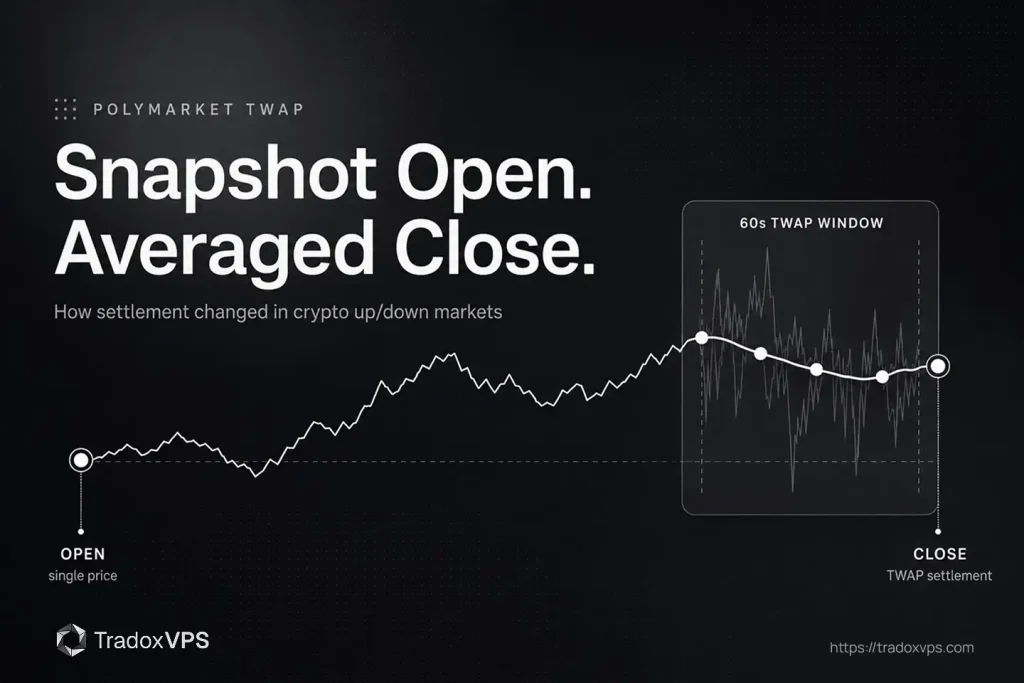
Polymarket’s crypto up/down markets settle against a Chainlink time-weighted average price rather than a single price snapshot. The switch took effect on 7 August 2026, and it applies to both ends of the contract: the price to beat at the open and the settlement price at the close are both readings of the same averaged feed.
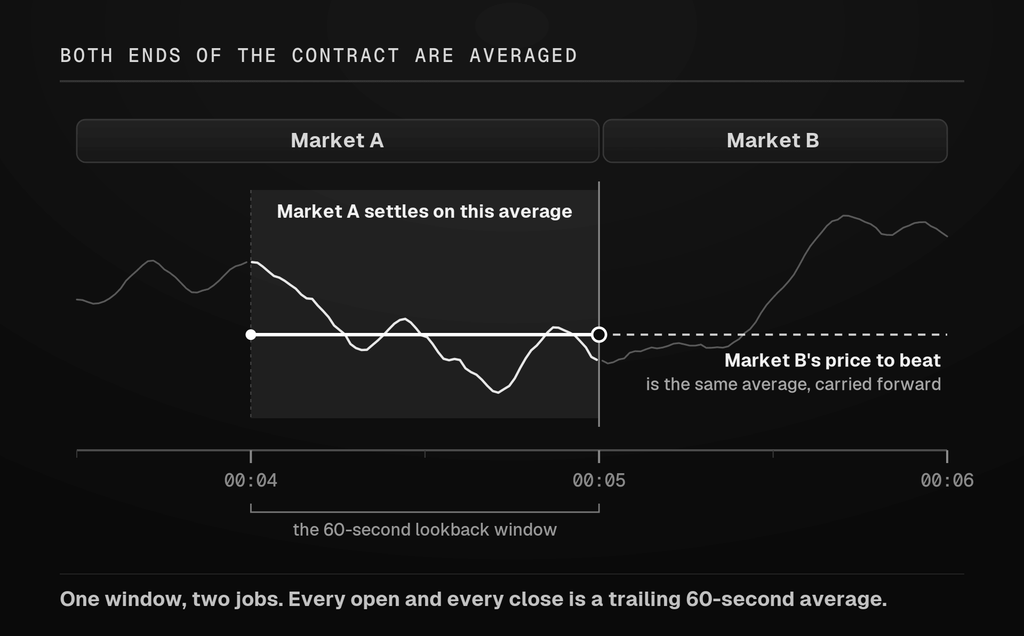
That last point is the one most likely to be misunderstood. The averaging is symmetric. There is no single print left in a 5-minute, 15-minute or 4-hour crypto market.
This page covers what the mechanism is, how the window moved after launch, what the first measured data shows the change actually did, which markets are not covered at all, and what an automated trader has to change.
Current status
Last verified: 17 September 2026.
All 5-minute, 15-minute and 4-hour crypto up/down markets resolve on the 60-second Chainlink TWAP stream. Five-minute markets launched on a 30-second window on 7 August and moved to 60 seconds at 00:00 UTC on 14 August, per Polymarket’s changelog. The crypto taker delay was cut from 250 to 50 milliseconds on 17 August. Hourly and daily crypto markets are not TWAP markets and settle on Binance candles.
Still unpublished: how Chainlink computes the TWAP, meaning its sampling boundaries, weighting, rounding and missing-input handling. Polymarket’s documentation says not to reproduce the value independently.
Polymarket TWAP settlement: what is confirmed
| Question | Answer | Source |
|---|---|---|
| When did TWAP settlement begin? | 00:00 UTC, 7 August 2026 | Polymarket changelog, live market rules |
| What window do 5-minute markets use? | 60 seconds, since 14 August | Changelog, live market rules |
| What window do 15-minute and 4-hour markets use? | 60 seconds, since 7 August | Changelog, live market rules |
| Does the window look back from the close? | Yes, a trailing lookback | Live market rules, Polymarket docs |
| Is the open, the price to beat, also averaged? | Yes. Both ends read the same TWAP feed | Changelog, live market rules |
| Which markets are affected? | 5-minute, 15-minute and 4-hour crypto, across eight assets | Live markets |
| Are hourly markets included? | No. They settle on Binance candles | Live market rules |
| Is Polymarket RTDS the recommended feed? | Yes | Polymarket docs |
The Polymarket TWAP spec
| Market duration | TWAP window at launch, 7 August | TWAP window now | Before 7 August |
|---|---|---|---|
| All crypto 5-minute markets | 30 seconds | 60 seconds, from 14 August | Single price at expiry |
| All crypto 15-minute markets | 60 seconds | 60 seconds | Single price at expiry |
| All crypto 4-hour markets | 60 seconds | 60 seconds | Single price at expiry |
Polymarket announced the switch on 30 July 2026, with up to $1 million in liquidity rewards on the affected markets during August. That figure is a cap rather than a payout: Polymarket’s own rewards documentation allocates $550,000 to 5-minute markets, of which $300,000 to Bitcoin, $350,000 to 15-minute markets and $100,000 to 4-hour markets, and states that actual payouts depend on eligible quoting. Live markets confirm the mechanism running across BTC, ETH, SOL, XRP, DOGE, BNB, ZEC and HYPE at all three durations.
The 5-minute row is the one that moved. A week after launch, Polymarket doubled its window to match the other two durations. The changelog entry of 14 August records it: all 5-minute crypto markets now resolve using a 60-second Chainlink TWAP, replacing the 30-second window introduced on 7 August. A live 5-minute market names its resolution source directly, the Chainlink BTC/USD TWAP data stream at the 60-second slug. It takes about thirty seconds to confirm: open any live 5-minute market and read the Resolution Source line.
Both ends of the contract are averaged
This deserves its own section because it is easy to get wrong.
The live rules resolve a market to Up if the Chainlink time-weighted average over the market’s time range is at or above “the price at the beginning of that range.” Read in isolation, “the price” sounds like a single number at a single instant. It is not, for two reasons that reinforce each other.
First, the rules bind resolution to one source only, the named Chainlink TWAP stream, and explicitly exclude any other source or spot market. There is no spot feed in the contract from which a single print could be drawn.
Second, the value that stream publishes at any instant is itself an average. Polymarket’s documentation states that the 30-second and 60-second figures are lookback windows, not publication cadences. So the stream’s value at the moment a market opens is the average of the preceding sixty seconds, and that average is the strike. Polymarket’s changelog says it plainly: both the price to beat and the final settlement price come from the applicable TWAP feed.
The practical consequence is that the contract has no single-print end. A push at the open would have to be sustained across a full averaging window against everyone fading it, exactly like a push at the close. The manipulation reasoning on this page applies to both ends equally.
One implication for bot design follows directly, and it is neater than it first looks. For back-to-back 5-minute markets, the close of one market is the open of the next, and both read the same feed at the same instant. So one market’s settlement value is, to the tick, the next market’s strike. Under snapshot settlement that was a single print carried forward. Now it is a sixty-second average carried forward. Your model of where the strike sits should read the averaged feed, not a spot print at the boundary.
Hourly markets are not TWAP markets at all
Polymarket’s hourly up/down markets are a different product. No Chainlink, no oracle, no averaging. A live Bitcoin hourly market resolves to Up if the close price is greater than or equal to the open price for the BTC/USDT one-hour candle beginning at the time in the title, and the resolution source is Binance, specifically the BTC/USDT pair, read once that candle is finalised. Daily markets follow the same pattern on a Binance one-minute candle. We have read Bitcoin’s rules directly; for other assets, check the pair named in the market you trade.
So both ends of an hourly contract are still single prints. Nothing on this page applies to them: not the lookback window, not the manipulation reasoning, not the feed integration.
Practically, an hourly bot needs an entirely separate data path. You are watching a Binance candle, not a Chainlink stream, and your settlement reference is a spot pair on one exchange rather than an oracle. If you trade hourly and 5-minute markets from the same code, they need two different resolution models, and mixing them is how you end up wrong about which number decides your trades.
Polymarket TWAP window: it looks back from the close
The averaging window is a trailing lookback: it covers the seconds immediately before the market’s close, not a period that starts at the close or straddles it.
Two independent things confirm it. Live markets bind their resolution to a named Chainlink stream whose identifier states the window length directly, and Polymarket’s documentation describes the 30 and 60 second figures as lookback windows rather than publication rates.
Why it matters in practice: the settlement value stops being a future unknown once the window opens. For a 5-minute market, that is the final 60 seconds, a fifth of the contract’s entire life. Settlement starts locking in around the four-minute mark. Everything printed inside the window is already weighted into the answer, so the outcome becomes progressively fixed as the window elapses. There is no late instant that overturns it, which is exactly the property the old design lacked.
Why Polymarket did this
Because the single-print design was measurably exploitable, and someone measured it carefully.
A working paper dated 30 June 2026 by David Dai and Ruizhe Jia of Stanford and Shihao Yu of Singapore Management University, “Settlement Manipulation in Prediction Markets”, studied roughly sixteen thousand 5-minute Bitcoin contracts from the 12 February 2026 launch. Its coverage reports 821 wallets, about one in three hundred of those who traded the contract, capturing around $8.2 million in the cycles they pushed while breaking even everywhere else, with 93 percent of the losses falling on retail. The tell was net spot order flow on Binance in the final ten seconds jumping far above its pre-launch level and then reverting, which is the signature of temporary price pressure rather than information. The same signature was much weaker in 15-minute contracts.
The authors’ recommendation was to lengthen the contract horizon. Polymarket did not do that. It kept the 5-minute product, its most popular, and changed the shape of the number that product settles against instead.
One detail worth holding onto for everything that follows. Binance is where the footprint was measured, but Binance is not the settlement source. The Chainlink stream aggregates prices from several venues that Chainlink does not name, so Binance is an observable proxy for the reference price rather than the reference price itself. When anyone, including this page, describes what happened on Binance around settlement, that is the spillover of pushing the reference, not the reference.
What the TWAP switch actually did: the first measured data
A working paper now provides the first measured answer. It is not peer reviewed, its author is a single researcher, and it was posted in September 2026, so treat it as the best available evidence rather than a settled result. With those caveats, the findings are specific and they are large.
The paper, by Guangzhe Wang of the Hong Kong Polytechnic University School of Accounting and Finance, measures the settlement footprint in Binance one-second data at 82,752 five-minute boundaries from July 2025 to early September 2026, reading each market’s settlement rule from its own resolution text. The main outcome is the share of each five-minute window’s volume that trades in its final ten seconds.
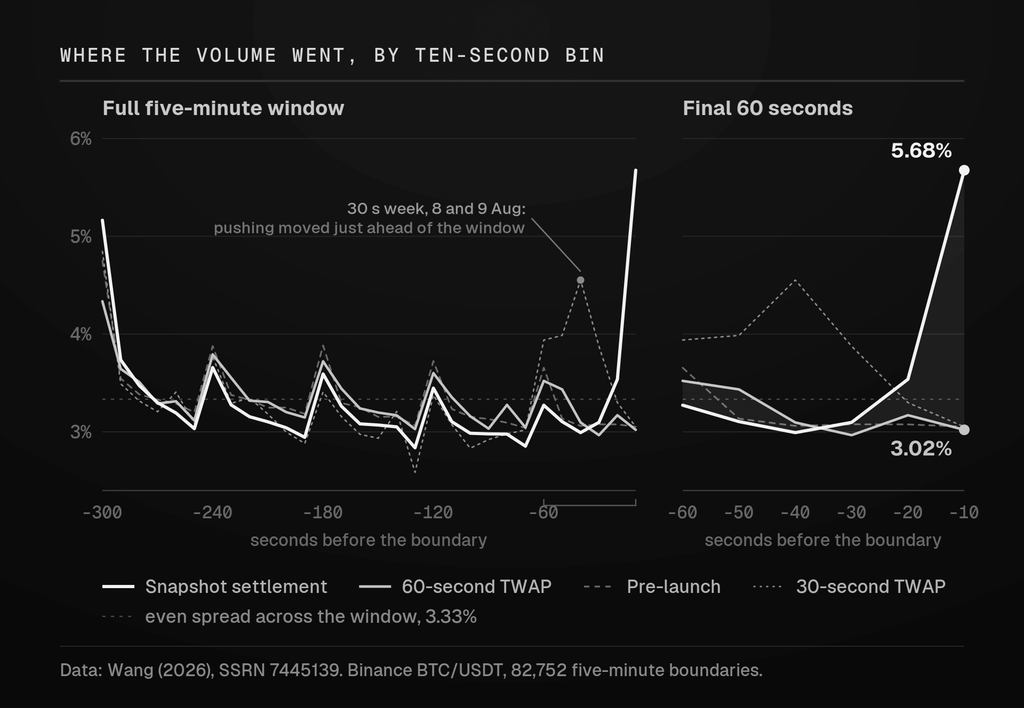
Under snapshot settlement the footprint was unmistakable. Before the 5-minute contract existed, the final ten seconds carried 3.05 percent of window volume. Under snapshot settlement it carried 5.68 percent. Tenfold volume spikes in the final ten seconds became six times as frequent. Near the strike, roughly a seventh of each final-ten-second price move reversed within thirty seconds, the signature of a push rather than information. In cycles within five basis points of the strike, the final-ten-second share was 7.46 percent against 4.14 percent further away. In dollar terms, the final ten seconds carried about $24 million a day more than an even spread of volume would imply.
Under the 60-second average the footprint is gone. The final-ten-second share is 3.02 percent, within 0.03 percentage points of its pre-launch level, and the confidence interval rules out any surviving excess above 0.11 points. Near-the-strike moves no longer revert; if anything they continue, which is what price moves do when they carry information rather than pressure. The excess dollar volume in the final ten seconds is gone. The footprint vanished in the week of the switch and has not returned.
Volume did not migrate to earlier bins. This was the obvious worry: an average can be moved by trading throughout its window, so a falling final-ten-second share need not mean a vanished incentive. Under the 60-second rule, no ten-second bin in the final minute differs from its pre-launch share by more than 0.30 percentage points.
The announcement changed nothing; the rule did. Polymarket announced the switch on 30 July, eight days before it took effect. Across those eight days the final-ten-second share averaged 6.0 percent, no different from the months before. Traders did not withdraw when told the rule was coming. They withdrew when it arrived.
The 30-second week is the interesting exception. During the seven days on the 30-second window, the final ten seconds looked clean, but on Saturday 8 and Sunday 9 August the thirty seconds immediately before the averaging window opened carried 20 and 19 percent of window volume, against nine to ten percent normally. Pushing had moved to just ahead of the window rather than stopped. That concentration does not appear anywhere in the 22 days of the 60-second regime. It is the clearest evidence available that the window’s length matters, and it is consistent with Polymarket doubling the window a week in.
Two things the paper is careful about, and so is this page. Its design compares before and after, with no untreated market, so it cannot separate the TWAP switch from the liquidity rewards Polymarket paid on the same contracts in the same month. And it does not test the open as a separate target, so it should not be read as having done so. The author’s own open question is whether a one-minute average will hold once stakes grow.
One further figure for anyone trading these markets: traded 5-minute BTC cycles carried $91,600 of contract volume on average under snapshot settlement and $54,100 under the 60-second rule, a fall of roughly 40 percent. Some of that is the manipulators leaving. Some may be everyone else.
Citation, in the form the author requested: Wang, Guangzhe, Does a Time-weighted Average Price Deter Settlement Manipulation? Evidence from Polymarket’s Five-minute Bitcoin Markets (September 11, 2026). Available at SSRN, abstract 7445139. The author states he does not trade prediction markets or crypto and has no financial interest in any platform.
Polymarket TWAP strategy impact, by strategy type
The mechanism is simple enough to reason about directly. Moving a snapshot means dislocating the price for one instant. Moving a 60-second average means holding that dislocation for a full minute while every arbitrageur on the other side fades you. That is not a slightly higher cost, it is a different class of problem, and it scales with the window.
What follows is reasoning from the mechanism, now supported by the measured data above.
Settlement snipers and final-seconds pushes. Ended, and the data confirms it. The strategy that extracted eight figures from 5-minute Bitcoin does not survive an averaged close, and the final-ten-second footprint is back at its pre-launch level. Because both ends of the contract are averaged, there is no single-print end for the strategy to migrate to.
Latency arbitrage against stale quotes. Alive. If your edge was reading the underlying and hitting a Polymarket quote that had not repriced, the settlement mechanism was never what you were exploiting. What changes is the other side of the trade: makers now carry less risk of a settlement flipping on a single print, so they can quote tighter and reprice with more confidence. The 17 August cut in the taker delay from 250 to 50 milliseconds narrows the stale-quote window further. Expect the windows you were harvesting to narrow rather than vanish.
Market makers. The clear winners. Less settlement-flip risk, plus the August liquidity rewards aimed squarely at this seat. Inventory risk during a real market move is unchanged, because a TWAP still moves when the market really moves.
Copy trading. Worse, and worth saying plainly. The wallets that looked most worth copying in 5-minute crypto were disproportionately running the strategy that stopped working on 7 August. Any track record built before that date is a record of a different game. The 40 percent fall in contract volume after the switch is consistent with some of those wallets leaving.
The strategy that replaces sniping. Once the window opens, the settlement value becomes a partially determined running average. That converts a speed problem into a forecasting problem: estimating where the average lands given what has already printed, and quoting against that estimate. Speed still matters, but it is speed applied to tracking and requoting rather than to landing one order at one instant. A 60-second window on a 5-minute contract makes that estimate easier to form and available earlier.
Polymarket rewards, fees, rate limits and the taker delay
Four things that change the arithmetic of the maker pivot above.
The liquidity rewards are a top-up to an existing programme, not a new one. Polymarket scores resting limit orders on a curve that rewards tightness to the midpoint and boosts two-sided quoting, normalises your score against every other maker, and pays out daily. The allocation is published by duration and by asset, and each incentivised market publishes its own configured daily reward rate, maximum qualifying spread and minimum qualifying order size. Query the real number for the market you intend to quote. Rewards are tallied per day against a $1 minimum, and days below it are not paid and do not roll over, so spreading thin across many markets can score all day and pay nothing.
Fees still favour makers heavily. The crypto taker fee is charged on a curve that peaks at the 50 cent midpoint, which is exactly where these markets trade, while makers pay nothing and receive a rebate funded from collected taker fees. That asymmetry existed before the switch and is unchanged by it, but it compounds with it.
The taker delay was cut. On 17 August 2026 at 11:00 UTC the delay on crypto markets went from 250 milliseconds to 50, per the changelog. A taker order that enters the delay window is pending until it completes and cannot be cancelled while pending. Anything in your execution logic that assumed a quarter-second is now wrong by a factor of five, in the direction that makes stale-quote windows shorter.
Per-signer rate limits. Polymarket runs token-bucket limits per signer, separate from address-level limits, with tiers scaling by thirty-day maker volume. Watch the rate-limit headers on your responses, and note that a batch is all-or-nothing against your bucket, so a batch larger than your burst capacity can never be admitted and must be split.
What is still unknown about the Polymarket TWAP
How Chainlink computes the value. Still unpublished. The sampling boundaries, weighting, rounding and missing-input behaviour are not documented, and Polymarket’s docs explicitly tell developers not to reproduce the value independently. The settlement number is an authoritative black box: you verify the signature and the freshness, you do not recompute it.
Which venues feed the stream. Chainlink aggregates several exchanges and does not name them or their weights. Every published measurement of the change, including the paper above, uses Binance as a proxy.
Whether the effect holds as stakes grow. The measured period covers a few weeks of a smaller market. The author of the paper flags this openly, and so should anyone building on it.
Integrating the Polymarket TWAP feeds
Two routes. Chainlink Data Streams gives you the signed reports directly, with the SDK handling authentication and reconnection. Polymarket’s Real-Time Data Streaming WebSocket relays the same Chainlink-computed values without credentials, using the 30-second and 60-second TWAP topics, filtered with an exact compact JSON symbol form, and kept alive with a PING text frame every five seconds.
The documentation does not publish feed identifiers: you find an asset’s TWAP ticker in the Chainlink Data Streams catalog and copy the ID from its product page. RTDS is the recommended production integration. Pull current identifiers and versions from Polymarket’s Chainlink TWAP documentation rather than from any blog, including this one.
The operational details that actually bite:
- The 30 and 60 second figures are lookback windows, not publication rates. Do not infer the window from update frequency and do not use update frequency as a health check. Use the observation timestamp for freshness.
- There is no snapshot, no history and no replay. Subscriptions start at the next update, so a disconnect at the wrong moment leaves a hole the stream cannot fill. Your reconnect path needs Data Streams as the authoritative source.
- Decoding is not verifying. The decode step parses the report, it does not verify the signatures. For anything settlement-sensitive, follow Chainlink’s verification requirements.
- Your clock is a dependency. The SDK signs each request and expects your server clock within five seconds of Chainlink’s. A drifting box fails in ways that look random rather than in ways that look like a clock problem.
- Preserve the exact value. The feed carries a full-accuracy fixed-point number alongside a display value. Keep the exact one as an integer or decimal string. Rounding a settlement price through a floating point type is how you build a bot that is right about the market and wrong about the outcome.
The 30-second topic settles nothing
Polymarket documents two windows, and RTDS exposes both a 30-second and a 60-second topic with equal prominence. But 5-minute markets moved to the 60-second stream on 14 August, and 15-minute and 4-hour markets were always on it. No live crypto up/down market resolves against the 30-second feed.
That makes it the most dangerous subscription in the stack. The 30-second topic is live, it returns real and correct numbers on schedule, and every health check you have will pass. It simply is not the number your markets settle on. Nothing errors, nothing disconnects, and your settlement logic drifts from reality without a single warning.
Check which topic your bot subscribes to before you check anything else, then match it against the Resolution Source printed on the market page for each duration you trade. The market page is the authority, not the documentation.
What to do with your Polymarket bot now
- Confirm you are reading the right TWAP window, not just a TWAP. Open a live market in each duration you trade, read the Resolution Source, and match it to the topic your bot subscribes to. If any part of your stack still infers resolution from a last-traded price or a single tick, it is wrong on every 5-minute, 15-minute and 4-hour crypto market.
- Model the strike as an average, not a print. The price to beat is the TWAP feed’s value at the open, which is the average of the preceding window. If your model reads a spot price at the boundary as the strike, it is off by whatever the last minute did.
- Separate your hourly logic from your TWAP logic. Hourly and daily markets settle on Binance candles and share no data path with the rest. If one codebase trades both, it needs two resolution models.
- Verify your feed path end to end. Confirm your topics return live events, confirm your decoder matches the current report schema and price scale, and confirm signature verification is actually running rather than merely present in the code.
- Update your taker-delay assumption. It is 50 milliseconds on crypto markets, not 250. Anything timed around the old figure is stale.
- Log both numbers for a week. Record the close print and the settlement TWAP for every market you touch. That dataset tells you how far apart they run in practice, which is the input to every edge estimate you make next.
- Re-derive rather than adjust. The measured data says the sniping edge is gone at the close and cannot move to the open. If your model was fitted to the old mechanism, a correction factor will not rescue it. Small size and a clean log are the cheapest way to find out what survives.
What infrastructure changes here, and what it does not
Our honest read, as the company that sells the servers.
The pitch that speed wins you a race to a single settlement print is finished, and the measured data confirms there is no such print left in these contracts. What survives is less glamorous and more durable: a stable low-latency path for quoting and cancelling, a machine that stays up through a window you cannot pause, clock discipline for a feed that checks your clock, and enough headroom to run a verification path alongside your trading path without either one starving. A 50-millisecond taker delay makes the quoting path matter more, not less.
What infrastructure does not fix is the strategy. If your edge was the snapshot, no server restores it. Rebuild first, then measure the path. The method for measuring it properly has not changed, our latency checker still gives you a zero-install first look, and our position on providers quoting fixed millisecond numbers from a sales page has not changed either.
For where the order engine actually sits and what drives these markets, see our Polymarket crypto trading infrastructure guide. If your client predates the April exchange upgrade, fix that first with the V2 migration guide, because a bot that cannot place an order has no opinion about settlement. Both our Polymarket locations come with a free 3-day demo if you want to measure the path yourself.
How we checked this
The settlement mechanics come from Polymarket’s own materials, read directly: the changelog entries of 7 August, 14 August, 17 August and 4 September 2026, the Chainlink TWAP documentation page, and the resolution text of live 5-minute, 15-minute and 4-hour markets, which bind resolution to a named Chainlink TWAP stream and exclude spot sources. Hourly and daily mechanics come from live Bitcoin market rules naming Binance candles. Reward allocations and the taker delay come from Polymarket’s documentation and changelog.
The measured effects of the switch come from the Wang working paper, read in full, together with bin-level results the author supplied on request. Every figure attributed to it is from the paper or that correspondence, and its own caveats, that the design cannot separate the switch from the liquidity rewards and does not test the open as a separate target, are carried across rather than dropped. The paper is not peer reviewed. Its findings are the author’s and are kept distinct from our views.
Frequently asked questions
TWAP means time-weighted average price: instead of reading the price once, it is averaged across a defined window. Since 7 August 2026, Polymarket’s 5-minute, 15-minute and 4-hour crypto up/down markets settle against a Chainlink-computed TWAP at both the open and the close. The window is 60 seconds for all three durations.
Sixty seconds. They launched on 7 August with a 30-second window and moved to 60 seconds at 00:00 UTC on 14 August, which Polymarket’s changelog records. Live 5-minute markets name the 60-second Chainlink stream as their resolution source. You can confirm it by opening any live 5-minute market and reading the Resolution Source line.
Before. It is a trailing lookback covering the seconds immediately preceding the close. Live market rules bind resolution to a Chainlink stream that names the window length, and Polymarket’s documentation describes the figures as lookback windows rather than publication rates.
Yes. Polymarket’s changelog states that both the price to beat and the final settlement price come from the applicable TWAP feed. The strike is the feed’s value at the open, which is the average of the preceding window, not a single print. Both ends of the contract are averaged.
Crypto up/down markets at 5-minute, 15-minute and 4-hour durations, confirmed live across BTC, ETH, SOL, XRP, DOGE, BNB, ZEC and HYPE. Hourly and daily up/down markets are not TWAP markets: they settle on Binance candles with no Chainlink involved. Always read the rules text of the specific market you trade.
No. Bitcoin hourly up/down markets settle on the Binance BTC/USDT one-hour candle, resolving Up if the candle closes at or above where it opened. Daily markets use a Binance one-minute candle. There is no Chainlink stream and no averaging, so none of the TWAP mechanics on this page apply to them.
The first measured data says yes, at least so far. A working paper found the final-ten-second volume share on Binance rose from 3.05 to 5.68 percent under snapshot settlement and returned to 3.02 percent under the 60-second average, with no migration to earlier bins and no more price reversals near the strike. The paper cannot separate the switch from the liquidity rewards paid the same month, and it is not peer reviewed.
There is no single-print open for it to move to. Both ends of the contract read the same averaged feed, so a push at the open faces the same problem as a push at the close. The measured data did not test the open as a separate target, so this is reasoning from the mechanism rather than a measured result.
No. It ends the specific game of racing to influence or capture a single settlement print. Quoting, cancelling and reacting to the underlying still reward speed, and market makers arguably need it more now, especially since the taker delay fell to 50 milliseconds. The edge shifts from sniping an instant toward tracking and forecasting a moving average.
Either directly from Chainlink Data Streams with credentials, or from Polymarket’s Real-Time Data Streaming WebSocket without them, using an exact symbol filter and a five-second PING heartbeat. RTDS is the recommended production integration. Subscribe to the 60-second window, which is what every crypto up/down duration settles on. Feed identifiers are not published in the documentation, so find an asset’s TWAP ticker in the Chainlink Data Streams catalog.
Because no live market settles on it. All three affected durations use the 60-second stream, so a bot subscribed to the 30-second topic is reading live, correct, on-schedule numbers that no market resolves against. Nothing errors and every health check passes, so the drift is silent. Check your subscription against the Resolution Source on the market page.
No, and you should not try. Chainlink has not published the feed’s sampling boundaries, weighting, rounding or missing-input behaviour, and Polymarket’s documentation explicitly says not to reproduce the value without a specification. Verify the signed report and its freshness instead of recomputing the number.
The shape of one is clear. Once the window opens, the settlement value becomes a partially determined running average, so the work moves from landing one order at one instant to estimating where that average lands and quoting against it. A longer window makes that estimate available earlier. Treat every specific profitability claim, including any of ours, as untested until you have your own live data.
Confirm you are reading the right TWAP window by matching the Resolution Source on a live market to the topic your bot subscribes to. Then make sure your model treats the strike as an average rather than a spot print, update your taker-delay assumption to 50 milliseconds, verify your feed path end to end including signature checking, and log the close print and the settlement average side by side for a week before you trust any edge estimate.
The settlement mechanics on this page come from Polymarket’s changelog and documentation and from the resolution text of live markets, read directly. The measured effects of the switch come from a working paper by Guangzhe Wang (SSRN 7445139), which has not been peer reviewed and whose findings are the author’s own. The rules text of the market you are trading is always the current authority, including over this page. This is infrastructure and educational content, not trading or financial advice.