
If you run a bot on Polymarket’s short crypto markets, the BTC and ETH “Up or Down” contracts that settle every 5 or 15 minutes, you have probably been told two things. First, that you need a server in Dublin. Second, that speed to Binance is the whole game, or alternatively that Polymarket now “leads” Binance so it does not matter.
Two of those three claims are wrong, and the third is only half right. Here is the honest version, with the sources, because the difference between a setup that works and one that quietly bleeds fees comes down to getting these details correct.
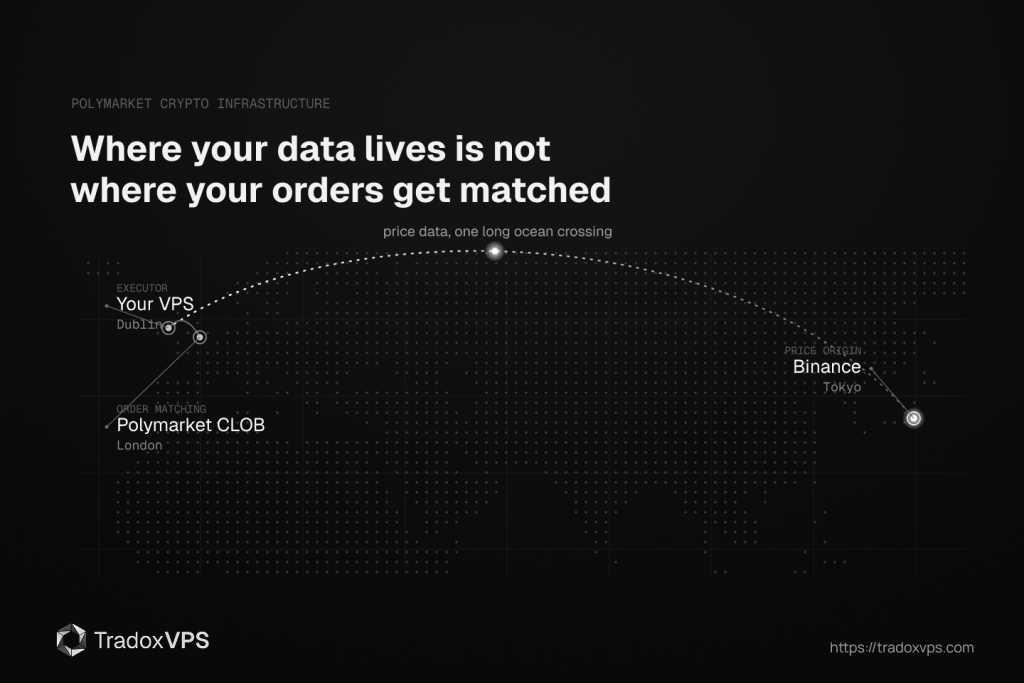
The short answer up front: Polymarket’s order engine is hosted in London, not Dublin. The market you are trading resolves on a Chainlink price feed that tracks Binance almost exactly, so Binance is still the ground truth. And the fastest raw price data on earth for BTC starts its life in Tokyo, roughly 200 milliseconds of round trip away from Europe no matter where in Europe you sit. Build around those three facts and you will make better decisions than most people running these markets.
The one location fact that matters here
We have covered where to host a Polymarket bot in depth already, so this is the short version, with one detail the crypto discussion actually depends on.
Jurisdiction comes first, always. Polymarket’s global platform is geoblocked in a long and growing list of countries (the United States, the United Kingdom, France, Germany, the Netherlands, and many more, with additions through 2026), enforced by IP. We do not help anyone evade that, and any provider who does is trading your account and sanctions risk for a sale. Choosing a compliant region near the engine is fair. Using a VPN to trade from a blocked country is not.
The detail that matters for what follows: the order engine itself is not in Dublin. When you trace the CLOB (the off-chain order book at clob.polymarket.com) through its Cloudflare layer, the origin lands in AWS London (eu-west-2), confirmed by Glassnode’s latency monitor, Polymarket’s own docs, and independent tracing. Dublin matters only because it is the closest region to London that is not geoblocked, about 11 to 12 milliseconds away on the AWS backbone. That is why Dublin wins for Polymarket, not because the engine lives there. For the full location breakdown and how to test each option, see our Polymarket VPS guide and how to test your Polymarket VPS latency.
Two quick footnotes. There is now a separate, CFTC-regulated Polymarket US on its own stack; infrastructure advice for the global CLOB does not map to it. And if you ever probed Polymarket and saw a US origin (Ashburn, Virginia), you were hitting the website front end or the US stack, not the global CLOB. The rest of this post is the part those location guides do not cover: the crypto data itself.
What actually decides these markets: the oracle, not the order book
Here is the fact that reframes the whole speed question. Since Polymarket launched 5-minute BTC markets on 12 February 2026 (built on the earlier 15-minute structure), these short crypto contracts resolve using Chainlink Data Streams, a low-latency oracle that aggregates BTC/USD (and ETH/USD, and others) across major spot exchanges.
Polymarket even exposes that exact feed on its real-time data WebSocket. Traders confirm the crypto_prices_chainlink topic streams the same number shown as the on-screen “Price to Beat” at the window boundary. The market grabs the oracle price at the opening timestamp, compares it to the oracle price at the close, and “Up” wins if the close is at or above the open.
Whatever the Chainlink stream prints at the boundary is, by definition, the truth for that market. Not your Binance feed, not the Polymarket mid, the oracle. Any edge you think you have needs to be measured against that oracle print, and the oracle basket is heavily weighted toward Binance. Which brings us to the argument you have probably seen on X.
The lead-lag question: does Polymarket now lead Binance?
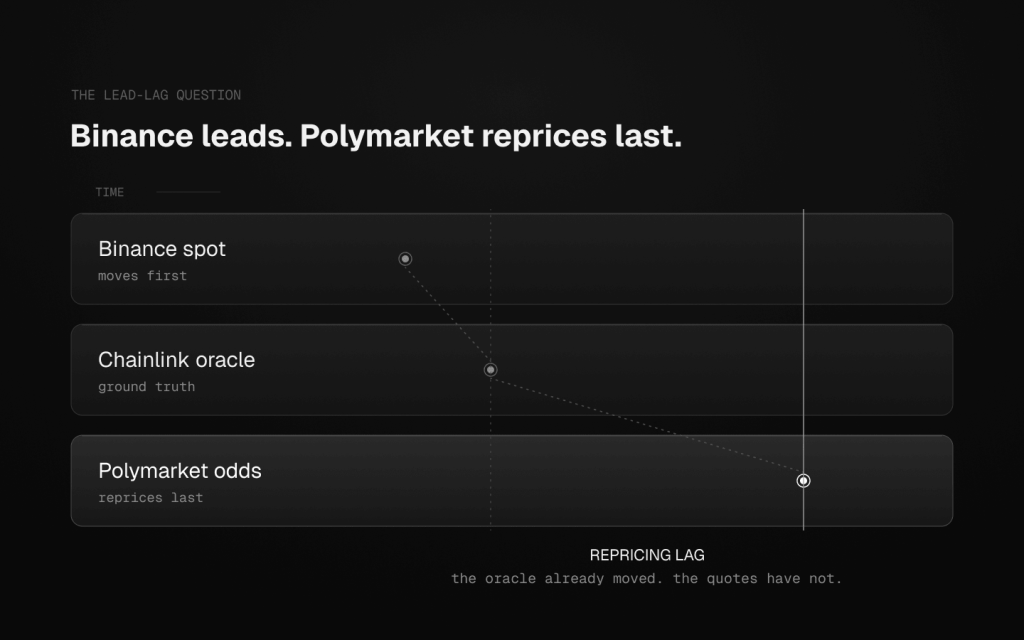
You have heard both versions. The old one: Binance moves, then Polymarket odds catch up. The newer one: Polymarket odds move first, and Binance follows. People point to the second and conclude that being fast to Binance no longer matters.
The clean verdict: Binance still leads in the only sense that pays out, and “Polymarket leads Binance” is a misreading of something real.
Two different things are getting mixed up:
Ground truth at settlement. The market resolves on the Chainlink feed, and that feed moves almost one-for-one with Binance spot. A July 2026 working paper from researchers at Stanford and Singapore Management University (Dai, Jia and Yu, “Settlement Manipulation in Prediction Markets”) measured it: Binance’s mid sits about two and a half basis points from the oracle, moves essentially in lockstep with it inside each 5-minute window, and finishes on the same side of the strike as the market resolution about 85% of the time. It is structurally impossible for Polymarket to “be the truth” here, because an external Binance-linked feed is what decides the outcome.
Odds moving before Polymarket’s own makers reprice. This is the real thing behind the “Polymarket leads” intuition, and it is not price discovery flipping. It is fast traders reading Binance and the oracle, then buying the correct side on Polymarket before the resident market makers move their quotes. Practitioners describe a 30 to 90 second window where Polymarket odds lag a Binance move before fully repricing. That lag is the edge people are harvesting. It is latency arbitrage against slow quotes, not evidence that Polymarket discovers price ahead of Binance.
So both camps are describing the same mechanism and drawing opposite conclusions. Speed to the price still matters. What it buys you is the chance to hit stale Polymarket quotes during that repricing lag, and the person who does it faster (and sizes it sanely) wins that slice.
There is a darker version of this too, worth knowing about even if you never touch it. The same paper documented that in thin overnight and weekend windows, some traders do not just anticipate the oracle, they push Binance spot with one-sided flow in the final seconds to drag the oracle across the strike, then the price reverts. They estimated roughly 8.2 million dollars captured this way across about 16,000 five-minute BTC contracts in early 2026, with retail funding most of the losses. It is a structural weakness of very short settlement windows, and it is one more reason to treat the 5-minute market with respect and consider the 15-minute version, where the same paper found the effect far weaker.
The Tokyo problem: where the data lives versus where you trade
Now the physics. Binance’s spot matching engine runs in AWS Tokyo (ap-northeast-1). That is where BTC price discovery is fastest and where the tick that will eventually move the oracle first exists. Your order engine is in London. Those two facts are 200-plus milliseconds apart, and no amount of hardware changes the speed of light across an ocean.
Here are the real network distances, so you can reason about them honestly. These are AWS backbone round-trip measurements from public monitoring, not a promise of what you personally will see, and definitely not something we would ever stamp as a guarantee.
| Path | Round trip (approx.) | Source (as of July 2026) |
|---|---|---|
| Tokyo to Ireland (Dublin) | ~204 ms | cloudping.co P50 |
| Tokyo to London (CLOB region) | ~210 to 213 ms standard, ~140 ms on an optimized private backbone | cloudping.co P50; AWS/Avelacom benchmark, 28 Apr 2026 |
| US-East (Virginia) to Ireland | ~69 ms | cloudping.co P50 |
| Ireland (Dublin) to London (CLOB) | ~11 to 12 ms | cloudping.co P50 |
Read that table and the whole architecture debate falls out of it.
So what should you actually build?
Three shapes come up in practice. Here is the honest read on each.
Option A: one box in Dublin, subscribing to Binance from there. This is the correct default for almost everyone. The key insight is that the Tokyo-to-Europe delay hits the Binance data no matter where in Europe you sit. A Binance tick has to cross that ocean once to reach any European server. Where you sit in Europe only changes how fast you then reach the London CLOB (roughly 11 to 12 ms from Dublin) and whether you are legally allowed to be there. A single well-connected Dublin box loses almost nothing on the decision path versus anywhere else legal in Europe, and it keeps you compliant. Start here.
Option B: a split setup, a collector in Tokyo feeding an executor in Dublin. This is the one people over-invest in. Be clear about what it does and does not buy you. It does not teleport the data: the signal still has to cross Tokyo to Europe once, whether as raw Binance frames to your Dublin box or as a compact “buy Up” signal from a Tokyo collector. Your order still fires from Europe either way, because that is where the engine is. What a Tokyo collector genuinely can buy you is three smaller things: you compute your decision about 2 ms from Binance instead of ~100 ms (one way) later in Europe, you forward a tiny signal instead of full order-book frames, and you can justify a premium private backbone. That last one is measurable: the AWS and Avelacom benchmark cut Tokyo to London from about 210 ms to about 140 ms over an optimized private path, a real saving of roughly 70 ms versus public routing. Worth it only if you have already maxed out your Europe-to-CLOB speed and your win rate is provably sensitive to sub-100 ms differences in signal arrival. For most operators, it is complexity you do not need yet.
Option C: use a closer exchange as a proxy feed. Kraken Futures runs in Dublin (eu-west-1), essentially next door to your executor with near-zero propagation. Coinbase runs in US-East (Virginia), about 69 ms from Europe. The trade-off is feed quality: neither Kraken nor Coinbase is what the oracle weights most heavily, and Binance is the venue that leads BTC price discovery. Using a European feed as a fast confirmation alongside a Binance primary is defensible. Using it alone means you may act on a move that has not yet, or will not, show up in the Binance-weighted oracle that actually settles your market.
The setups documented in the wild are almost all Option A: a single EU VPS in Dublin or Amsterdam-adjacent regions, subscribing to Binance (and sometimes Coinbase) WebSockets, firing at the London CLOB, and competing on the Europe-to-engine hop plus signal logic and discipline. The exotic split architectures are rarer than the forum chatter suggests.
The uncomfortable part: fees are eating the naive edge
Speed alone is a fading strategy, and honesty requires saying so. In January 2026 Polymarket introduced taker fees on crypto markets and has expanded them since. The fee curve is deliberately highest right at 50/50, exactly where the latency bots operate. Reporting put the effective taker fee as high as around 3% on a 50-cent contract, which is more than most latency-arb margins. That is not an accident, it is the mechanism Polymarket chose to neutralize the strategy, in place of a speed bump or a batch auction.
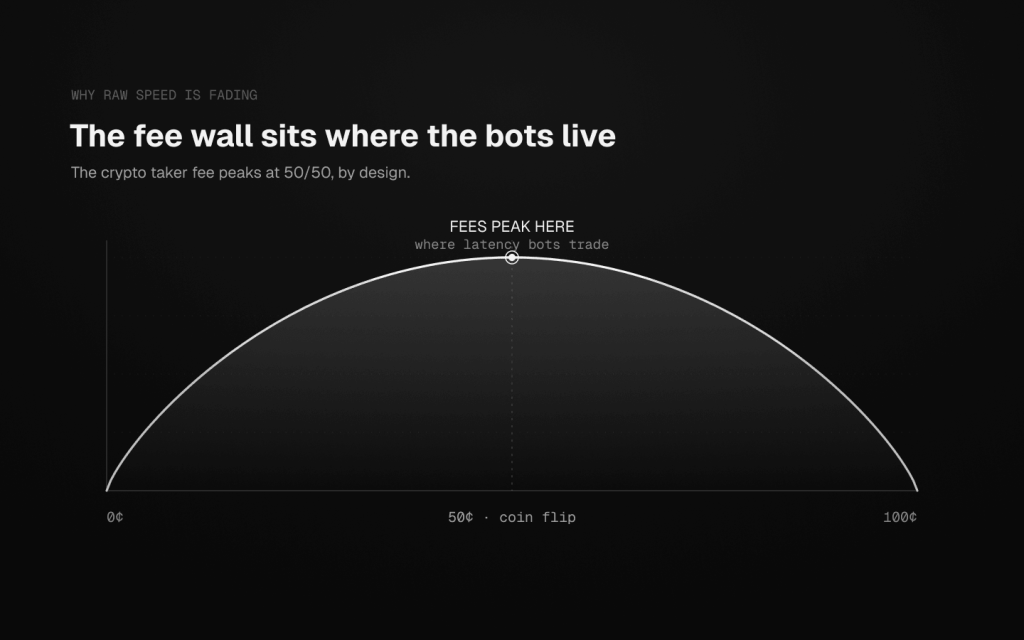
The implications are concrete. Prefer maker or limit orders where your strategy allows, since those avoid the taker fee (and can earn rebates). Model the fee into every trade before you decide the edge is real. And accept that if your entire thesis is “be milliseconds faster to Binance,” the window on that has narrowed sharply since fees launched. The traders still winning are combining speed with fee-aware execution and risk sizing, not relying on raw latency.
A sane, staged build
- Get location and legality right first. Host the executor in Dublin, the fastest region to the London engine that is not geoblocked. If you can pass Polymarket’s KYC, ask about co-location in the London region for the lowest possible engine latency. Never evade a geoblock.
- Build the data path. Subscribe to Binance bookTicker or aggTrade as your primary signal, and subscribe to Polymarket’s
crypto_prices_chainlinktopic as your resolution reference, because that is what actually settles the market. Add Kraken (Dublin) or Coinbase (Virginia) as optional low-latency confirmation, understanding they are proxies. - Add a Tokyo collector only at the frontier. Do it only after you have logged your own timestamps (Binance tick, decision, order acknowledgment) and proven your win rate is sensitive to sub-100 ms differences. Otherwise it is over-engineering.
- Make it fee-aware and manipulation-aware. Price the taker fee in, lean on limit orders, avoid thin overnight and weekend windows on the 5-minute market, and consider the 15-minute market where settlement games are weaker.
Measure your own path, do not trust a number on a sales page
Every latency figure in this post is a third-party network measurement of the internet’s physics, dated and sourced. None of it is a promise about what your bot will see to Polymarket, because that depends on your exact route, your code, and the moment you measure. Anyone quoting you a fixed “sub-1ms to Polymarket” is quoting a ping to a CDN edge, not an order round trip to the London engine.
The only number that means anything is the one you measure from your own server to the endpoints you actually use. That is why we publish real per-plan hardware results on our benchmarks page and give you a live latency checker to test the path yourself, and why we walk through the method in how to test the latency of your Polymarket VPS. If you are deciding where to host a Polymarket crypto bot, our Polymarket VPS guide and current pricing cover the Dublin options in detail.
And the honest caveat we lead with everywhere: if you are a casual Polymarket user placing occasional bets by hand, you do not need any of this. Low-latency infrastructure is for automated, latency-sensitive strategies where the repricing lag is your edge. If that is not you, save your money.
Frequently Asked Questions
The CLOB and its order WebSocket resolve, through Cloudflare, to AWS eu-west-2, which is London. Dublin is only relevant because it is the closest region to London that is not geoblocked, roughly 11 to 12 milliseconds away on the AWS backbone. As of July 2026 this is a high-confidence inference from Glassnode, Polymarket’s docs, and independent tracing, but Cloudflare hides the true origin, so it is worth confirming with your own probe.
Binance leads in the sense that pays out. These markets resolve on a Chainlink oracle that tracks Binance almost exactly, so Binance is the ground truth. When people say “Polymarket leads,” they are describing fast traders buying the right side before Polymarket’s own market makers reprice, a 30 to 90 second lag. That is latency arbitrage against stale quotes, not Polymarket discovering price ahead of Binance.
A Chainlink Data Streams price feed (BTC/USD, ETH/USD and others), which Polymarket also streams live on its data WebSocket as the “Price to Beat.” The market compares the oracle price at the window open to the oracle price at the close. Confirm the mechanism at docs.polymarket.com before relying on it, since oracle arrangements can change.
Usually no. Binance’s engine is in Tokyo, but that Tokyo-to-Europe delay (around 200 milliseconds round trip) applies to the data no matter where in Europe you sit, and your order still fires from Europe because that is where the CLOB is. A Tokyo collector only buys you earlier processing, a smaller forwarded payload, and the option of a premium private backbone. It is worth it only at the very front of the queue, after you have proven your edge is sensitive to sub-100 millisecond differences.
Less than it used to be. The crypto taker fee peaks right at 50/50, exactly where latency bots operate, and can exceed typical arbitrage margins. Speed alone is a fading edge. Traders still winning combine speed with fee-aware execution (favoring limit orders) and disciplined sizing.
No, and we will not help with that. It violates Polymarket’s terms and creates account and sanctions risk. Choosing a compliant hosting region near the engine is a legitimate infrastructure decision. Evading a geoblock is not.
It depends on your exact route, your code, and when you measure, so no honest provider can hand you a fixed number. Anyone quoting a fixed “sub-1ms to Polymarket” is measuring a ping to a CDN edge, not an order round trip to the London engine. Measure your own path with a latency checker from the server you plan to use.
Disclaimer: This article is infrastructure and educational content, not trading or financial advice. Trading prediction markets carries risk, and short-duration crypto markets carry the specific risks described above, including settlement manipulation in thin windows. Latency figures are third-party measurements as of July 2026 and change over time. Availability of Polymarket depends on your jurisdiction, and you are responsible for complying with the platform’s terms and your local law. Do not use infrastructure to evade geographic restrictions.