
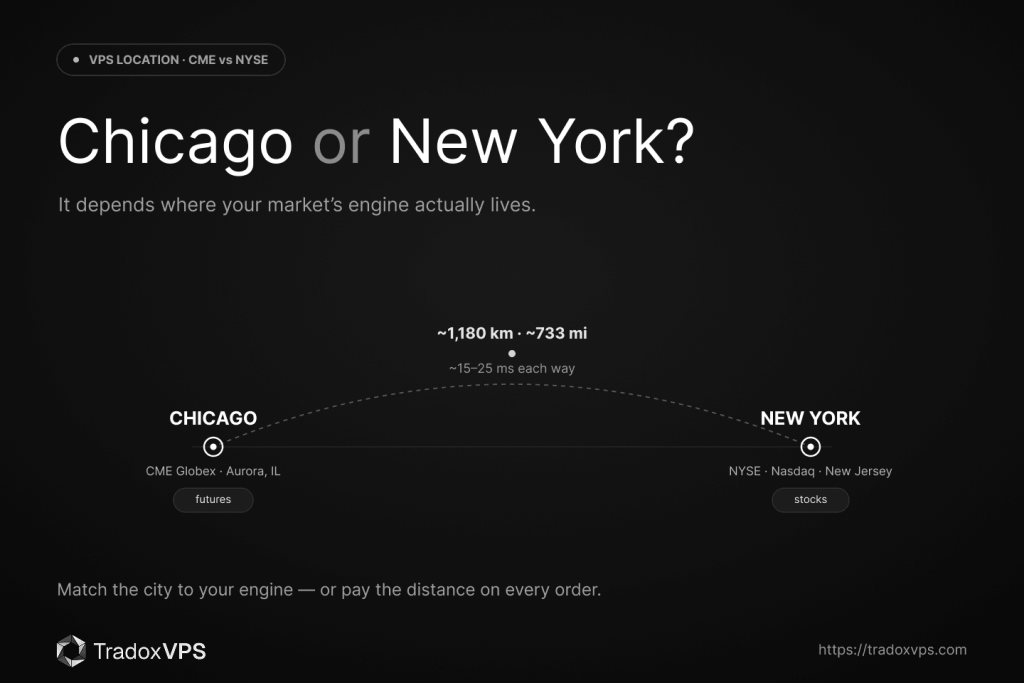
Pick the wrong city and you hand away 15 to 25 milliseconds on every single order, before your strategy has done a thing. The Chicago-versus-New-York question has a clean answer, but it isn’t the one most people assume. New York is the name everyone attaches to American trading, and yet the CME’s futures matching engine isn’t in New York, or even in downtown Chicago. It’s in Aurora, Illinois. So the right call depends entirely on what you trade, and this lays out exactly which city wins for which market, with the latency numbers, so you don’t pay a cross-country tax for sitting in the wrong place.
The one rule that decides it
For VPS location, the only thing that really matters is physical distance to your market’s matching engine — the exchange computer that pairs your buy order with someone else’s sell. Latency is mostly a function of distance, so you want your server in the same metro area as that engine. The mistake, made constantly, is choosing a city by reputation, “New York equals Wall Street equals fastest,” instead of by where your specific market actually matches. Latency being distance is the whole reason hosting location matters at all, which we cover in how a low-latency VPS improves trade execution.
Where the engines actually are
Here are the facts most traders never learn, and they decide everything.
CME futures — the E-mini S&P (ES), the Nasdaq (NQ), crude (CL), gold (GC), the bonds, and all the micros, everything that runs on Globex — are matched at CyrusOne Aurora I in Aurora, Illinois, roughly 30 to 40 miles west of downtown Chicago. Not Manhattan. Not even the Loop. The proximity hosting hubs that serve it, Equinix CH1, CH2 and CH4, sit in the Chicago metro near that engine.
US stocks and equity options — NYSE and Nasdaq, are matched in northern New Jersey. NYSE runs in Mahwah, Nasdaq in Carteret, and the FX and broader financial hub lives at Equinix NY4 and NY5 in Secaucus. In other words, “New York” trading is really New Jersey trading.
So when people say “Chicago VPS” they really mean near Aurora, and when they say “New York VPS” they really mean near northern New Jersey. Each city is close to a completely different set of engines, which is the entire point.
Chicago vs New York VPS, side by side
[IMAGE: chi-ny-decision] <<<
| Chicago VPS | New York VPS | |
|---|---|---|
| Best for | CME futures (ES, NQ, CL, GC, micros), CBOT, NYMEX/COMEX | US stocks, equity options, equity-side FX |
| Matching engine nearby | CME Globex — Aurora, IL | NYSE (Mahwah), Nasdaq (Carteret), Cboe (Secaucus) |
| Typical latency to CME (Aurora) | ~1 ms (proximity) | ~15–25 ms (cross-country) |
| Typical latency to NYSE / Nasdaq (NJ) | ~15–25 ms (cross-country) | ~1 ms (proximity) |
| Who should pick it | Futures & prediction-market traders; NinjaTrader, Rithmic, Tradovate | Equity & options traders; US-stock algos |
| TradoxVPS status | Available (flagship) | Coming soon |
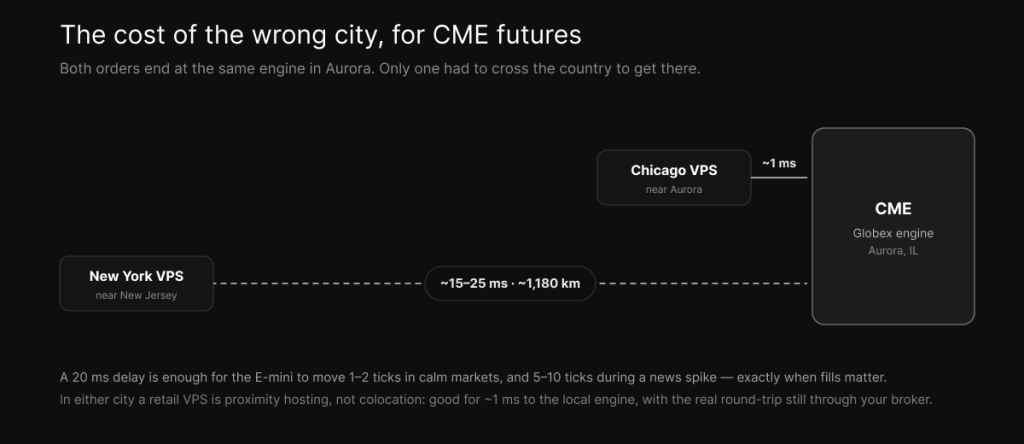
A note on those numbers, kept honest and consistent with everything else we publish: these are typical network paths, and in either city a retail VPS is proximity hosting, not colocation. It’s good for around a millisecond of network ping to the local engine, but your real order round-trip still runs through your broker’s gateway, so it stays in single-digit milliseconds regardless.
If you trade CME futures, it’s Chicago, and here’s the cost of getting it wrong
[IMAGE: chi-ny-latency-tax] <<<
For anything on CME Globex, a Chicago VPS near Aurora is the answer, full stop. Host in New York instead and every order makes a round trip of roughly 1,180 km, about 733 miles, to reach Aurora, which on a normal network path is 15 to 25 milliseconds of added latency. In futures terms that’s not abstract: a 20 ms delay is enough for the E-mini to move 1 to 2 ticks in calm conditions, and 5 to 10 ticks during a news spike — which is exactly the moment your fill matters most, and exactly where those ticks turn into slippage. You aren’t losing to high-frequency firms there; you’re losing to a geography you chose. This is the brand’s home market, and the Chicago VPS is built around that Aurora proximity, with the full case made in why a Chicago VPS is best for CME futures and the data-center detail in VPS near the CME data center.
If you trade US stocks or options, it’s New York (well, New Jersey)
The mirror image holds. NYSE and Nasdaq match in New Jersey, so a New-York-area VPS puts you about a millisecond from those engines, while a Chicago VPS adds the same cross-country tax in reverse. If your strategy is equities or equity options, New York is the right call, and forcing it onto a Chicago box just to be “near the CME” would cost you the same 15-to-25 ms going the other direction.
Here’s the honest brand note: TradoxVPS’s New York hub is launching soon — today the flagship is Chicago, built for futures. If you trade equities, New York is the box you want, and it’s on the way rather than live this minute. We’d rather say that than pretend otherwise.
What about forex, crypto, and prediction markets?
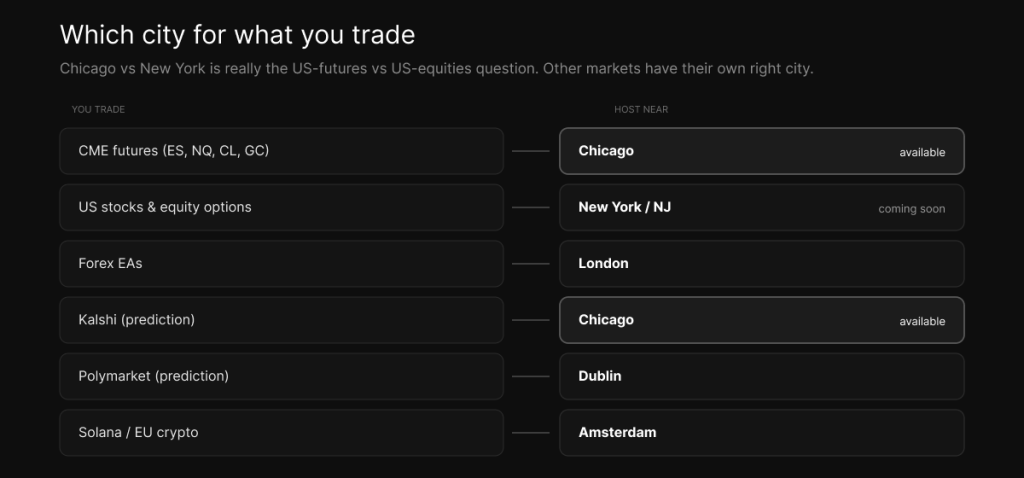
Chicago vs New York is really the US-futures-versus-US-equities question. Other markets have their own right city, and it’s worth knowing yours.
Forex isn’t a Chicago or New York decision at all. FX is most latency-sensitive near London, in the LD4 and LD5 ecosystem, where a large share of brokers host their servers, FTMO being a notable London-only example. That’s what the London VPS is for.
Crypto is venue-dependent. Many centralized exchanges match in Tokyo or specific AWS regions, and for Solana the relevant geography is validator-dependent, so neither Chicago nor New York is automatic; EU-centric crypto and Solana work is what the Amsterdam hub targets.
Prediction markets split too: Kalshi runs on CME-style infrastructure and is Chicago-adjacent, while Polymarket is better served from Dublin and the EU, which is why those sit on different hubs entirely.
The honest ceiling: city is a floor, not a finish line
Choosing the right city removes the biggest and dumbest latency cost there is, being in the wrong place. What it does not do is turn a retail VPS into colocation. Even on Aurora’s own campus, true microsecond execution means renting space inside the exchange’s data center, and CME charges around $12,000 a month plus a setup fee for a Globex handoff, before you add cross-connects, which is firmly institutional territory. A proximity VPS gets you roughly 1 ms of network ping to the local engine, your order still travels through your broker, and the real round-trip stays in single-digit milliseconds. That’s the honest expectation. The point of picking the right city isn’t to out-run the HFTs, it’s to not beat yourself by giving away 20 ms for nothing, which is precisely what hosting in the wrong city does. The proximity-versus-colocation line is the same one we draw in the automated futures bots guide.
So which VPS do you actually need?
The whole decision in one place:
- Trade CME futures → Chicago. Available now, and the brand’s core build.
- Trade US stocks or options → New York / New Jersey. Coming soon.
- Trade forex → London, not either of these.
- Trade Kalshi → Chicago; Polymarket → Dublin; Solana or EU crypto → Amsterdam.
Match the city to your venue’s engine, accept that a VPS is proximity rather than colocation, and you’ve made the right infrastructure call. If you trade futures, the Chicago box is ready, and you can compare plans on pricing.
Frequently asked questions
Chicago, clearly. The CME Globex matching engine is in Aurora, Illinois, near Chicago, so a New York VPS adds roughly 15 to 25 ms of cross-country latency on every order. For futures, Chicago wins on physics.
Because the CME matching engine isn’t in New York — it’s in Aurora, Illinois. New York’s exchanges, NYSE and Nasdaq, are for equities and actually sit in New Jersey, so New York’s reputation doesn’t help a futures trader at all.
In northern New Jersey — NYSE in Mahwah and Nasdaq in Carteret, with the FX hub in Secaucus — not Manhattan. So a “New York VPS” for trading really means a server near New Jersey.
Roughly 15 to 25 ms on a normal network path between the Chicago/Aurora and New York/New Jersey metros, which are about 733 miles apart. A 20 ms delay is enough for the E-mini to move 1 to 2 ticks in calm markets and 5 to 10 ticks during news.
Chicago is the current flagship, built for CME futures, and a New York hub is launching soon. For futures today, Chicago is both the correct and the available choice.
No. It’s proximity hosting near the Aurora campus, good for about a millisecond of ping to the local engine. True colocation inside the exchange data center is an institutional service that costs thousands of dollars a month plus cross-connect fees.
Then Chicago versus New York isn’t your question. Forex is most latency-sensitive near London, where many brokers host, so a London VPS is the relevant choice.
We operate TradoxVPS and provide trading infrastructure, not financial advice. Latency figures are typical for normal network paths and vary with your broker, route, and configuration; a proximity VPS is not exchange colocation and does not eliminate the round-trip through your broker. Trading futures and other leveraged products carries substantial risk, including the loss of more than your initial deposit.