
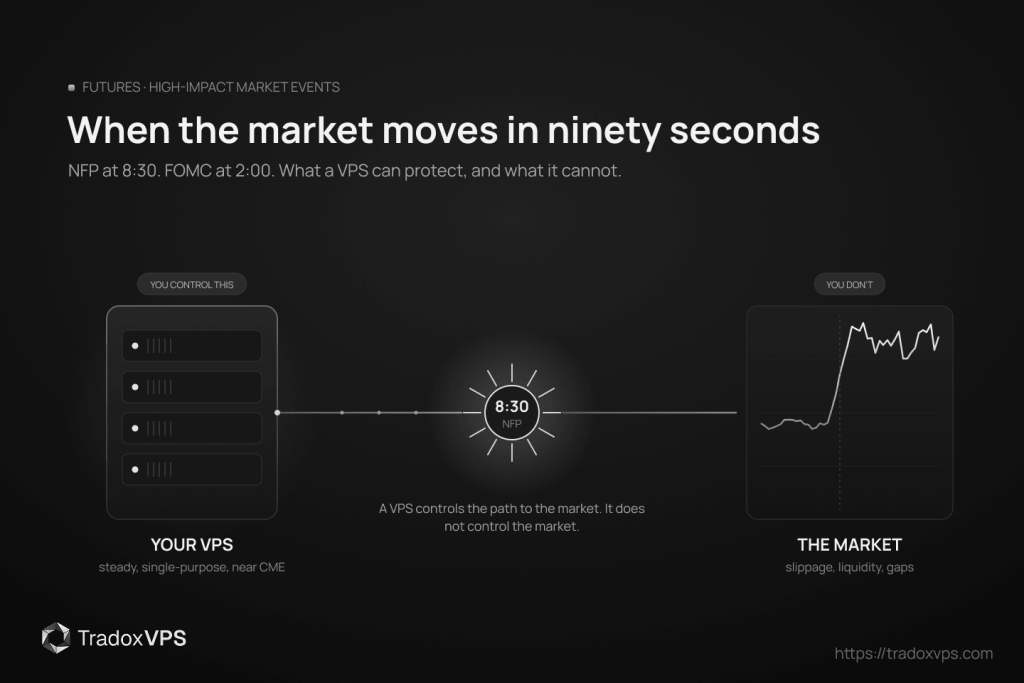
At 8:30 a.m. Eastern on the first Friday of most months, the US jobs report hits, and the E-mini S&P, the Nasdaq, gold and the Treasury complex move more in the next ninety seconds than they often do all day. At 2:00 p.m. Eastern on eight days a year, the Fed’s rate decision does the same, followed by a press conference at 2:30 that frequently moves it again. Four Fridays a year, the quarterly roll and quadruple witching pile expiring positions on top of everything else. For a futures trader running automation, these are not “some volatility.” They are the specific minutes where a month of careful work is made or unmade, and where the gap between a good setup and a fragile one becomes very expensive very fast.
This guide is about what actually happens to an automated futures setup during those events, and precisely how a VPS fits in. We are going to be more honest than most articles on this topic, in both directions: a VPS genuinely removes some of the biggest, dumbest ways traders lose money during high-impact events, and it does nothing at all about others. Knowing which is which is the difference between preparing properly and trusting infrastructure to do a job it cannot do.
The events that actually matter, and when they hit
Vague talk about “market events” is useless. Here is the real calendar a futures trader’s infrastructure has to survive, with the timing that matters:
- Nonfarm Payrolls (NFP). Released by the Bureau of Labor Statistics at 8:30 a.m. ET, usually the first Friday of the month. Because it lands before the New York equity open, it detonates directly in the futures market first. It is the single most reliably violent scheduled event of the month for index and rate futures.
- CPI (inflation). Also 8:30 a.m. ET, typically mid-month. In a rate-sensitive regime, a CPI surprise can reprice Fed expectations in seconds; there have been sessions where Fed Funds futures volume more than tripled in a single day on a hot print.
- FOMC rate decision. 2:00 p.m. ET, eight scheduled meetings a year, with the Chair’s press conference at 2:30 p.m. ET. The decision produces one move; the press conference often produces a second, larger one. This is a mid-session event, so it hits while you are likely already in positions.
- The CME quarterly roll and quadruple witching. The third Friday of March, June, September and December. Index futures and their options expire together, open positions get rolled from the front contract to the next, and volume and volatility surge, concentrated heavily into the final hour. If your automation trades the front month, it needs to be rolling to the new contract around this window, and liquidity behaves unusually while everyone else does the same.
- PCE, GDP, retail sales, and central bank speakers. A second tier that can still move futures sharply, often clustered around the same weeks as the majors.
The common thread: these are scheduled. You know NFP is Friday at 8:30 days in advance. That means the entire question is not “can I react faster than the news,” it is “is my infrastructure ready for a moment I can see coming.” That reframing is the whole point of this article.
What actually happens to your setup in those ninety seconds
When NFP prints, several things happen at once, and each stresses a different part of your stack:
- The data rate explodes. Tick volume can jump by an order of magnitude in seconds as every participant reacts. Your platform (NinjaTrader, Sierra Chart, MultiCharts) has to ingest, process, and chart that surge without falling behind. A machine that was comfortable at 9:00 a.m. can stall at 8:30:01 if it is underpowered or sharing resources badly.
- Your strategy fires into a moving market. Entries, stop adjustments, and bracket orders all try to execute at once, in the exact moment prices are gapping. This is where the difference between a request leaving your machine in 2 milliseconds versus 80 milliseconds actually shows up on the fill.
- Spreads widen and liquidity thins, then floods. For a brief window the book can be thin and fast; a market order can fill several ticks from where you saw it. This is a market-structure event, and it is the same for everyone in the venue.
- Everything downstream is under load too. Your data feed (Rithmic, CQG, Denali/Teton), your broker’s gateway, and the exchange’s own matching engine are all handling the same surge.
Read that list carefully, because it already contains the honest split this article is built on. Some of those stress points are on your machine and your path to the market, where a VPS helps directly. Others are in the market itself and the venues downstream, where a VPS changes nothing. Let’s take each side plainly.
What a VPS genuinely protects you from
These are real, common, expensive failure modes during high-impact events, and a well-placed VPS removes or reduces them. This is the honest case for hosting, and it is a strong one.
Your home internet choosing the worst possible moment to drop. The classic disaster: NFP prints, your residential connection hiccups or your Wi-Fi stutters, and your platform disconnects with a position open and a stop unconfirmed. A VPS sits on a data-center network built for uptime, not a household broadband line shared with everyone streaming in your house. Removing your home connection from the critical path during the exact minutes it is most likely to fail is, on its own, a sufficient reason to run automation on a VPS.
Your machine stalling under the tick surge. If your trading PC also has a browser with forty tabs, a game updating, and antivirus doing a full scan, the moment the data rate spikes is the moment it chokes. A dedicated, single-purpose VPS running only your platform, on a current CPU with fast storage, ingests the surge without the local stall that makes people think “the market moved against me” when really their machine froze for two seconds.
The retail-broadband routing penalty. A home connection reaches the exchange over a long, variable, consumer-grade path. A VPS in a data center near the exchange sits on a short, stable, business-grade route. During calm markets that difference is minor; during the burst after NFP, a shorter and more consistent path means your orders and your market data are less likely to lag exactly when milliseconds are moving.
Power and hardware failure at the worst time. A blackout or a dying home PC during FOMC is catastrophic and entirely avoidable. Data-center redundancy (backup power, redundant networking) takes that class of failure off the table.
Always-on operation for the roll and off-hours events. Futures trade nearly around the clock, and some catalysts land outside your waking hours. A VPS runs your automation and manages the contract roll whether or not you are at the desk.
The honest summary of this side: a VPS makes your own infrastructure reliable and fast under load, and takes your home environment out of the equation during the minutes it is most likely to betray you. For automated futures trading, that is real value, and it is what you are actually buying.
What a VPS cannot do, and no honest provider should claim it can
Here is where most “VPS for news trading” content quietly oversells, and where we draw the line clearly, because a trader who believes the overpromise gets hurt and rightly blames the person who made it.
A VPS does not prevent slippage. When the book thins and price gaps on an NFP surprise, a market order can fill several ticks away from the last print. That is a liquidity and market-structure event happening inside the exchange, identical for a co-located professional and a home trader. A VPS can make sure your order reaches the matching engine promptly and on a stable path; it cannot conjure liquidity that is not there or freeze the price while you fill. Anyone promising “minimized slippage under extreme volume” is describing something infrastructure does not control.
A VPS does not guarantee your fill price, or that you fill at all. In a fast market, stops become market orders and fill where liquidity exists, which may be well past your level. Limit orders may simply not fill as price rockets through them. This is the nature of the event, not a defect in your hosting.
A VPS does not speed up the exchange, your broker, or your data feed. Your order still routes through your broker’s gateway and the exchange’s matching engine, all of which are under the same load. Shortening the first leg (your machine to the venue) helps; it does not re-architect the parts you do not own.
A VPS does not fix your strategy. If your logic sizes too large for a volatile session, chases a gap, or has no rule for widened spreads, faster infrastructure just lets it make the same mistake more promptly. Execution speed is not a substitute for a strategy that respects volatility.
And a specific technical honesty point, because it matters on this topic: you will see providers advertise “guaranteed CPU” or “dedicated cores” as the answer to event-driven load. Be precise about what your provider actually gives you. On most trading VPS plans, including standard TradoxVPS plans, RAM is dedicated to your VPS, while CPU is shared across the host and allocated dynamically. That is normal and works well for trading, but “your RAM is yours” is a different and more honest claim than “you have guaranteed dedicated cores.” What you should actually ask any provider, ours included, is their CPU oversubscription ratio, and then test “steal time” yourself under load. Infrastructure marketing that leans on “guaranteed CPU” is telling you something you should verify rather than take on faith.
The honest summary of this side: a VPS controls the path from your machine to the market. It does not control the market. Slippage, liquidity, and fill uncertainty during a Fed print live on the far side of a line your hosting cannot cross.
The line, in one table
| During an NFP / CPI / FOMC surge… | A VPS helps | A VPS cannot help |
|---|---|---|
| Home internet drops mid-event | Removes the home line from the path | — |
| Your PC stalls under the tick surge | Dedicated, single-purpose machine absorbs it | — |
| Long, variable retail route to the exchange | Short, stable data-center path | — |
| Power or hardware failure | Data-center redundancy | — |
| Price gaps and the book thins | — | Slippage is a market event, identical for everyone |
| Stop fills several ticks past your level | — | Fast-market fills follow liquidity, not your hosting |
| Broker gateway and exchange under load | Shortens only your leg | Cannot speed up the venue |
| Strategy sized wrong for volatility | — | Faster execution of a flawed rule is still a loss |
If you remember one thing from this article, remember this table. It is the difference between what infrastructure buys and what it cannot.
Why the machine’s specs matter for exactly these minutes
Given the tick surge, the box itself has to hold up, and this is where hardware earns its place specifically during events rather than in calm markets.
- Fast single-thread CPU. Platforms like NinjaTrader lean heavily on a small number of cores for live processing, so per-core speed is what determines whether your platform keeps up when the tick rate spikes. A current desktop-class chip such as the Ryzen 9 9950X (Zen 5, up to 5.7 GHz) has the single-thread headroom to absorb the NFP surge without the platform falling behind. (See our benchmarks for the real numbers rather than a marketing adjective.)
- Dedicated RAM. Your charts, indicators, and strategy state need memory that is truly yours, so a busy neighbor never squeezes you at 8:30:01. This is the resource that is dedicated on a proper trading VPS, and it matters most under load.
- NVMe storage. Tick recording and logging spike during events; fast storage keeps that from stalling the platform in the moment.
- A short, stable network path to the venue. For CME-listed futures, a Chicago location shortens the route to the exchange. The honest framing, though, is the one from our other guides: proximity gives you a shorter and more consistent path, not a magic millisecond, and the only number worth trusting is the one you measure yourself to your own feed.
How to actually prepare for the calendar’s worst minutes
Because these events are scheduled, preparation beats reaction. A practical routine:
- Know the calendar. Mark NFP, CPI, FOMC and the quarterly roll in advance. You should never be surprised by 8:30 on jobs Friday.
- Decide your event policy per strategy, and enforce it in code. Many automated and prop traders flatten or stand aside in the minutes around a major release rather than trade the initial spike, precisely because fills there are unreliable. Whatever you choose, the rule should live in your automation, not in your intentions. (Also check your prop firm’s news-trading rules; several restrict trading around high-impact releases, and that is a compliance question, not just a risk one.)
- Widen your assumptions, not just your stops. Assume spreads widen and fills slip during the window, and size and place orders as if that will happen, because it will.
- Handle the roll deliberately. Around the third Friday of the quarter, make sure your automation is trading and rolling to the correct contract. A bot left pointed at an expiring front month is its own avoidable disaster.
- Harden the box before the event, not during it. Confirm your platform auto-reconnects, your VPS is not mid-update, and your bots restart cleanly. Never schedule a Windows reboot into a Friday morning. (Our security guide covers setting update windows around the trading calendar so an auto-restart never lands mid-event.)
- Watch the two things that are actually yours: your machine’s headroom (CPU and RAM under load) and your connection’s stability to your feed. Those you control. The market’s behavior you do not.
Where TradoxVPS fits, honestly
For automated futures trading through high-impact events, TradoxVPS is built for the half of the problem infrastructure can actually solve. Every plan runs the Ryzen 9 9950X with dedicated RAM and NVMe, so your platform has the single-thread speed and the exclusive memory to absorb an NFP tick surge without stalling. Our Chicago location sits near CME’s matching engines in Aurora, which shortens and steadies the network path for a Rithmic, CQG, or Teton-fed setup, and you can measure that path to your own feed with our latency checker before you commit rather than trusting a number we printed. We target 99.999% uptime with redundant power and networking and publish a live status page so you can verify it, and Path.net handles DDoS at the network edge.
What we will not tell you is that we prevent slippage, guarantee your fills, or give you “dedicated cores.” RAM is dedicated; CPU is shared and allocated dynamically, which is standard and works well, and we would rather you know that and ask us our oversubscription ratio than believe a marketing line. A VPS from us, or anyone, makes your infrastructure reliable and your path to CME short and stable during the minutes that matter. The market’s behavior in those minutes is not something any host can sell you control over. See the NinjaTrader VPS, Rithmic VPS and Chicago VPS pages for the setup detail.
Final takeaway
High-impact events are the scheduled minutes that decide a disproportionate share of an automated futures trader’s results, and infrastructure is exactly half the battle. A VPS wins that half decisively: it removes your home connection and your overloaded PC from the critical path, absorbs the tick surge on a fast single-purpose machine, and puts you on a short, stable route to CME during the exact moment milliseconds move. What it does not do, and what no honest provider will claim, is control the market itself: the slippage, the liquidity gaps, and the fill uncertainty of a fast print live on the far side of a line your hosting cannot cross. Prepare for the calendar you can see coming, size for the volatility you know will arrive, enforce your event rules in code, and let your VPS do the real and worthwhile job of making your own infrastructure the last thing you have to worry about at 8:30 on jobs Friday.
Frequently asked questions
Not directly, and be cautious of anyone who says it does. Slippage during NFP or FOMC happens because liquidity thins and price gaps inside the exchange, which is identical for everyone in the venue. A VPS ensures your order reaches the matching engine promptly on a stable path, which avoids additional delay from a slow home connection, but it cannot prevent the market-structure slippage of a fast print.
A single-purpose VPS near the exchange (Chicago for CME futures), on a fast single-thread CPU with dedicated RAM and NVMe, running only your platform, with your data feed (Rithmic, CQG, Teton) and auto-reconnect confirmed before the event. The goal is a machine and a path that hold up under the tick surge, plus an event policy enforced in your automation.
Technically yes, but understand what you are trading into: thin, fast liquidity where fills are unreliable and stops can slip several ticks. Many automated and prop traders deliberately flatten or stand aside in the seconds around a major release for exactly that reason. If you do trade it, size and place orders assuming widened spreads. And check your prop firm’s news rules first, as several restrict it.
This is more marketing than substance on most trading VPS. What actually matters under an event surge is fast single-thread performance and dedicated RAM, both of which a good plan provides. On most VPS, including ours, CPU is shared and dynamically allocated while RAM is dedicated. Rather than trust a “guaranteed CPU” label, ask the provider their oversubscription ratio and test steal time yourself under load.
Around the third Friday of March, June, September and December, make sure your automation is trading and rolling to the new front contract, and expect unusual liquidity and heavy volume concentrated late in the session. A bot left on an expiring contract, or one that ignores the roll, is a common and avoidable failure.
For CME-listed futures it helps, because it shortens and steadies the network path to the exchange, which matters most during the burst after a release. It is not a magic latency number, and it does not change exchange-side slippage. Measure the path to your own feed to see the real benefit for your setup.
Disclaimer: TradoxVPS provides infrastructure only and does not provide investment or trading advice. Trading futures involves substantial risk of loss and is not suitable for all investors. Event dates and times reflect published 2026 schedules; verify against official BLS, Federal Reserve, and CME sources.