
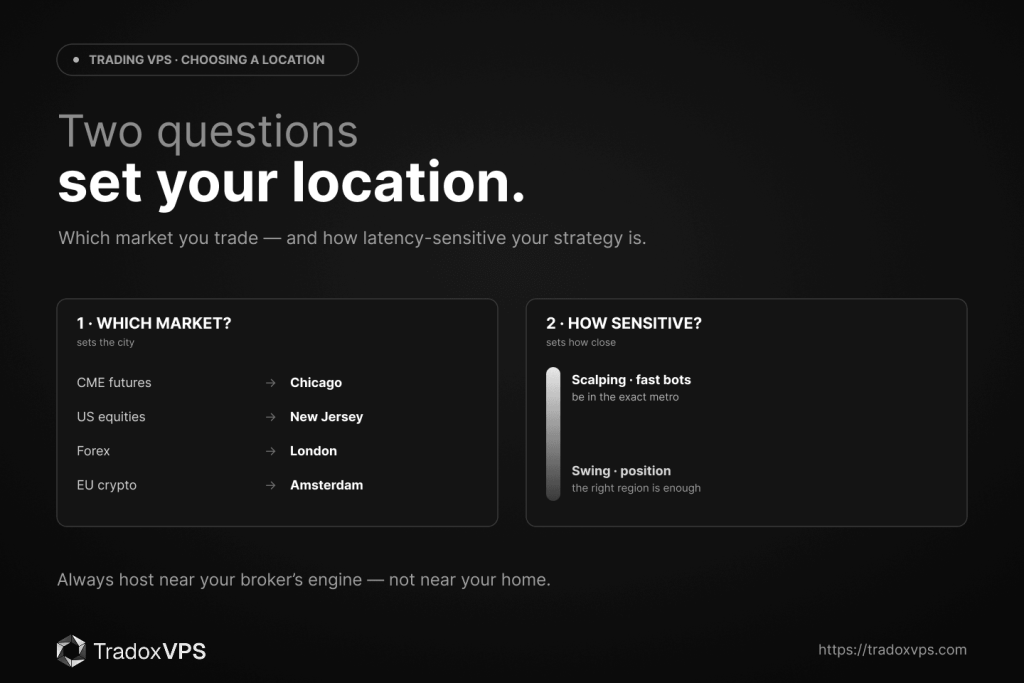
The single biggest mistake traders make with VPS location is choosing it based on where they live instead of where their broker’s matching engine is. Your remote-desktop session to the VPS isn’t time-sensitive — a bit of screen lag is harmless — but your orders travel from the VPS to the exchange on every single trade, and that’s the path you actually want short.
So choosing a location comes down to two questions: which market do you trade, which decides the city, and how latency-sensitive is your strategy, which decides how much proximity is worth paying for. Here’s how to answer both.
Rule one: match the location to your broker’s engine, not your home
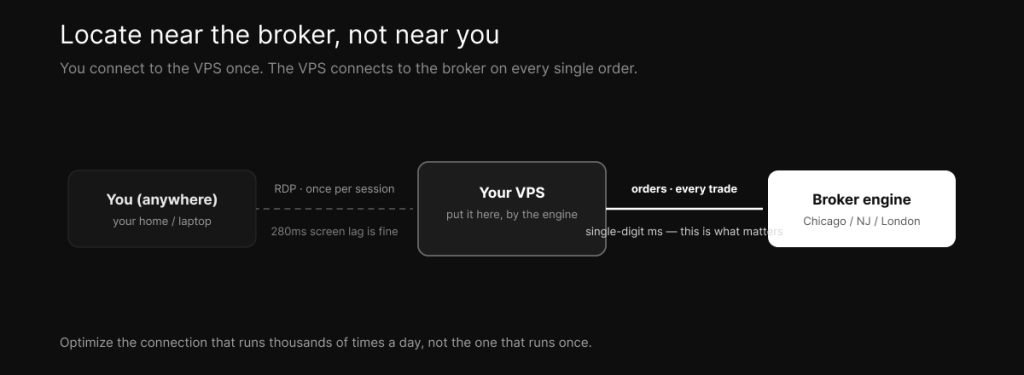
The mechanism is simple, and it trips up traders constantly. You connect to the VPS once per session; the VPS connects to your broker on every order. So you optimize the connection that happens thousands of times a day, not the one that happens once.
A trader in Sydney whose broker matches orders in London should host in London, not Sydney. The RDP screen will feel slightly laggy — maybe a couple hundred milliseconds of visual delay — but that only affects watching the charts, not execution. The orders travel from the London VPS directly to the London engine in a couple of milliseconds. The rule that falls out of this: the VPS goes where the matching engine is, which is the whole reason distance matters, as the server-location physics piece explains.
Match the city to your market
Your orders are matched at a specific data center, so host near that.
| If you trade | Matching happens in | Host your VPS in |
|---|---|---|
| CME futures (ES, NQ, CL, GC) | Aurora, Illinois (CME Globex) | Chicago / Aurora |
| US equities & options (NYSE, Nasdaq) | Northern New Jersey (Mahwah, Carteret, Secaucus) | New Jersey / “New York” |
| Forex (most retail brokers) | London (Equinix LD4 / LD5) | London |
| US-session forex (USD pairs, US brokers) | New Jersey (Equinix NY4 / NY5) | New York / NJ |
| European equities (Xetra, DAX, Eurex) | Frankfurt (Equinix FR2 / FR4) | Frankfurt |
| EU crypto / Solana | Amsterdam (dense EU peering) | Amsterdam |
| Asian session / JPY | Tokyo, Hong Kong, Singapore | Tokyo / Singapore |
Two honest catches here. First, “New York” trading is really New Jersey — the engines sit in Secaucus, Mahwah, and Carteret, so match the engine, not the city name. Second, for futures, your data feed (Rithmic, CQG, Tradovate) has its own server location, so verify which one your broker uses rather than assuming. For CME specifically, Chicago and Aurora are the answer, which the Chicago VPS and VPS-near-CME pieces cover in depth, and the Chicago-versus-New-York matchup settles the common futures question.
Match the proximity to your strategy’s latency-sensitivity
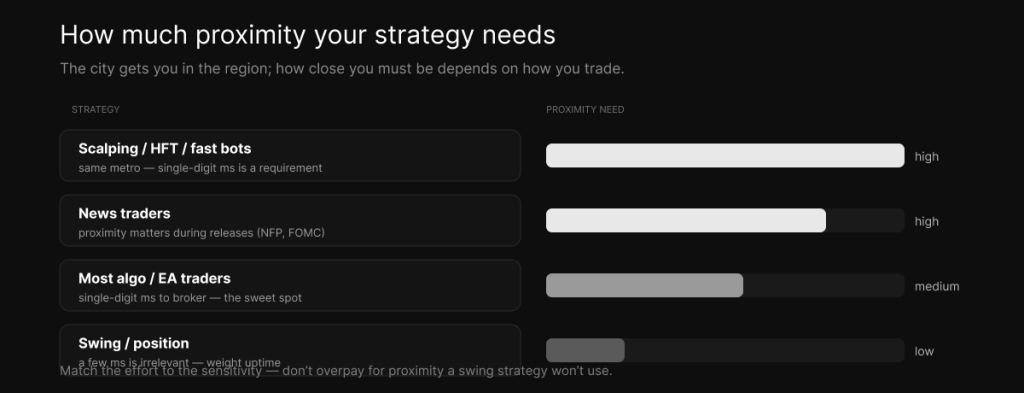
The city gets you into the right region. How close you need to be depends on how you trade, and this is where most traders either overpay or under-provision.
Scalpers, HFT-style traders, and fast bots sit at one extreme: latency is everything, you want to be in the exact metro (ideally same data center), and single-digit-millisecond execution is a functional requirement, not a nice-to-have, because every millisecond is ticks — the world of the HFT and low-latency piece. Swing, position, and longer-term traders sit at the other: if you hold for hours, days, or weeks, a few milliseconds of execution delay is irrelevant, and what matters is uptime, stability, and being roughly in the right region — a solid VPS in the correct hub is more than enough, and you can skip HFT-tier pricing entirely. News traders care about proximity mainly during releases like NFP, CPI, and FOMC, when prices move fastest. And most retail algo and EA traders are the middle — single-digit milliseconds to the broker, reliable uptime, dedicated CPU, enough RAM, which is the sweet spot a well-specced VPS in the right location hits without HFT cost.
The honest rule is match the effort to the sensitivity. Don’t pay for proximity a swing strategy will never use, and don’t under-provision a scalping bot — the full set of trade-offs is in the futures-VPS buyer’s guide.
The multi-market problem: you can’t be optimal everywhere
If you trade more than one market, the matching engines live in different cities, and one VPS simply cannot be optimal for all of them. A few honest options.
If your brokers are in the same city — say two forex brokers both at LD4 — one VPS handles both perfectly. If your brokers are in different cities — CME futures in Chicago and forex in London — you either pick the location of your primary, most-latency-sensitive market, or you run two VPS in two locations; there’s no single “best” location optimal for both. When you’re unsure across several forex brokers, London is the common default, since more brokers cluster their engines at LD4 than anywhere else. And for US futures, Chicago is the answer regardless of broker, because CME matches in Aurora no matter who you trade through.
Verify your broker’s actual data center before you buy
Don’t assume — confirm. Ask your broker directly which data center hosts their trading servers; the good ones will name the exact Equinix facility. Or ping your broker’s gateway from a trial VPS and read the location: Slough or London means LD4, Secaucus or Weehawken in New Jersey means NY4 or NY5, and Aurora means the CME. For futures, check your data feed provider separately, since Rithmic and CQG have their own locations. And be wary of providers listing a vague “New York” or “London” without naming the actual facility — if they can’t tell you exactly where the server is and the measured latency to your broker, the numbers on the homepage are marketing, a point the buyer’s guide makes about the whole category.
The honest scope, so you set expectations
Two things to keep in mind as you decide. Being in the right city gets you to about 1 ms of network ping and single-digit-millisecond order execution, which captures most of the available benefit — but it isn’t colocation, the sub-millisecond, microsecond world of a server inside the exchange, and the sub-millisecond figures providers advertise (ours included) are ping, not your fill. And location is necessary but not sufficient: the right city paired with a congested network or a slow CPU still underperforms, so you want clean routing, a chip that keeps up, and low, consistent jitter alongside the proximity.
The bottom line
Choosing a VPS location is two questions. Which market — match the city to your matching engine, Chicago for CME, New Jersey for US equities, London for most forex. And how sensitive your strategy is — maximize proximity for scalping and fast bots, weight reliability over milliseconds for swing and position trading. Locate the VPS near your broker rather than your home, verify the actual data center, and if you trade multiple markets, pick for your dominant one or run more than one VPS. For CME futures, that location is Chicago — which is what our Chicago plans and pricing are built around, with London, Dublin, and Amsterdam live today and New York and Frankfurt on the way.
Frequently asked questions
Near your broker’s matching engine, not near where you live. For CME futures that’s Chicago and Aurora, for US equities northern New Jersey, and for most forex London (Equinix LD4). The VPS connects to your broker on every order, so that’s the path to keep short.
Near your broker. Your remote-desktop session to the VPS isn’t time-sensitive — a little screen lag is harmless — but your orders travel from the VPS to the broker on every trade, so that connection is the one to optimize.
Far less than for scalping. If you hold positions for hours, days, or weeks, a few milliseconds of execution delay is irrelevant, and uptime and stability matter more than proximity. Being roughly in the right region on a reliable VPS is plenty.
Usually London (Equinix LD4 or LD5), where most retail forex brokers host their matching engines and the largest share of FX volume trades. For US-session USD pairs with US brokers, New York and New Jersey (NY4 or NY5) can be better — match it to your specific broker.
You can’t be optimal for engines in different cities from one VPS. Pick the location of your primary, most-latency-sensitive market, or run two VPS in two locations. For futures it’s Chicago regardless of broker; for several forex brokers, London is the common default.
Ask the broker directly which data center hosts their trading servers, or ping the gateway from a trial VPS — “Slough” means London LD4, “Secaucus” means New Jersey NY4 or NY5, and “Aurora” means the CME. For futures, also check your data feed provider’s location.
No. The right city gets you proximity — about 1 ms of ping and single-digit-millisecond execution — which captures most of the benefit. Colocation puts your server inside the exchange’s data center at sub-millisecond latency, an institutional service. Advertised sub-millisecond figures are ping, not execution.
We operate TradoxVPS and provide trading infrastructure, not financial advice. Latency figures are typical for normal network paths and vary with your broker, route, and configuration; a proximity VPS is not exchange colocation, and advertised sub-millisecond figures are network ping rather than order execution. Trading futures and other leveraged products carries substantial risk, including the loss of more than your initial deposit.