

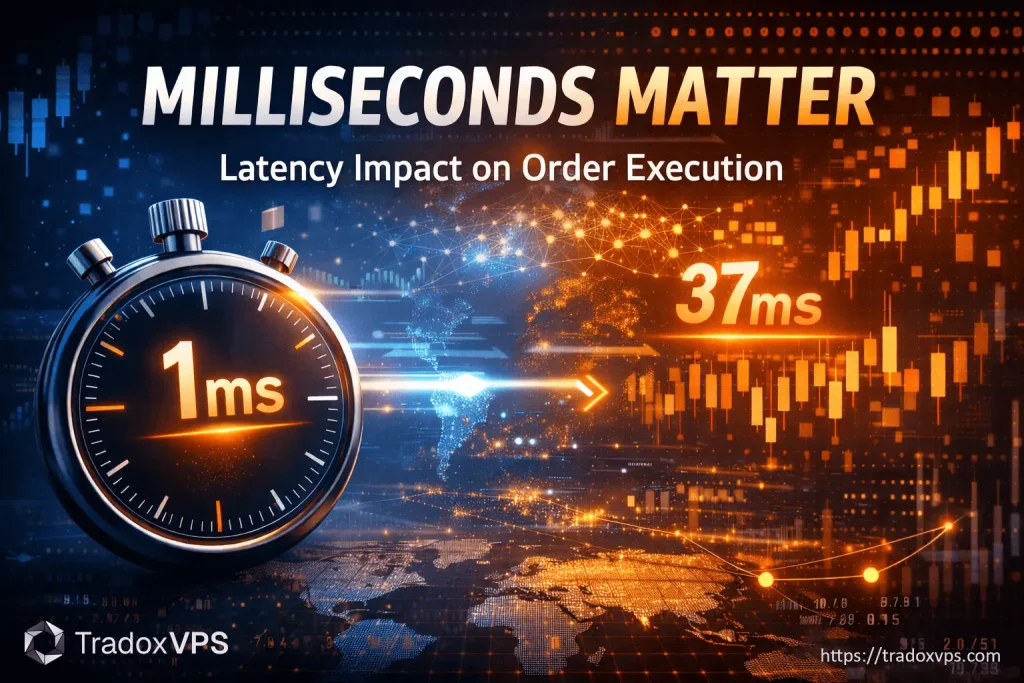
Introduction: Why Milliseconds Define Modern Trading Performance
In today’s electronic financial markets, milliseconds matter. What once seemed insignificant—a few milliseconds of delay—can now determine whether a trade is profitable, break-even, or outright unviable. This is especially true in futures, equities, and derivatives markets where competition is fierce and liquidity moves at machine speed.
The concept of order execution latency sits at the core of this reality. It represents the time delay between when a trader or algorithm submits an order and when that order is received, processed, and executed by the exchange’s matching engine.
This article provides a comprehensive breakdown of order execution latency, why it matters, how it impacts trading outcomes, and how professional traders optimize their infrastructure to reduce latency and gain a measurable edge.
What Is Order Execution Latency?
Order execution latency is the total time it takes for a trading instruction to travel from a trader’s platform to the exchange, get matched, and return a confirmation.
Latency is typically measured in:
- Milliseconds (ms)
- Microseconds (µs)
In modern markets, even retail traders operate in an environment where institutions measure latency in microseconds. This means that any unnecessary delay can result in inferior execution.
Order execution latency is not a single delay but a combination of multiple components, each contributing to the final execution time.
Key Components of Order Execution Latency
1. Platform Processing Latency
This is the time your trading platform takes to:
- Process market data updates
- Generate trade signals
- Package and send orders
Platforms like NinjaTrader, Sierra Chart, MultiCharts, and TradeStation have different internal architectures that can affect processing speed, especially for automated strategies.
2. Network Latency
Network latency is the time it takes for data to travel between:
- Your trading platform or VPS
- Your broker’s infrastructure
- The exchange’s data center
This component is heavily influenced by:
- Physical distance
- Network routing
- Fiber quality
- Number of network hops
3. Broker Routing Latency
Brokers act as intermediaries. Poor routing logic or overloaded broker infrastructure can introduce additional delays before an order even reaches the exchange.
4. Exchange Matching Engine Latency
Once an order arrives at the exchange, it must be processed by the matching engine. Major exchanges such as CME, NASDAQ, and NYSE operate extremely fast matching systems, but queue position still matters.
Official CME Globex performance details can be reviewed here: CME Globex Technology .
Why Order Execution Latency Matters
Fill Quality and Price Accuracy
Markets move continuously. A delay of just a few milliseconds can mean the difference between getting filled at the intended price or chasing the market.
Higher latency often results in:
- Worse entry prices
- Missed exits
- Partial fills
Slippage Amplification
Slippage occurs when an order is executed at a worse price than expected. Order execution latency is one of the primary drivers of slippage, especially during volatile market conditions.
Queue Position Disadvantage
In order-driven markets, execution priority is determined by:
- Price
- Time
Lower latency improves time priority, placing your order ahead of slower participants.
Latency Sensitivity by Trading Style
High-Frequency Trading (HFT)
HFT strategies operate at microsecond precision. For these traders, even sub-millisecond delays are unacceptable.
Execution latency directly determines:
- Profitability
- Strategy viability
- Risk exposure
Scalping
Scalpers rely on small price movements and fast exits. Order execution latency has a direct and visible impact on scalping performance.
Day Trading
Day traders benefit from lower latency, especially during:
- Market opens
- News releases
- High-volume sessions
Swing and Position Trading
Latency is less critical for long-term traders, but it still affects:
- Entry efficiency
- Stop-loss execution
- Gap risk management
Order Execution Latency and VPS Location
One of the most effective ways to reduce order execution latency is choosing the correct VPS location.
Exchanges operate matching engines in specific data centers:
- CME: Aurora, Illinois
- NYSE: New Jersey
- NASDAQ: Carteret, New Jersey
Hosting your trading platform near the exchange reduces:
- Physical distance
- Network hops
- Transmission delay
For CME futures trading, a Chicago-based VPS often provides sub-3ms execution latency, while distant locations can exceed 30ms.
Hardware and Software Optimization
CPU and Memory Performance
Underpowered servers introduce processing delays. Professional trading VPS environments use:
- High clock-speed CPUs (Ryzen 9 9950X Processor)
- NVMe storage
- DDR5 RAM
Operating System Tuning
Latency-optimized environments disable unnecessary background services and prioritize real-time processing.
Trading Platform Configuration
Optimizing platform settings—such as reducing chart load and limiting unnecessary indicators—can lower internal delays.
Network Jitter and Latency Consistency
Average latency is not enough. Consistency matters.
Network jitter causes unpredictable execution timing, leading to:
- Inconsistent fills
- Strategy instability
- Increased execution risk
Professional low-latency VPS providers focus on:
- Dedicated network routes
- Low jitter guarantees
- Redundant connectivity
Measuring Order Execution Latency
Traders can measure latency using:
- Platform execution reports
- Ping and traceroute tests
- Broker-provided latency metrics
Some platforms log timestamps for order submission and confirmation, allowing traders to analyze execution performance over time.
Common Myths About Execution Latency
“Retail Traders Don’t Need Low Latency”
While retail traders may not compete at HFT levels, execution latency still affects slippage and fills—especially for active traders.
“Broker Location Is All That Matters”
Broker location matters, but exchange proximity is more important. Orders always end up at the exchange’s matching engine.
“Faster Internet at Home Solves Everything”
Residential internet connections cannot match the stability, routing quality, and proximity of professional VPS environments.
FAQs: Order Execution Latency
What is considered low order execution latency?
Under 5 milliseconds is generally considered low-latency. Professional setups often achieve under 3 ms for CME trading.
Does lower latency guarantee profitability?
No, but it improves execution quality and preserves strategy edge.
Can latency affect stop-loss orders?
Yes. High latency can delay stop execution during fast markets, increasing losses.
Is VPS mandatory for low-latency trading?
For serious low-latency or automated trading, VPS hosting is strongly recommended.
Does order execution latency matter in volatile markets?
Yes. Volatility amplifies the negative effects of latency.
Final Thoughts: Why Milliseconds Truly Matter
In modern electronic markets, order execution latency is not a technical detail—it is a strategic variable.
Reducing latency improves:
- Execution precision
- Slippage control
- Risk management
- Long-term consistency
Whether you trade manually or deploy automated strategies, understanding and optimizing execution latency is essential.
In a world where machines compete at lightning speed, milliseconds matter—and those who respect them trade with an edge.