
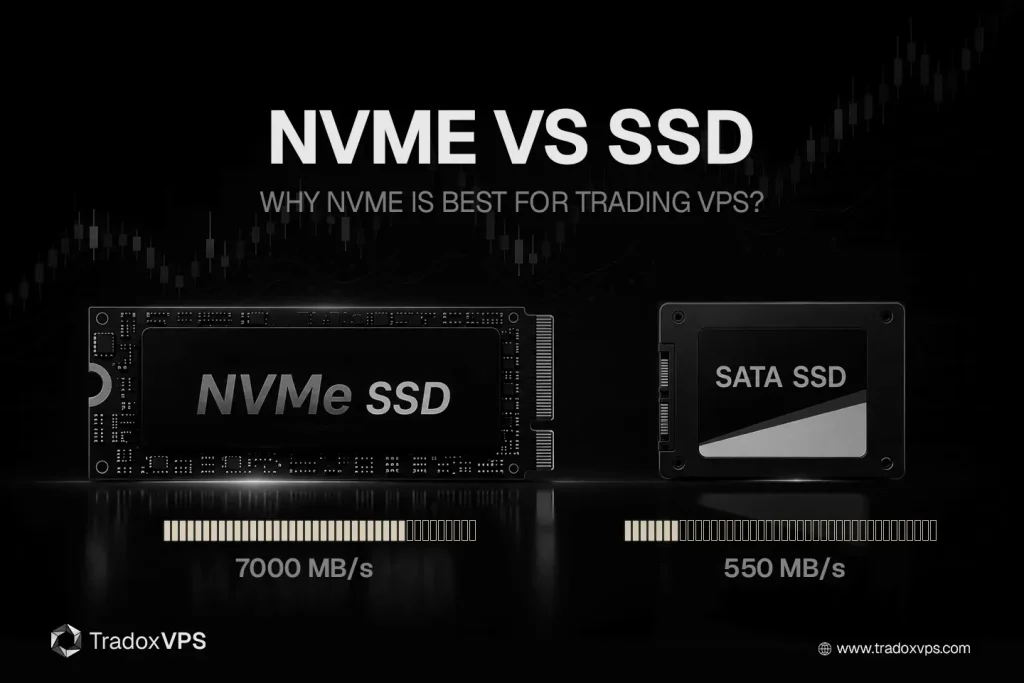
NVMe is the right storage for a trading VPS, and you should insist on it. But there is a widespread overstatement about why, and clearing it up will help you buy well and avoid paying for the wrong thing. This guide covers what NVMe actually is, the real performance difference in numbers, what it actually speeds up in a trading workflow and what it does not (it will not make your orders execute faster), and, the part most articles skip, how to check that your VPS is actually using NVMe rather than just claiming to.
Let us start with the honest headline, because it frames everything: NVMe dramatically speeds up anything that touches the disk, which in trading means loading data, backtesting, logging, and recovering after a reboot. It does almost nothing for your live order execution or your strategy’s decision loop, because those live in memory, CPU, and the network, not on storage. Both halves of that sentence matter, and most “why NVMe for trading” content only tells you the flattering half.
SSD vs NVMe: what is actually different
“SSD” and “NVMe” are often set against each other, but they describe different things. SSD means solid-state drive (no moving parts, unlike a mechanical hard disk). NVMe describes how a drive connects and talks to the system. So the real comparison is between a SATA SSD (a solid-state drive using the older SATA interface designed in the hard-drive era) and an NVMe SSD (a solid-state drive using PCIe lanes straight to the system). Both are flash; the interface is the difference, and it is a big one.
SATA was built for spinning disks and carries their overhead and their ceiling. NVMe was built for flash, uses many more parallel lanes over PCIe, and supports far deeper command queues. The result is an order-of-magnitude jump in throughput and in the small-random-operations-per-second (IOPS) that actually matter for responsiveness:
| Storage | Sequential read | Random IOPS (4K) | Typical latency |
|---|---|---|---|
| Hard disk (HDD) | ~125 MB/s | ~100 to 150 | Milliseconds |
| SATA SSD | ~550 MB/s (SATA ceiling) | ~80,000 to 100,000 | ~100 microseconds |
| NVMe SSD (PCIe Gen3) | ~3,500 MB/s | ~500,000 to 600,000 | Tens of microseconds |
| NVMe SSD (PCIe Gen4) | ~7,000 MB/s | ~1,000,000+ | Under 20 microseconds |
The SATA SSD figure is a hard ceiling: the SATA interface tops out around 550 MB/s no matter how good the drive is. NVMe is not limited that way, which is why the gap is roughly ten times in throughput and IOPS and larger still in latency. For a trading VPS, this is the difference that matters, but only for the operations that touch the disk. That qualifier is the whole point, so let us be specific about which operations those are.
What NVMe genuinely speeds up in trading
These are real, disk-bound parts of a trading workflow, and here NVMe makes a clear, felt difference:
- Platform launch and chart loading. Starting NinjaTrader, Sierra Chart, MetaTrader, or similar, and loading months of chart history, is heavy disk reading. On NVMe the platform opens and populates noticeably faster.
- Backtesting. This is where NVMe shines. Backtesting reads large historical datasets from disk repeatedly, and fast storage cuts a backtest that crawls on slow storage down to something usable. If you iterate on strategies, this alone justifies NVMe.
- Recording and reading tick data. High-resolution tick recording writes a lot of data continuously, and pulling it back for analysis reads a lot. NVMe keeps both from becoming a bottleneck.
- Logging under load. During a volatile session your platform and bots log heavily. Fast storage keeps that logging from stalling anything, especially when the market is moving fast.
- Recovery after a reboot. When a VPS restarts, NVMe gets your platform and data back up quickly, which shortens the window where you are not trading.
None of these are trivial. For anyone doing serious backtesting or running a data-heavy setup, slow storage is a real, daily drag, and NVMe removes it. That is the honest case for NVMe, and it is a strong one.
What NVMe does not speed up, honestly
Here is the half the marketing leaves out, and the half that will keep you from overpaying for the wrong reason. NVMe does not speed up the thing traders most want to be fast: live execution.
Your order’s journey is strategy logic to your broker’s gateway to the exchange’s matching engine. That path runs through CPU, memory, and the network, and it does not touch your disk. So faster storage does not reduce your order latency, and it does not make your bot’s decision loop run faster, because that loop is computed in memory and on the CPU, not read from disk on every tick (and if it were, that would be a bug in the code, not a storage problem). This is well established beyond trading too: across storage benchmarks, it is the CPU that limits compute-bound work, not the drive.
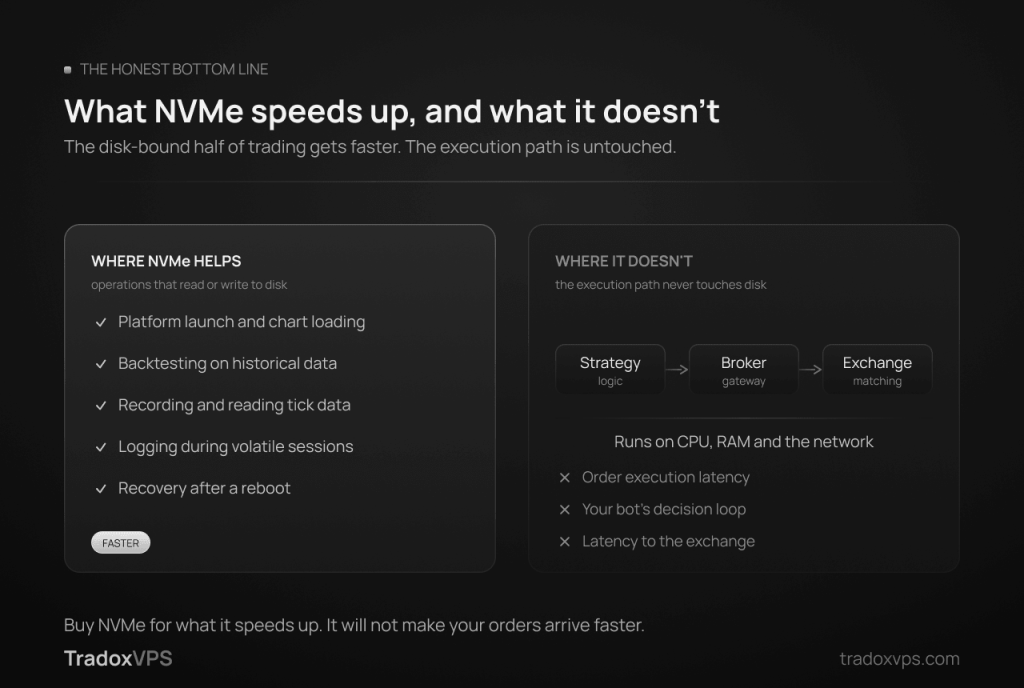
So be skeptical of any provider or article that sells NVMe as a way to “execute faster,” “reduce trading latency,” or “speed up your bot’s decisions.” That is conflating disk speed with execution speed, and they are unrelated. For execution, what actually matters is single-thread CPU performance (covered in our note on single-core performance for trading), dedicated memory, and a short, consistent network path to your venue, which you can measure with our latency checker. NVMe is important, but for a different job.
The honest summary: NVMe makes your machine load, backtest, log, and recover fast. It does not make your orders arrive faster. Buy it for the first reason, not the second.
So does NVMe matter for a trading VPS?
Yes, with the honest framing above. The disk-bound operations, backtesting, data handling, platform launch, logging, and recovery, are a real and recurring part of any serious trading workflow, and slow storage there is a real handicap. NVMe removes an entire category of friction, and there is no good reason to accept SATA-era storage on a machine you are trusting with automated trading. For a heavy backtester or a data-intensive platform it is clearly worth it; even for a minimal always-on bot that touches the disk little, NVMe costs you nothing in downside and helps with launch and recovery. The practical answer for a trading VPS is simply to insist on it, while understanding it is a data-and-recovery advantage, not an execution-latency one.
How to verify you are actually getting NVMe
This is the part most guides skip, and it is the most useful, because “NVMe” on a plan page is a claim, not a guarantee. Some providers advertise NVMe while serving storage that is heavily shared, throttled, or network-attached, and does not deliver anything close to real local-NVMe numbers. Check it yourself rather than trust the label.
On a Linux VPS, run a quick random-read test with fio:
fio --name=randread --ioengine=libaio --rw=randread --bs=4k \
    --numjobs=4 --size=1G --runtime=60 --time_based --group_reporting
On Windows, use the free CrystalDiskMark tool and run the default test.
What you are looking for: real local NVMe should show sequential reads in the thousands of MB/s and random IOPS in the hundreds of thousands. If your “NVMe” VPS benchmarks like a SATA drive (around 550 MB/s) or worse, or if performance collapses under sustained load, the storage is not delivering what the label implies, whether because it is shared, throttled, or network-backed. A provider confident in its hardware will not mind you testing, and the honest ones publish real figures. Ours are on the benchmarks page, and you should verify them on a trial rather than take them on faith.
Where TradoxVPS fits, honestly
Every TradoxVPS plan uses enterprise NVMe storage, which is the right foundation for the disk-bound side of trading: platforms launch quickly, backtests read large datasets fast, tick recording and logging do not stall under a volatile session, and a rebooted VPS recovers promptly. Paired with the Ryzen 9 9950X and NVMe, that covers the load-backtest-log-recover half of the job well, and you can confirm the real storage numbers yourself on our benchmarks page or a trial.
Being straight about the rest: NVMe is one piece, not the execution story. For live order execution, what matters is single-thread CPU speed, dedicated memory, and proximity to your venue, and we would rather you evaluate us on those than on a storage buzzword. RAM is dedicated on our plans; CPU is shared and dynamically allocated, which is standard, so if you want to be thorough, ask us our oversubscription ratio and test steal time under load. Insist on NVMe, yes, and then judge the parts that actually determine your fills separately. See pricing to get started, and the NinjaTrader VPS page for platform-specific detail.
Conclusion
NVMe is the correct storage for a trading VPS, and the honest reason is worth being precise about. It delivers roughly ten times the throughput and IOPS of SATA, which makes a real, felt difference to the disk-bound parts of trading: platform launch, backtesting, tick data, logging, and recovery. What it does not do is speed up your live execution or your strategy’s decision loop, because those run in CPU, memory, and the network, not on disk. So insist on NVMe for what it actually gives you, verify with a quick benchmark that you are actually getting it rather than a shared or throttled substitute, and judge the parts that determine your fills, CPU, memory, and network proximity, on their own terms. Buy NVMe for the right reason and you will not be disappointed by it.
Frequently asked questions
Not your execution or network latency. NVMe speeds up operations that read or write to disk (loading data, backtesting, logging, recovery), but your order’s path to the exchange runs through CPU, memory, and the network, not storage. Anyone marketing NVMe as a way to “reduce trading latency” is conflating disk speed with execution speed. Judge execution latency by the round-trip to your broker, not by the drive.
Yes. The disk-bound parts of trading (backtesting, data handling, platform launch, logging, recovery) are a real part of the workflow, and slow storage there is a real drag. NVMe is roughly ten times faster than SATA in throughput and IOPS, so there is no reason to accept older storage. Just buy it for those reasons, not for execution speed.
A minimal bot touches the disk little, so NVMe matters less to the running loop than CPU, memory, and network do. But NVMe still helps with platform launch, logging under load, and fast recovery after a reboot, and it costs you nothing in downside, so there is no reason to choose slower storage.
Test it. On Linux, run a fio random-read benchmark; on Windows, use CrystalDiskMark. Real local NVMe shows sequential reads in the thousands of MB/s and hundreds of thousands of IOPS. If it benchmarks like a SATA drive (~550 MB/s) or degrades under sustained load, the storage may be shared, throttled, or network-attached despite the “NVMe” label.
NVMe, clearly, for a trading VPS. Both are solid-state, but SATA is capped around 550 MB/s by its interface, while NVMe reaches several thousand MB/s and far higher IOPS over PCIe. For backtesting and data-heavy platforms the difference is substantial. SATA SSDs are fine for cheap general storage, but there is no reason to accept one on a trading machine.
It will function, and it is far better than a mechanical hard drive, but it is the slower choice and its interface ceiling shows up in backtesting and data handling. Since NVMe is now standard and the price gap is small, insisting on NVMe is the sensible call for a trading VPS.
Disclaimer: TradoxVPS provides infrastructure only and does not provide investment or trading advice. Trading involves substantial risk of loss. Storage performance figures are typical ranges; verify actual performance on your own instance. Latency, uptime, and execution also depend on CPU, memory, network conditions, broker and data-feed connectivity, and exchange infrastructure.