
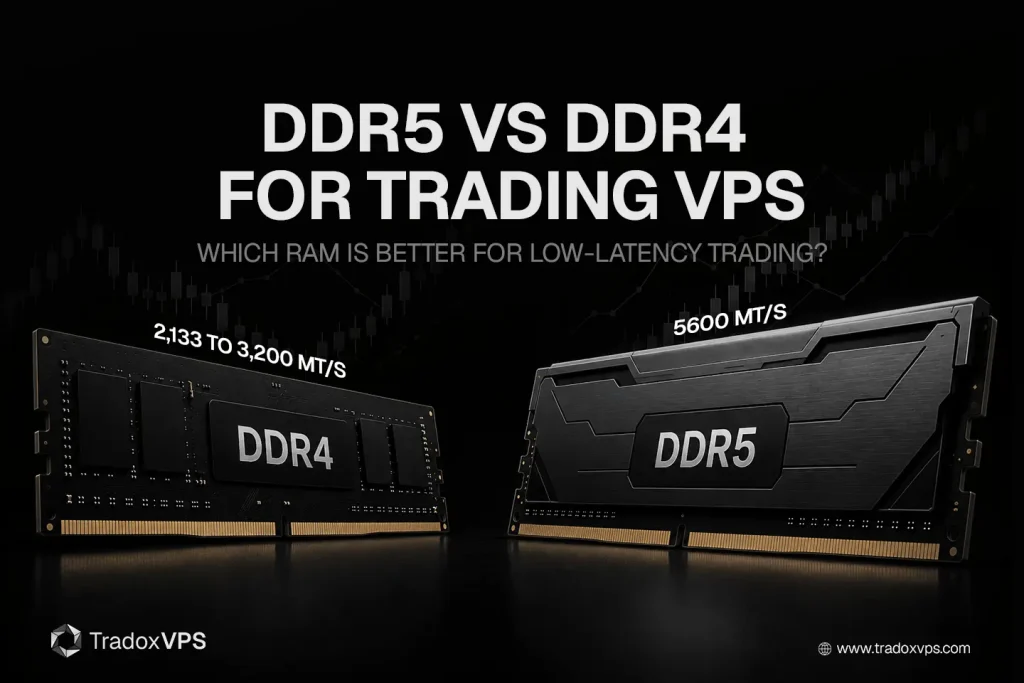
There are thousands of DDR4-versus-DDR5 comparisons online, and almost none of them are about trading. They tell you about gaming frame rates and video encoding, which is useless if what you actually run is NinjaTrader, a fistful of charts, and an automated strategy. This guide is the trading-specific version: what memory actually does in a trading setup, whether DDR5 makes any difference to execution (the honest answer will surprise people who have read the marketing), and the memory decision that truly matters for a trading VPS, which is not the one the comparisons obsess over.
The short version, so you have it up front: DDR5 is the modern standard and worth having, but not for the reason it is usually sold to traders. It will not make your orders execute faster or reduce your slippage. Its real advantages are bandwidth for running a lot at once, capacity, and stability, and for most traders the memory question that matters is not DDR4 versus DDR5 at all, but how much RAM you have. Here is the full picture.
What RAM actually does in a trading setup
Before comparing generations, it helps to be clear about memory’s job, because it is different from what people assume. In a trading setup, RAM holds the things your system is actively using: your platform itself, every open chart and its history, your indicators and their calculations, the live order book, your strategy’s state, and, during a backtest, chunks of historical data being processed. More RAM means you can hold more of this at once without the system slowing down or spilling to disk.
Notice what is not on that list: your order’s path to the exchange. When your strategy decides and sends an order, that decision is computed on the CPU using data already in memory and cache, and the order travels over the network. The speed of your RAM is not a step in that journey. This is the crux of the whole DDR4-versus-DDR5 question for trading, and we will come back to it, because it is where most articles go wrong.
DDR5 vs DDR4: the honest technical difference
DDR5 is a real generational step, but it is precise about where it improves, and that precision matters for trading. Here is the accurate comparison:
| Spec | DDR4 | DDR5 |
|---|---|---|
| Data rate | 2,133 to 3,200 MT/s | 4,800 to 8,400+ MT/s |
| Bandwidth per module | ~25.6 GB/s (DDR4-3200) | ~38 to 51 GB/s (DDR5-4800 to 6400) |
| Absolute latency | ~10 ns (DDR4-3200 CL16) | ~10 ns (DDR5-6000 CL30) |
| Channel design | Single 64-bit | Dual 32-bit subchannels |
| Voltage | 1.2 V | 1.1 V (with on-module power management) |
| Error checking | Optional | On-die ECC built in |
| Max per module | Up to 64 GB (typical) | Up to 128 GB+ |
The single most important and most misunderstood row is latency. You will see DDR5 quoted with much higher CAS numbers (CL40 versus CL16) and conclude it is slower. That is a myth. CAS latency is measured in clock cycles, and because DDR5 runs at far higher frequencies, each cycle is shorter, so the actual delay in nanoseconds comes out about the same. DDR4-3200 CL16 and DDR5-6000 CL30 both land near 10 nanoseconds. So DDR5’s advantage over DDR4 is bandwidth, not latency. They respond to a memory request in roughly the same amount of time; DDR5 can simply move more data per second once it is responding.
Hold onto that distinction, because it decides the trading answer entirely.
Does DDR5 make your trading faster? For one strategy, honestly, no
Here is the part the marketing leaves out. For a single trading strategy, moving from DDR4 to DDR5 makes essentially no difference to execution, and understanding why saves you from paying for the wrong thing.
Your strategy’s hot path, receiving a tick, computing a decision, and sending an order, is bound by single-thread CPU speed and network latency, not memory throughput. The working set it touches (current prices, a few indicators, the order book) is small, fits comfortably in CPU cache and memory, and does not come close to saturating even DDR4’s bandwidth. The rule from every serious benchmark applies directly: if a workload never saturates DDR4’s data rate, moving to DDR5 shows almost no change. A single trading loop is exactly such a workload. And since absolute memory latency is about the same between the two, there is no latency win either.
So be skeptical of anyone selling DDR5 to traders as a way to “execute faster,” “reduce latency,” or “cut slippage.” Memory latency is not your execution latency, DDR5 does not lower it anyway, and slippage is a market-structure event inside the exchange that no memory generation touches. For execution, what actually matters is single-thread CPU performance (see our note on single-core performance for trading and why the Ryzen 9 9950X) and a short, consistent network path, which you can measure with our latency checker. RAM generation is not on that list.
Where DDR5 genuinely helps a trader
None of that makes DDR5 pointless for trading. It has real advantages; they are just different from the ones usually advertised, and they are worth having:
- Running a lot at once. This is where DDR5’s bandwidth and dual-subchannel design pay off. If you run several platforms, dozens of charts, and multiple bots on one VPS, that is sustained, parallel memory traffic, and DDR5 handles it more smoothly than DDR4. A single strategy will not feel it; a heavy multi-platform setup will.
- Backtesting. Backtests stream large historical datasets through memory, which is a bandwidth-heavy, data-intensive job, exactly the kind that benefits from DDR5. If you iterate on strategies over big datasets, DDR5 plus enough capacity helps.
- Stability for 24/7 operation. DDR5’s built-in on-die ECC corrects certain memory errors automatically, which matters for a machine running unattended around the clock. For an always-on bot, quiet reliability is worth more than a spec-sheet speed.
- Capacity and efficiency. DDR5 supports larger modules (more total RAM) and runs at lower voltage with better power management, both useful on a server that never turns off.
- It is the current standard. Modern trading-grade CPUs use DDR5, so on current hardware you get it by default. You are not paying a premium to seek it out; it is simply what the platform runs.
The honest framing: DDR5 helps when you are doing a lot (many platforms, big backtests) and helps your machine stay stable and modern. It does not help a single strategy execute faster.
The memory question that actually matters: capacity, not generation
Here is the most useful, trading-specific insight, and it is the one the generic comparisons bury. For a trader, how much RAM you have matters far more than whether it is DDR4 or DDR5. Running out of memory forces the system to spill to disk, which causes stalls and latency spikes at the worst moments. That is a real, felt problem. DDR4-versus-DDR5 for a single strategy is not. Capacity beats generation, and it is not close.
Practical guidance for a trading VPS:
- 8 GB is the bare minimum and is tight for modern platforms. It can run a single lightweight bot, but it gets cramped fast once you open NinjaTrader with several charts. Do not plan around it if you are doing anything serious.
- 16 GB is the comfortable floor for real work: NinjaTrader, Sierra Chart, or MetaTrader with a reasonable number of charts and a strategy running, without fighting for memory.
- 32 GB is the right choice if you run multiple platforms at once, many charts, backtest over large datasets, or run several bots alongside your platform.
- 64 GB and up is for heavy multi-platform operations, large-scale backtesting, or many concurrent strategies.
If you take one thing from this article, take this: size your RAM to your actual workload, and get comfortably more than you think you need, before you spend a moment worrying about DDR4 versus DDR5. Enough capacity, on either generation, will serve you better than a spec upgrade you cannot feel. (Memory is only one piece; the resilience of the bot running in it is covered in optimizing a VPS for algorithmic trading.)
So which should you choose for a trading VPS?
DDR5, in practice, because modern trading-grade hardware uses it and it is a solid, current standard: good bandwidth for multitasking, larger capacity, on-die ECC for stability, and better efficiency for a 24/7 machine. Choose it for those reasons. Just do not choose it expecting lower execution latency or less slippage, because that is not what any RAM generation delivers. For the things that actually determine your fills, prioritize a fast single-thread CPU, enough RAM capacity for your workload, fast NVMe storage, and a short network path to your venue. Get those right and the DDR4-versus-DDR5 debate becomes the footnote it should be.
Where TradoxVPS fits, honestly
Every TradoxVPS plan runs modern DDR5 memory alongside the Ryzen 9 9950X and NVMe, which is the right current-generation foundation: bandwidth for running several platforms and bots at once, on-die ECC stability for around-the-clock operation, and the efficiency that suits an always-on server. RAM is dedicated to your instance, so a busy neighbor does not squeeze your platform, and you can see the hardware on our benchmarks page.
Being straight about it: DDR5 here is table stakes on current hardware, not a magic latency feature, and we would rather you evaluate us on the things that actually move your execution, single-thread CPU, network proximity, and enough dedicated RAM for your workload, than on a memory buzzword. Size your plan to how many platforms and bots you will run (see the pricing tiers), and judge execution on CPU and network, which you can measure yourself. The NinjaTrader VPS page has platform-specific detail.
Conclusion
For a trading VPS, DDR5 is the sensible modern choice, but the honest reasons are worth being clear about, because the usual ones are wrong. DDR5’s advantage over DDR4 is bandwidth and capacity, not latency, and it will not make your orders execute faster or reduce your slippage, since your execution path runs through the CPU and the network, not your memory. Where DDR5 earns its place is running a lot at once, backtesting over large datasets, and staying stable and efficient around the clock. And the memory decision that actually matters for a trader is not the generation at all, but the capacity: enough RAM for your workload will do far more for you than a spec upgrade you cannot feel. Choose DDR5 because it is the current standard and get enough of it, then put your attention where your fills are actually decided, on the CPU, the network, and the storage.
Frequently asked questions
No. DDR5’s advantage over DDR4 is bandwidth, not latency; their absolute memory latency in nanoseconds is about the same. And memory latency is not your execution latency anyway, which runs through the CPU and the network. Anyone marketing DDR5 as a way to “reduce trading latency” or “cut slippage” is overstating it. Judge execution by the round-trip to your broker, not the RAM generation.
Yes, but for the right reasons: it is the current standard on modern trading hardware, and it helps if you run many platforms and bots at once, backtest over large datasets, or want on-die ECC stability for 24/7 operation. It is not worth paying a premium for expecting faster execution on a single strategy, because there you will not feel a difference versus good DDR4.
More than the generation, capacity is what matters. 8 GB is a tight minimum, 16 GB is comfortable for a platform with several charts and a bot, 32 GB suits multiple platforms or backtesting, and 64 GB+ is for heavy multi-strategy operations. Size to your actual workload and get a little more headroom than you expect to need.
For a single bot, barely. A bot’s decision loop is CPU and network bound and does not saturate DDR4’s bandwidth, so DDR4 and DDR5 perform about the same for it. DDR5 helps when you run many bots and platforms together. In all cases, having enough RAM capacity matters far more than which generation it is.
Not meaningfully, beyond a point. Once you have enough capacity so the system is not spilling to disk, adding memory speed gives little for a trading workload, because the bottlenecks are the CPU and the network, not memory throughput. Prioritize enough RAM and a fast CPU over chasing memory speed numbers.
It is the bare minimum and is tight for modern platforms. It can run a single lightweight bot, but it gets cramped quickly with a full platform and several charts. For real trading, 16 GB is a more comfortable floor, and more if you run multiple platforms or backtest.
Disclaimer: TradoxVPS provides infrastructure only and does not provide investment or trading advice. Trading involves substantial risk of loss. Memory specifications are typical ranges for current hardware. Latency, uptime, and execution depend on CPU, memory capacity, storage, network conditions, broker and data-feed connectivity, and exchange infrastructure.