
Most guides on this topic are a list of things you already know: use Linux, use SSD, keep it updated. All true, all useless, because none of it tells an algorithmic trader the specific things that actually make a bot run deterministically and survive a bad day. This is the longer, more specific version. It covers the settings that measurably change execution consistency, the algo-specific concerns that generic “VPS tips” never mention (time synchronization, process resilience, state recovery on restart), and it is honest about the parts of tuning a VPS simply cannot do that only bare metal or colocation can.
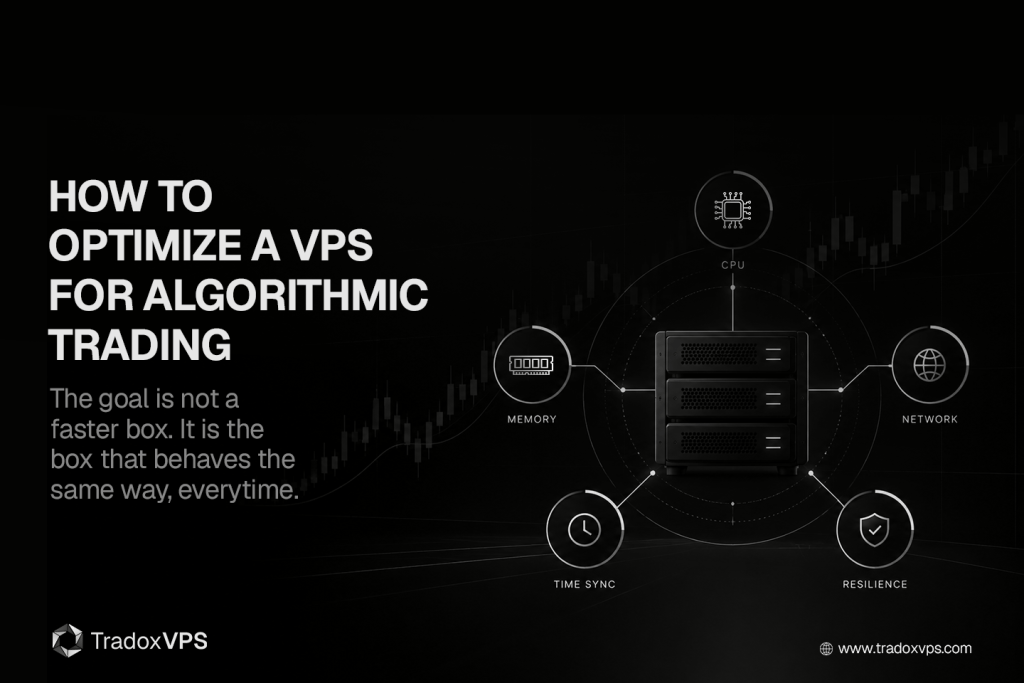
Before the details, one reframe that changes how you should read everything below. Optimizing a VPS for algorithmic trading is not about making it fast. It is about making it predictable. A strategy backtested on clean data fails in production not usually because the server was slow on average, but because it was inconsistent: a latency spike here, a memory stall there, a clock that drifted, a process that died overnight and came back confused. The goal is to remove variance and remove the ways a bot silently breaks, so that live behavior matches tested behavior. Speed matters, but consistency and resilience matter more, and they are what this guide optimizes for.
The goal: determinism and resilience, not raw speed
An algorithmic trading system is a long-running program that must react the same way every time, stay alive unattended, and recover cleanly when something goes wrong. That gives you three optimization targets, in order of how often they actually cost people money:
- Resilience. The bot must not die silently, and if it restarts, it must come back correct, not blindly re-entering positions it already holds. This is the single most under-appreciated area, and the one that causes the worst losses.
- Consistency. Latency, CPU availability, and memory behavior should be stable, not just good on average. A machine that is fast at noon and erratic at the open is worse than one that is merely adequate but steady.
- Speed. Genuinely matters for latency-sensitive strategies, but it is the third priority, not the first, and it is the one with the hardest ceiling on a shared VPS.
Everything below serves those three, and there is an honest boundary worth stating up front: a VPS optimizes your layer, the machine and its path to the market. It does not control your broker’s gateway, your data feed, or the exchange, and some low-level tuning that helps on bare metal is limited or unavailable on a virtualized host. We will flag those limits as we go rather than pretend they do not exist.
Start with a minimal, purpose-built OS
The operating system decides how your strategy’s process gets scheduled, so it is the foundation. For almost all algorithmic trading, that means a minimal Linux server, Ubuntu Server or Debian, with no desktop environment and nothing running that is not part of trading.
The reasoning is concrete, not stylistic. Every background service is CPU and memory you are not using for trading and a process that can wake at the wrong moment and cause a scheduling hiccup. A GUI in particular consumes resources continuously for something a bot never needs. So install the server edition, and audit what is actually running:
systemctl list-units --type=service --state=running
Disable anything that is not trading-critical or system-essential (printing services, Bluetooth, avahi, snap-related timers you do not use, and so on) with systemctl disable --now <service>. The aim is a boring machine that does exactly one job. If you run Windows-based platforms instead (NinjaTrader, MetaTrader, cTrader), the same principle applies: Windows Server, nothing installed that is not for trading, no browsing or email on the box. The point is single-purpose, whichever OS your stack requires.
The optimization most guides forget: time synchronization
Here is a section you will not find in the generic checklists, and it matters more for algorithmic trading than half the things that are on them. Your VPS clock drifts. Left uncorrected, it can be off by seconds, and for an algo that is a real problem: strategies that act on timestamps misjudge event ordering, your logs no longer line up with the exchange’s, latency measurements become meaningless, scheduled logic fires at the wrong moment, and some exchange APIs reject requests whose timestamp is outside a tolerance window (a signed request with a skewed clock simply fails authentication).
The fix is to run a proper time-sync daemon and verify it. On modern Ubuntu and Debian, chrony is the standard choice and handles drift better than the old ntpd for this use case:
sudo apt install chrony
systemctl enable --now chrony
chronyc tracking
chronyc tracking shows your current offset from reference time; you want it in the low milliseconds or better, and stable. This is a five-minute task that removes an entire class of subtle, hard-to-diagnose bugs, and almost nobody does it. If your strategy timestamps anything, reconciles against exchange time, or authenticates to a timestamped API, treat time sync as mandatory, not optional.
CPU: single-thread speed, and the honest truth about sharing
Most trading logic, the hot path from receiving a tick to deciding and sending an order, is dominated by a small number of threads, often effectively one. That means per-core clock speed matters far more than core count for live execution. A high-clock, modern CPU keeps that hot path short. (We go deeper on why in our note on single-core performance for trading.)
But the more important thing to understand on any shared VPS is the part providers rarely volunteer. On a virtual server, RAM is typically dedicated to your instance, while CPU is shared across the host and allocated dynamically. That is normal and works well for trading, but it means “how much CPU do I really have during a busy moment” is a real question, and you can measure the answer yourself. The metric is CPU steal time: the percentage of time your virtual CPU was ready to run but had to wait because the physical host was busy serving someone else. Watch it with:
vmstat 1
The st column is steal time. On a well-run host it should sit at or near zero most of the time, including during market hours. If you see steal time climbing during the session open, that is the host being oversubscribed at the worst possible moment, and it is exactly the kind of inconsistency that makes a bot behave differently in production than in testing. This is why the honest question to ask any provider, ours included, is their CPU oversubscription ratio, and then to verify it with steal time under real load rather than trust a marketing number.
A few tuning notes, with honest caveats about what a VPS actually lets you control:
- CPU affinity (pinning) your strategy process to a specific core with
tasksetcan reduce cache-thrashing and scheduling jitter for the hot path. On a shared VPS this helps within your guest, but the host scheduler still sits underneath you, so the benefit is smaller than on bare metal. - CPU frequency scaling (the “governor”) set to performance avoids the CPU downclocking itself between bursts, which improves consistency. The honest caveat: on many VPS you cannot control the host’s frequency governor at all, so this is more of a bare-metal lever. Check whether it is exposed before assuming it applies.
- Run only trading-critical processes. The cleanest way to guarantee CPU for your strategy is to have nothing else competing for it on your side of the machine.
Memory: headroom, leaks, and why swap is the enemy
Memory problems in trading bots are insidious because they appear only after the machine has been up for days. A long-running strategy that slowly leaks memory will run perfectly in a backtest and a short live test, then degrade, spike in latency, and eventually stall or get killed a week later, often overnight when you are not watching.
Two things prevent this. First, size for headroom and actually watch the trend: a bot’s memory use should be flat over time, not creeping upward. Monitor it (free -m, or a proper monitor as below) and treat steady growth as a bug to fix, not a reason to buy more RAM. Second, and this is the latency-specific point, avoid swap for anything in the hot path. When the system swaps, memory pages move to disk, and an operation that should take microseconds can take milliseconds while it waits on storage. For a latency-sensitive strategy that is catastrophic and unpredictable. On a box with adequate dedicated RAM you should rarely swap, but you can bias the kernel away from it:
sudo sysctl vm.swappiness=10
Lower swappiness tells the kernel to prefer reclaiming cache over swapping process memory, which keeps your strategy’s working set in RAM. The real fix, though, is enough dedicated memory that you never approach the limit, because swapping under load is precisely the wrong-moment failure you are trying to design out.
Disk and logging: fast storage, and never let logging block the strategy
Storage matters less for the trade decision itself and more for everything around it: writing logs, persisting state, recovering after a restart. Two priorities.
Use NVMe, not spinning disks or slow SSD, so that writes never become a bottleneck during a volatile session when your bot is logging heavily and the market is moving fast. And, the part people miss, make sure logging cannot stall your hot path. A strategy that writes a synchronous log line to disk on every tick can block on I/O at the worst moment. Log asynchronously or to a buffer, keep the volume sane, and rotate logs so a runaway log file never fills the disk and takes the bot down with it. logrotate handles rotation; configure it before you need it, not after a full disk has already stopped your trading. For high-frequency ephemeral writes that do not need to survive a reboot, writing to a tmpfs (memory-backed) path avoids disk entirely. The principle is simple: storage should support the strategy silently and never be the thing that pauses it.
Network: consistency over bandwidth, measured honestly
For algorithmic trading, network quality means low and consistent latency to your broker or exchange, not raw bandwidth. A trading bot sends and receives small messages; it does not need a fat pipe, it needs a steady one. The two levers are location and measurement.
Location: put the VPS close, in network terms, to where your orders are going. For CME futures that means a Chicago-region host; for other venues it means matching the exchange or broker’s data center. We cover the specifics in our guides on choosing a location for forex and how a VPS handles high-impact events, so we will not repeat them here beyond the core rule: proximity gives you a shorter, steadier path, and the only latency number worth trusting is the one you measure yourself from a live box to your own endpoint.
Measurement: do not judge your network by a single ping or an average. Track p50, p95, and p99 latency to your endpoint during the actual session, because the average hides the tail, and the tail is what hurts a bot. A connection that averages a clean few milliseconds but spikes to hundreds at the open is exactly the inconsistency that makes live behavior diverge from tested behavior. Test with our latency checker against your real destination, during your real trading hours. And build the network’s imperfection into your code: a bot needs sane reconnection logic and defined behavior when a feed drops, because it will drop eventually, and what the strategy does in that moment is your responsibility, not the provider’s.
Process resilience and state recovery: the part that actually keeps an algo alive
This is the most important section in this guide, and it is the one the original version of this article covered in a single bullet. Everything above optimizes how the bot runs. This optimizes what happens when it stops, and getting it wrong is how automated strategies produce their worst losses.
Start with the basics: your strategy should not run as a script you launched in a terminal, because when it crashes, it stays dead until you notice. Run it under a supervisor that restarts it automatically. On Linux, systemd does this natively with a unit file:
[Service]
ExecStart=/usr/bin/python3 /home/trader/strategy/main.py
Restart=always
RestartSec=3
WatchdogSec=30
Restart=always brings the bot back if it exits or crashes. WatchdogSec lets the process signal that it is healthy and forces a restart if it hangs without crashing, which catches the silent freeze that a simple restart policy misses. (Docker with a restart policy, or supervisor/pm2, achieve the same thing; the concept matters more than the tool.)
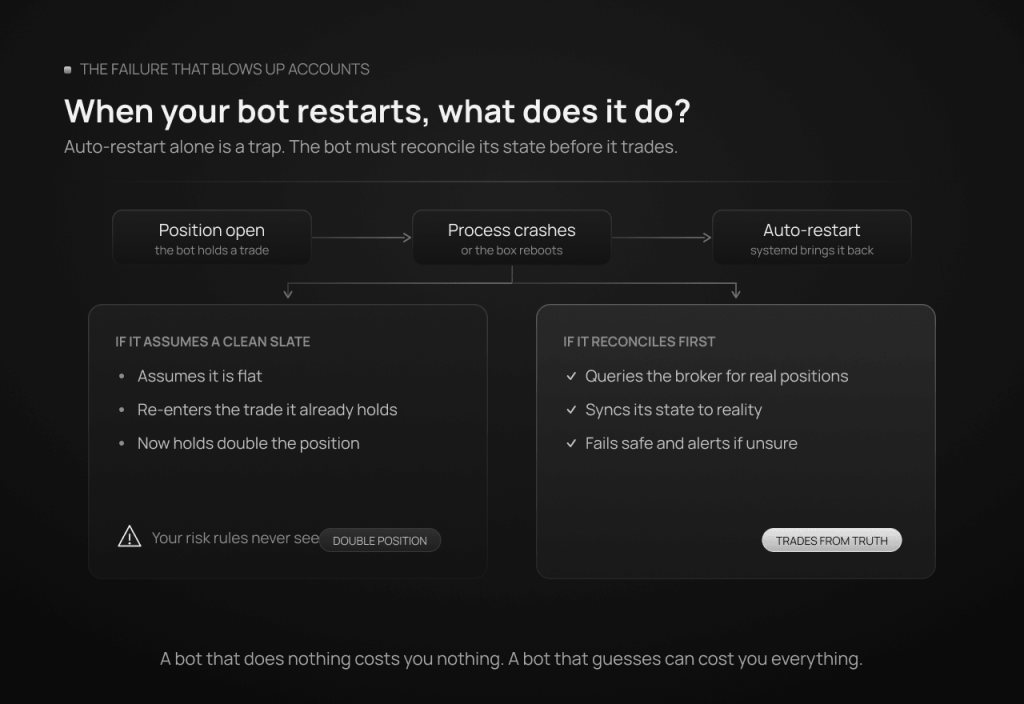
But automatic restart alone is a trap, and here is the critical point: a bot that restarts must reconcile its state before it acts, not blindly resume. Imagine your strategy opens a position, then the process crashes and systemd restarts it two seconds later. If the fresh process assumes it is flat and re-enters, you now hold double the position you intended, and no risk rule you wrote will catch it because the bot does not know its own state. This is a real and common way people blow up an automated account, and it is entirely preventable.
The defenses are design, not configuration:
- Persist state and reconcile on startup. On launch, before trading, the bot should query the broker or exchange for its actual open positions and orders and sync its internal state to reality, rather than assuming a clean slate.
- Make actions idempotent where possible. Use client order IDs so a retried order is recognized as the same order, not a new one, if a network blip caused an ambiguous response.
- Fail safe, not aggressive. On startup uncertainty or repeated crashes, the correct default is to stand down and alert you, not to trade into an unknown state. A bot that does nothing costs you nothing; a bot that guesses can cost you everything.
- Shut down gracefully. Handle termination signals so that a planned restart cancels or secures open orders rather than abandoning them.
If you optimize only one thing from this entire guide, optimize this. A slightly slower bot that always knows its own state and fails safely will outlast a lightning-fast one that occasionally wakes up confused.
Monitoring: watch the box and the strategy
You cannot fix what you cannot see, and for an unattended system, monitoring is what converts a silent failure into an alert you can act on. Monitor two layers.
The infrastructure layer: CPU (including steal time), memory (watching for that slow creep), disk usage, and network latency to your endpoint. A lightweight tool like netdata gives you this out of the box with almost no setup; a Prometheus and Grafana stack does it more powerfully if you want history and custom alerts. Alert on the things that precede failure: rising steal time, memory growth, latency climbing, disk filling, and any disconnect from your feed or broker.
The strategy layer, which generic monitoring ignores and which matters more: is the bot actually trading as expected? Watch for order rejections, unusual fill rates, a position that does not match intent, a P&L curve that suddenly departs from normal, or a heartbeat that has gone quiet. An infrastructure dashboard can be all green while your strategy is quietly malfunctioning, so monitor the behavior, not just the box. The goal is that you learn about a problem from your own alert, on your phone, within seconds, rather than from your broker statement at the end of the day.
Security: the short version, with the real guide linked
Security is part of optimization because a compromised bot is worse than a crashed one. The essentials for an algorithmic setup: restrict inbound access and use key-based SSH only (no password login), run the bot as a non-root user with only the permissions it needs, and above all keep exchange API keys withdrawal-disabled and IP-whitelisted to your VPS, so a stolen key cannot drain the account. Separate trading and withdrawal permissions completely.
That is the summary. Because security on a money-connected machine deserves real depth rather than four bullets, we wrote a dedicated guide covering the full threat model, RDP and SSH hardening, API-key and wallet protection, and a first-fifteen-minutes incident runbook: VPS security best practices for trading automation. If your bot touches real capital, read it after this.
What optimization cannot do, honestly
A well-tuned VPS removes execution uncertainty. It does not perform miracles, and being clear about the ceiling is part of giving you useful advice:
It cannot fix a losing strategy. If the logic is unprofitable, a deterministic, resilient, low-latency machine just executes the losses more reliably. Infrastructure protects a good strategy; it does not create one.
It cannot beat the venue or the market. Your orders still cross your broker’s gateway and the exchange’s matching engine under the same load as everyone else, and slippage during a volatile print is a market-structure event no server setting prevents. We cover that boundary in detail in the high-impact events guide.
And it cannot turn a shared VPS into colocation. Some of the deepest tuning (host CPU governor, kernel bypass networking, guaranteed dedicated cores, same-facility latency to the matching engine) belongs to bare metal or colocation, not a virtualized host. For the large majority of algorithmic traders a well-optimized VPS is exactly the right tool; for the true latency-arbitrage tier it is not, and it is honest to say so.
Where TradoxVPS fits, honestly
TradoxVPS gives you a strong foundation for the optimization above and the tools to verify it. Every plan runs the Ryzen 9 9950X (high single-thread clock for the hot path, detailed on our benchmarks and why the 9950X pages) with dedicated RAM and NVMe, which covers the CPU-speed, memory-headroom, and fast-storage needs directly. Our Chicago location shortens and steadies the path to CME for futures algos, and you can confirm the real latency to your own endpoint with the latency checker before committing.
On the honest side of the ledger: RAM is dedicated, but CPU is shared and dynamically allocated, so measure steal time under load and ask us our oversubscription ratio rather than take a number on faith. We target 99.999% uptime and publish a live status page so you can check the real history instead of trusting a badge, and Path.net handles DDoS at the edge. What we cannot optimize for you is the resilience of your own code, the reconciliation logic, the monitoring, the fail-safe behavior on restart. That half is yours, and it is the half this guide spent the most words on, because it is the half that most often decides whether an automated strategy survives.
Final takeaway
Optimizing a VPS for algorithmic trading is not about chasing a faster number. It is about building a machine and a process that behave the same way every time and recover cleanly when they do not: a minimal single-purpose OS, synchronized time, a fast single-thread CPU whose steal time you have actually measured, dedicated memory that never swaps under load, storage and logging that never stall the strategy, a consistent low-latency path you verified yourself, and above all a process that restarts safely and reconciles its own state rather than guessing. Get those right, monitor both the box and the strategy, secure the money-connected parts properly, and be honest about the ceiling: infrastructure protects a good strategy and removes execution uncertainty, but it does not create an edge, beat the venue, or replace colocation. Do the work that is actually yours to do, and your live results will finally match the system you tested.
Frequently asked questions
Process resilience and state recovery, ahead of raw speed. A bot that auto-restarts but reconciles its real positions on startup and fails safely will avoid the worst losses; a fast bot that wakes up after a crash and blindly re-enters can double a position and blow past your risk rules. Optimize for correctness and resilience first, consistency second, speed third.
Both work; the right one depends on your platform. Custom bots in Python, C++, Rust, or Go usually run best on a minimal Linux server. Platform-based automation (NinjaTrader, MetaTrader, cTrader) runs on Windows Server. The optimization principles are identical either way: single-purpose machine, fast single-thread CPU, dedicated RAM, NVMe, consistent low latency, resilient process management, and monitoring.
Measure CPU steal time. Run vmstat 1 and watch the st column during market hours; on a well-run host it stays at or near zero. Steal time that climbs during the session open means the host is oversubscribed when it matters most. This is a better test of a trading VPS than any advertised uptime or latency figure, and you should run it on a trial before committing.
Almost always a slow memory leak or a disk filling with unrotated logs. A long-running strategy can creep upward in memory use until it triggers swapping (which destroys latency) or gets killed. Monitor memory as a trend and treat growth as a bug, keep swappiness low, and configure log rotation before the disk fills. Steady behavior over a week, not just a good first hour, is the real test.
No. Optimization removes delay and instability on your side of the connection, which is worth doing, but slippage and fill quality during volatile moments are market-structure events inside the exchange, identical for everyone in the venue. A VPS makes your execution consistent and reliable; it does not change your counterparty, your liquidity, or the market’s behavior.
For the large majority of algorithmic traders, a well-optimized VPS is the correct and cost-effective tool. You move up to bare metal or colocation only when your strategy genuinely competes on microseconds (latency arbitrage, high-frequency market making), where host-level tuning and same-facility latency that a shared VPS cannot provide become the edge. Match the tier to whether your edge actually depends on it.
Disclaimer: TradoxVPS provides infrastructure only and does not provide investment or trading advice. Trading involves substantial risk of loss. Configuration examples are general guidance; test all changes in a safe environment, and verify commands against your operating system’s and platform’s current documentation before relying on them in production.