
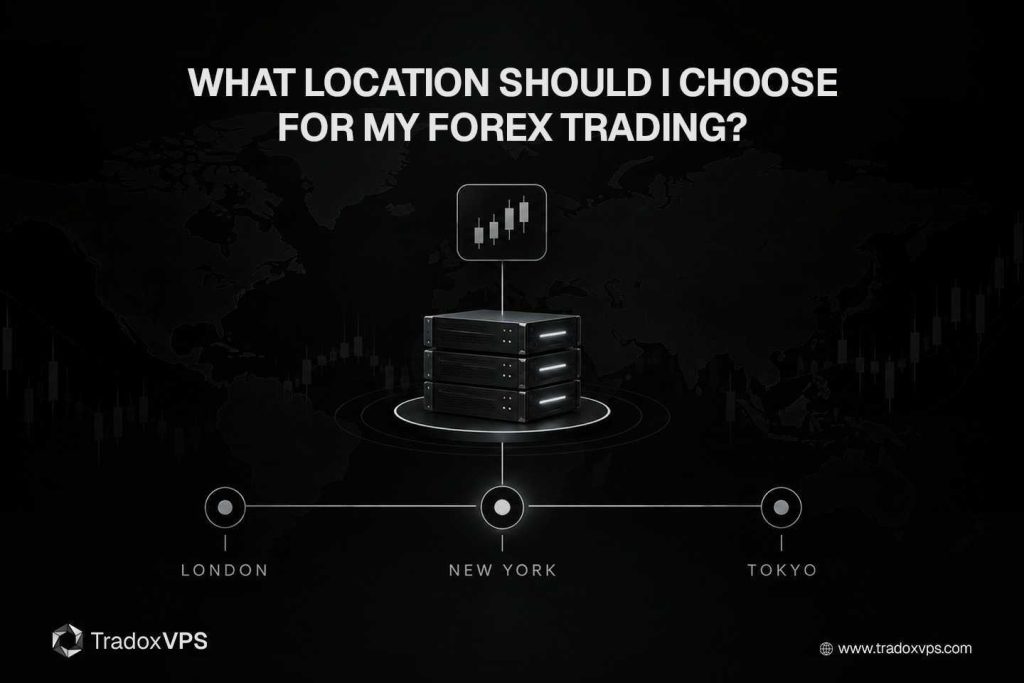
Short answer: the best VPS location for forex trading is not the city closest to you, and it is not even simply “London” or “New York.” It is the location closest, in network terms, to your broker’s trade server. For most retail brokers that server sits in one of a handful of specific buildings: Equinix LD4/LD5 near London, Equinix NY4/NY5 in New Jersey, or Equinix TY3 in Tokyo. Find out which one your broker uses (we show you how below), put your VPS in that metro, and you have made the single decision that matters most.
That is the short version. The long version is worth reading, because forex location advice is full of half-truths, and the difference between the right and wrong choice is not subtle: it is the difference between a few milliseconds and an unnecessary ocean crossing on every order.
The forex paradox: a decentralized market with concentrated plumbing
Forex has no central exchange. There is no CME building to park next to. Yet the market’s physical infrastructure is remarkably concentrated, and the 2025 BIS Triennial Survey (the definitive census of the FX market, run every three years by the Bank for International Settlements) shows just how much.
In April 2025, global FX turnover reached $9.6 trillion per day, up 28% from 2022. Of that, sales desks in just four jurisdictions handled 75% of all trading: the United Kingdom at 38% (still the largest FX center on earth, roughly $4.7 trillion a day through London alone), the United States at about 19%, Singapore at 11.8%, and Hong Kong next. The US dollar was on one side of 89% of all trades.
So while the market is legally and structurally decentralized, the machines that run it cluster in a few cities, and within those cities they cluster in a few specific data centers. Those data centers are where your broker’s server almost certainly lives, and they are the real map for your VPS decision.
The real map: the Equinix hubs where brokers actually host
When a broker says its servers are “in London” or “in New York,” it usually means one of a small set of Equinix International Business Exchange buildings where brokers, liquidity providers, ECNs and prime brokers physically interconnect. Knowing these names turns vague marketing into a concrete address.
| Hub | Where it actually is | What lives there | Matters most for |
|---|---|---|---|
| Equinix LD4 / LD5 | Slough, west of London | The main European FX hub: most UK/EU broker servers, major ECNs and bank liquidity. The highest broker density of any hub worldwide. | EUR, GBP, CHF and cross pairs; the London session; most European and many offshore brokers |
| Equinix NY4 / NY5 | Secaucus, New Jersey | The main US hub: most North American and offshore retail broker infrastructure, major FX ECN matching engines, hundreds of financial firms | USD majors, the New York session, US-facing and many global brokers |
| Equinix TY3 | Tokyo | The Asian session anchor: JPY pairs and Asia-Pacific broker gateways | JPY strategies, Asian-session trading |
| Equinix SG1 | Singapore | The other Asian pillar (Singapore is now the world’s third-largest FX center at 11.8%) | APAC routing, SGD and regional flows |
| Frankfurt (FR2) / Amsterdam | Germany / Netherlands | Regional European hubs used by EU-regulated brokers, liquidity providers and exchange infrastructure | EU-hosted brokers, EU forex and CFD flows |
Two details in that table matter more than they look. First, the famous names are not where you think: LD4 is in Slough, not central London, and NY4 is in New Jersey, not Manhattan. “London” and “New York” are shorthand for a metro area, and what counts is being on a short, clean network path into that metro’s financial data centers. Second, these are buildings, not cities, which is why a generic cloud instance “in London” from a big cloud provider can still sit on a mediocre path to LD4, while a purpose-placed trading VPS in the same metro reaches it in low single-digit milliseconds. City-level proximity is necessary; the network path is what you actually buy.
Rule one: your broker’s server location beats everything else
Everything above is background to the one decision that matters. Retail forex execution is broker-centric: your MT4, MT5 or cTrader terminal talks to your broker’s trade server, and that server talks to liquidity. So the right VPS region is defined by where that server is, not by where you live, and not by which city sounds most “financial.”
Here is how to find it, in increasing order of certainty:
- Read the ping in your platform. MT4 and MT5 show the round-trip time to your current trade server in the bottom-right corner of the terminal. That number is your baseline from wherever you are now.
- Geolocate the server. Your platform’s connection settings (or the server list under File, then Open an Account) expose the trade server’s address. Look up its IP in a geolocation tool such as ipinfo.io. A result of “Slough” or “London” means the LD4/LD5 ecosystem; “Secaucus” or “Weehawken, New Jersey” means NY4/NY5; Tokyo means TY3.
- Ask support directly. “Which data center are your live trade servers located in?” Most brokers answer plainly, and the better ones name the exact facility.
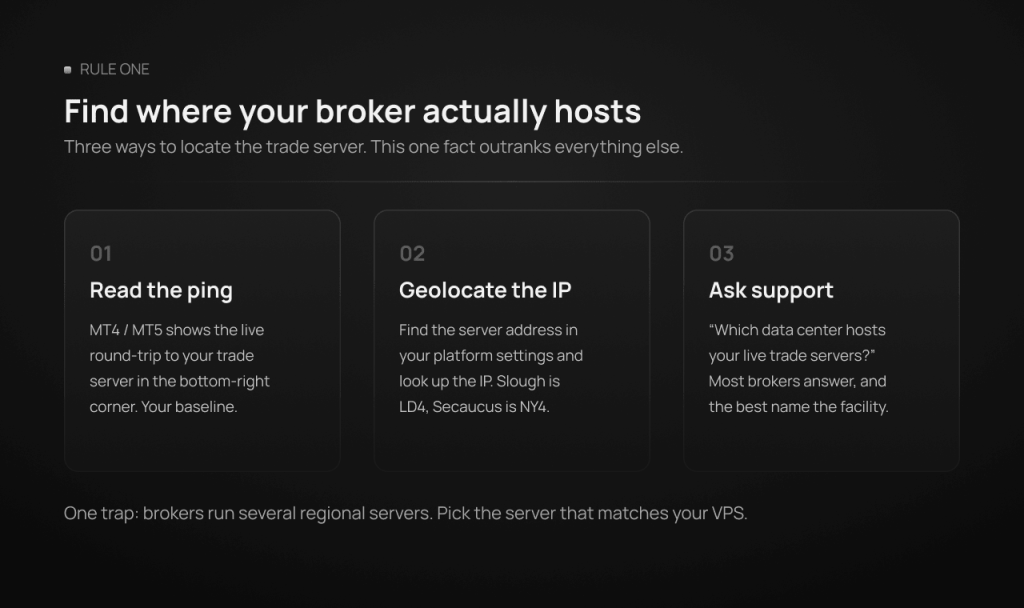
And one trap that catches even experienced traders: many brokers run several regional servers, for example a Live1 in London and a Live3 in Singapore, and the platform may auto-assign you to one far from your VPS. Check which server your account actually sits on, and if your broker allows it, choose the one that matches your VPS region. A perfectly placed VPS pointed at the wrong server wastes the whole exercise.
What the distances cost: a latency reality table
Approximate, real-world figures (routes vary; always measure your own):
| Setup | Typical round-trip to the broker server |
|---|---|
| Home internet connection | roughly 50 to 200 ms, with spikes and jitter on top |
| VPS in the same data center as the broker | about 0 to 2 ms |
| VPS in the same metro (for example, London Docklands to Slough) | low single digits, roughly 1 to 10 ms |
| VPS in the same region (for example, Amsterdam to London) | around 10 to 20 ms |
| VPS on the wrong continent (for example, London-hosted broker, Asia-hosted VPS) | 75 ms or more added, every order, both ways |
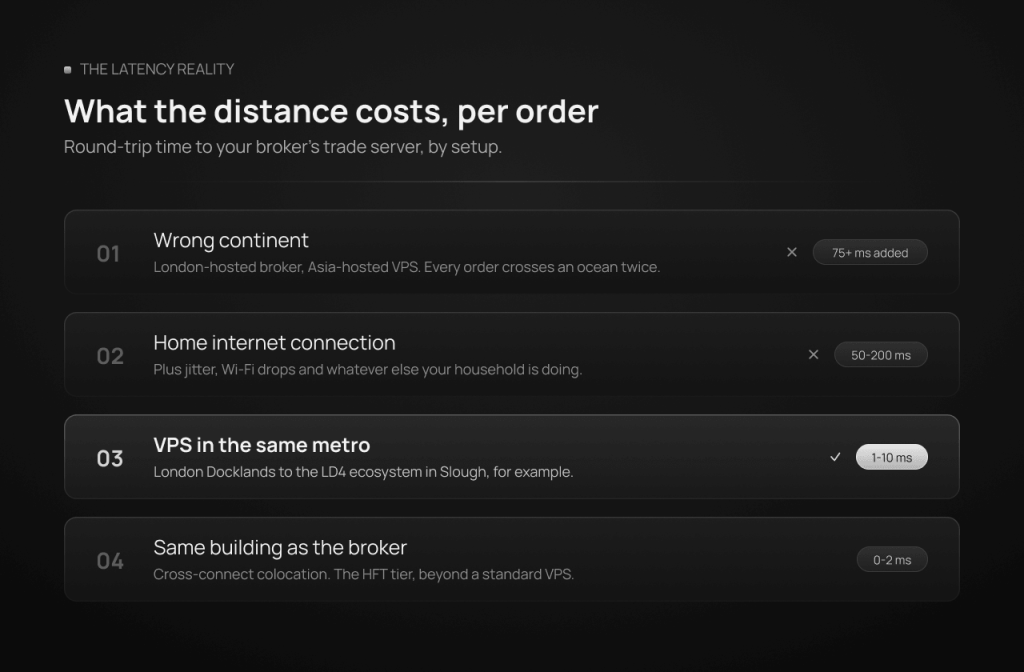
The expensive mistake is the last row, and it is the most common one: a trader in Asia or the Americas rents a VPS near their home for a comfortable remote desktop, while their broker’s server sits in Slough. Every order then crosses an ocean twice. The correct mental model is the opposite: put the VPS next to the broker and let the remote-desktop session be the long hop. A laggier screen only affects how the charts feel to you; your EA’s orders travel the short path from the VPS to the broker, and that is the path that executes trades.
What latency actually buys you (the honest version)
This is where we depart from the usual VPS marketing, because latency does not matter equally for everyone, and pretending otherwise sells people upgrades they do not need.
Where location genuinely matters: market-order-heavy strategies. Scalping EAs that fire and modify orders constantly, news traders reacting to releases like NFP and CPI within the first seconds, high-frequency styles, and arbitrage-adjacent systems. For these, the gap between 2 ms and 80 ms is the strategy.
Where it matters much less than you think: pending-order systems. Stop-loss, take-profit and pending orders are stored and triggered on the broker’s server, not on your machine, so once they are placed, execution does not wait for your VPS at all. Grid systems, set-and-forget swing EAs and position traders fall in this camp: for them, what a VPS buys is 24/7 uptime and stability, and 15 to 40 ms of latency is entirely workable.
And the caveats an honest guide owes you: a low ping is not a fast fill. Your real execution time also includes the broker’s bridge, liquidity aggregation, and execution policy, and in FX specifically, liquidity providers can apply “last look” and reject or requote in fast markets. Slippage during a news spike is mostly a liquidity phenomenon, not a network one; no VPS location prevents it. And check your broker’s rules before optimizing for speed: many retail brokers explicitly prohibit latency arbitrage, impose minimum hold times, or cap message rates, and a strategy built purely on out-running the feed can get an account closed faster than it gets it funded.
In short: location reduces one specific, controllable source of delay and slippage. It does not change your counterparty, your liquidity pool, or your strategy’s edge. It is worth getting right precisely because it is one of the few execution variables fully within your control.
Sessions: when your latency matters most
The FX day has three overlapping sessions (Asia, London, New York), and they are not equal. London is the center of gravity, consistent with the UK’s 38% share of global turnover, and the London/New York overlap (roughly 13:00 to 17:00 UK time) is the deepest, most liquid window of the day, when EUR/USD and the other majors do much of their volume. If your strategy concentrates there, the LD4 and NY4 ecosystems are the two addresses that matter, and the choice between them comes back to rule one: whichever of the two your broker’s server sits in. Asian-session and JPY-focused strategies point instead at TY3 or SG1.
The machine itself: what forex platforms actually need
Location gets the order onto a short path; the box still has to run your stack without stalling, and many “latency” complaints are really platform stalls in disguise.
- High single-thread clock speed. MT4 is an older 32-bit platform where each chart and EA leans on a small number of threads, and MT5’s live processing also rewards fast cores. The common community guidance is a CPU of at least 3 GHz; a current desktop-class chip such as the Ryzen 9 9950X (Zen 5, 4.3 GHz base, boosting to 5.7 GHz) clears that bar with room to spare, which shows up as responsive charts and EAs that do not queue behind each other.
- Enough dedicated RAM for your real chart and EA count. Every chart, indicator set, EA instance and copier holds working memory. Size for your actual stack (many traders run several terminals for several accounts), and prefer dedicated RAM so a neighbor’s workload never squeezes yours.
- NVMe storage. Tick history downloads, logs and MT5 strategy-tester runs are disk-heavy; NVMe keeps backtests and terminal restarts from freezing the platform.
- Windows Server for the standard MT4/MT5/cTrader stack, and stable RDP for managing it from anywhere.
- A note for optimizers: MT5’s strategy tester is genuinely multi-threaded and will happily use many cores for optimization passes, so if heavy backtesting is part of your workflow, core count matters to you more than to a pure live-execution setup.
Where TradoxVPS fits, honestly
TradoxVPS operates a London node at Telehouse in the Docklands, one of the city’s core carrier hotels. Being precise, because precision is the point of this article: Telehouse Docklands is not inside Equinix LD4 in Slough. It is a first-class London-metro location on dense interconnection, and same-metro paths to the LD4/LD5 ecosystem typically run in the low single-digit milliseconds. For a broker hosted in the London ecosystem, that puts your platform a short, stable hop from its trade server, which is exactly the tier most MT4/MT5 and cTrader traders need. If your strategy genuinely requires same-building cross-connect latency (true HFT), that is colocation territory, and we would rather tell you that than blur the line.
Amsterdam is our second Europe node, on AMS-IX with strong European peering, and it suits EU-regulated brokers and liquidity that host in the Amsterdam/Frankfurt region, as well as traders who run mixed forex and crypto stacks on one box. New York is on the roadmap (marked “coming soon”), which will cover NY4-hosted brokers properly; today, if your broker’s only trade server is in Secaucus, an honest answer is that a US-East VPS closer to NY4 will beat any European node, ours included. We do not currently offer Tokyo or Singapore, so TY3- or SG1-hosted brokers are outside our short-path coverage for now.
Every plan runs the Ryzen 9 9950X with DDR5, dedicated RAM and NVMe on Windows Server 2022, which covers the platform-stall side of the problem. And we will not print a “your broker in X ms” number here, because the only figure that matters is the one measured from a live box to your broker’s actual server. Use the latency checker, open your platform on a trial, and read the ping in the corner of MT4/MT5 before you commit. More detail: London VPS, Amsterdam VPS, MetaTrader VPS, cTrader VPS, and the hardware benchmarks.
A practical framework for choosing
- Find your broker’s trade server first. Platform ping, IP geolocation, or ask support. This single fact outranks every other consideration.
- Match the metro. LD4/LD5 ecosystem: London VPS. NY4/NY5: New York metro VPS. TY3/SG1: Tokyo or Singapore. If your broker offers multiple regional servers, pick the server and the VPS in the same place.
- Check your strategy’s real sensitivity. Market-order scalping and news trading justify chasing single-digit latency. Pending-order and swing systems mostly need uptime; do not pay a complexity tax for milliseconds they will never use.
- Measure during your session, not at midnight. Watch round-trip time and jitter to the broker server during London open or the NY overlap, plus CPU and RAM headroom while every chart is ticking.
- Re-verify occasionally. Brokers migrate servers and routes change. The ping in your terminal is a free, continuous audit; glance at it.
Final takeaway
Forex is a decentralized market with very centralized plumbing: $9.6 trillion a day flowing mostly through a handful of buildings near London, in New Jersey, and in Tokyo. The best VPS location is therefore not a matter of opinion but of lookup: find your broker’s trade server, put your VPS in that metro, select the matching platform server, and confirm with a measured ping during your live session. Do that, size the machine for your real chart and EA load, and be honest with yourself about whether your strategy trades on milliseconds or on uptime. One decision, correctly made, removes the largest controllable delay in your entire execution path, and it costs nothing but ten minutes of checking.
Frequently asked questions
The metro where your broker’s trade server sits. For most retail brokers that means the Equinix LD4/LD5 ecosystem near London or NY4/NY5 in New Jersey, with TY3 in Tokyo for Asia-focused brokers. If you cannot determine it, London is the statistically safest default, because broker density there is the highest in the world, but finding your broker’s actual server is always better than defaulting.
Three ways: read the ping shown in the bottom-right of MT4/MT5 as a baseline, geolocate the trade server’s IP from your platform’s connection settings (Slough means LD4, Secaucus means NY4), or simply ask support which data center hosts the live servers.
Far less than for scalping. Stop-loss, take-profit and pending orders execute on the broker’s server once placed, so those systems mainly need a stable, always-on machine rather than minimal latency. Uptime is the feature you are buying.
Neither, universally. London hosts the largest share of global FX (the UK is 38% of turnover) and the densest broker ecosystem; New York anchors USD flow and US-facing brokers. The right one is whichever holds your broker’s server. Choosing the other adds roughly 75 ms or more of transatlantic round trip to every order.
No, and be wary of anyone implying it can. A well-placed VPS removes network delay and home-connection instability, which reduces one source of slippage. Volatility, liquidity gaps, broker execution policy and last-look rejections remain, especially around news.
London (Telehouse) for brokers hosted in the London/LD4 ecosystem, which covers most European and many global brokers; Amsterdam for EU-hosted brokers and mixed forex/crypto stacks. If your broker is NY4-only, wait for our New York node or use a US-East box in the meantime; we would rather route you right than sell you the wrong hop.
Disclaimer: TradoxVPS provides infrastructure only and does not provide investment or trading advice. Trading involves substantial risk. Market data cited from the BIS 2025 Triennial Central Bank Survey.