

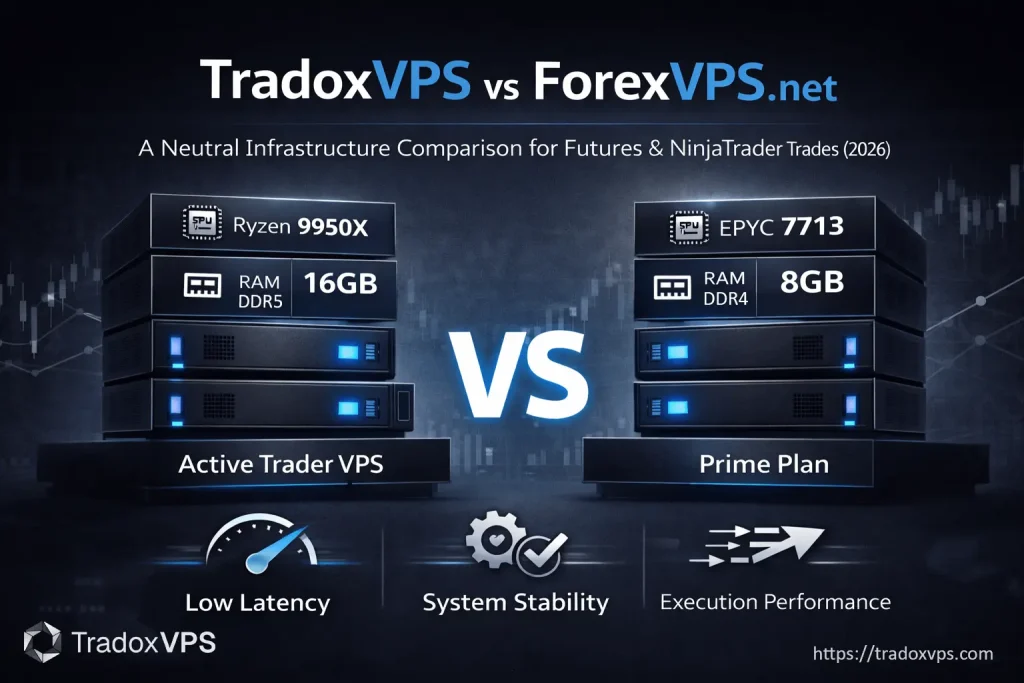
A Neutral Infrastructure Comparison for Futures & NinjaTrader Traders (2026)
Selecting a Trading VPS is not a branding decision — it is an infrastructure risk decision.
For traders running NinjaTrader, automated strategies, or latency-sensitive futures systems, the real questions are:
- How fast can orders be processed under load?
- How stable is execution during volatility?
- How predictable is performance during peak sessions?
This comparison objectively analyzes TradoxVPS Active Trader VPS and ForexVPS.net Prime Plan, focusing on real-world trading performance, not surface-level specs.
This guide is written for:
- Futures traders
- NinjaTrader users
- Automated and semi-automated strategy traders
- Traders concerned with execution consistency, not marketing claims
No hype. No bias. Just infrastructure reality.
Why VPS Hardware Choices Matter in Trading (Experience)
Trading platforms are latency-sensitive and execution-critical systems, not general workloads.
During:
- CME session opens
- High-impact news (CPI, NFP, FOMC)
- Volatility spikes
your VPS must handle:
- Bursty CPU demand
- Single-thread execution paths
- Real-time market data ingestion
- Strategy evaluation without delay
A VPS that looks powerful on paper can still underperform in trading if its CPU architecture, clock speed, and memory latency are not optimized for these workloads.
Side-by-Side Specification Comparison (Expertise)
| Feature | TradoxVPS – Active Trader VPS | ForexVPS.net – Prime Plan |
|---|---|---|
| CPU Model | AMD Ryzen 9950X | AMD EPYC 7713 |
| CPU Cores | 4 Cores | 6 Cores |
| Base Clock | 4.3 GHz | 2.0 GHz |
| Boost Clock | Up to 5.7 GHz | Up to 3.68 GHz |
| RAM | DDR5 16GB | DDR4 8GB |
| Storage | NVMe SSD 300GB | NVMe SSD 200GB |
| Network Speed | 3 Gbps Upload / Download | Not specified |
| Latency | ~1ms (CME-proximal) | Not specified |
| Uptime | 99.999% | Not specified |
| NinjaTrader | Pre-installed | Not specified |
| Bandwidth | Unlimited | Not specified |
| Price | $69 / month | $80 / month |
CPU Architecture: Trading Performance vs Server Density (Expertise)
This is the most misunderstood part of VPS comparisons.
Ryzen 9950X vs EPYC 7713 — Different Design Goals
- Ryzen 9950X is designed for:
- High single-core performance
- High clock speed
- Low latency workloads
- EPYC 7713 is designed for:
- High core density
- Virtualization at scale
- Enterprise batch workloads
You can read a deeper technical breakdown here: Ryzen vs EPYC for Trading VPS .
Why This Matters for Trading
Most trading platforms (including NinjaTrader):
- Execute order logic on a single dominant thread
- Are limited by clock speed, not core count
- Benefit from fast IPC + high boost clocks
A 2.0 GHz base clock CPU with many cores may:
- Look powerful
- Perform well in databases or virtualization
- Underperform in latency-sensitive trading workloads
This is why higher clock speed often beats higher core count for trading.
Clock Speed: The Hidden Execution Multiplier (Experience)
Let’s look at clock speeds alone:
- TradoxVPS:
- Base: 4.3 GHz
- Boost: up to 5.7 GHz
- ForexVPS.net:
- Base: 2.0 GHz
- Boost: up to 3.68 GHz
That difference directly affects:
- Order processing speed
- Strategy calculation timing
- ATM logic execution
In fast markets, even milliseconds of CPU delay can change fill quality.
For traders, clock speed is not a benchmark number — it is execution risk control.
Memory Technology: DDR5 vs DDR4 in Trading Context (Expertise)
You can explore why DDR5 matters for trading workloads here: Why DDR5 RAM Is Best for Trading VPS .
Trading platforms load:
- Market depth
- Historical bars
- Tick streams
- Strategy states
DDR5 16GB provides:
- Higher bandwidth
- Lower effective latency
- More headroom for volatility
DDR4 8GB:
- Can be sufficient for light workloads
- May become constrained with:
- Multiple charts
- Multiple instruments
- Automated strategies
Memory pressure often causes micro-stutters — invisible to users, but damaging to execution consistency.
Storage Performance: NVMe Capacity & Trading Stability (Experience)
Storage speed and capacity are often underestimated in trading environments.
Trading platforms constantly perform disk operations such as:
- Logging executions and orders
- Writing tick and bar data
- Caching historical market data
- Saving strategy state and workspace files
TradoxVPS provides 300GB NVMe SSD, while ForexVPS.net offers 200GB NVMe SSD.
The difference is not just capacity — it is operational headroom.
- More space for historical data
- Lower risk of I/O contention
- More stable performance during heavy logging
Storage saturation can introduce delayed writes, which indirectly affect platform responsiveness during volatile sessions.
Network Speed & Latency: The Execution Backbone (Experience)
Trading VPS performance is ultimately constrained by network quality.
TradoxVPS provides:
- 3 Gbps upload / download bandwidth
- ~1ms latency to CME infrastructure
- Dedicated, non-oversubscribed trading routes
ForexVPS.net does not publicly specify:
- Exact network throughput
- Exchange-proximity latency
- Bandwidth guarantees
Low latency is not about speed tests — it is about:
- Faster order acknowledgements
- Reduced slippage during volatility
- Consistent fills during session opens
You can test and verify execution latency here: Latency Checker .
Uptime & Reliability: Risk You Don’t See Until It Happens (Trust)
Infrastructure failures rarely announce themselves — they appear as:
- Frozen charts
- Missed orders
- Delayed exits
- Disconnected strategies
TradoxVPS is built on infrastructure designed for:
- 99.999% uptime
- Redundant power systems
- Redundant networking
- Continuous monitoring
You can review infrastructure and reliability details here:
ForexVPS.net does not publicly disclose an uptime SLA at the same transparency level.
NinjaTrader Readiness & Trading Focus (Experience)
TradoxVPS includes:
- NinjaTrader pre-installed
- Optimized Windows configuration
- Trading-focused system tuning
This reduces:
- Setup time
- Configuration errors
- Compatibility issues
ForexVPS.net does not specify NinjaTrader pre-installation or trading-specific OS optimization.
For active traders, pre-optimized environments reduce operational risk.
Benchmark Transparency (Authority)
Raw specifications only matter if they translate into real performance.
TradoxVPS provides:
- Public benchmark results
- CPU performance validation
- Transparent hardware specifications
You can review benchmarks here: Performance Benchmarks .
ForexVPS.net does not provide comparable benchmark transparency for this plan.
Pricing vs Performance Value (Expertise)
Let’s compare cost efficiency:
- TradoxVPS:
- $69 / month
- Higher clock speed CPU
- DDR5 16GB RAM
- Lower latency
- ForexVPS.net:
- $80 / month
- Lower clock speed CPU
- DDR4 8GB RAM
- Less disclosed infrastructure detail
Lower price does not always mean better value — but in this case, performance and pricing align.
Final Verdict: Which VPS Is Better for Active Traders?
This comparison is not about brand preference.
It is about execution consistency, latency control, and infrastructure transparency.
TradoxVPS Active Trader VPS is better suited for:
- Futures traders
- NinjaTrader users
- Automated strategy trading
- Latency-sensitive execution
ForexVPS.net Prime Plan may suit:
- General VPS usage
- Less latency-sensitive workloads
For traders who care about milliseconds, stability, and execution predictability, infrastructure design matters more than marketing.
You can explore full hardware details here: Hardware Specifications .
Frequently Asked Questions (FAQ)
Is TradoxVPS or ForexVPS.net better for NinjaTrader?
For NinjaTrader users, performance depends heavily on single-core CPU speed, clock frequency, memory latency, and execution consistency. TradoxVPS uses a high-clock Ryzen CPU with DDR5 memory, which aligns well with NinjaTrader’s execution model. ForexVPS.net may be sufficient for lighter workloads, but lower clock speeds can affect execution timing during volatile market conditions.
Why does clock speed matter more than core count for trading?
Most trading platforms, including NinjaTrader, execute order logic and strategy calculations on a single dominant thread. This means higher clock speed and stronger single-core performance typically have a greater impact on execution speed than having more CPU cores.
Is EPYC CPU bad for trading VPS?
EPYC CPUs are not bad, but they are designed for enterprise-scale workloads such as virtualization density and batch processing. For latency-sensitive trading workloads, higher-clock CPUs like Ryzen often deliver more predictable execution performance.
Does DDR5 RAM improve trading performance compared to DDR4?
DDR5 provides higher memory bandwidth and improved efficiency compared to DDR4. In trading environments, this can help reduce memory-related delays when handling market data, charts, indicators, and automated strategies—especially during high-volatility sessions.
How important is latency for futures trading VPS?
Latency directly impacts how quickly orders reach the exchange. Lower latency can reduce slippage and improve fill consistency, particularly during fast-moving markets such as session opens or economic news releases.
Can a lower-priced VPS still outperform a more expensive one?
Yes. VPS pricing often reflects brand positioning rather than infrastructure optimization. A lower-priced VPS with better CPU architecture, higher clock speed, faster memory, and closer proximity to exchange infrastructure can outperform a more expensive but less optimized solution.
Is uptime really critical for automated trading?
Yes. Even short outages can interrupt automated strategies, cause missed trades, or leave positions unmanaged. High uptime is a core risk-control factor for traders running systems continuously.
Should I choose a VPS based only on specifications?
Specifications are important, but they should be evaluated in the context of trading workloads. Real-world execution consistency, latency stability, and infrastructure design matter more than raw numbers alone.
Learn more about TradoxVPS here: Official Website .