
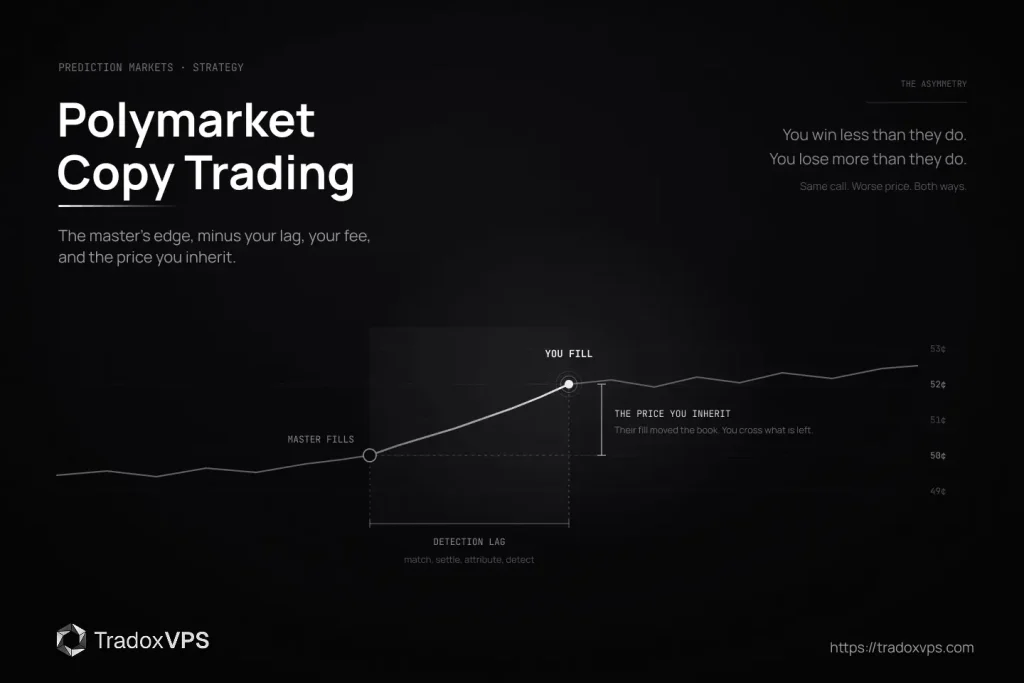
Every guide to Polymarket copy trading tells you the same story: every wallet is public, the winners are visible on-chain, so point a bot at a profitable trader and mirror their moves. Set it up in ten minutes. Passive income.
Here is what almost none of them tell you: copy trading does not copy a trader’s returns. It copies their decisions, then charges you three separate taxes on each one: the price drift during your detection lag, the taker fee on your entry, and the worse fills that the master’s own order just helped create. Whether anything is left after those taxes is not a matter of opinion. It is one line of arithmetic, and this post does it in public, because we run our own copy-trading experiments on these exact markets and the arithmetic is what decides everything.
The honest summary up front: a wallet is worth copying only if its per-trade edge is larger than your lag cost plus your fees plus any service split. On slow political markets that bar is low. On 5-minute Bitcoin markets, the ones most copy-trading content is quietly aimed at, that bar is brutally high, and a master who looks strongly profitable can still lose you money. We will show exactly where the line sits.
First, the jurisdiction reality
Wallet-based copy trading exists on the international Polymarket platform, because that is where trading is wallet-based and settles publicly on Polygon. Two things follow.
First, the international platform restricts order placement in a list of jurisdictions that has included the US, UK, France, Germany, and others. Reading public data is open; placing the mirrored order is the regulated act. A VPS does not change where you are allowed to trade, and using one to appear somewhere else violates Polymarket’s terms. That is not a service we offer.
Second, if your lawful venue is Polymarket US, the CFTC-regulated exchange, note that this strategy does not port there. Polymarket US accounts are identity-verified with no public wallet trail, so there is no on-chain feed of another trader’s fills to mirror. Wallet copying, as described in this post, is an international-platform strategy for traders in eligible jurisdictions. Our Polymarket API guide covers the two-platform split in full.
How copy trading actually works on Polymarket
Polymarket has no native copy-trading feature. What exists is an ecosystem of web dashboards, Telegram bots, and open-source scripts, all built on the same public fact: every filled trade on the international platform settles on Polygon and is attributable to a wallet. The tools differ in interface, fees, and custody model (prefer non-custodial, where your key never leaves your wallet), but underneath they all run the same loop:
- Watch a chosen wallet’s activity.
- Detect a new fill.
- Compute a proportional order.
- Submit it from your wallet.
- Repeat, including for exits.
The loop looks instant in marketing copy. It is not, and the anatomy of the delay is where every downstream number in this post comes from.
The anatomy of the lag
When a master’s order fills, five clocks start, and you only control the last two:
| Stage | What happens | Who controls it |
|---|---|---|
| Match | The order matches at Polymarket’s CLOB. A trade print hits the public websocket almost immediately, but it is anonymous: price, size, side, no identity | Polymarket |
| Settlement | The operator settles the matched trade on Polygon (roughly two-second blocks, plus finality) | Polymarket / Polygon |
| Attribution | The fill becomes readable as that wallet’s trade: on-chain logs at settlement, indexers and the Data API shortly after | Polymarket / indexers |
| Detection | Your watcher notices: websocket-driven on-chain log monitoring is faster, Data-API polling is simpler and slower | You |
| Your fill | Your order crosses whatever book remains after the master’s fill and everyone else’s reaction | You, partly |
The detail that surprises people: the trade is public within about a second, but the identity takes several more. Stage 1’s anonymous print is visible to everyone instantly. Knowing it was your master requires stage 2 and 3 to complete. Copy trading lives inside that gap.
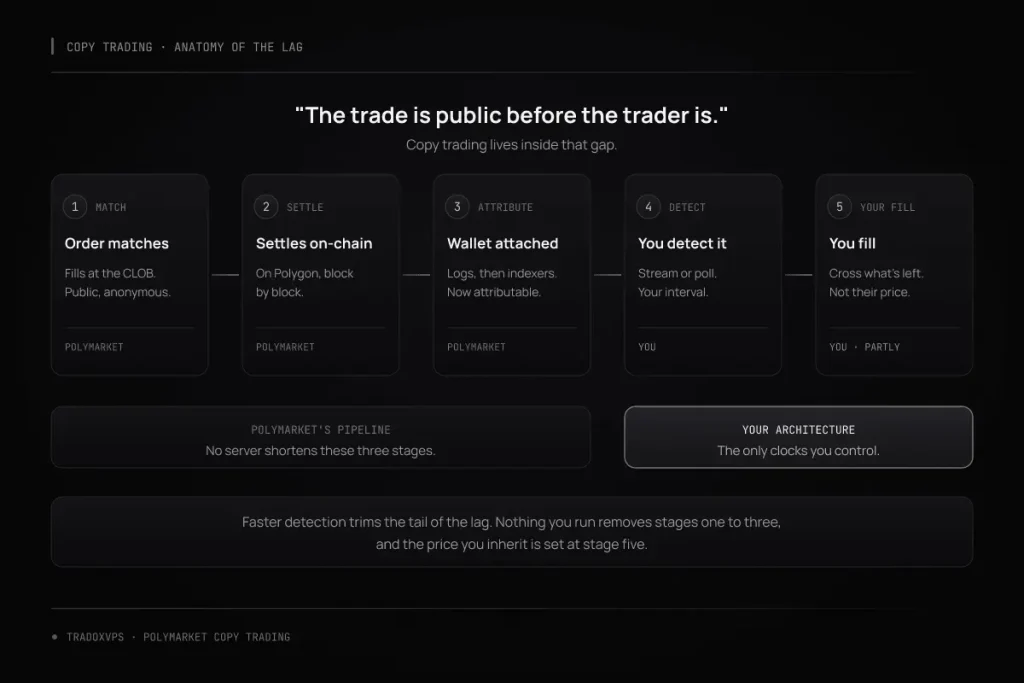
In our own testing on 5-minute BTC markets, using Data-API polling as the detection path, the gap from a master’s fill to an attributable detection ran about four to five seconds (measured July 2026; your architecture and route will differ, so measure your own). Watching settlement logs on Polygon directly trims stages 3 and 4, but nothing you buy or build removes stages 1 through 3, because they belong to Polymarket’s pipeline, not yours.
Be appropriately skeptical of copy tools advertising sub-second mirroring or fills “in the same block as the leader.” Even if your transaction lands in the same block, you do not get the leader’s price: their fill consumed that liquidity, and your order crosses what is left. Landing early and landing at their price are different claims, and only one of them is physically available to a copier.
The copier’s equation
Now the arithmetic. Binary contracts make this unusually clean.
Buy a YES share at price p (in dollars) and hold to resolution. If the outcome hits, the share pays $1, so you gain (1 − p). If it misses, you lose p. If w is the true win probability of the trade, the expected value per share is:
EV = w − p
That is the whole engine. A trader’s edge, per share, is simply their win probability minus their average entry price.
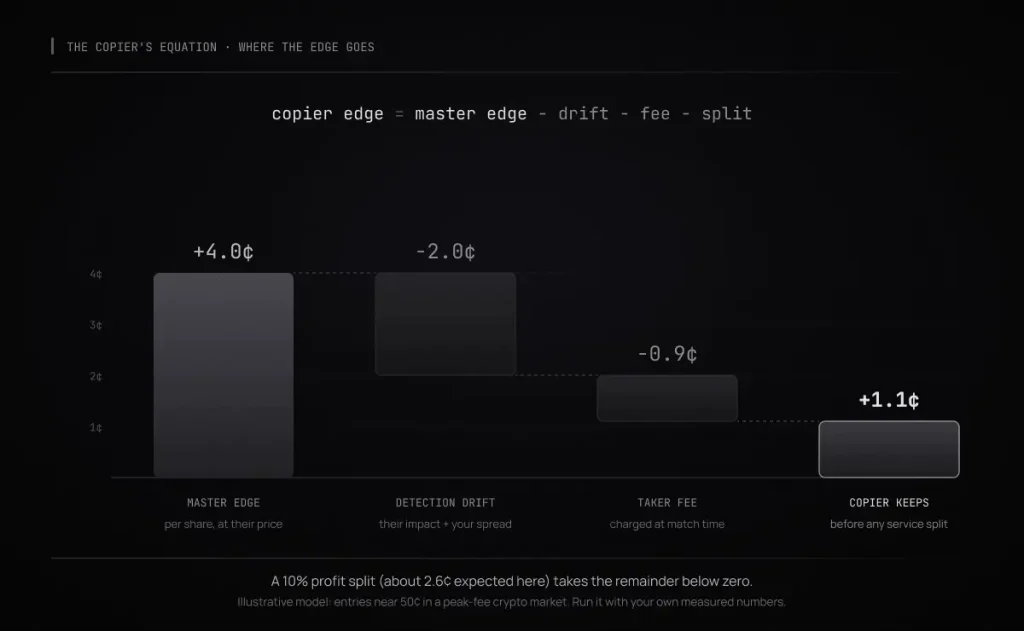
Now copy them. The master enters at price p. By the time you detect and fill, the price has drifted by some amount δ (delta): their own market impact, other copiers, momentum, and your half of the spread. You also pay a taker fee f on entry, and if you use a copy service with a profit split, that comes out of your wins. So:
Copier edge = Master edge − δ − f − split
Everything in this post is a footnote to that line. The master’s edge is the only income. Delta, fees, and splits are the taxes. You cannot negotiate with any of the three; you can only measure them and pick masters whose edge clears them.
The asymmetry: worse in both directions
One consequence deserves its own section, because most people feel it before they can prove it: a copier earns less than the master on every win and loses more on every loss.
Per share, with the master at 50c and you at 52c:
| Outcome | Master (50c entry) | Copier (52c entry) |
|---|---|---|
| Win (share pays $1) | +50c | +48c, minus fee |
| Loss (share pays $0) | −50c | −52c, minus fee |
Wins are discounted, losses carry a premium, and the fee applies either way. If you size in fixed dollars instead of shares, the same asymmetry appears as identical −100 percent downside with reduced upside. There is no sizing scheme that removes it, because it is not a sizing effect. It is the direct consequence of paying a worse price for the identical outcome. Copy trading inherits the master’s losses in full and their wins at a discount, and that is before the lag has cost you a single missed trade.
Where the breakeven line actually sits
Let us put numbers on it for the market type where copy trading is most aggressively marketed: crypto up-or-down contracts trading near 50c, where the taker fee is at its peak. As of mid-2026 reporting, short-duration crypto markets are the fee-bearing exception on Polymarket, with a peak effective taker fee around 1.5 to 1.8 percent of notional at the midpoint (roughly 0.9c per share; verify the current schedule, these have changed during 2026). Master’s entry: 50c.
| Your detection drift δ | Your entry | Your breakeven win rate | Master ROI needed just for you to break even |
|---|---|---|---|
| 0.5c | 50.5c | 51.4% | 2.8% per trade |
| 1c | 51c | 51.9% | 3.8% per trade |
| 2c | 52c | 52.9% | 5.8% per trade |
| 3c | 53c | 53.9% | 7.8% per trade |
Read the third row slowly, because it kills a popular heuristic. A master printing a 5 percent per-trade ROI, which is a strong, real edge in these markets, leaves a copier with a 2-cent drift underwater. Five percent sounds like a safe threshold for choosing who to copy. It is not a threshold. At ordinary drift, it is roughly the breakeven, and reported spreads of 2c to 5c on these contracts mean a 2-cent drift is not a pessimistic assumption; crossing the spread alone can cost you that before any momentum is counted.
Push the master’s edge to 8 percent per trade (a 54 percent win rate at even prices, which is elite and rare at this frequency) and the copier at 2 cents of drift keeps about a 2 percent ROI. At 3 cents of drift, even the 8 percent master rounds to zero for you.
And a profit split is worse than it looks. A service taking 10 percent of gross wins from that 8-percent master costs you roughly 2.6c per share in expectation, which is more than double the 1.1c edge you had left. Splits are charged on gross wins, not on your net edge, so a “small” split can quietly exceed everything you were going to make.
If you take one number away from this post: required master edge ≈ your measured drift + your fee + your split, divided by the entry price. Compute it with your own measured numbers, not ours, and demand comfortable headroom above it, because the master’s future edge will be smaller than their past one more often than not.
Why 5-minute Bitcoin markets are the hardest place on the platform to copy
Everything above applies everywhere on Polymarket. Five-minute BTC up-or-down markets stack four extra penalties on top, and it is worth being precise about them because these markets are exactly where new copiers are pointed.
The fee peaks where these markets live. The taker fee formula scales with p × (1 − p), maximal at 50c, and an up-or-down market spends its life near the coin flip. You pay the platform’s highest effective fee on nearly every copied entry. The same fee formula would cost you a fraction as much on a 90c favorite in a slow market.
Your lag is a meaningful share of the market’s entire life. Four to five seconds is under 0.03 percent of a monthly political market. It is about 1.5 percent of a 300-second window, in the asset class where prices move the fastest. The same lag that rounds to zero elsewhere is structural here.
Some edges are physically uncopyable. These markets resolve on a Chainlink BTC/USD feed comparing the window’s start and finish, and a meaningful slice of the action concentrates in the final seconds. There is also public reporting of manipulation concerns, participants pushing the spot price in the closing seconds to move the resolution print. Whatever you think of that, the copy-trading consequence is mechanical: if your master’s edge lives in the last seconds of the window, your 4-to-5-second lag means the window can end before your fill, or resolve against a position you just opened. A speed edge, mirrored with a delay, is not a smaller edge. It is no edge. Skip any master whose entries cluster in a window’s final moments, and configure your bot to refuse copies inside the last N seconds outright.
The books are thin. Per-window volume in these markets is small, frequently a few thousand to a few tens of thousands of dollars, so the master’s fill visibly moves the price you inherit, and your own mirrored size moves it again. If several copiers follow the same wallet, the followers become the move. That leads directly to the ugliest risk in this niche: a wallet that knows it is being copied can enter a thin window, let the mirror flow push the price, and exit into its own followers. On-chain transparency makes copying possible, and it makes copiers visible. Assume any master you can find, others found too.
How to vet a master: PnL, ROI, win rate, and the traps in each
Your instinct to rank wallets by PnL, ROI, and win rate is right. Each number is also gameable or misleading on its own, so here is what each one actually tells you.
PnL is a bankroll artifact. Leaderboards sort by dollars, and dollars mostly measure size. A wallet up $400,000 on $10 million of volume has a 4 percent return and needed enormous capital to print it; a wallet up $40,000 on $200,000 of volume is five times the trader. Check whether the PnL is realized or riding on open positions, and whether one oversized winning bet accounts for most of it. One great call is luck; a distribution of gains across many markets is skill.
Win rate rewards exactly the wrong wallets. Buying favorites at 90c wins about nine times in ten by construction. The payoff math is merciless: each win earns about 11 percent, each loss costs 100 percent, so one extra loss erases roughly nine wins, and the per-trade edge is a sliver. Now recall the copier’s equation: a sliver of edge minus your drift minus your fee is negative. This is the counterintuitive rule of copy trading: all else equal, the higher the win rate, the less copyable the wallet, because high win rates usually mean expensive entries and thin margins that your lag consumes whole. The masters worth copying often have unimpressive-looking win rates in the mid-50s with entries near even prices, where the per-trade edge is fat enough to survive your taxes.
ROI is the right metric with the wrong sample size. A 55 percent win rate over 100 trades is statistically indistinguishable from a coin flip. The binomial math on how many trades you need before a win rate means anything at roughly 95 percent confidence:
| Claimed win rate (at ~50c entries) | Trades needed to distinguish from 50/50 |
|---|---|
| 52% | ~2,400 |
| 53% | ~1,070 |
| 55% | ~380 |
| 60% | ~100 |
Most “profitable” wallets on any leaderboard have not cleared these bars. In 5-minute markets the good news is that active wallets accumulate trades fast; the bad news is that the modest edges realistic at this frequency (52 to 54 percent) need four-digit histories before you should believe them. Also check consistency across time: an edge concentrated in one volatile week is a regime, not a strategy, and watch the sizing pattern, because stake escalation after losses is a martingale, and a martingale master hands you their eventual blowup at a worse price.
The replay test: backtest the copy, not the trader
Here is the single most useful technique in this post, and the one almost nobody does. Every metric above evaluates the master. None of them evaluates your copy of the master, and those are different strategies. So simulate yours:
- Pull the wallet’s public trade history from the Data API.
- Re-price every entry with your measured lag: shift each fill by your δ (or, better, use the first public trade print at least τ seconds after theirs in the same market, with τ from your own measured detection lag).
- Deduct your taker fee at the re-priced entry, and any service split from the wins.
- Recompute every outcome at resolution and rebuild the equity curve.
- Compare it to the master’s own curve.
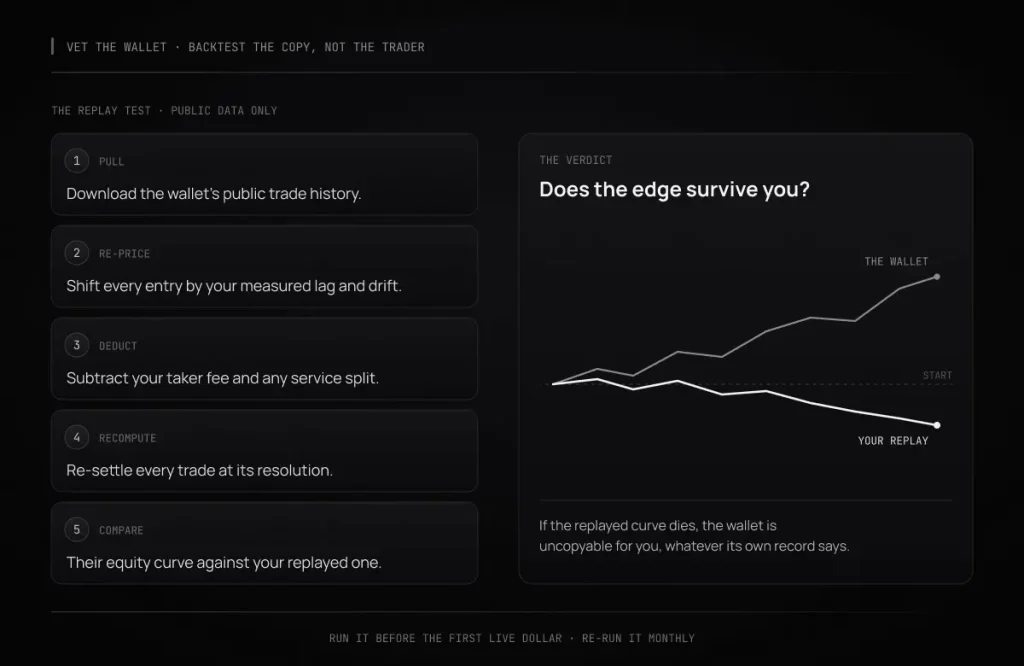
If the replayed curve is flat or negative, the wallet is uncopyable for you, regardless of how genuinely profitable it is for its owner. This test uses only public data plus one number you can measure this afternoon, and it converts “this trader looks good” into “this trader survives my taxes.” Run it before the first live dollar, and re-run it monthly, because masters change, and the wallet you vetted in March is not always the wallet you are mirroring in July.
Execution rules that protect you
A few operating rules follow directly from the math, and they are where a copy setup is won or lost:
- Cap your copy size by the book, not by proportionality. Mirroring a whale’s size into a thin 5-minute window makes you the slippage. Size against visible depth at your price limit, whatever the master did.
- Use a bounded order, not a blind market order. Set your maximum price at the master’s fill plus the drift tolerance your replay test says survives. Missing a fill that ran past your bound is not a failure; the fills you miss that way are disproportionately the worst ones.
- Never copy into a window’s final seconds. For 5-minute markets, refuse entries inside your own lag plus a safety margin. A fill you cannot receive before the resolution picture changes is a coin flip with a fee on top.
- Handle exits with care. If you missed the entry, do not mirror the exit; you would be opening a position, not closing one. And your exit fill suffers the same δ as your entry did, in the other direction.
- Set a stop-copy rule in advance. A drawdown limit, a deviation-from-history trigger, or a detection-latency alarm. Decide the conditions for unplugging before you plug in.
The operational layer, and what a VPS honestly does here
A copy bot is an always-on process with three jobs: hold a watcher connection, react within your measured lag, and never sleep through a fill. That is a reliability problem before it is a speed problem, and it is worth being precise about which is which, because this is the part of the stack we sell and the part most providers oversell.
What an always-on server actually fixes: your watcher does not die when a laptop sleeps, reboots for an update, or rides out a home ISP drop, and a datacenter connection reconnects cleanly with the heartbeat, resubscribe, and watchdog logic a production websocket needs (we cover that pattern, including the silent-freeze failure mode, in our Polymarket API guide). A missed detection is a trade at 100 percent drift, so uptime is the first-order term in your real-world δ distribution.
What no server fixes: stages 1 through 3 of the lag anatomy belong to Polymarket’s settlement pipeline, the taker fee is charged by the protocol at match time, and a master whose edge dies at your drift stays dead at every latency. We will not tell you a VPS improves your fills or your slippage, because it does not; slippage is a market event, and the copier’s version of it is priced by the equation above, not by your ping. What you can and should do is measure the route you would actually run on, from the location you would actually run in, with our latency checker, and weigh it as one input among several. The method is written up in how to test the latency of your Polymarket VPS.
One more operational trap: the popular open-source copy-trading scripts on GitHub largely predate Polymarket’s hard cutover to CLOB V2 on April 28, 2026. If a repo imports the old V1 clients or funds with USDC.e, its trading path is dead on production, whatever its stars say. The Polymarket V2 migration guide covers what changed. If you decide the always-on layer is worth paying for, our Polymarket VPS plans run from Dublin, and the best Polymarket VPS writeup covers picking a plan honestly, including when you should not buy one: if you are still in the replay-testing phase, a laptop and a spreadsheet are the correct infrastructure, and the server can wait until the math says go.
The pre-copy checklist
Before the first live dollar follows another wallet:
- You are legally eligible to place orders where you trade, without any workaround.
- You have measured your own detection lag, end to end, on the market type you will copy.
- The wallet’s history is long enough for its win rate to mean something (see the sample-size table).
- The replay test, at your lag and your fees, still shows an edge with headroom.
- The wallet’s entries do not cluster in final-seconds windows your lag cannot reach.
- Your copy size is capped by book depth, your orders carry a price bound, and your stop-copy rule is written down.
- Your watcher runs on infrastructure that will still be connected at 4 a.m., with reconnect and watchdog logic you have tested by killing the connection yourself.
Frequently Asked Questions
No. As of mid-2026, Polymarket has no native copy-trading product. Copying is done through third-party dashboards, Telegram bots, and open-source scripts that watch a wallet’s public on-chain activity and mirror it from your wallet. Prefer non-custodial tools, where your private key never leaves your control, and remember that a tool’s fee or profit split enters the same breakeven math as the platform’s taker fee.
Every filled trade on the international platform settles on Polygon and becomes attributable to a wallet. Bots either watch settlement events on-chain or poll Polymarket’s public Data API for the wallet’s trades. The trade itself prints anonymously on the public websocket within about a second; the identity becomes readable only after settlement and indexing, which is why detection lags fills by seconds rather than milliseconds regardless of the tool.
Because the copier pays a worse price for the identical outcome. If the master buys at 50c and you fill at 52c, a win pays you 48c against their 50c, and a loss costs you 52c against their 50c, with a taker fee on top either way. The asymmetry is structural: it comes from the entry price, not from sizing, so no allocation scheme removes it.
As a rule: their per-trade edge must exceed your measured price drift plus your fees plus any service split. Near 50c entries with a 2-cent drift and the peak crypto taker fee, that works out to a master ROI of roughly 6 percent per trade just to break even, so a 5-percent-per-trade master, strong as that is, can still lose you money. Compute the bar with your own measured drift, and demand headroom above it.
Usually the opposite. Very high win rates typically come from buying expensive favorites, where each win earns little and one loss erases many wins, leaving a per-trade edge too thin to survive a copier’s drift and fees. Wallets with mid-50s win rates at near-even entries tend to carry the fat per-trade edges that copying requires.
More than most leaderboard darlings have. Distinguishing a 53 percent win rate from a coin flip at roughly 95 percent confidence takes on the order of a thousand trades; a 55 percent claim needs a few hundred. Below those counts, the record is noise. Also check that the edge persists across different weeks and volatility regimes rather than coming from one hot streak.
No, and be wary of anyone who implies it does. An always-on server removes preventable failures, the sleeping laptop, the home ISP drop, the missed reconnect, each of which is a trade at maximum drift. It cannot shorten Polymarket’s settlement pipeline, cannot un-pay the taker fee, and cannot restore an edge your lag has consumed. Run the replay test first; buy infrastructure only if the math survives it.
Not in this form. The international platform restricts order placement for US users, and a VPS or VPN is not a lawful workaround. The US-regulated venue, Polymarket US, uses identity-verified accounts with no public wallet trail, so there is no on-chain feed of another trader’s fills to mirror there. This strategy applies to traders in jurisdictions where the international platform permits order placement.
Disclaimer: This post is for informational purposes and is not financial, legal, or trading advice. Prediction market trading involves risk, including the total loss of any amount staked, and copy trading adds execution, counterparty-behavior, and tooling risks on top of market risk. Fee schedules, market rules, platform mechanics, and jurisdiction eligibility change, sometimes quickly; verify all of them against Polymarket’s current documentation and your own measurements before trading, and confirm your own eligibility in your jurisdiction. Past performance of any wallet does not predict its future results, and worked examples in this post are illustrative models, not projections.