
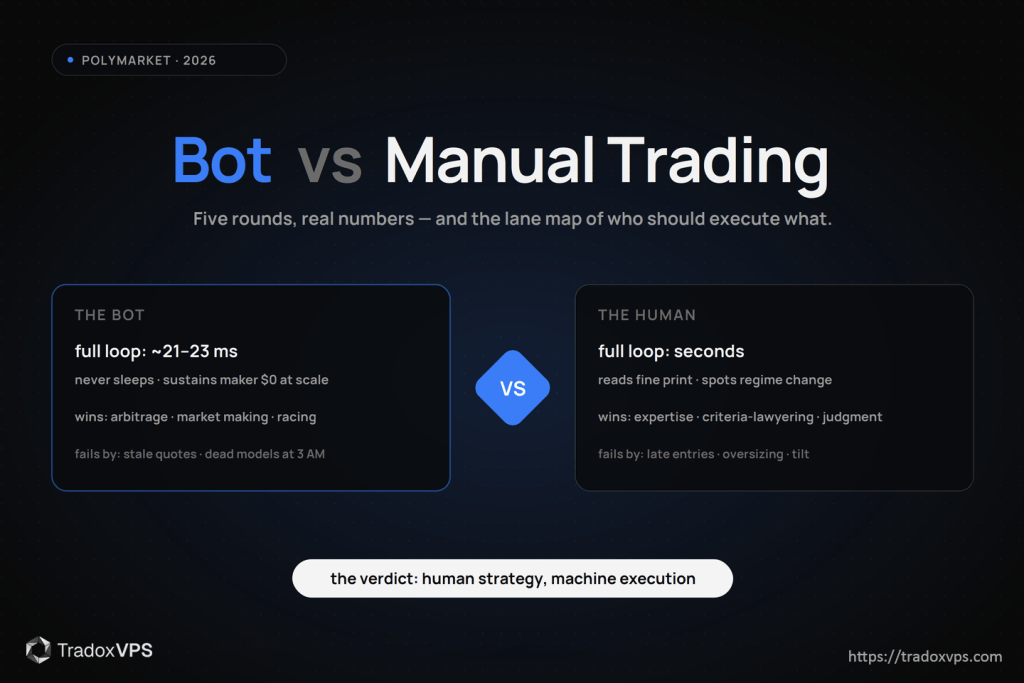
Here’s the uncomfortable opening fact for both camps: of 2.5 million Polymarket wallets analyzed on-chain in April 2026, 84.1% have lost money — and that majority includes plenty of bots. Automation is not a profit machine; it’s an amplifier. Point it at a real edge and it compounds $500-a-trade advantages thousands of times — the top wallet in the academic arbitrage study made ~$2.0 million across 4,049 systematic trades. Point it at a bad assumption and it executes that assumption flawlessly, around the clock, at scale.
So “bot vs manual” is the wrong fight. The data shows each side losing in its own signature way — manual traders by entering after the price already moved and oversizing “obvious” calls; bots by quoting stale books, ignoring fee math, and running broken models at 3 AM. The right question, and the one this page actually answers: which trading lanes belong to software, which belong to your judgment, and how the people who win combine them. Five rounds, with numbers.
Round 1 — Speed: this isn’t a contest, and the margin is measurable
Median human simple reaction time to a visual stimulus is roughly a quarter of a second — and that’s just noticing. The full manual loop (see the price change, read the market, judge it, click, confirm) runs in seconds on a good day.
A bot’s loop is a different species. On our June 2026 benchmark, four providers, one public script, raw data downloadable, Polymarket’s live feed arrived at ~13–15 ms median from Dublin and ~10 ms from Amsterdam, with warm order round-trips completing in ~21–23 ms from either. From book change to order-at-the-exchange, a well-built bot finishes its entire perceive-decide-act cycle before a human’s eye has registered that anything happened — call it a 100× class difference, conservatively.
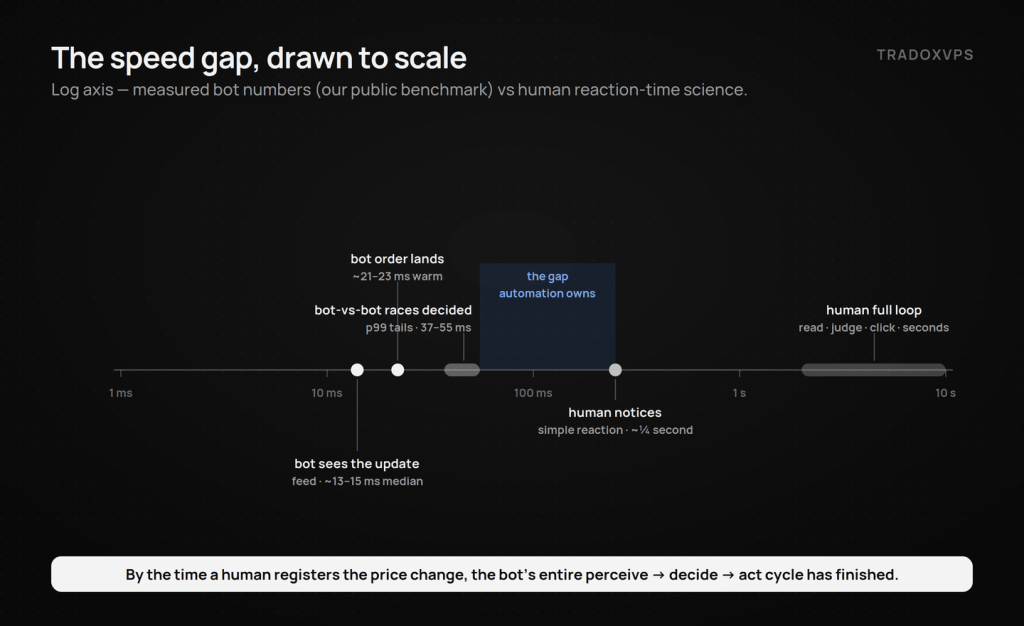
Two honest footnotes that vendors skip. Between bots, the race moves to the tails: order-path p99 across the four boxes we tested ranged 37–55 ms, and the machine with the smallest worst-case wins the ties — which is why we publish percentiles, not adjectives. And the venue has tails of its own: we measured Polymarket’s API root stretching to 250–650 ms at p99 across every provider — even perfect infrastructure sometimes waits. Verdict: any edge with a clock on it — arbitrage windows, news repricing, quote refreshes — belongs to software. Full stop.
Round 2 — Coverage and stamina: you sleep a third of every day
A focused human comfortably tracks a handful of markets. One bot on a single fast core holds dozens of WebSocket book mirrors simultaneously; our specs guide shows a 10–20-market bot idling on a 2-core box, and it holds them at 3 AM, during your commute, and through the Fed print you forgot was scheduled.
This round matters more than it looks, because prediction markets are event markets: the information that moves them arrives on the world’s schedule, not yours. A human with resting limit orders and a bedtime is, mechanically, an unattended market participant eight hours a day. Verdict: breadth and continuity are automation’s home turf — and if you hold resting orders overnight, you’re already half-running a bot strategy without the bot.
Round 3 — Fees: the 2026 plot twist that flips the cliché
The lazy version of this comparison says bots win on costs. The 2026 reality is sharper and more interesting. Under Polymarket’s current fee structure, makers pay $0 on every market and earn rebates, while takers pay a curve, rate × P × (1−P), peaking at 50¢: up to ~$1.80 per 100 shares on crypto, ~$1.00 on politics, with geopolitics free. Rates as of July 2026; the schedule has changed once already this year, so confirm the current curve before pricing a strategy on it.
Read that carefully and the truth emerges: the fee edge belongs to the order type, not the executor. A patient human posting resting limit orders trades exactly as free as any bot. What automation changes is the ability to sustain maker behavior — refreshing quotes every time the book moves, across twenty markets, for weeks — which no human can do by hand, and which is precisely why an unautomated “maker” becomes the stale quote that informed flow feasts on. Meanwhile the impatient human clicking market orders pays the taker curve on every single trade, and so does a badly designed bot: the arbitrage study only counted edges above 5¢ because execution costs eat the rest. Verdict: split decision — humans can trade fee-free too, but only software can stay on the free side of the book at scale. The math lives in our fee-curve breakdown.
Round 4 — Judgment: where the human is still undefeated
Now the rounds the bots lose. Prediction markets resolve on words — criteria, sources, edge cases — and reading a resolution clause like opposing counsel is a human skill that no rules engine replicates. The highest-value manual lanes in our strategies guide are all judgment lanes: genuine domain expertise in a niche the crowd misreads, criteria-lawyering on near-certain markets where one ambiguous phrase is the entire risk, and recognizing regime changes — the moment the world shifts in a way that invalidates every model trained on yesterday.
Bots fail here in a characteristic way: silently and confidently. A model built on last quarter’s parameters keeps trading after the platform changes a rule, a category’s fee, or a market’s structure — flawlessly executing a strategy that stopped existing. That’s why the bot deployment guide treats the circuit breaker as non-optional: the machine cannot notice its own obsolescence; it can only be capped. Verdict: interpretation, fine print, and “something changed” belong to you.
Round 5 — Discipline: the round everyone scores wrong
The cliché says bots win on emotion, and it’s half-true: software never revenge-trades, never doubles down at 2 AM, never sizes up because a market “feels” certain — and the on-chain record says emotional sizing is exactly how the manual 84% loses. But the cliché hides the symmetry: a bot is only as disciplined as its sizing code. Full-Kelly output on a strong signal will happily bet a third of your bankroll unless you cap it (production bots run quarter-Kelly with a hard 10% ceiling), and a bot with no daily-loss stop will execute its way through your capital with perfect emotional composure. Humans tilt; bots compound. The difference is that human discipline must be practiced and bot discipline must be written — once, correctly, in advance. Verdict: bots, narrowly — because written discipline survives 3 AM and willpower doesn’t.
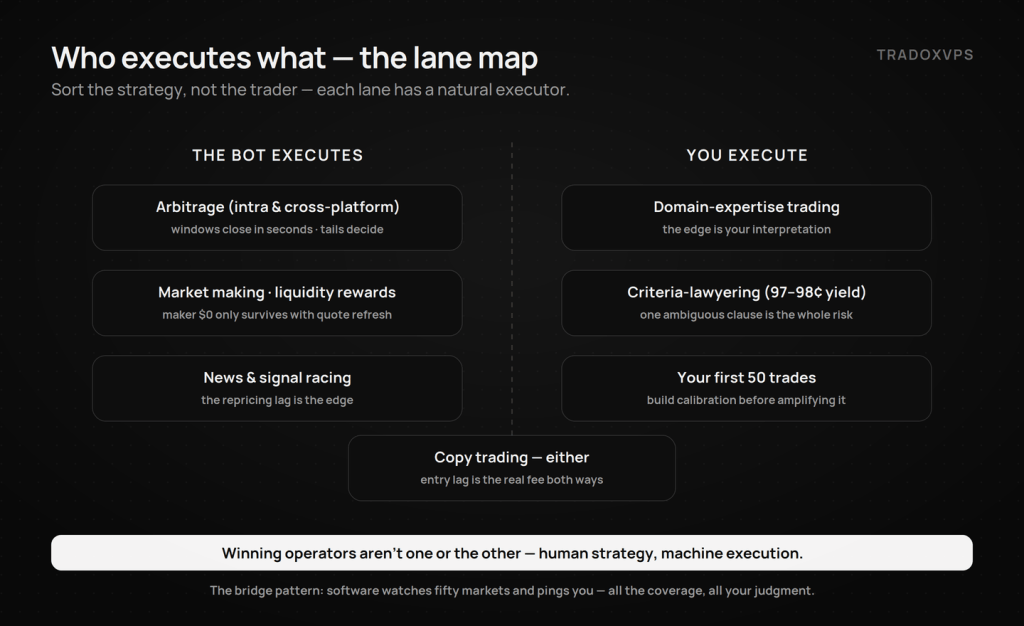
The scorecard: lane by lane, who executes
| Trading lane | Executor | Why |
|---|---|---|
| Intra-market & cross-platform arbitrage | Bot | Windows close in seconds; races decided in 37–55 ms tails |
| Market making / liquidity rewards | Bot | Maker fees $0 + rebates, but only sustained quote-refresh survives adverse selection |
| News & signal racing (e.g., crypto repricing) | Bot | Repricing lag is the edge; measure both venue paths from your box first |
| Domain-expertise trading in your niche | Human | The edge is your interpretation; no clock involved |
| Near-certain yield (97–98¢ markets) | Human (+ price alerts) | The job is criteria-lawyering; one ambiguous clause is the whole risk |
| Copy trading | Either | Entry lag is the real fee either way; bots shrink it, judgment screens the wallets |
| Your first 50 trades | Human, always | You’re building the calibration a bot would only amplify |
The hybrid that actually wins (not the platitude version)
“Combine both approaches” is what every generic article says. Here’s what it concretely means in 2026, in the order that works:
- Human finds the edge. Trade a lane manually with a journal: your probability written before seeing the price, entry, exit, result. After 25–50 trades you know whether your 70% calls happen 70% of the time — calibration, the only license worth having.
- Human writes the rules; machine inherits them. Encode the now-proven logic: entry condition, fractional-Kelly size with a hard cap, exit, circuit breaker. The bot doesn’t replace your judgment — it replays it without sleep or tilt.
- Bridge with alert-bots. The intermediate species nobody talks about: software watches fifty markets and pings you; you make the call. All of automation’s coverage, all of your judgment, none of the unattended risk — and the natural step before full autonomy.
- Dry-run 48 hours, go live with $50–100, scale only when live matches sim. The deployment guide covers the whole pipeline, dry-run flag included.
- Human stays portfolio manager. You watch for regime changes, read every new market’s criteria, and own the kill switch. The study’s winning wallets weren’t “bots” in the popular sense — they were systematic operators: human strategy, machine execution, thousands of small edges on schedule.
What each path honestly costs
Manual trading costs a browser. Automation costs three real things: build time (the deployment guide is a weekend for a competent Python developer), maintenance attention (logs, fills, model drift — an hour or two a week, forever), and infrastructure — an always-on box starts at $44.90/month on our Starter plan, and the home-PC alternative fails precisely during the volatile events bots exist for. The break-even arithmetic is unsentimental: a bot must out-earn its hosting plus the value of your hours before it beats a good manual process. For a calibrated edge in a time-sensitive lane, it clears that bar embarrassingly fast; for a beginner with no proven edge, it’s a monthly fee on amplified mistakes.
And verify the infrastructure layer the same way you’d verify a strategy — with measurements. Our latency numbers are public, the 20-minute probe runs on anything, and the 3-day demo exists so your bot’s first job on our hardware is fact-checking us.
The decision in six questions
Is your edge time-sensitive (does it decay in seconds or minutes)? → bot. Does it depend on interpreting words, context, or fine print? → human. Are you calibrated yet (50+ journaled trades)? If no → human, regardless of anything else. Does the strategy require maker-side persistence across many markets? → bot. Can you afford the strategy to run unsupervised through a surprise? If no → alert-bot bridge. Would the bot’s monthly cost exceed the edge it protects? → stay manual until the edge grows.
Frequently Asked Questions
Neither wins outright — they win different lanes. Time-sensitive strategies (arbitrage, market making, news racing) belong to bots, whose full decision loop completes in tens of milliseconds against a human’s seconds. Judgment strategies (domain expertise, resolution-criteria analysis) belong to humans. The on-chain data shows winners are systematic operators combining both: human strategy, machine execution.
Some, demonstrably: an academic study measured ~$40M in systematic arbitrage profit in one year, with the top wallet earning ~$2.0M across thousands of small trades. But automation amplifies whatever it’s given — 84% of all wallets lose money, bots included. A bot makes a calibrated edge scale and a bad assumption catastrophic; profitability lives in the strategy, not the automation.
Measurably, about two orders of magnitude. Median human visual reaction is roughly a quarter-second before any reading or clicking; the full manual loop runs in seconds. A bot on well-placed infrastructure sees book updates at ~10–15 ms median and completes order round-trips at ~21–23 ms, the entire perceive-decide-act cycle finishes before a human registers the price change. (Figures from our published benchmark; verify on any box with the free probe.)
For anything serious, yes — Python plus the official py-clob-client-v2 SDK is the standard stack, and our setup guide walks the full build. No-code copy-trading tools exist as a lighter on-ramp, with their own risks (entry lag, wallet screening, and never granting withdrawal permissions).
Manual, without exception — not because bots are dangerous, but because a bot can only amplify a process, and a beginner hasn’t built one yet. Trade small, journal 25–50 entries, measure your calibration, then automate the part of your process that proved itself. Automation is a graduation, not a starting point.
Manual trading is free beyond your capital. A bot costs build time, ongoing maintenance attention, and an always-on server — from $44.90/month on our Starter tier. The honest test: the bot must out-earn its hosting plus your time versus the manual alternative. For proven time-sensitive edges it does so quickly; for unproven ones it’s a subscription to faster mistakes.
Disclaimer: Figures on wallet performance and systematic arbitrage profit are from third-party on-chain analysis and academic research, linked above, and describe past results for other traders rather than anything you should expect. Position-sizing references (fractional Kelly, hard caps, daily-loss stops) describe how production systems are commonly built, not a recommendation for your capital. Latency figures are from our published benchmark with raw data downloadable, and vary with routing and configuration, so measure your own box. Fee structures and market rules change; verify against Polymarket’s official documentation before pricing a strategy on them. We operate TradoxVPS and provide infrastructure, not financial, investment, or trading advice. Automated trading involves substantial risk, including rapid total loss.