

Introduction
Automation is becoming increasingly common in prediction markets. Many traders now use bots to monitor markets, identify opportunities, and execute trades automatically.
However, once traders start using automation tools, an important question quickly arises:
Where should the bot run?
Most traders initially run their bots on their local personal computer since it is the easiest option. But as strategies evolve and trading becomes more active, many users begin migrating their systems to a VPS environment.
Both setups can work, but they differ significantly in terms of reliability, uptime, and operational stability.
In this guide, we compare running a trading bot locally versus running it on a VPS, helping you understand which setup is better for long-term automation.
What Is a Trading Bot?
A trading bot is an automated system designed to monitor markets and execute trades based on predefined rules.
These bots can:
- monitor multiple markets simultaneously
- detect pricing inefficiencies
- place buy or sell orders automatically
- track changes in real time
Because bots run continuously and react instantly to market conditions, they require a stable and always-available environment.
Running a Trading Bot on a Local Computer
Many traders start by running their automation tools directly on their personal computer. This approach has some advantages, especially for beginners.
Advantages of Running Locally
- Easy setup: No external infrastructure required
- No additional cost: Uses existing hardware
- Direct control: Easy to monitor and manage
For testing strategies or learning automation, a local setup is often sufficient.
Limitations of a Local Setup
Personal computers are not designed for continuous, server-level operation. Several issues can interrupt bot performance:
- System shutdowns: Bots stop when the computer turns off
- Internet instability: Home networks may disconnect
- Operating system updates: Unexpected restarts can interrupt execution
- Power interruptions: Outages can stop automation completely
Over time, these interruptions can reduce the effectiveness of automated strategies.
What Is a VPS?
A Virtual Private Server (VPS) is a remote server hosted in a professional data center where automation systems can run continuously.
Unlike a local machine, a VPS provides:
- stable internet connectivity
- redundant power infrastructure
- remote access from anywhere
- continuous uptime
Because of these characteristics, VPS environments are widely used for automation across trading systems.
Advantages of Running Bots on a VPS
- 24/7 uptime: Bots run continuously without manual intervention
- Stable connectivity: Data center networks are more reliable than home internet
- Remote access: Manage your system from anywhere
- Reduced interruptions: Not affected by local outages or shutdowns
For traders who rely on consistent automation, a VPS provides a more stable operating environment.
For example, using a dedicated Polymarket VPS can improve uptime and ensure trading systems remain active during critical market events. 👉 Explore an optimized Polymarket VPS solution
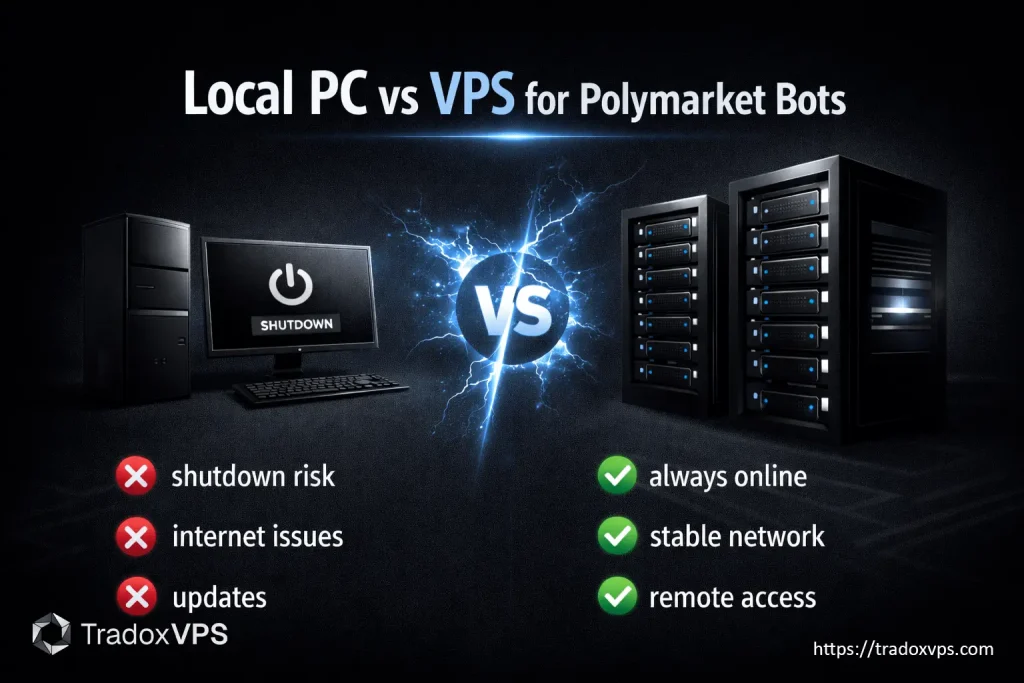
Local PC vs VPS: Key Differences
| Feature | Local PC | VPS |
|---|---|---|
| Availability | Depends on user uptime | 24/7 continuous operation |
| Internet Stability | Home connection | Data center network |
| Shutdown Risk | High | Very low |
| Remote Access | Limited | Accessible from anywhere |
| Reliability | Moderate | High |
When Should You Use a VPS?
A VPS becomes useful when:
- running bots continuously
- monitoring multiple markets
- executing time-sensitive strategies
- requiring stable and predictable uptime
For occasional testing, a local machine may be sufficient. For long-term automation, a VPS is generally more reliable.
Conclusion
Both local computers and VPS environments can run trading bots, but they offer different levels of reliability.
Local setups are convenient for testing and experimentation, but they are prone to interruptions. VPS environments, on the other hand, provide stable, always-on infrastructure designed for continuous operation.
For traders who depend on automation, infrastructure reliability plays a critical role in overall performance.
Frequently Asked Questions
Can I run a Polymarket bot on my local computer?
Yes, you can run a Polymarket bot on your local computer. Many traders start this way when testing strategies or learning how automation works. However, local computers are not always reliable for continuous trading because they may shut down, lose internet connectivity, or restart due to system updates.
What is a Polymarket VPS?
A Polymarket VPS is a virtual private server used to run automated trading bots in a professional data center environment. Unlike a home computer, a VPS stays online 24/7 and provides stable network connectivity, making it a common solution for running prediction market trading bots continuously.
Why do traders use a VPS for prediction market bots?
Traders use VPS servers for prediction market bots because they provide reliable uptime, stable internet connectivity, and remote access. These features allow automation systems to run continuously without interruptions caused by home internet outages, power issues, or accidental shutdowns.
Is running a Polymarket bot on a VPS safer than using a local PC?
Running a Polymarket bot on a VPS is generally more reliable than using a local PC. VPS servers operate in professional data centers with stable power infrastructure and high-quality networking, reducing the risk of unexpected downtime.
Do Polymarket bots need to run 24/7?
Many Polymarket bots are designed to monitor markets continuously and react to price changes or new information. Running the bot 24/7 allows traders to capture opportunities that might occur outside normal working hours.
When should I switch from a local PC to a VPS for my Polymarket bot?
Traders often switch to a VPS when their automation strategies need to run continuously or when reliability becomes important. A VPS can provide a stable environment for long-running trading bots without relying on a personal computer.