
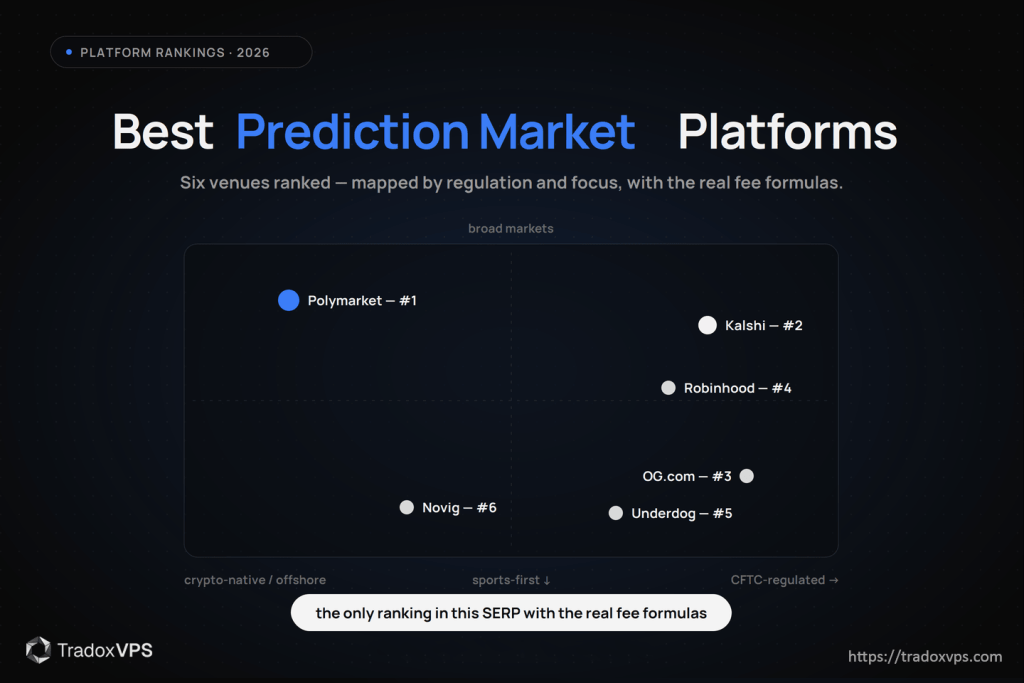
Prediction markets crossed from experiment to financial arena this year — monthly volumes topped $13 billion in early 2026, Kalshi alone has been running around $4 billion a week, and the platforms have become source material for journalists, funds, and traders who want probability priced by capital instead of pundits. Six venues matter most right now. Here they are, ranked, with the fee math the marketing pages round off.
Why prediction markets are booming in 2026
Three forces compound. Scale: volumes set records through early 2026, and the mix broadened far past politics — sports now dominate flow on the regulated US venues, with macro, weather, tech, and culture filling out the book. Regulation: CFTC-registered exchanges turned a legal gray zone into a federally supervised market structure, pulling in institutional capital, brokers, and even an industry coalition lobbying for uniform federal treatment. Structure: peer-to-peer order books beat sportsbook economics on the dimensions traders care about — tighter spreads than a vig-loaded line, the ability to exit a position mid-event as news breaks, and prices that react to the world in seconds.
The competitive field is also crowding fast: FanDuel and DraftKings both launched prediction products in the last six months, Coinbase joined the industry coalition, and embedded prediction features are spreading through brokers and crypto apps. The six below are still where the liquidity, the tooling, and the serious traders are.
How we ranked these prediction market platforms
Five criteria, weighted toward what professional traders feel daily: liquidity depth (can you enter and exit size without moving the book), regulatory standing (CFTC-registered venue vs offshore/crypto-native vs sweepstakes), real fee math (formulas from official schedules, not “low fees” adjectives), market breadth and tooling (API quality, order types, rewards programs), and automation-friendliness. One honesty note: we publish measured latency data for Polymarket because we benchmark it; for the other venues, execution assessments come from API documentation and public behavior, not our instruments. Anyone ranking six platforms by “execution speed” with precise numbers for all six is decorating.
The top 6 at a glance
| # | Platform | Best for | Regulation | Funding | Fees (the short version) |
|---|---|---|---|---|---|
| 1 | Polymarket | Global liquidity, bots, breadth | Crypto-native intl. book + CFTC-licensed US exchange | USDC on Polygon, wrapped to pUSD; fiat on US venue | Taker formula by category, makers free (intl.) |
| 2 | Kalshi | US-regulated trading, bank rails | CFTC (DCM) | ACH, debit, PayPal, Apple Pay | 0.07 × P × (1−P) taker; reduced maker |
| 3 | OG.com | Regulated sports + parlays | CFTC (DCM, Crypto.com) | Fiat, Crypto.com | Spread-based |
| 4 | Robinhood | Frictionless retail entry | Via Kalshi + own Rothera venue | Robinhood balance | No user-facing commission on most contracts |
| 5 | Underdog | DFS-to-prediction transition | CFTC (own Aristotle DCM/DCO) | Fiat | Embedded in pricing |
| 6 | Novig | No-vig sports P2P | Sweepstakes model (most states) | Fiat / virtual currency | No vig; P2P matching |
1. Polymarket — the liquidity center of gravity
Polymarket processed on the order of $8 billion in April 2026 alone and remains the deepest venue for event trading: a hybrid CLOB that matches orders off-chain and settles them on Polygon, with thousands of live markets from elections to OpenAI milestones. For builders, the CLOB API and SDK are the best tooling in the category, there’s a daily liquidity-rewards program for makers, and since late 2025 there are effectively two Polymarkets: the global book, which is now close-only in a growing list of jurisdictions including the US, UK, Germany, France, Italy, Canada, Australia and Singapore, and the CFTC-licensed Polymarket US exchange built on the QCEX acquisition. Close-only means existing positions can be closed but new ones cannot be opened, so check the current list before you fund anything.
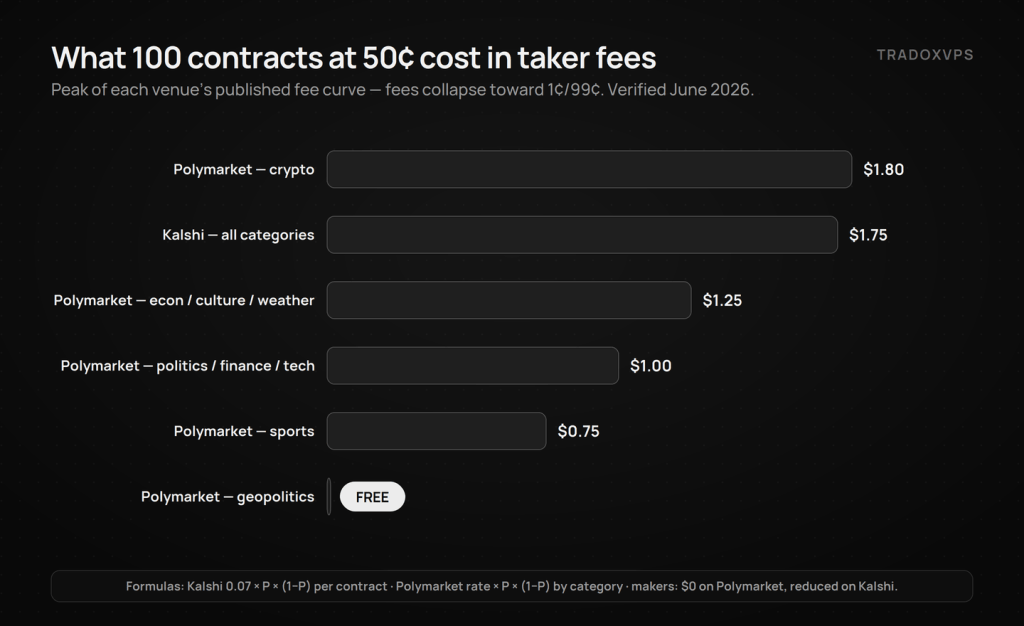
Fees — the 2026 reality, not the 2024 reputation. The “Polymarket has no fees” era ended on 30 March 2026. The international book now charges takers by formula — rate × P × (1−P) per share — with category peaks at 50¢ of roughly $0.75 per 100 shares (sports), $1.00 (politics, finance, tech), $1.25 (economics, culture, weather), and $1.80 (crypto), while geopolitics markets remain fee-free and makers pay nothing (and earn rebates). The US venue runs its own simpler schedule with a maker rebate. Verify before modeling a trade: official fee article · docs.polymarket.us/fees.
Pros: deepest books and tightest spreads in the category; unmatched market breadth; on-chain settlement transparency; the strongest bot ecosystem. Cons: the global book requires USDC/Polygon fluency and is close-only across the US, UK and much of Western Europe; fees now real on most categories; resolution runs through UMA’s optimistic oracle, which has edge cases worth understanding before sizing up.
2. Kalshi — the regulated workhorse
Kalshi is the most established CFTC-designated contract market, with bank-grade on-ramps (ACH, PayPal, Apple Pay), availability across nearly all US states, and volume that has exploded to roughly $4 billion a week — around 90% of it sports. It’s a true peer-to-peer exchange (you trade other participants, not the house), it powers Robinhood’s event contracts behind the scenes, and it has begun expanding internationally starting with Brazil.
Fees, precisely: takers pay 0.07 × P × (1−P) per contract — a curve peaking at 1.75¢ on a 50¢ contract and collapsing toward fractions of a cent near the extremes; maker orders pay a reduced rate, and a few series carry their own settlement quirks, so check the schedule for the specific market. The practical read for active traders: fees are highest exactly where contested markets price, and limit-order discipline cuts costs dramatically.
Pros: federal oversight and fund security; the easiest fiat experience in the category; deep macro/policy/weather catalog alongside the sports flood; solid API. Cons: fee load at mid prices is the highest among the big two; order types trail the crypto-native venues; the sports-dominated book means thinner attention on niche markets.
3. OG.com — Crypto.com’s regulated sports specialist
Launched in February 2026 by Crypto.com on its CFTC DCM registration, OG is the breakout of the year: a regulated venue purpose-built for sports prediction, including a parlay builder — bundled multi-contract positions previously unavailable on regulated prediction exchanges — and a public stance against limiting winning players, the practice that drives sharp bettors off sportsbooks. Pricing is spread-based rather than explicit-fee, which is simpler to see but harder to audit than a formula.
Pros: the regulated-parlay niche to itself; sportsbook-grade UX with exchange economics; Crypto.com’s infrastructure and funding rails behind it. Cons: liquidity well below the big two; spread-based pricing obscures true cost; sports-first catalog.
4. Robinhood — the on-ramp for millions
Robinhood embedded event contracts directly into the app its users already hold stocks in — initially routing through Kalshi’s exchange, and more recently also listing markets on Rothera, its own venue built as a joint venture with Susquehanna. No new account, no crypto, no user-facing commission on most contracts. It is the lowest-friction entry point in the category, and it reportedly accounts for a meaningful slice of Kalshi’s flow.
Pros: zero-friction access for an enormous existing user base; clean mobile-first UX; credible market plumbing behind it. Cons: a curated fraction of the market catalog; no advanced order types or serious API access for algorithmic traders — this is a consumption interface, not a builder’s venue.
5. Underdog — fantasy sports goes native
Underdog converted its DFS audience into prediction market traders, first through a Crypto.com partnership and now structurally: in March 2026 it acquired Aristotle Exchange’s CFTC-registered DCM and clearinghouse (DCO), putting it in the small club (Kalshi, Polymarket, Crypto.com) that owns its own exchange stack, with natively listed markets expected by NFL season. The product keeps the simplified Yes/No mechanics its fantasy users expect, available in 30+ states.
Pros: the smoothest on-ramp for fantasy players; now structurally independent with its own licenses; fast-growing sports liquidity. Cons: strictly sports — no politics, macro, or weather; simplified interface trades away pro tooling.
6. Novig — the no-vig peer-to-peer experiment
Novig runs peer-to-peer sports markets where users set odds against each other with no house edge, operating under a sweepstakes model in most states. It exposes a real order book with visible depth, welcomes winning players, and claims — its own marketing figure, worth that framing — that 43% of its users are profitable versus low single digits at traditional books.
Pros: genuinely vig-free matching; transparent book; sharp-friendly policies.
Cons: mainstream US sports only; the sweepstakes-currency model confuses newcomers; the thinnest liquidity on this list.
Prediction market platforms worth watching
FanDuel Predicts went nationwide in January and DraftKings Predictions launched across 38 states in December — both giants are converting sportsbook audiences into event traders, with DraftKings planning its own native exchange. Coinbase joined the industry’s federal-regulation coalition. And on the crypto-native side, the smaller books (Limitless, Myriad, Opinion) matter mainly to one audience: cross-platform arbitrageurs, for whom thin liquidity means wider gaps — covered in our prediction market arbitrage guide.
Infrastructure: the honest version
If you trade these venues manually, you need none of what we sell. A browser is enough, and our beginner strategies guide says so explicitly. Automation changes the math: bots market-making, arbitraging between venues, or reacting to news need always-on execution and a short, measured path to the venue.
Measured is the operative word. Our four-provider benchmark publishes raw data you can download, and it found no sub-millisecond anything, from anyone, ourselves included. If you are choosing where to host a bot, the location comparison has the side-by-side numbers and the 20-minute probe runs free on any box before you pay us or anyone.
Frequently Asked Questions
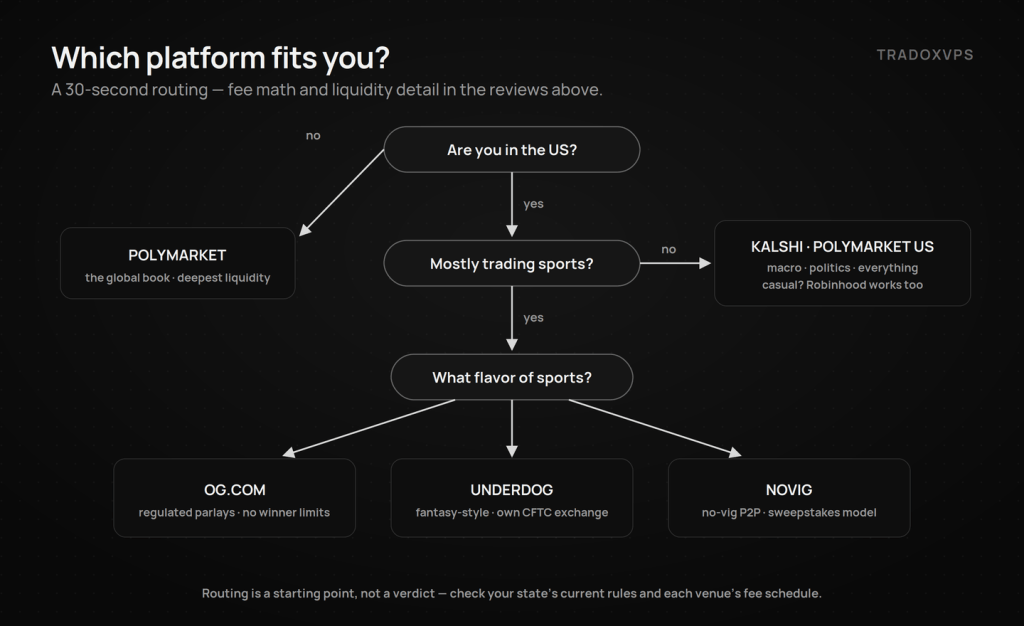
Kalshi for breadth under full CFTC regulation with bank funding; OG.com for regulated sports and parlays; Robinhood for zero-friction access inside an app you may already use; Polymarket US for the CFTC-licensed version of the deepest global brand. The right answer tracks what you trade — macro and politics point to Kalshi, pure sports to OG or Underdog.
Polymarket globally — billions in monthly volume and the deepest books on politics, tech, and world events. Among US-regulated venues, Kalshi leads at roughly $4 billion a week, dominated by sports.
Polymarket’s international book charges takers by formula (rate × P × (1−P)) with category peaks from $0.75 to $1.80 per 100 shares, geopolitics fee-free and makers at zero; Polymarket US runs a simpler schedule with a maker rebate. Kalshi charges 0.07 × P × (1−P) per contract — 1.75¢ max at 50¢ — with reduced maker rates. OG embeds cost in spreads; Robinhood shows no user-facing commission on most contracts. Always verify on the official schedules — these changed twice in the last year.
Structurally, for traders: peer-to-peer matching means tighter effective pricing than vig-loaded lines, positions can be exited mid-event, and the regulated exchanges don’t ban winners. They’re exchanges, though — the counterparty is someone sharper than a sportsbook’s margin, and most participants still lose (the data is in our strategies guide).
CFTC-regulated venues (Kalshi, OG, Robinhood’s offerings, Underdog, Polymarket US) operate federally, but it’s not friction-free: several states — Arizona, Illinois, Massachusetts, Maryland, Michigan, Nevada, and Ohio among them — have challenged sports event contracts, and rules are actively evolving. Check your state’s current status; the international Polymarket book is close-only for US users, meaning existing positions can be closed but not opened.
Not for manual trading on any platform here. For automated strategies — market-making, arbitrage, news reaction — an always-on box with measured latency to your venue is standard practice; judge providers (us included) on published, reproducible numbers, never advertised milliseconds.
Volume figures and platform developments are attributed to linked reporting and official announcements as of June 2026; fee schedules link to official pages and change — verify before trading. Latency figures are from our published Dublin benchmark; we quote no numbers we haven’t measured. We operate TradoxVPS and provide infrastructure, not financial advice.