
A buying guide, not a benchmark — the benchmark, with raw files and methodology, is here. This page borrows only its decisive numbers. We operate TradoxVPS; the rows AWS won are printed anyway.
Most “VPS vs AWS” articles are written by people who sell one of the two and have never billed an EC2 egress line in their lives. Here’s the version from a team that runs trading infrastructure for a living, benchmarked its own box against an m7a.large in the same city, and lost some rows doing it. You’re not choosing between two servers — you’re choosing between a product and a platform, and the right answer depends on five questions about you, not about us. Data first, sixty seconds of it, then the questions.
60 seconds of data
One purchased box each, same public probe, same Dublin evening (the AWS run executed one hour before ours — disclosed, with everything else, on the benchmark page):
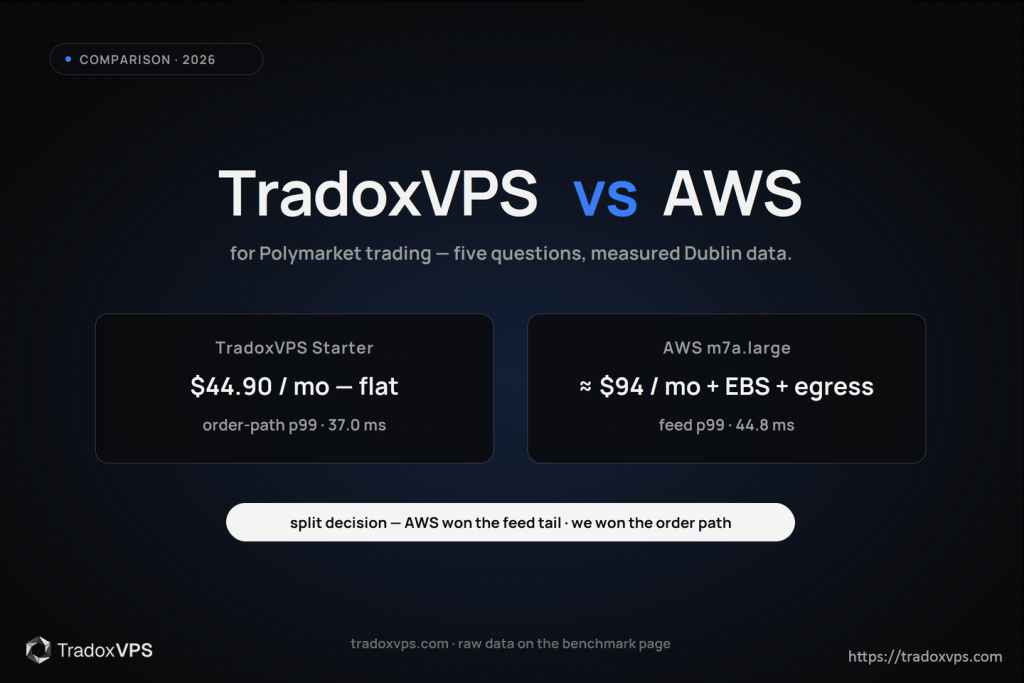
| What the probe said | TradoxVPS Starter ($44.90 flat) | AWS m7a.large (≈$94/mo + extras) |
|---|---|---|
| Live-feed tail (WS p99) | 68.2 ms | 44.8 ms |
| Order-path tail (/book p99 · worst of run) | 37.0 · 40.9 ms | 55.3 · 61.9 ms |
| Medians, both paths | ~13.7 / 22.5 ms | ~15.3 / 23.1 ms |
| Large-payload speed | 20.9 ms | 21.1 ms — tie |
| Silicon under the bot | 2 Ryzen 9 9950X cores, 5.7 GHz, DDR5 | 2 vCPU EPYC, ~3.7 GHz class |
Split decision, honestly: AWS held the steadier feed tail; our box held the tighter order tail — across 92 round-trips to the live book it never exceeded 40.9 ms, better than the m7a’s 95th percentile. Medians were a coin flip; bulk throughput identical. Hold those five rows in mind; the rest of this page is about everything the probe can’t measure.
Question 1 — What does your bot’s hot loop look like?
Every Polymarket bot has the same innermost loop: parse the book update → decide → sign the EIP-712 order → write the socket. That loop is single-threaded — it runs at the speed of one core, not the sum of them — and it runs thousands of times an hour with money attached. The m7a.large gives that loop a ~3.7 GHz server core; the Starter gives it a dedicated desktop core boosting to 5.7 GHz on DDR5. Adding vCPUs doesn’t speed the loop up; it just runs more copies.
So: if your bot is a single strategy reacting to book events, the clock and the order-path tail above are your rows, and they both point one way. If you’re running a fleet of strategies, parsing firehoses in parallel, or doing heavy numerical work between trades — core count and burst capacity start to matter, and the calculus shifts toward Question 4.
Question 2 — Are you the infrastructure team?
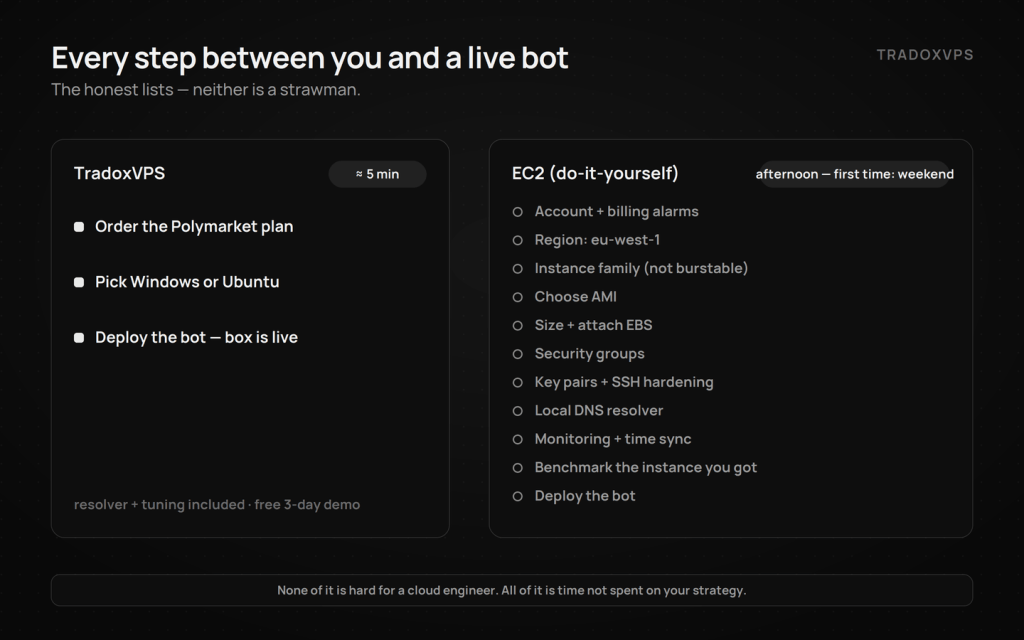
Here is everything between you and a live bot, on each path. Not a strawman — the honest list:
On EC2: create the account and set billing alarms → pick a region (eu-west-1) → pick an instance family (fixed-performance, not burstable — see the traps below) → choose an AMI → size and attach EBS → write security groups → key pairs and SSH hardening → install a local caching DNS resolver (stock images don’t ship one tuned) → time sync, monitoring, log rotation → benchmark the instance you actually got, because silicon varies between launches → only now, deploy the bot. A competent cloud engineer does this in an afternoon. The first time, with docs open, it’s a weekend.
On TradoxVPS: order the Polymarket plan → pick Windows or Ubuntu → box is live in ~5 minutes, resolver and tuning included → deploy the bot (walkthrough here).
The 3 a.m. test belongs here too. When something breaks during the US-election rush, AWS gives you world-class documentation, forums, and — on paid support plans, themselves a monthly fee — a ticket queue staffed by generalists. We give you a Discord and support staff whose entire job is trading boxes. Neither is magic; one is specialized.
If reading the EC2 list made you nod along comfortably — that’s a real signal for AWS. If it read like a second job, that’s your answer too.
Question 3 — How do you actually count costs?
Our number is one line: $44.90/month. The AWS number is an equation, so let’s do the anatomy properly instead of hand-waving:
- Instance: m7a.large at $0.1292/hr × 730 hrs ≈ $94.32/month on-demand.
- Storage: EBS gp3 at ~$0.08/GB-month — call it $2–4 for a sensible volume.
- Egress: the ambush line. Data out of AWS bills per gigabyte (on the order of $0.09/GB in EU regions after the free allowance). A 24/7 bot streaming markets, shipping logs, syncing backups: measure yours, then do
GB out × $0.09. It’s pennies for a test and a real line item for an always-on fleet. - The fine print: a public IPv4 address now bills hourly; CloudWatch beyond basics bills; support plans bill.
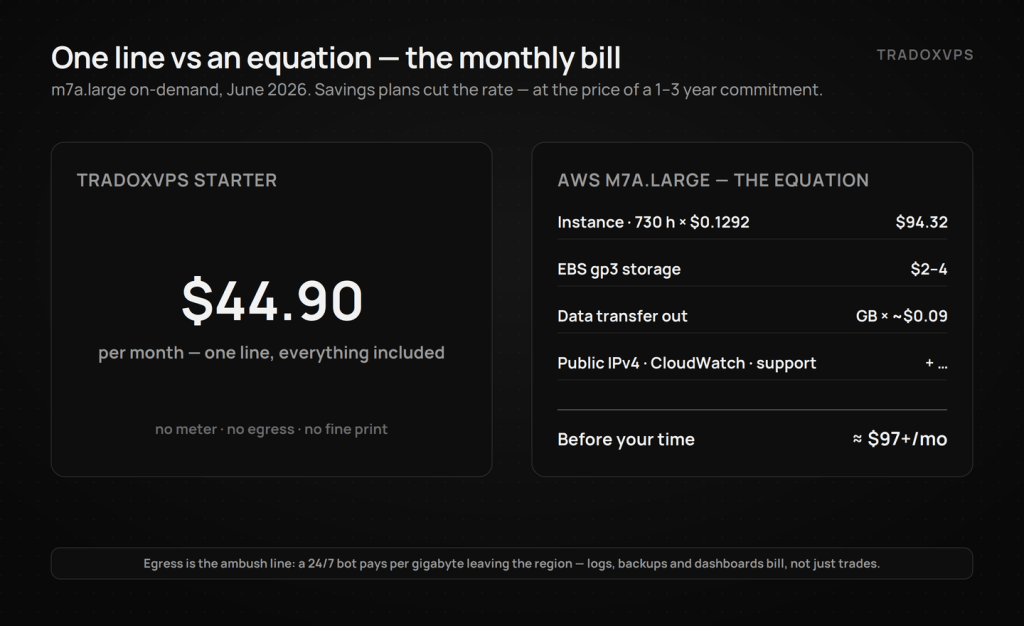
Two honest reducers exist. Savings plans cut the instance rate substantially — in exchange for a 1–3 year commitment, which is the opposite of the flexibility argument that brought you to cloud. Spot instances are cheaper still and can be reclaimed by AWS mid-trade with two minutes’ notice; they’re excellent for backtesting fleets and disqualifying for live market-making. Run your own total in the AWS calculator. For one always-on trading box it lands at roughly 2× our flat rate before you’ve priced a single hour of your own time — and your hours were the expensive part all along.
Question 4 — Does your bot live alone, or inside a stack?
This is the question where AWS genuinely wins, and we’d rather tell you than have you discover it. If your signals come off a Lambda, your historical data sits in S3, your team manages access with IAM, and your backtests want a hundred spot cores for an hour on Sunday — then putting the execution box in the same VPC as everything else is simply correct architecture, and a standalone VPS would be the awkward outsider. The same goes if compliance or an employer mandates a single cloud. We sell a tuned trading box, not a platform; pretending otherwise would insult your intelligence.
If, like most Polymarket traders we host, the bot is the stack — one box, one strategy or a handful, talking to Polymarket and nothing else — the platform’s powers are weight you’re paying for and not using.
Question 5 — Will you verify what you’re given?
On AWS, the spec is a menu and the silicon is a draw: families differ, launches differ, and the only way to know what your instance does is to measure it. That’s not a flaw — it’s the nature of a hyperscaler — but it makes the twenty-minute probe mandatory equipment, every launch. On our side the spec is fixed and published — lscpu outputs for our boxes ship with the benchmark raw data — and the 3-day demo exists precisely so you can run that same probe against us before paying. Whichever way you go: never trust a spec sheet, ours included. Measure.
Three AWS traps Polymarket traders actually hit
The free-tier trap. Free-tier and t-class instances are burstable: they accrue CPU credits and throttle hard when credits run out — and a 24/7 trading loop is the exact workload that drains them. The bot runs beautifully for a day, then mysteriously lags during the busiest market of the week. Weekend experiments: fine. Live capital: fixed-performance families only.
The Lightsail trap. Lightsail looks like the answer — AWS simplicity at a flat VPS price. Under the hood it’s burstable-class compute with capped networking: the same credit cliff in a friendlier wrapper. For a trading bot it combines the cloud’s complexity ceiling with a budget box’s performance floor.
The spot trap. Spot pricing is genuinely brilliant for research — and AWS can reclaim the instance with two minutes’ warning. A market-making bot that vanishes mid-position isn’t a cost optimization. Spot for backtests, on-demand or dedicated for execution.
The decision, compressed
Build on AWS if Question 2 made you nod, Question 4 described your architecture, and you’ll honor Question 5 every launch. eu-west-1 is a legitimate home for a Polymarket bot — this window’s m7a even beat our box on feed-tail steadiness, and we put that in print.
Take the TradoxVPS box if the bot is the stack and your edge lives in the strategy: the tightest order-path tail we’ve measured on any box this campaign (never above 41 ms), 5.7 GHz dedicated silicon under the loop that signs your orders, one flat $44.90 line, and five minutes to live. Run the probe on the free demo first — that’s what it’s for.
Frequently Asked Questions
Generally no: Lightsail runs burstable-class compute with network caps, so a 24/7 bot eventually hits the CPU-credit cliff at the worst moment. If you want AWS for trading, use fixed-performance EC2 (we tested an m7a.large); if you want flat-rate simplicity, that’s what dedicated trading boxes are for.
For a weekend test, yes. For live trading, no — burstable instances throttle once CPU credits drain, which is precisely what an always-on loop does. The failure mode is silent lag during busy markets.
eu-west-1 (Dublin). Our measured Dublin boxes reach Polymarket’s order book in ~21–23 ms warm round-trips; the phase-by-phase breakdown is in the full benchmark.
Run the bot for a week, check the data-transfer-out line in Cost Explorer, multiply by ~4.3 for the month, and price it at your region’s per-GB rate (~$0.09/GB in EU after the free allowance). Streaming markets in is cheap; everything leaving — logs, backups, dashboards — is what bills.
You shouldn’t, on faith. Every measured number here comes from the public benchmark with downloadable raw files, the rows AWS won are printed above, and the probe runs on any box in twenty minutes — including a free demo of ours and any EC2 instance you launch. Verify; that’s the design.
Measured figures from the June 4, 2026 Dublin benchmark (runs one hour apart — disclosed; AWS instance type as launched: m7a.large). Prices checked June 4, 2026; AWS pricing varies by region and commitment — confirm in the calculator. We operate TradoxVPS.