
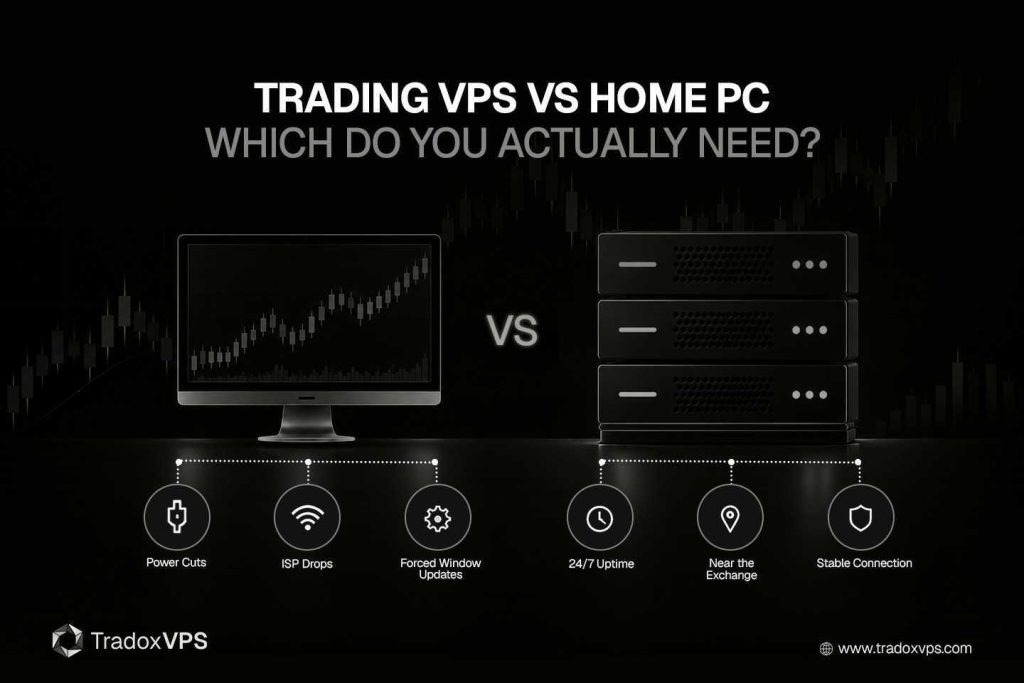
Most “VPS vs home PC” articles are written by VPS companies, so they all reach the same conclusion: buy a VPS. We sell VPS hosting too, and we’re going to tell you something different. A home PC is perfectly fine for a lot of traders, and a VPS is a waste of money for some of them.
The honest question isn’t which one is “better” in the abstract. It’s what a VPS actually buys you, uptime, proximity, and consistency, and whether the way you trade needs those things enough to justify a monthly fee. So here’s the real comparison, dimension by dimension, and a straight answer for which setup fits how you actually trade.
What a VPS actually buys you, and what it doesn’t
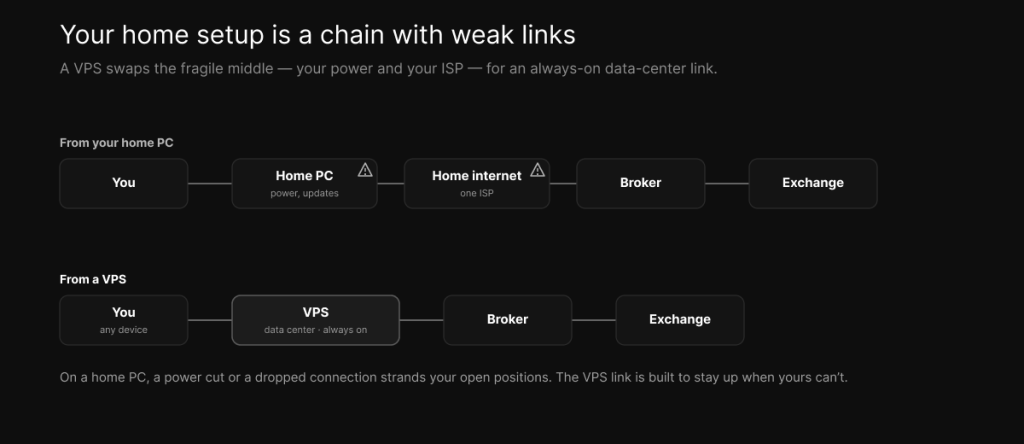
A trading VPS is not a faster internet connection and not a magic performance upgrade. It’s a professionally managed, always-on computer sitting in a data center, which you reach by remote desktop and leave running. It buys three things a home PC genuinely struggles with: uptime, because it runs 24/7 without your home power, your home internet, or Windows getting in the way; proximity, because it can sit near the exchange in a way your house never can; and consistency, because its resources are dedicated and nothing else is fighting your platform for CPU.
What it does not buy is a better strategy, or, very often, more raw power than a good home computer. This is the part the marketing skips, and even neutral broker sources say it plainly: for most manual traders, the real value of a VPS is uptime and stability, not raw speed. Keep that straight and the rest of the decision gets easy.
Trading VPS vs home PC, dimension by dimension
| Dimension | Trading VPS | Home PC |
|---|---|---|
| 24/7 uptime | Runs unattended in a data center | Must stay on; sleep, updates, and restarts interrupt it |
| Internet reliability | Redundant enterprise network | One consumer ISP — a drop strands your positions |
| Power reliability | Redundant power and generators | A blackout kills it, unless you own a UPS |
| Latency to the exchange | Single-digit ms if near the venue | 50–200 ms, wherever you happen to live |
| Dedicated resources | Isolated; nothing else competing | Browser, Discord, and games steal CPU and RAM |
| Access from anywhere | Any device via remote desktop | Tied to that one physical machine |
| Security | Hardened and DDoS-protected (you still secure RDP) | Your personal machine, with its personal risks |
| Monthly cost | ~$39–$249/mo | “Free” — you already own it, plus electricity |
| Best for | 24/7 bots, scalping, prop automation, shaky home setup | Discretionary RTH trading on a reliable connection |
The one-line summary of that whole table: the home PC wins on cost, and the VPS wins on everything that keeps a position safe when you’re not watching it. Which of those columns matters depends entirely on how you trade, which is the actual decision, so let’s make it.
When a home PC is genuinely fine
Don’t buy what you don’t need. A home PC is the right call if most of these describe you: you’re a discretionary trader who trades during market hours while sitting at your desk and shuts everything down when you’re done; your internet and power are reliable; you don’t run anything that has to operate while you’re away; and you trade on web-based platforms like TradingView in a browser, clicking your own orders.
In that world, the difference between one millisecond and a hundred is invisible to you, nothing you run needs to survive overnight, and a VPS is simply a monthly bill for benefits you’ll never actually use. A trader in that situation who buys a VPS has been sold something, not helped.
When a VPS earns its fee
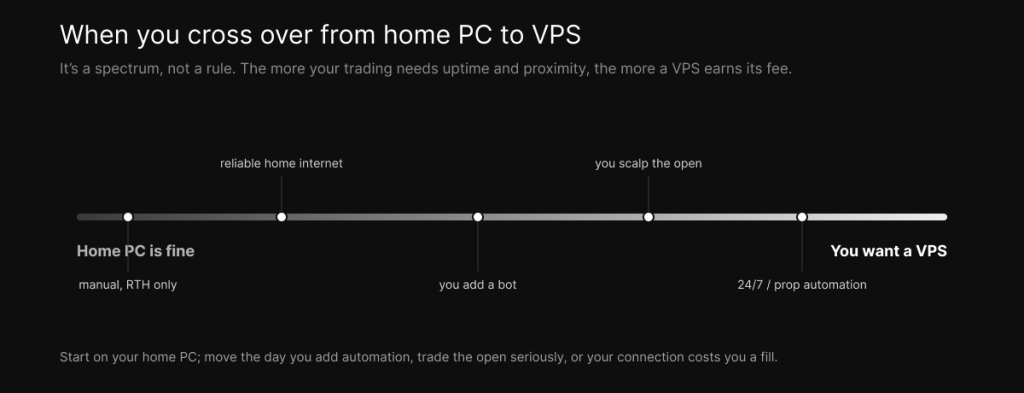
A VPS stops being optional the moment any one of these becomes true.
You run automated strategies or bots that must execute 24/7. This is the big one. A bot running on your home PC dies the instant your internet hiccups or Windows decides to restart for an update, and it leaves any open positions unmanaged until you notice. An always-on VPS exists precisely to prevent that, which is the whole point of the automated futures bots guide.
You’re latency-sensitive, scalping or running anything where the fill price matters, and you’d rather be near the exchange than 100 ms away across the country. On a fast move those milliseconds turn into ticks, which is the slippage you can actually control, and the case for proximity in how a low-latency VPS improves execution.
Your home internet or power is unreliable. If your connection is the single point of failure while you’re holding leveraged positions, a VPS is cheap insurance against the day it drops at the worst possible moment.
You want to trade from anywhere. Your setup lives in the data center and runs whether your laptop is open or not, so you can check it from your phone, travel, and never worry that the machine at home went to sleep.
You run a prop-account bot, where a missed stop from a home outage can blow the account in a single move. One honest caveat that belongs here: some prop firms ban VPS use entirely, Topstep among them, so confirm your firm’s rules before you rely on one, as we cover in the bots guide.
The common thread across all five: a VPS is insurance and proximity. If your trading needs either of those, it’s worth the fee.
The honest nuances most comparisons skip
A few things the typical “just buy a VPS” article leaves out, because they complicate the sale.
A good home PC can be more powerful than a budget VPS. Raw CPU is not the VPS’s advantage. A high-end gaming rig may out-spec an entry-level VPS on horsepower outright. What the VPS wins on is uptime, location, and consistency, so don’t buy one expecting a faster machine, buy it for where it sits and for the fact that it never turns off.
If your bot is a headless Python or API script, you may not need a Windows trading VPS at all. A cheap Linux instance can run it for less, though for latency-sensitive futures a host near the exchange still helps. Match the tool to the job rather than defaulting to the biggest Windows box.
“Free” isn’t quite free. Running a home PC 24/7 burns electricity, invites forced Windows updates in the middle of a session, ties you to one location, and wears the hardware out faster. The home option has costs; they’re just quieter.
A VPS doesn’t remove your responsibilities. You still have to secure it with a strong password and 2FA, still keep your protective orders server-side, and still pick the right location for your market. It’s a better environment to trade in, not an autopilot.
So, which do you need?
The decision in three lines:
- Manual, at your desk, reliable connection, no automation → home PC. Save your money.
- Bots, scalping, 24/7 operation, prop automation, or shaky home internet → VPS. It’s insurance and proximity, and it pays for itself the first time your home setup would have failed.
- Somewhere in between? Start on your home PC and move to a VPS the day you add automation, start trading the open seriously, or your connection costs you a fill.
If and when you do move, match the location to your market, the Chicago VPS is built for CME futures, and you can compare plans on pricing.
Frequently asked questions
It depends entirely on how you trade. Manual, at-your-desk trading on a reliable connection means a home PC is fine. Running 24/7 bots, scalping, or dealing with unreliable home internet or power is where a VPS is worth it.
For latency, yes if it’s located near the exchange, single-digit milliseconds versus 50 to 200 from home. But for a manual trader that speed is secondary; the bigger benefit is uptime and stability, not raw execution speed.
Not necessarily. A high-end home PC can out-spec a budget VPS on raw CPU. The VPS’s real advantage is uptime, proximity to the exchange, and dedicated, consistent resources, rather than sheer horsepower.
It stops, and any open positions go unmanaged until you’re back online, which is the single most common reason traders move their automation onto an always-on VPS.
A VPS is typically around $39 to $249 a month depending on specs, while a home PC has no monthly fee but adds electricity from running 24/7 and ties you to one location. The question is whether uptime and proximity are worth the fee for the way you trade.
Yes, and if it’s a headless script, a lightweight Linux VPS can be cheaper than a Windows one. For latency-sensitive futures, a host near the exchange still helps execution.
It removes one specific risk, a missed stop caused by a home outage, but it can’t fix a flawed strategy, and some prop firms ban VPS use entirely, so check your firm’s rules before relying on one.
We operate TradoxVPS and provide trading infrastructure, not financial advice. A VPS improves reliability, proximity, and consistency, but it does not guarantee profitability and is unnecessary for some traders. Trading futures and other leveraged products carries substantial risk, including the loss of more than your initial deposit.