
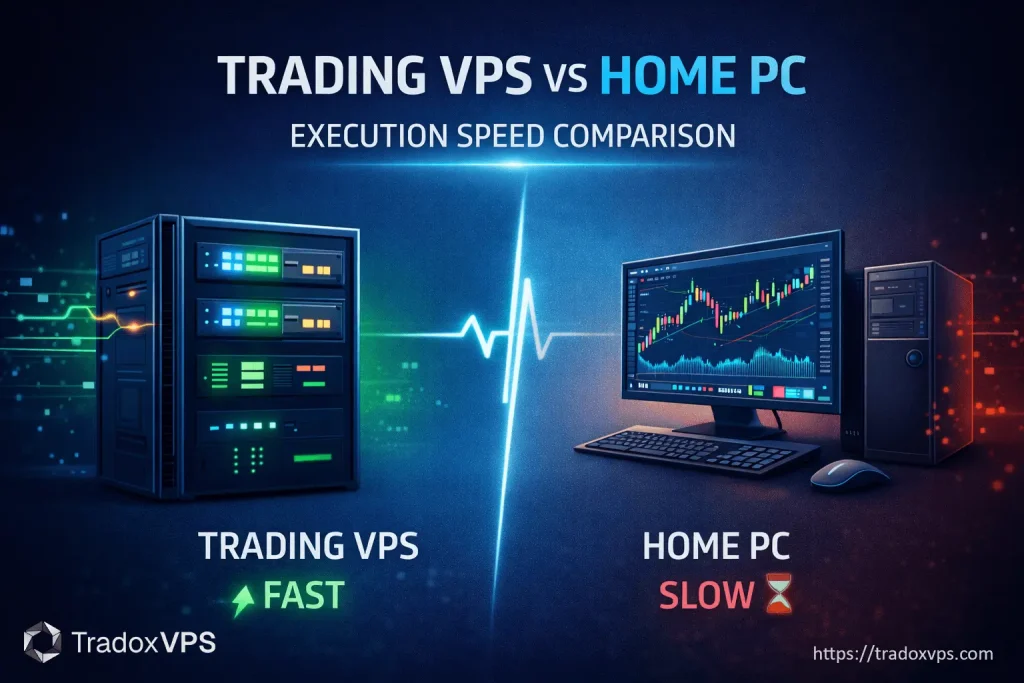
Execution speed is one of the most critical factors in modern futures trading. Whether you are scalping, day trading, or running automated strategies, even milliseconds can determine whether a trade is profitable or not.
This leads many traders to ask an important question:
Is a trading VPS faster than a home PC?
In this guide, we provide a detailed, real-world comparison of Trading VPS vs Home PC execution speed, focusing on futures trading performance, latency, reliability, and consistency.
By the end of this article, you will clearly understand:
- How execution speed actually works
- Why home PCs are often slower than expected
- How a trading VPS improves execution speed
- When a VPS makes the biggest difference
- Which traders benefit most from a VPS
What Is Execution Speed in Trading?
Execution speed refers to how quickly a trade order travels from your trading platform to the exchange and gets filled.
This process includes:
- Market data reception
- Strategy or indicator calculation
- Order generation
- Network transmission
- Exchange matching
Any delay in this chain increases the risk of slippage and missed entries.
Why Execution Speed Matters in Futures Trading
Futures markets are centralized, fast-moving, and highly competitive.
Execution speed is especially critical for:
- Scalpers targeting small price moves
- Traders entering at market open
- News-based traders
- Algorithmic and automated strategies
In these scenarios, even a 10–20 ms delay can change execution price.
Trading on a Home PC: The Reality
Most traders begin by trading from a home PC or laptop. While this setup may seem sufficient, it has several hidden limitations.
1. Internet Latency
Home internet connections suffer from:
- Variable routing paths
- ISP congestion
- Wi-Fi interference
- Packet loss and jitter
Latency can fluctuate dramatically throughout the day.
2. Distance to the Exchange
Physical distance matters.
If you trade CME futures from:
- West Coast
- Europe
- Asia
Your orders must travel thousands of miles to reach Chicago, increasing execution delay.
3. Hardware Resource Contention
Home PCs often run:
- Web browsers
- Streaming services
- Background updates
- Security software
This competes with your trading platform for CPU and RAM.
4. Stability Issues
Power outages, system restarts, and OS updates can interrupt trading at critical moments.
What Is a Trading VPS?
A Trading VPS (Virtual Private Server) is a remote computer hosted in a professional data center, optimized specifically for trading workloads.
Key characteristics:
- 24/7 uptime
- Dedicated resources
- Low-latency connectivity
- Professional-grade hardware
When properly configured, a VPS provides a cleaner and faster execution environment than a home PC.
Trading VPS vs Home PC: Execution Speed Comparison
1. Network Latency
This is the biggest difference.
- Home PC: 30–150 ms (unstable)
- Trading VPS (Chicago): 1–5 ms (stable)
Lower latency means your order reaches the exchange sooner.
2. Execution Consistency
Consistency is often more important than raw speed.
Trading VPS:
- Predictable execution times
- Minimal variance
Home PC:
- Latency spikes
- Inconsistent routing
3. Hardware Performance
Trading VPS platforms are optimized for:
- High single-core CPU performance
- Dedicated RAM
- Fast NVMe storage
This reduces internal processing delays.
4. Platform Responsiveness
Trading platforms respond faster on a VPS because:
- No background apps
- Clean OS environment
- Consistent CPU scheduling
Execution Speed Comparison Table
| Factor | Home PC | Trading VPS |
|---|---|---|
| Latency Stability | Low | High |
| Distance to CME | Far | Near |
| Execution Speed | Variable | Consistent |
| Slippage Risk | Higher | Lower |
| 24/7 Reliability | No | Yes |
Who Benefits Most from a Trading VPS?
A trading VPS provides the biggest advantage for:
- Futures scalpers
- High-frequency traders
- Automated strategy users
- Traders outside the US
- Traders executing during volatile sessions
When a Home PC Is Still Enough
A home PC may be sufficient if you:
- Trade higher timeframes
- Place limit orders far from market
- Do not require precise timing
However, execution quality still depends on network stability.
How TradoxVPS Improves Execution Speed
TradoxVPS is designed specifically for trading performance:
- Chicago-based data centers
- Low-latency CME routing
- Dedicated CPU and RAM
- Optimized Windows environments
This setup minimizes execution delay and improves trade consistency.
Frequently Asked Questions (FAQs)
Is a VPS faster than a high-end gaming PC?
Yes. Network latency and proximity to the exchange matter more than raw hardware.
Does a VPS guarantee better fills?
No guarantees, but it reduces avoidable delays that cause poor fills.
Is a VPS necessary for futures trading?
For fast or automated strategies, it is highly recommended.
Final Verdict: Trading VPS vs Home PC
A Trading VPS consistently outperforms a home PC in execution speed, stability, and reliability.
While a home PC may work for casual trading, serious futures traders benefit significantly from a VPS-based setup.
Explore professional trading infrastructure at TradoxVPS.com.