Ryzen 9950X vs EPYC 4565P for trading: Why identical specs tell different stories

Written by TradoxVPS Engineering Team
|
Ryzen 9950x vs Epyc 4565p for Trading

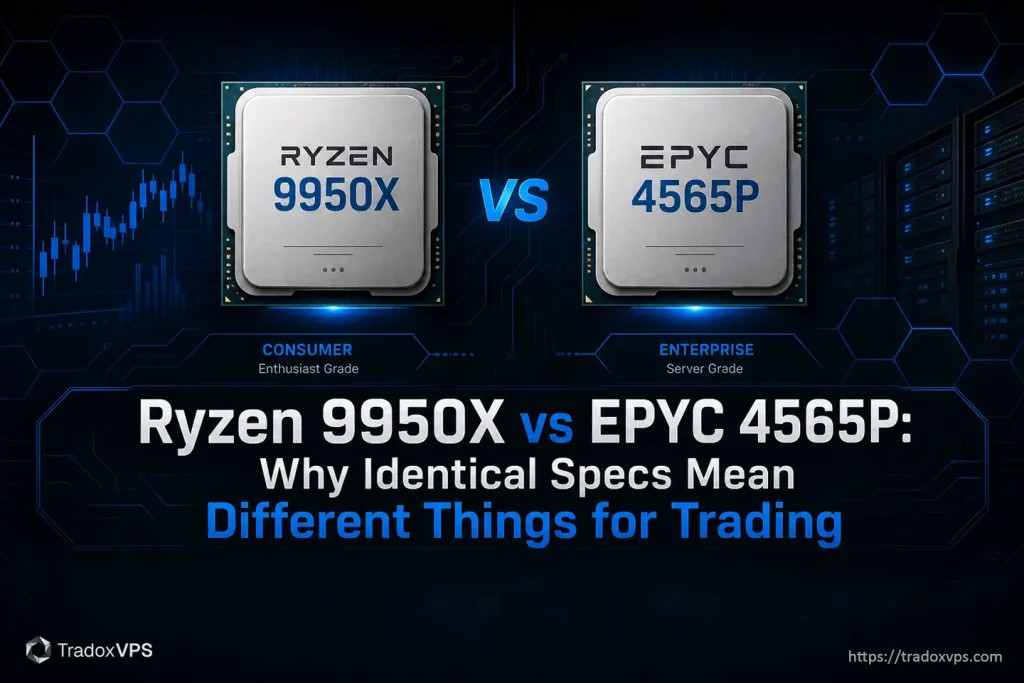
Spend five minutes comparing the specs of the AMD Ryzen 9 9950X and the AMD EPYC 4565P and you will come away confused. They share the same Zen 5 architecture, the same 16-core/32-thread layout, the same 4.3 GHz base clock and 5.7 GHz boost, the same 64 MB of L3 cache, the same 170W TDP, and the same AM5 socket. The MSRP gap is barely $60. On every spec sheet that matters, these two processors are siblings.

And yet the trading VPS industry has a clear consensus: Ryzen 9950X is the standard for active trading infrastructure, and EPYC occupies a different tier entirely. That gap deserves a proper explanation, because the answer reveals something important about how trading software actually works, and why choosing the right CPU comes down to more than reading a spec sheet.


TL;DR

The Ryzen 9 9950X and EPYC 4565P are spec-for-spec identical on the metrics that drive trading execution: same Zen 5 core, same 5.7 GHz boost clock, same L3 cache. For live trading, both will perform similarly — the EPYC 4565P is not the weak link its server-class label implies. The real differences are platform: Ryzen gives you a massive consumer motherboard ecosystem, Curve Optimizer overclocking headroom, and 33% lower street pricing. EPYC gives you server-grade remote management (IPMI) and enterprise validation. For 90% of futures and prediction market traders, Ryzen wins on cost and ecosystem. For the remaining 10% — datacenter operators who need remote management and buy in bulk — EPYC 4565P is a legitimate option with no execution penalty.


The specs that look the same

When AMD launched the EPYC 4005 series in May 2025, the flagship 4565P surprised the server market with specs that overlapped completely with its consumer sibling:

Epyc 4565p vs Ryzen 9 9950X

The table above is not a mistake. Both CPUs are running the same silicon generation, the same manufacturing process (5nm N4P for EPYC, 4nm N4 for Ryzen — effectively equivalent), and the same frequency targets. AMD deliberately built the EPYC 4565P to compete on clock speed, not just core density, which is why the 4005 series is positioned differently from the 64-core EPYC 7003 workhorses that dominated trading VPS budget tiers in previous years.

The EPYC 4565P’s official AMD specification page lists: 16 cores, 32 threads, 4.3 GHz base, 5.7 GHz boost, 64 MB L3, 170W TDP, DDR5-5600 memory support, AM5 socket, $589 MSRP. The Ryzen 9 9950X specification page lists: 16 cores, 32 threads, 4.3 GHz base, 5.7 GHz boost, 64 MB L3, 170W TDP, DDR5-5600, AM5, $649 MSRP (currently available at $434 to $528 retail).

So the real question is not performance — it is everything else.


Why single-core speed is everything for trading

Before comparing what differs between these two CPUs, it is worth understanding what matters most for trading workloads — because this shapes every comparison that follows.

Live trading platforms are fundamentally single-threaded in their execution core. NinjaTrader 8, Tradovate, Rithmic, and MetaTrader all follow the same pattern: when a trade signal fires, the system executes a sequential chain on a single thread.

Why Single-core speed wins in trading

That sequential chain — tick received, strategy logic evaluated, order object built, broker API called — cannot be parallelized across cores. Each step depends on the output of the previous one. A 64-core CPU processing a market tick is running that chain on exactly one core at maximum boost. The platform latency is entirely determined by that one core’s speed, not the total core count.

This is why the old-generation EPYC 7765 (64 cores, 2.45 GHz base, 3.5 GHz boost) was problematic for live trading despite its core density. Its single-core speed was 80% slower than the Ryzen 9950X by PassMark single-thread score: 2,641 versus 4,742. During a high-volatility period like an FOMC announcement, those slow cores formed tick queues — the processor could not process incoming market ticks as fast as they arrived, causing execution slippage even on a fast network. See our breakdown of how clock speed maps to trading execution for the full analysis.

The EPYC 4565P is a completely different story from the 7765. At 5.7 GHz boost, it eliminates the core speed penalty of its server predecessors.


Where the Zen 5 generation changed the EPYC story

Zen 5 matters for this comparison more than any other architectural factor. The 16% IPC improvement over Zen 4 means both the Ryzen 9950X and the EPYC 4565P accomplish more per clock cycle than their Zen 4 predecessors at identical frequencies.

What this means practically: the Ryzen 7950X (Zen 4, 5.7 GHz boost) already performed well for trading. Both the Ryzen 9950X and the EPYC 4565P, running Zen 5 at the same boost clock, are 16% faster on the instructions that actually execute trading logic — signal evaluation, order construction, risk calculations. Neither chip needs to run faster than the other; they are both running Zen 5 at 5.7 GHz.

For the trading execution path, this makes them effectively equivalent. The EPYC 4565P is not limited by its “server” designation. It is running the same core silicon as the 9950X.

Cache and memory: the same there too

Both chips carry 64 MB of L3 cache and support DDR5-5600 memory across two channels, with 89.6 GB/s peak bandwidth. Cache keeps trading data close to the processor, reducing how often the CPU stalls waiting for memory. At 64 MB, both have the same cache floor — position data, order books, strategy parameters for multiple instruments all comfortably fit in cache on either chip.

Memory latency is approximately 70 nanoseconds with DDR5-6000 configuration on the Ryzen 9950X, and comparable figures on the EPYC 4565P with the same DDR5 speeds. Neither chip has a meaningful advantage here.


How the CPUs actually differ

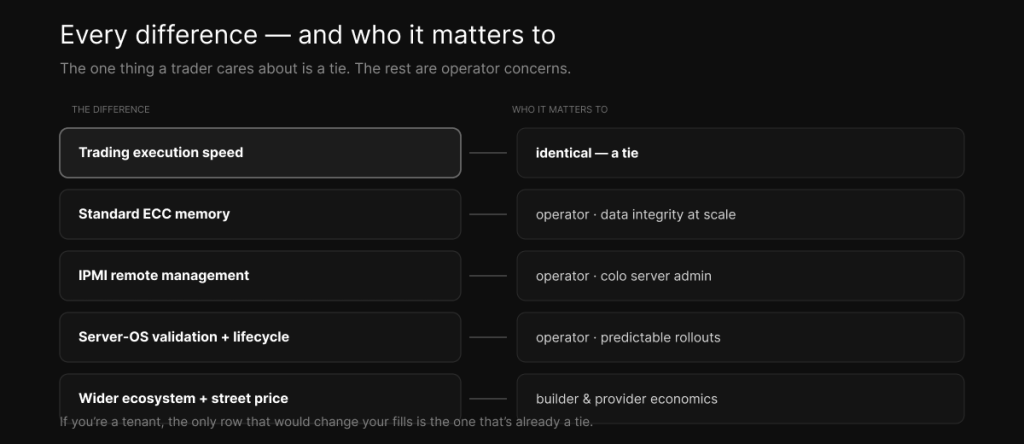
If raw execution performance is tied, the real comparison is everything around the silicon: platform, ecosystem, cost, and deployment context.

Motherboard ecosystem

This is where the Ryzen 9950X builds a clear lead. Over 50 consumer and workstation motherboards support the AM5 socket with full Ryzen compatibility — ranging from $150 budget boards to $600 flagship X870E platforms. Availability is universal; any system builder or data center operator can source compatible hardware without lead times.

The EPYC 4565P runs on the same AM5 socket, but the server-validated board ecosystem is much narrower. Enterprise AM5 server boards from ASRock Rack, Gigabyte, and Supermicro cover the use case, but the selection sits at roughly 5 to 10 models, often priced $400 to $600 as OEM units. These are not consumer products — they are data center components with longer lead times and fewer retail stocking points.

IPMI and remote management

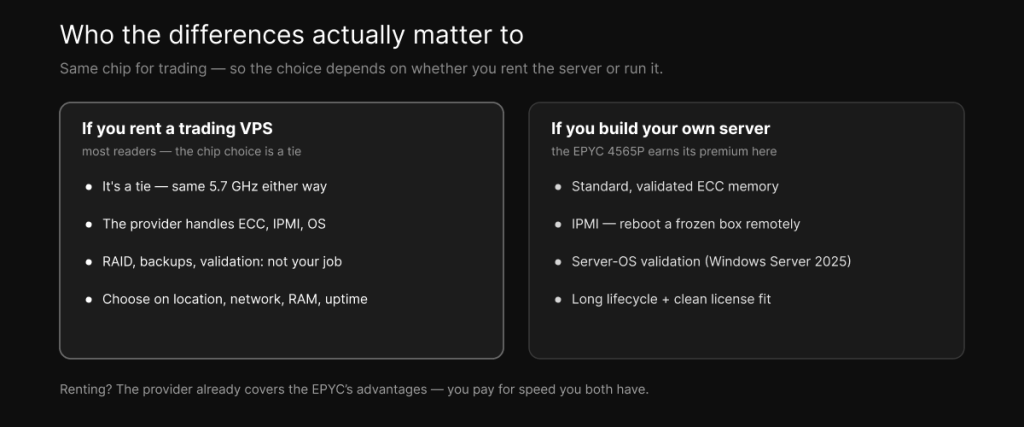
Here EPYC has a concrete advantage. Enterprise AM5 server motherboards designed for the EPYC 4565P typically include IPMI (Intelligent Platform Management Interface), which lets a data center operator reboot, reinstall, and diagnose the server remotely even when the OS is unresponsive. This is meaningless to a retail trader who rents a VPS — the hosting provider handles that layer. But for operators building their own trading server infrastructure in a colocation facility, IPMI changes the management equation significantly.

Consumer Ryzen boards can include BMC (Baseboard Management Controller) on some high-end models, but it is not standard, and the feature set is more limited than enterprise IPMI.

ECC memory

The Ryzen 9950X supports ECC when the motherboard enables it. The EPYC 4565P on enterprise boards gets ECC as a standard feature, with full server validation. For live trading, ECC matters: a memory bit flip in an order quantity or price field is not a theoretical risk. Most traders running on a hosted VPS get ECC at the infrastructure level regardless of which CPU is in the box.

Overclocking and tuning

This is an area where Ryzen has a real, practical advantage for trading VPS operators who tune their hardware. AMD’s Curve Optimizer allows per-core voltage and frequency tuning on the Ryzen 9950X, which Level1Techs forum users have documented as more responsive than the 7950X generation. A trading VPS operator who tunes the most-used cores can push sustained single-core boost beyond stock frequencies without increasing TDP significantly.

The EPYC 4565P, as a server-grade processor, is not designed for consumer overclocking. AMD locks multiplier headroom on EPYC parts. For a data center operator, that stability is a feature — predictable power envelopes, validated thermal behavior. For a trading VPS provider trying to extract maximum single-core performance, Ryzen gives more levers.

No efficiency cores

One underappreciated point: the Ryzen 9950X has 16 identical performance cores with no efficiency cores. Intel’s hybrid architecture (P-cores and E-cores) creates a real risk for trading: the OS can schedule a trading process onto a slow efficiency core, producing inconsistent execution latency. AMD avoids this on both the Ryzen 9950X and the EPYC 4565P — all cores on both chips are full-speed Zen 5 cores. Neither chip has a scheduling risk in this regard.


Where EPYC genuinely makes sense for trading

The EPYC 4565P is not a wrong choice for trading. It is a different deployment model.

Consider a proprietary trading firm or a small hedge fund that self-hosts servers in a colocation facility. They are not renting VPS slots — they own the hardware, manage it remotely, and need enterprise support contracts. For them, IPMI remote management, enterprise board validation, and ECC as a standard (not an opt-in) justify the EPYC 4565P over the Ryzen 9950X. The execution speed is identical. The platform manageability is meaningfully better.

Similarly, a high-core-count EPYC (the 7003 or 9004 series with 64+ cores) makes sense for firms running heavy parallel backtesting — running hundreds of strategy parameter combinations simultaneously to optimize a model. Live execution speed does not matter during backtesting; you want the simulation to finish before market open. Sixty-four cores and 128 threads cut that time more than clock speed improvements would.

The use case the EPYC 4565P specifically is not built for: the retail futures day trader running NinjaTrader on a single-thread execution path who needs the cheapest, fastest, most widely-supported option. That trader’s market is the Ryzen 9950X.

From TradoxVPS’s engineering analysis of Ryzen vs EPYC: “For the vast majority of individual futures traders, the Ryzen 9 9950X is the clear winner. Its 5.7GHz boost clock and Zen 5 architecture provide the single-threaded dominance required for NinjaTrader… The only reason to choose an EPYC-based solution is if you are running massive, highly parallelized backtests that require 64+ cores simultaneously.”


The market positioning tells you what you need to know

Trading VPS providers position these CPUs explicitly. QuantVPS offers two tiers: EPYC 7003-series on entry-level plans (their “enterprise-grade” framing is accurate — server grade, not performance grade) and Ryzen on premium plans billed as the fastest single-thread available. The pricing delta — roughly $20 to $30 per month more for Ryzen — reflects the market’s conclusion: providers charge a premium for Ryzen because it reduces slippage complaints and produces better client retention.

TradoxVPS runs Ryzen 9950X exclusively across both its Chicago and Dublin locations. ChartVPS operates the same way. Providers who built their entire product around execution quality chose Ryzen as the hardware standard before the EPYC 4565P launched, and nothing in the 4565P’s spec sheet changes that calculus — because the 4565P performs identically on the metric that matters, while costing more on the platform side and limiting ecosystem choices.


Cost and deployment comparison

which CPU for your trading setup

A full platform build comparison illustrates the real cost difference:

ComponentEPYC 4565P buildRyzen 9 9950X build
CPU$589 (MSRP)~$450-528 (current street price)
Motherboard (ECC-capable)$450-600 (enterprise server board)$300-500 (consumer/workstation)
DDR5 ECC RAM (32 GB)$200$200
NVMe SSD (500 GB)$50$50
Case + PSU$150$150
Cooling$120$120
Total$1,559-1,709$1,270-1,548

The platforms converge at the high end — a fully-loaded workstation-grade Ryzen build with an X870E board approaches the same total as a basic EPYC 4565P server build. But the ceiling for Ryzen is higher (more overclocking headroom, more board choices, lower CPU street prices) and the floor is lower. Unless IPMI or enterprise support contracts are requirements, Ryzen wins on build flexibility and cost efficiency.

For most traders, none of this matters because they rent a trading VPS rather than owning hardware. In that context, the only relevant question is which CPU is in the server you are renting — and the VPS provider has already made the call based on what delivers best execution outcomes at their price points.


Which CPU wins for active traders?

The honest answer depends on what you are doing:

Live execution — futures, options, Polymarket bots, automated strategies: Ryzen 9 9950X and EPYC 4565P perform identically at 5.7 GHz Zen 5. If you are renting a VPS, choose the provider who optimizes for single-core throughput and infrastructure stability — the CPU label matters less than how the VPS operator has configured the host. If you are buying hardware, Ryzen gives better ecosystem support, overclocking headroom, and lower street pricing.

Heavy parallel backtesting (64+ strategy simulations simultaneously): High-core-count EPYC (7003/9004 series, 64+ cores) beats anything with 16 cores. Neither the 9950X nor the 4565P is the right tool for this workload — you want the 64-core parts.

Self-hosted colocation with remote management requirements: EPYC 4565P is the right choice. The enterprise board ecosystem is narrower, but IPMI remote management justifies it if you are managing physical servers without on-site access.

Cost-conscious setup with no enterprise requirements: Ryzen 9 9950X at current street prices of $434 to $528 beats the EPYC 4565P’s $589 MSRP with a wider motherboard selection and Curve Optimizer tuning available.

The spec sheet told you they were the same. Now you know what “the same” actually means for different use cases.


TradoxVPS

TradoxVPS runs AMD Ryzen 9 9950X across its entire infrastructure — both Chicago and Dublin locations. The hardware choice reflects what this post describes: Zen 5 at 5.7 GHz, 16 identical performance cores with no efficiency core scheduling risk, and Curve Optimizer tuning at the host level to sustain peak boost during active market hours.

Plans span 2-core entry setups for single-strategy bots through full-node allocations for multi-chart, multi-instrument trading desks. All plans include NVMe SSD storage, DDR5 RAM, and 99.999% uptime SLA — the infrastructure is purpose-built for trading, not repurposed general-purpose cloud. If you are running NinjaTrader, Polymarket bots, or automated futures strategies, the hardware is tuned for exactly that workload.


Frequently Asked Questions

Is the EPYC 4565P the same as the Ryzen 9950X for trading?

On paper, yes — both are Zen 5, 16-core, 5.7 GHz boost, 170W TDP, on AM5. For live trading execution, performance is effectively the same since both hit the same boost clock. The difference comes down to platform: EPYC motherboards are scarcer and pricier, while Ryzen gives you a wider ecosystem, Curve Optimizer overclocking, and more cooling options. TradoxVPS covers the full comparison here.

Why does single-core speed matter more than core count for trading?

Trading platforms like NinjaTrader, Tradovate, and MetaTrader execute their core path — tick received, strategy logic, order built, broker API call — sequentially on a single thread. Adding more cores does not parallelize that path. Clock speed and IPC determine how fast that single thread runs, which directly affects execution speed. See our deep dive on single-core performance for trading.

Does the EPYC 4565P support ECC memory?

Yes, ECC memory support is standard on server-grade EPYC 4565P motherboards. The Ryzen 9950X also supports ECC, but it requires a compatible consumer or workstation motherboard that enables the feature via BIOS. For most traders running on a trading VPS, ECC is handled at the infrastructure level.

Which CPU is better for backtesting trading strategies?

For backtesting, core count matters more because simulations can run in parallel. A high-core-count EPYC (64+ cores, 128 threads) can run multiple strategy simulations simultaneously and finish faster. However, if your backtesting framework is single-threaded or lightly parallelized, the Ryzen 9950X at 5.7 GHz boost will still outperform a slow-clocked 64-core EPYC. Read our guide to VPS for automated trading bots.

What CPU does TradoxVPS use for its trading VPS plans?

TradoxVPS uses the AMD Ryzen 9 9950X across both its Chicago and Dublin locations. This choice is intentional: Zen 5 architecture, 5.7 GHz boost clock, and a 16-core homogeneous design (no efficiency cores) provide consistent single-core dominance for futures and prediction market trading.

Share this article:
Facebook
X
LinkedIn

TradoxVPS Engineering Team

Infrastructure specialists focused on low-latency trading VPS and CME-proximal hosting.
Published:
Discover how Tradox VPS can power your trading with speed, stability, and 24/7 uptime to stay ahead in the markets.
First month’s price for New Users
Promo Code:
WELCOME