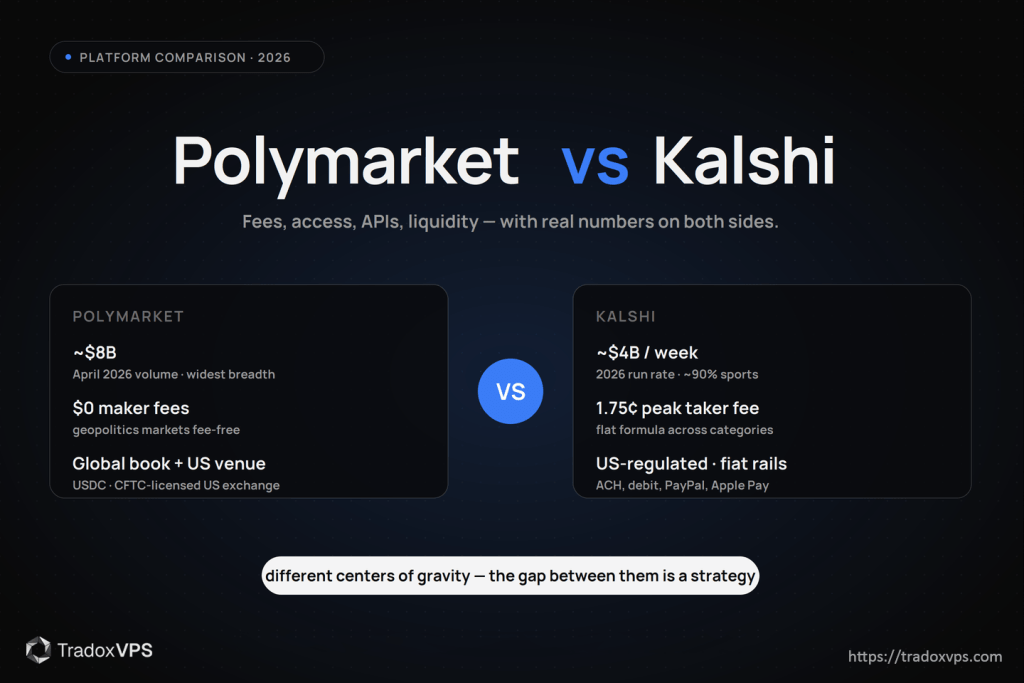
The 30-second answer: these are no longer a “crypto one” and a “regulated one” — they’re two serious exchanges with different centers of gravity. Polymarket is the global liquidity leader with the deepest market breadth and the strongest builder tooling, now split into a global book (geoblocked for US users) and a CFTC-licensed US exchange. Kalshi is the established US-regulated venue with bank funding rails, roughly $4 billion a week in volume, and a market mix dominated by sports. Both have real APIs. Both host serious bots. Fees differ by formula, not vibes — worked out below. And for a meaningful set of traders, the right answer is both, because the price gaps between them are themselves a strategy.
What each platform actually is in 2026
Polymarket is a hybrid exchange: orders match off-chain on a central limit order book and settle on-chain (Polygon, USDC), with outcomes resolved by UMA’s optimistic oracle. It processed on the order of $8 billion in April 2026 across thousands of markets — politics, geopolitics, crypto, tech, culture, sports. Since the QCEX acquisition there are effectively two Polymarkets: the global platform (no KYC, USDC, geoblocked for US users) and Polymarket US (CFTC-licensed, identity verification, fiat funding, its own fee schedule).
Kalshi is a CFTC-designated contract market — a US-regulated exchange where event contracts trade in dollars with ACH, debit, PayPal, and Apple Pay on-ramps. Its growth has been explosive: around $4 billion a week in 2026 volume, roughly 90% of it sports, with Robinhood routing its event contracts through Kalshi’s exchange and Kalshi beginning international expansion in Brazil. It resolves markets under its regulated rulebook rather than an oracle.
Head-to-head: the table that matters
| Dimension | Polymarket | Kalshi |
|---|---|---|
| Structure | Hybrid CLOB — off-chain matching, on-chain settlement | Centralized regulated exchange |
| Regulation | Global book: crypto-native · Polymarket US: CFTC-licensed | CFTC (designated contract market) |
| US access | Global book geoblocked · Polymarket US open with KYC | Yes (most states; sports contracts contested in several) |
| Funding | USDC on Polygon (global) · fiat (US venue) | USD — ACH, debit, PayPal, Apple Pay |
| Scale | ~$8B in April 2026; deepest politics/world-events books | ~$4B/week; ~90% sports |
| Market breadth | Widest: politics, geopolitics, crypto, tech, culture, sports | Sports-heavy plus macro, rates, weather, policy |
| Taker fees | rate × P × (1−P) by category; peaks $0.75–$1.80 per 100 at 50¢; geopolitics free | 0.07 × P × (1−P); peaks 1.75¢ per contract at 50¢ |
| Maker treatment | $0 + rebate programs | Reduced rate (a fraction of taker) |
| API & automation | CLOB REST + WebSocket, official SDKs, large bot ecosystem | Full REST + WebSocket API, active algo community |
| Resolution | UMA optimistic oracle | Regulated exchange rulebook |
| Custody | Self-custody wallet (global) — your keys, your risk | Exchange account under US regulatory protections |
| Beginner on-ramp | Email sign-up now exists; crypto fluency still helps | The easiest: dollars in, dollars out |
Fees: the formulas, worked side by side
Both venues now price taker fees on a curve that peaks exactly at 50¢ — the price where contested markets live — and collapses toward zero near the extremes.
- Kalshi: taker fee = 0.07 × P × (1−P) per contract → at 50¢, 1.75¢ per contract ($1.75 per 100); maker orders pay a reduced rate.
- Polymarket (global book), Fee Structure V2 since March 30, 2026: taker fee = category rate × P × (1−P) per share → at 50¢, roughly $0.75 per 100 (sports), $1.00 (politics/finance/tech), $1.25 (econ/culture/weather), $1.80 (crypto) — while geopolitics is fee-free and makers pay nothing (and earn rebates). Polymarket US runs a simpler schedule with a maker rebate. Official pages: Polymarket fees · Kalshi’s published schedule.
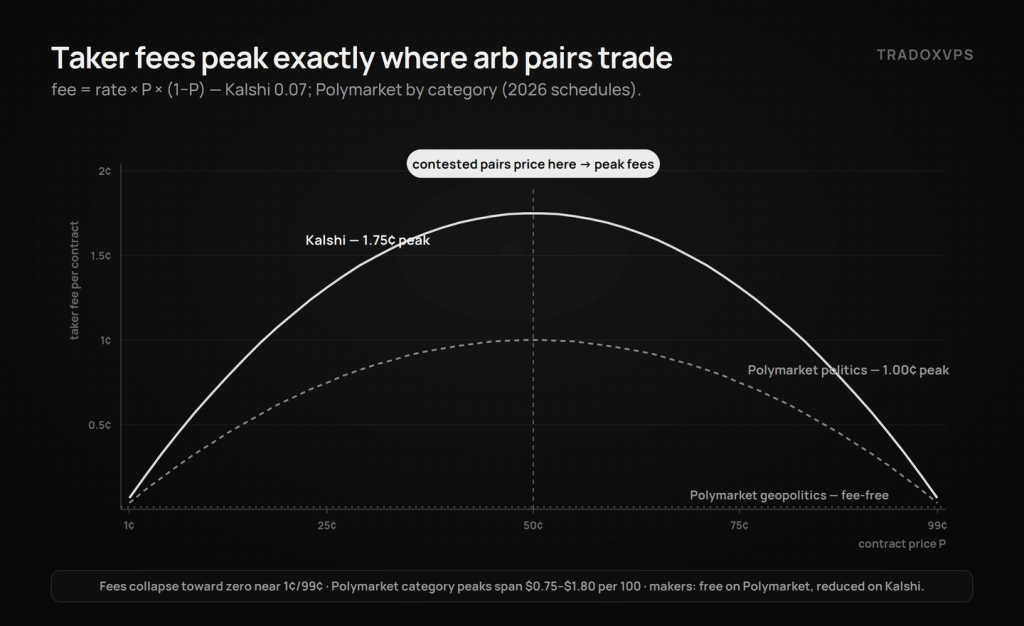
Worked example — the same politics market at 50¢, 100 contracts: a taker pays $1.75 on Kalshi vs $1.00 on Polymarket; a patient maker pays a reduced fraction on Kalshi vs $0 on Polymarket. Trade the same view in a geopolitics market on Polymarket and the taker fee is zero too. The structural readout: Polymarket rewards maker behavior and category selection more aggressively; Kalshi’s curve is flat across categories and never exceeds 1.75¢. For the deeper math — why the curve shape punishes mid-price arbitrage and what it does to a 3¢ spread — see our fee-curve breakdown.
Liquidity and market mix: different centers of gravity
Polymarket’s depth is broadest where the world’s attention is — elections, geopolitics, crypto, tech milestones — and its order books on flagship political markets are the deepest in the category. Kalshi’s firehose is sports: the ~90% share means tight, fast, bot-made books on games, with its non-sports catalog (CPI prints, Fed decisions, weather, policy) offering the structured macro contracts Polymarket’s crowd treats as a side dish. Practical consequence: which platform has “more opportunity” depends entirely on what you trade — a politics specialist will find Polymarket’s books deeper; a sports modeler will find Kalshi’s flow richer; a macro trader will find Kalshi’s rate/inflation ladders cleaner.
Regulation and access: the 2026 reality
The old framing — “Polymarket global, Kalshi US-only” — is now wrong in both directions. Polymarket’s global book excludes US users by geoblock, while Polymarket US offers the brand under full CFTC licensing with KYC. Kalshi remains the incumbent US-regulated venue but is expanding internationally (Brazil first, with XP), and its sports contracts face active state-level challenges — Arizona, Illinois, Massachusetts, Maryland, Michigan, Nevada, and Ohio among them — so “legal in the US” carries a check-your-state asterisk in 2026. If regulatory clarity is your first filter: Kalshi and Polymarket US are the federally supervised options; the global Polymarket book trades convenience and breadth for self-custody responsibility outside that perimeter.
Automation and APIs: correcting the record
An earlier version of this page claimed Kalshi was “primarily manual” with “limited API capabilities.” That was wrong, and it’s worth being precise because automation is where platform choice gets expensive:
- Polymarket offers the CLOB REST + WebSocket stack with official SDKs and the largest open bot ecosystem in prediction markets — order book mirrors, liquidity-rewards market-making, and the on-chain transparency that makes copy trading possible at all.
- Kalshi runs a full REST + WebSocket API of its own, and its sports-dominated books are substantially made by algorithmic traders — $4B a week doesn’t happen by hand. The differences are flavor, not capability: dollar settlement and exchange-style account mechanics on Kalshi; wallet signatures, USDC, and on-chain settlement on Polymarket.
Both are automatable. The honest engineering distinction is what you must be good at: crypto-stack operations (keys, allowances, Polygon) for Polymarket; brokerage-style API discipline for Kalshi.
Resolution: oracle vs rulebook
Polymarket resolves through UMA’s optimistic oracle — decentralized, dispute-driven, with occasional edge cases on ambiguous wording. Kalshi resolves under its regulated rulebook with the exchange as referee. On clean events they agree; on messy ones they can diverge — which is precisely why anyone trading the same event on both (the cross-platform arbitrage crowd) reads both venues’ resolution criteria before sizing a pair. Different resolution machinery is a risk on hedged positions and an opportunity everywhere else: divergent participants are where price gaps come from.
Security and custody
Polymarket’s global book is self-custodial: your wallet, your keys, your responsibility — smart-contract and operational risk in exchange for no-permission access. Kalshi (and Polymarket US) hold funds inside the US regulatory perimeter with the protections and the paperwork that implies. Neither model is “safer” in the abstract; they fail differently. A beginner who has never secured a seed phrase is objectively safer on the regulated rails; a self-custody native may prefer holding their own keys to trusting any intermediary.
So which should you use?
- You’re in the US and want the simplest path → Kalshi (or Polymarket US): dollars in, regulated venue, the beginner workflow minus the crypto stack.
- You trade politics, geopolitics, or world events → Polymarket: the deepest books and the fee-free geopolitics category.
- You model sports → Kalshi’s firehose (with OG and Underdog as alternatives — see the full platform ranking).
- You build bots → both work; pick by stack comfort and where your strategy’s liquidity lives. Maker-heavy strategies tilt toward Polymarket’s $0 maker fees.
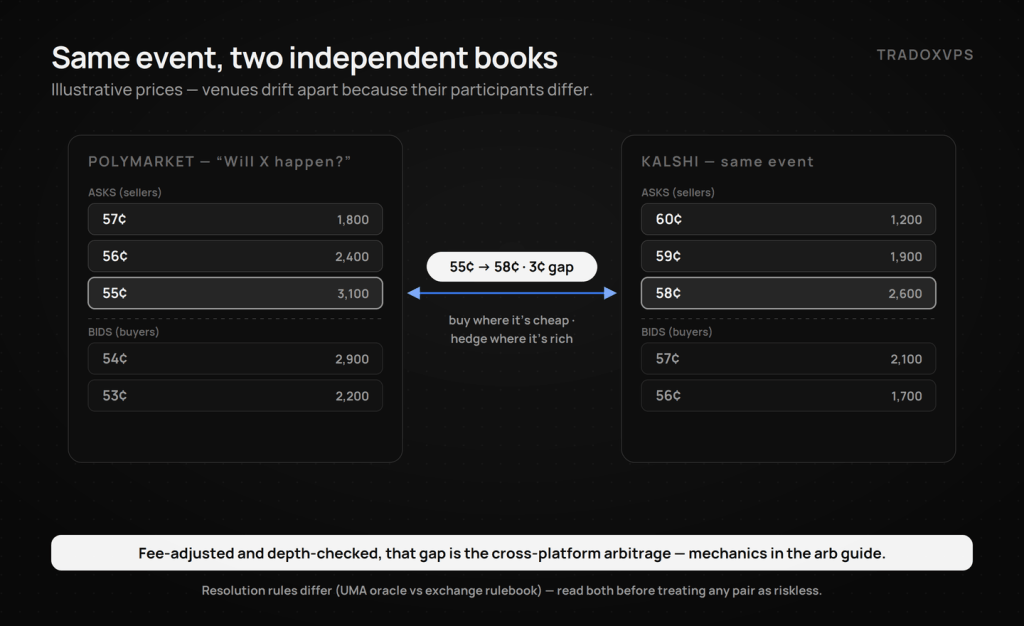
- You trade seriously → realistically, accounts on both. The same event prices independently on each venue, and that gap — verified, fee-adjusted, depth-checked — is the arbitrage strategy in its own right.
Infrastructure, honestly
Manual trading on either platform needs a browser, full stop. Automation changes the requirements identically on both: always-on execution, reconnect-and-resync logic, and a short measured path to the venue. For Polymarket, our published four-provider Dublin benchmark shows ~13–15 ms median to the live feed and ~21–23 ms warm to the order book — and found no sub-millisecond anything, from anyone. For the Kalshi side, our Chicago location serves US-market traders, and we’ll publish Chicago measurements when the probe runs there — until then we quote nothing, and you can run the same 20-minute test yourself on a free 3-day demo before paying us or anyone.
Frequently Asked Questions
Center of gravity. Polymarket is the global liquidity leader (USDC, self-custody, widest market breadth, plus a CFTC-licensed US venue); Kalshi is the established US-regulated exchange with bank funding and a sports-dominated ~$4B/week of volume. Fees, resolution mechanics, and custody models differ structurally — the comparison table above covers each.
It depends on category and behavior. At 50¢, takers pay $1.75 per 100 contracts on Kalshi versus $0.75–$1.80 per 100 shares on Polymarket depending on category — and Polymarket charges makers nothing while geopolitics markets are entirely fee-free. Patient, maker-style traders generally pay less on Polymarket; both venues’ fees collapse near 1¢/99¢.
Yes — despite a persistent myth (which an earlier version of this page repeated), Kalshi has a full REST and WebSocket API and a substantial algorithmic ecosystem; its sports books are heavily bot-made. Polymarket’s tooling and open bot ecosystem are larger, but both platforms fully support automated trading.
The global Polymarket book is geoblocked for US users. Polymarket US — built on the CFTC-licensed QCEX acquisition — is the legal US route, with KYC and fiat funding. Kalshi operates federally across most states, though several states are actively challenging sports event contracts; check your state’s current status.
They fail differently. Kalshi and Polymarket US hold funds under US regulatory protections; Polymarket’s global book is self-custodial, trading regulatory protection for permissionless access and putting wallet security on you. For someone new to crypto, the regulated rails are the safer default.
Kalshi (or Polymarket US) for the funding simplicity — dollars in, dollars out. Polymarket’s email sign-up has lowered its barrier substantially, and its breadth rewards curiosity; our step-by-step starter guide covers that path including the 2026 fees.
Usually, yes. Independent order books mean the same event prices differently on each venue, which creates hedging flexibility and outright arbitrage opportunities — with the caveat that different resolution mechanisms (UMA oracle vs exchange rulebook) must be checked before treating a cross-platform pair as riskless.
Not for manual trading on either. For automated or time-competitive strategies the standard practice is an always-on box near the venue — and the standard discipline is demanding measured latency numbers, not advertised ones. Ours are published for Polymarket; Chicago/Kalshi measurements will be published when probed, not before.
Volume and platform facts are attributed to linked reporting and official pages as of June 2026; fee schedules change — verify before trading. Polymarket latency figures are from our published Dublin benchmark; we quote no Kalshi-side numbers we haven’t measured. We operate TradoxVPS and provide infrastructure, not financial advice.