
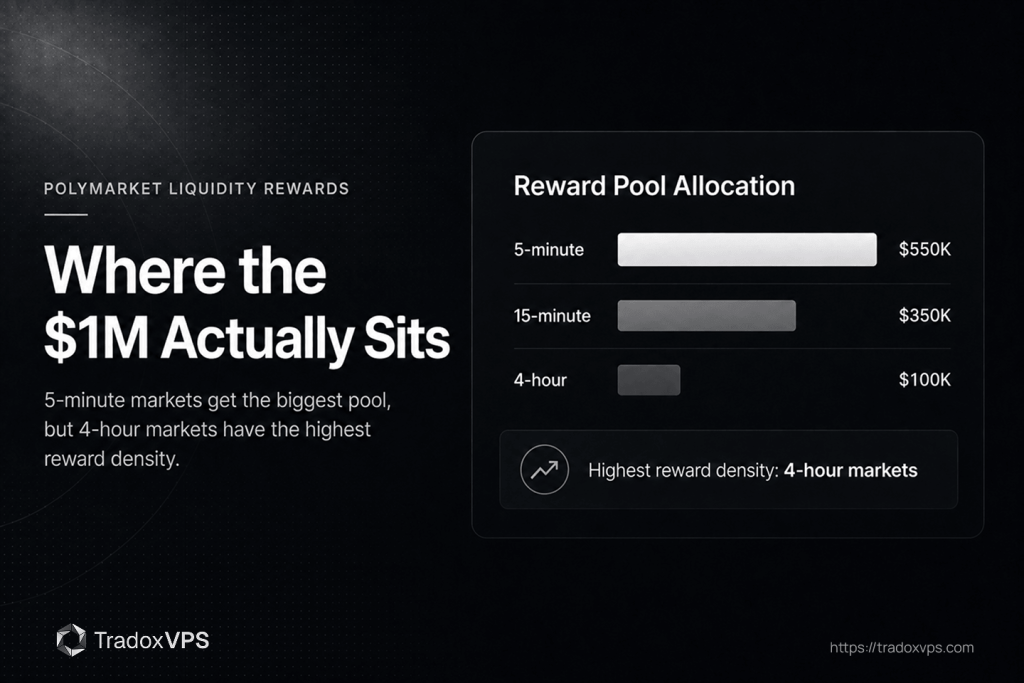
When Polymarket moved its crypto up/down markets to TWAP settlement, it attached a million dollars in Polymarket liquidity rewards to the transition. Most coverage stopped at the headline number. Polymarket has since published the full allocation, and it is far more lopsided than “a million dollars across crypto markets” suggests: nearly a third of the entire pool sits on Bitcoin five-minute markets alone, and the per-market budget is densest in the place almost nobody is looking.
This is the breakdown, the scoring maths that decides what share of it you get, and the two rules inside the formula that most quoting bots get wrong. Every figure comes from Polymarket’s own documentation, checked today, and every piece of arithmetic is shown so you can redo it when the numbers change.
Polymarket liquidity rewards vs maker rebates: two programs, not one
Before any numbers, the distinction that most guides blur. Polymarket runs two separate maker incentives, and they pay for different things.
| Liquidity Rewards | Maker Rebates | |
|---|---|---|
| What it pays for | Having resting orders near the midpoint | Your resting orders actually getting filled |
| Do you need a fill? | No | Yes |
| Funded by | A configured reward pool | Taker fees collected in that market |
| Paid | Daily at midnight UTC | Daily |
| Minimum payout | $1 | $1 |
| You compete with | Other makers in that market | Other makers in that market |
They stack. The same resting order can score liquidity rewards for sitting there and earn a rebate if someone takes it. But they reward different behaviour, and a bot tuned for one is not automatically tuned for the other. The $1 million is entirely in the first column.
On the rebate side, the numbers are worth knowing because they are unusual. Makers pay a zero fee rate in every category. Crypto carries the highest taker fee rate of any category at 0.07 and the lowest maker rebate share at 20 percent, while most other categories rebate 25 percent on smaller fees. Geopolitics has no fees and therefore no rebates. If you have read elsewhere that sports rebates 15 percent, that is wrong; Polymarket’s own table says 25. Rebates are fee-curve weighted, meaning your share is proportional to the fee value your liquidity generated rather than to raw volume, and Polymarket states the percentages are at its discretion and may change.
The $1M Polymarket liquidity rewards breakdown
The full allocation, as published, applying only to crypto 5-minute, 15-minute and 4-hour markets that settle on TWAP:
| Duration | Pool | BTC | SOL, ETH, HYPE, XRP | BNB, DOGE |
|---|---|---|---|---|
| 5-minute | $550,000 | $300,000 | $200,000 split evenly | $50,000 split evenly |
| 15-minute | $350,000 | $225,000 | $100,000 split evenly | $25,000 split evenly |
| 4-hour | $100,000 | $50,000 | $40,000 split evenly | $10,000 split evenly |
Split out per asset, that is $50,000 each for SOL, ETH, HYPE and XRP on 5-minute markets, $25,000 each on 15-minute, $10,000 each on 4-hour, and half those figures each for BNB and DOGE at every duration.
Two things stand out immediately. Bitcoin takes $575,000 of the million, more than every other asset combined. And the durations are weighted heavily toward the short end, with 5-minute markets carrying 55 percent of the pool against 10 percent for 4-hour.
Polymarket is explicit that these are configured reward caps, not promised payouts. Actual distribution depends on eligible quoting and the scoring method below. A pool with no qualifying liquidity in it does not pay out.
Where the Polymarket reward budget is actually densest
Here is where the headline numbers mislead, and it takes one division to see it.
A pool is shared across every market of that type running that month. Five-minute markets run continuously, so there are 288 of them per asset per day. Fifteen-minute markets give 96 a day. Four-hour markets give 6. Dividing each published pool by 31 days and then by those counts gives the budget available per individual market per day:
| Duration | Markets per day | BTC | SOL, ETH, HYPE, XRP | BNB, DOGE |
|---|---|---|---|---|
| 5-minute | 288 | $33.60 | $5.60 | $2.80 |
| 15-minute | 96 | $75.60 | $8.40 | $4.20 |
| 4-hour | 6 | $268.82 | $53.76 | $26.88 |
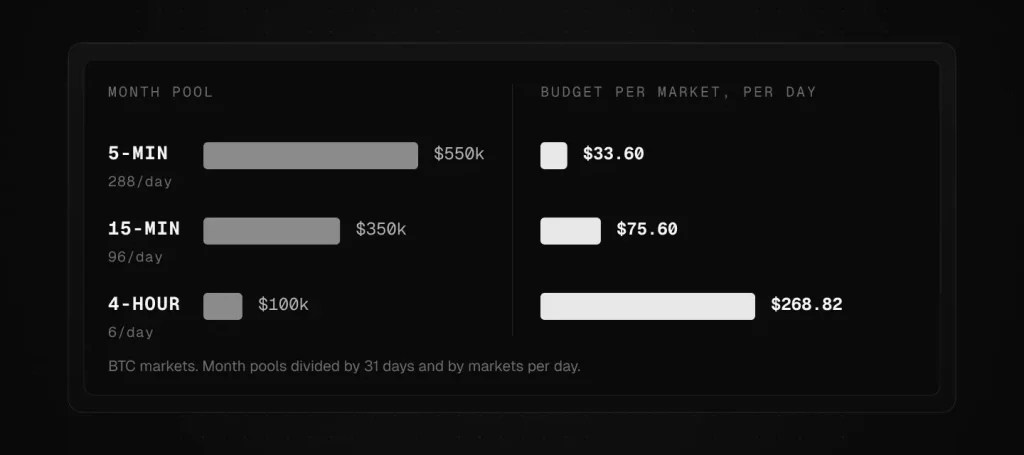
A single Bitcoin 4-hour market carries roughly eight times the reward budget of a Bitcoin 5-minute market, and the 15-minute market carries a bit over twice. The pool that looks smallest in the headline table is the densest per market by a wide margin.
That arithmetic assumes the pools are spread evenly across the month and across every market of a type, which Polymarket has not confirmed. If it weights differently, the absolute numbers move. The ordering does not, because it is driven by market counts that differ by a factor of 48 between the shortest and longest durations.
You do not have to rely on our average, and you should not. Every incentivised market carries its own configured daily reward rate, maximum qualifying spread and minimum qualifying order size, and those are visible on the market’s order book and readable per market through the API. Treat the table above as the map of where to look, then query the actual rate on the specific market before you commit size to it. A market’s configured numbers beat anyone’s monthly division, including ours.
There is an operational point layered on top of the financial one. Quoting a 4-hour market means one set of orders resting through a long window. Quoting 5-minute markets means requoting 288 times a day per asset, which is 288 opportunities to be picked off, 288 rounds of cancel-replace against your rate limit budget, and a far heavier uptime requirement for a comparable slice of a much thinner per-market pot.
None of this says the 4-hour market is the better trade. It says the reward density is not where the headline puts it, and if you have been assuming the money is in five-minute Bitcoin because that is where the biggest number sits, the per-market maths disagrees.
How Polymarket liquidity rewards are calculated
The scoring is documented in full, and it is worth understanding precisely because two of its properties are counter-intuitive and both are expensive to get wrong.
Each incentivised market configures a maximum qualifying spread and a minimum qualifying order size. Orders inside that band are scored every minute by random sampling, using a quadratic function of how far they sit from the size-cutoff-adjusted midpoint:
S = ((v − s) / v)² × size
where v is the market’s max qualifying spread in cents and s is your order’s distance from the adjusted midpoint. Your two book sides are scored separately, combined, normalised against every other maker in that sample, summed across samples, and normalised again to give your share of the pool. Polymarket’s documentation also lists an in-game multiplier b in the scoring function without stating its value for crypto markets, and defines the epoch sum over 10,080 samples, which is a week of per-minute samples, while stating that rewards are distributed daily. We report both as documented rather than guessing at how they reconcile.
Distance beats size, quadratically
Because the score squares your closeness to the midpoint, moving one cent further out costs far more than adding size recovers. Using Polymarket’s own worked example, on a market with a 3-cent max spread:
- 100 shares at 1 cent from the midpoint scores 44.4
- 200 shares at 2 cents from the midpoint scores 22.2
Double the size, one cent further out, and you score half as much. To match that 100 shares at 1 cent you would need 400 shares at 2 cents, putting four times the capital at risk for the same points. Tightening from 1 cent to half a cent takes the same 100 shares from 44.4 to 69.4.
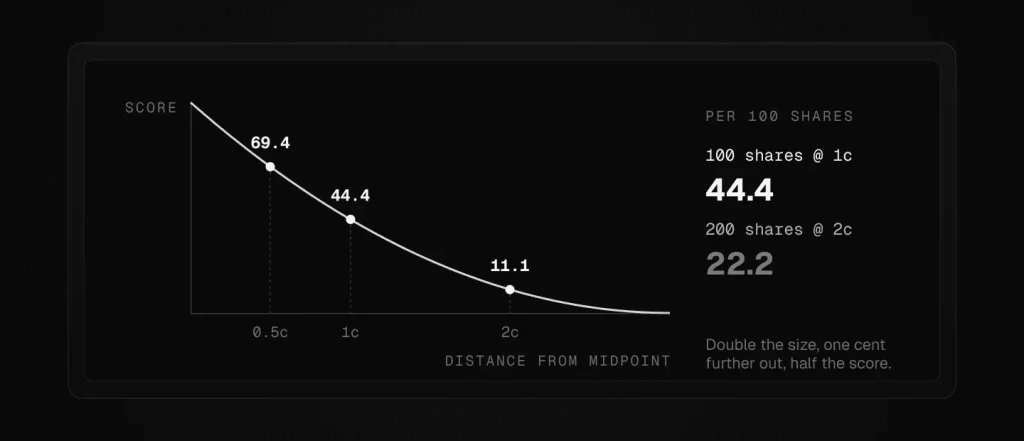
The practical consequence for a quoting bot: your score is dominated by how tight you can afford to sit, not by how much you can afford to post. Capital is the easy lever and it is the weak one.
The 3:1 balance rule nobody writes down
The second property is buried in the formula and, as far as we can find, has not been explained plainly anywhere. Your two book sides are combined as:
Q = max( min(Q₁, Q₂), max(Q₁, Q₂) / c ) with c currently 3.0 on all markets
Read that carefully, because it means the formula pays you on whichever is better of two paths: your weaker side, or one third of your stronger side. Which path you land on depends entirely on how balanced you are.
- Balanced, 100 against 100: you score 100, the weaker-side path.
- Mildly unbalanced, 200 against 100: you still score 100. Everything you added to the strong side earned nothing.
- Heavily unbalanced, 400 against 100: you score 133, and you have crossed onto the one-third path.
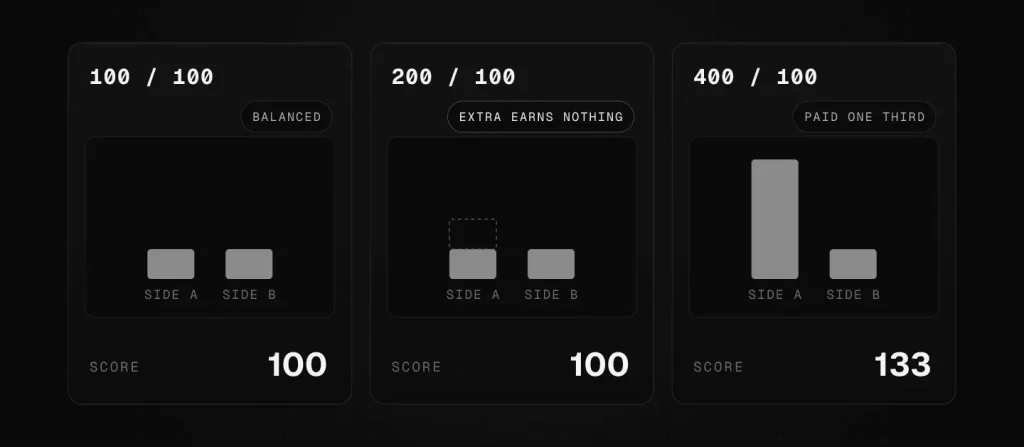
The crossover sits exactly at 3:1. Inside that ratio you are scored on your weaker side, so any size on the heavy side beyond three times the light side is dead weight. Beyond it, you are effectively being treated as single-sided and paid a third.
Which gives the cleanest rule available: keep your two sides within 3:1, and put every marginal share on the lighter side. A bot that quotes one side heavily and the other thinly is paying full inventory risk for a third of the points.
One qualification on where that applies. Single-sided quoting scores at all only while the midpoint sits between 0.10 and 0.90. Outside that band, in the tails, liquidity must be two-sided to score anything. Crypto up/down markets spend most of their life near even money, so the single-sided path is usually available to you, at one third.
What this means for a Polymarket market making bot
Pulling the mechanics together into what actually changes behaviour.
Tightness is the lever, capital is not. The scoring is quadratic in distance and linear in size. Any engineering effort that lets you sit closer to the midpoint safely is worth more than the same effort spent on posting more.
Balance, and put marginal size on the light side. Up to 3:1, your weaker side is your score.
Uptime is scored directly. Sampling happens every minute and your epoch score is the sum across samples. A bot that is down for an hour has not lost an hour of opportunity, it has lost an hour of score in a pool that is being divided among the makers who stayed up. This is the least glamorous requirement in the whole programme and the one most likely to decide your share.
Requoting frequency has a cost you can hit. Polymarket runs per-signer token buckets with separate order and cancel budgets, tiered by thirty-day maker volume. A tight-quoting bot on short-duration markets is a cancel-heavy bot. Size your loop against your tier rather than discovering the ceiling during a volatile session.
Rewards and rebates want slightly different things. Liquidity rewards pay for resting near the midpoint whether or not you fill. Rebates pay only when you are taken. Quoting tighter increases both your score and your fill rate, which is fine if your pricing is right and expensive if it is not.
The honest risks of farming Polymarket rewards
We are not going to tell you market making these markets is profitable, because that depends on things neither we nor anyone publishing this week can measure.
Your share is a denominator you do not control. Every formula here normalises against total maker score. You can quote perfectly and earn less than yesterday because someone else showed up. The published pools are caps, and your slice of a cap is unknowable in advance.
Adverse selection is the real cost. Quoting tight near the midpoint on a market that settles against an oracle means the traders taking your quotes are frequently better informed about the underlying than your quotes are. Rewards are paid in dollars and are easy to see. The cost of being picked off is paid in fills and is easy to miss. A bot can farm rewards enthusiastically all month and lose more on inventory than it collects.
TWAP settlement changed the risk shape, not the direction. Settlement flipping on a single print is no longer the hazard it was, which is a real help to makers. A real move during the averaging window still moves the settlement value, and your inventory still cares.
Sub-$1 days are forfeited, not banked. Rewards are tallied per day against a $1 minimum, and days below it do not roll over or combine with any other day. Read that next to the density table: on BNB and DOGE five-minute markets the entire per-market daily budget works out near $2.80, so a maker taking a modest share of several thin markets can score all day and be paid nothing. Concentration beats spreading thin, and the reason is the payout floor rather than the scoring.
The pool has an end date. It is scoped to August. A strategy that only works while a temporary pool is running is a strategy with an expiry, and the rebate and fee structure underneath it is the part that persists.
What infrastructure has to do with Polymarket market making
Our honest read, as the company selling the servers.
Reward scoring is a direct function of being present. Orders are sampled every minute across the whole epoch, so downtime is scored as a zero rather than as a missed chance, and there is no catching up afterwards. A quoting bot also lives on cancel-replace, which means its cost is measured in round trips to the exchange rather than in throughput. That is the workload a close, stable, always-on box is actually for, and it is a far better fit for this seat than for the sniping strategies the TWAP change retired.
What infrastructure does not do is price your quotes. If your pricing is wrong, faster requoting gets you picked off more efficiently. Get the model right, then shorten the path. The method for measuring the path properly has not changed, and our latency checker gives you a zero-install first look.
For what the settlement change did and did not do, see our Polymarket TWAP settlement guide. If your client predates the April exchange upgrade, fix that first with the V2 migration guide, because a bot that cannot place an order cannot rest one either. Both our Polymarket locations come with a free 3-day demo if you want to measure the path from where you would actually quote.
Frequently Asked Questions
A programme that pays makers for keeping resting limit orders near a market’s midpoint, whether or not those orders ever fill. Eligibility is automatic when you post qualifying limit orders, scoring samples the book every minute, and payouts go to maker addresses daily at midnight UTC with a $1 minimum.
One million dollars, applying only to crypto 5-minute, 15-minute and 4-hour markets that settle on TWAP. It splits $550,000 to 5-minute markets, $350,000 to 15-minute and $100,000 to 4-hour, with Bitcoin taking $575,000 of the total across all three. Polymarket describes the figures as configured caps rather than promised payouts.
Liquidity rewards pay you for having orders resting near the midpoint, with no fill required. Maker rebates pay you a share of the taker fee when your resting order actually gets filled. They are separate programmes, they stack on the same order, and only the first one holds the $1 million.
Each qualifying order scores by a quadratic function of its distance from the size-cutoff-adjusted midpoint, multiplied by size. Your two book sides are combined so that the weaker side usually determines your score, the result is normalised against all other makers in that sample, summed across samples, then normalised again to give your share of that market’s pool.
Tighter, and by a wide margin, because the score is quadratic in distance and only linear in size. On a market with a 3-cent maximum spread, 100 shares at 1 cent from the midpoint outscores 200 shares at 2 cents by two to one. Matching that 100 shares would take 400 shares one cent further out.
Not always, but it costs you. While the midpoint sits between 0.10 and 0.90 you can score single-sided at one third of the rate. In the tails, outside that band, liquidity must be two-sided to score at all. The combining formula also means that once your sides are more unbalanced than 3:1, extra size on the heavy side stops helping.
Twenty percent on crypto and twenty-five percent on most other fee-enabled categories, funded from taker fees collected in that market and paid daily with a $1 minimum. Geopolitics markets are fee-free and rebate nothing. Polymarket states the percentages are at its discretion and may change.
Four-hour markets, by a distance. Because a pool is shared across every market of its type and there are 288 five-minute markets a day against six four-hour ones, dividing the published pools gives roughly eight times more budget per individual Bitcoin four-hour market than per five-minute market. That is arithmetic from the published allocations, not a Polymarket figure.
Each incentivised market publishes its own configured daily reward rate, maximum qualifying spread and minimum qualifying order size. Those appear on the market’s order book and are readable per market through the API, so you can check the real number for the specific market you intend to quote rather than working from any monthly average.
That depends on things nobody can see in advance, including how much maker liquidity you are competing against and how badly your quotes get picked off. Rewards are visible and adverse selection is not, which is exactly why reward income can look healthy while a book loses money. Treat any specific profitability claim, including any of ours, as untested.
Allocations, scoring equations, rebate percentages and fee rates on this page come from Polymarket’s Liquidity Rewards and Maker Rebates documentation, verified on August 7, 2026. Per-market density figures are our own arithmetic from the published pools, with assumptions stated inline. Reward parameters are set at Polymarket’s discretion and change; Polymarket’s own documentation is always the current authority. This is infrastructure and educational content, not trading or financial advice.