
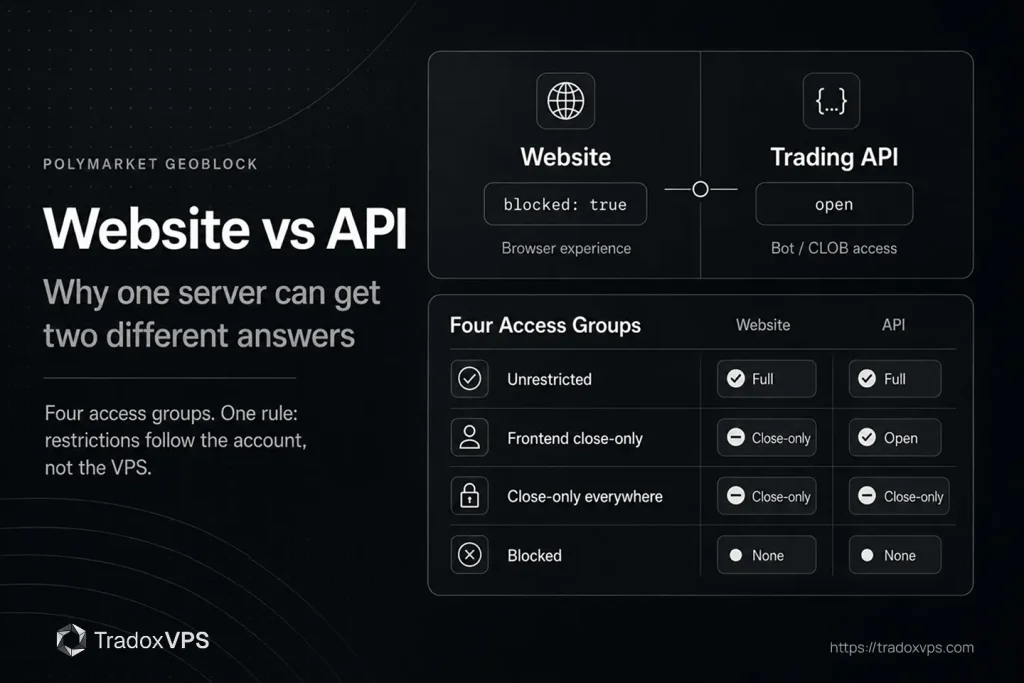
Every week traders ask us two versions of the same question. The first: “is Polymarket blocked in my country?” The second, usually with a screenshot attached: “my Dublin server says blocked: true, is my bot dead?” The two questions have different answers, because Polymarket’s geoblock is not one wall. It is a set of four access groups, applied separately to the website and to the trading API, and the check most people run answers only the website half.
This page explains the whole model as of July 29, 2026: what the geoblock endpoint actually reads, what each of the four groups can and cannot do, why a bot in Dublin or Amsterdam trades all day while the website check says blocked, and how to find your real status instead of guessing. One thing this page is not: legal advice, or a route around a restriction that applies to you. Group assignments are Polymarket’s response to regulatory requirements, they follow your jurisdiction and your account rather than your server’s IP address, and no infrastructure changes that. We say so three times below, on purpose.
The Polymarket geoblock: what it actually checks
The check everyone runs is one line:
curl https://polymarket.com/api/geoblock
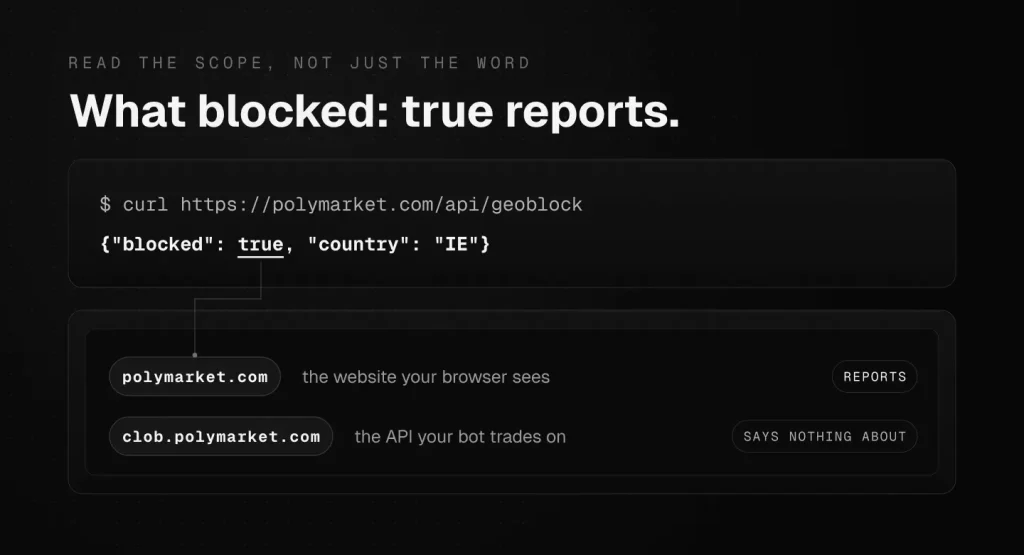
From an Irish or Dutch server it returns something like {"blocked": true, "country": "IE"}, and that answer is both accurate and widely misread. The endpoint lives on polymarket.com, the consumer website, and it reports whether the website will serve full trading to the IP that asked. That is all it reports. The CLOB, the order book API that bots trade against, is a separate system with its own access policy, and the geoblock endpoint says nothing about it.
So the check is useful for exactly one thing: predicting what you will see in a browser from that machine. It is not a bot health check, and treating it as one has cost people working setups. A different IP in the same country returns the same answer, because the answer is about the country, not the address.
All four Polymarket access groups at a glance
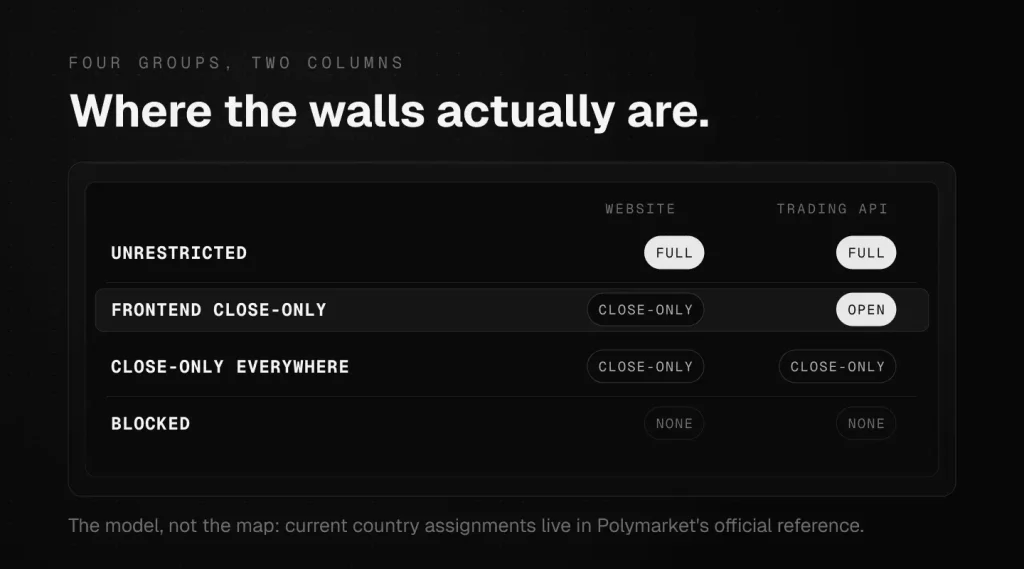
As of July 29, 2026, access falls into four groups. The examples below are the ones we can verify today; the authoritative current list is always Polymarket’s own geoblock reference, and groups have moved more than once this year, so check it before you rely on any table, including this one.
| Group | Website | Trading API | What you can actually do | Current examples |
|---|---|---|---|---|
| Unrestricted | Full | Full | Everything | Most countries |
| Frontend close-only | Close positions only | Open | Trade fully by API, exit-only in the browser | Ireland, Netherlands, Japan, Malta |
| Close-only everywhere | Close positions only | Close-only | Reduce and exit existing positions, nowhere to open new ones | US, UK, France, among others |
| Blocked | None | None | Nothing | OFAC-sanctioned jurisdictions such as Iran, North Korea, Syria |
Two rows deserve a closer look, because they are where the questions come from.
The frontend close-only group is the strange one, and it is where both of our Polymarket locations sit. From Ireland or the Netherlands, the website will only let you wind positions down, and the geoblock check duly reports blocked: true. The CLOB API, meanwhile, is open, which is why bots in Dublin and Amsterdam place and fill orders normally. Same country, two systems, two answers.
The close-only-everywhere group is the one that actually stops trading. Here the restriction reaches the API too: the exchange will let an affected account reduce and exit, and rejects attempts to open. To a bot this is not a mystery or a timeout, it is an explicit rejection string on the order itself, which our diagnosis guide covers alongside every other rejection the CLOB returns. Two dated notes for this group. In July 2026, France added a state-level layer on top of Polymarket’s assignment by directing internet providers to block the website itself; that changes nothing about the group model, it just means the wall in France now has two builders. And for US readers, there is a second story entirely: Polymarket also operates a separate, CFTC-regulated US product with its own access rules and its own API. That platform is out of this page’s scope, but “the US is close-only” describes the global platform only, not the regulated US one.
Is Polymarket blocked in Dublin or Amsterdam?
The question in our inbox all month, in both its forms: is Polymarket blocked in Ireland and the Netherlands, and is a Dublin or Amsterdam server safe to trade from? Here is the answer in full, dated. In July 2026 Ireland moved into the frontend close-only group, joining the Netherlands. So as of July 29, 2026: the polymarket.com website is close-only from both countries, and the CLOB API is open from both. A trading bot on a Dublin or Amsterdam server runs normally. The blocked: true your server shows you is the website check doing its job, reporting on a browser experience your bot never uses.
Neither city is “blocked” in the sense the question means, and neither is safer than the other on this axis: they sit in the same group and moved together in the same direction this year. Performance stays the story it was: the two cities trade blows on the paths that matter, and which one edges which depends on the path and the day. Those numbers, measured properly, live in our Dublin vs Amsterdam comparison, and the broader which-location question is the location guide‘s job, so we will not re-argue either here.
Why the Polymarket website and API split
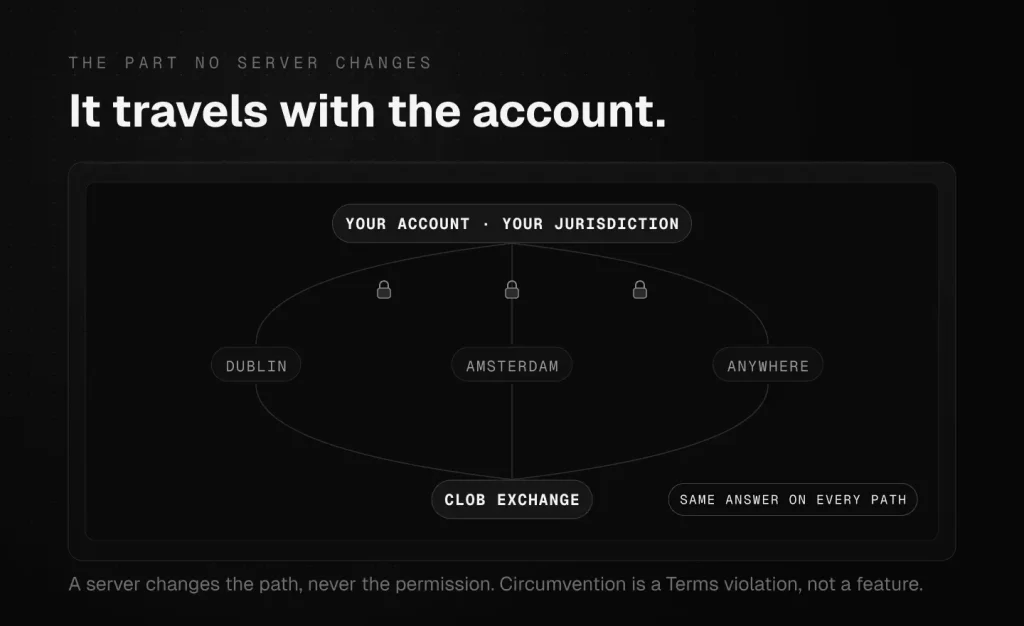
Not for a mysterious reason. The website is a consumer product serving a browser to a person at an IP address, which makes IP-level geoblocking the natural enforcement tool, and “close-only” the humane version of it: a restricted user can still exit what they hold rather than being locked away from their own positions. The API is trading infrastructure where the meaningful identity is the account and its jurisdiction, so that is where the restriction attaches when a regulator’s requirement reaches trading itself. The practical consequence is the asymmetry this whole page exists to explain: the website answer is about where your browser is, the API answer is about who you are.
Which leads to the sentence worth reading twice. Restrictions follow the person and the account, not the server. A server in Dublin does not make anyone Irish, and an account restricted in its own jurisdiction stays restricted through any IP on earth.
How to check your real Polymarket status
Three steps, in order, each answering a different question.
One: the geoblock endpoint, for the website answer only. Run the curl above from the machine in question. Whatever it says, remember its scope: the browser experience from that IP’s country, nothing more.
Two: the official reference, for your group. The geoblock reference is the current, authoritative statement of who sits where. It outranks this page, every third-party list, and every screenshot on X, most of which contradict each other because they were written in different months of a year with multiple changes.
Three: the definitive test, a real order. For a bot, the only answer that matters is the exchange’s. Place a minimal order from the box you trade on, with a current V2 client (the migration guide covers the setup if yours predates April). An accepted order is a yes. A closed-only rejection string is the API-level restriction telling you it applies to your account, and no infrastructure question remains, because it was never an infrastructure answer.
What a VPS changes, and what it never will
Here is our honest position, as the company selling the server. A VPS in the right city gives an eligible trader a shorter, steadier path to the exchange, a machine that is awake when markets move, and an environment built for a bot rather than a laptop. That is the entire product.
What it never does: change your group. Polymarket’s Terms prohibit circumventing geographic restrictions, and circumvention attempts carry real account consequences, up to close-only mode or losing the account. If your jurisdiction is restricted, a server in Dublin, Amsterdam, or anywhere else does not make you unrestricted, and we do not sell infrastructure as a route around the rules. If that is the question that brought you here, the honest answer is the short one: no.
For eligible traders, though, the group model is exactly why we run two Polymarket locations rather than one. Groups have moved more than once in 2026, the changes arrive with little notice, and nobody, including us, knows when the next update lands. Dublin and Amsterdam both sit in the group where the trading API is open, both are close to the exchange, and both are measured against each other in public. Two strong, API-open jurisdictions means an eligible trader is never one policy update away from having no good option, and that redundancy, not any workaround, is the point of offering both. Both come with the free 3-day demo, so the numbers can be checked before any money moves.
Frequently Asked Questions
Check two things, because there are two answers. The geoblock endpoint tells you what the website will do from your location, and Polymarket’s official geoblock reference tells you which of the four groups your country sits in, which is what determines API trading. Third-party country lists conflict with each other and go stale fast; the official reference is the one that counts.
Because the check reports the website, and the website is close-only from Ireland and the Netherlands as of July 2026. The CLOB API is open from both countries, so a bot on either box trades normally. The two systems give different answers by design.
No. Restrictions follow your jurisdiction and your account, not your server’s IP. Circumventing geographic restrictions violates Polymarket’s Terms, and detection carries account consequences up to close-only mode or account closure. We sell performance to eligible traders, not eligibility.
You can reduce and exit positions you already hold, and you cannot open new ones. In the frontend close-only group that limit applies to the website while the API stays open; in the stricter group it applies everywhere, and the API enforces it with an explicit rejection on the order.
No. The website check evaluates the country, so another IP in the same country returns the same answer, and the API-level restriction follows the account rather than the IP at all. Swapping addresses answers nothing.
The exchange tells you directly: an order attempt from a restricted account is rejected with a closed-only-mode error string rather than failing silently. A small test order with a current V2 client is the definitive check, and our diagnosis guide covers that string next to every other rejection.
For eligible traders, Dublin and Amsterdam, and the honest answer to “which of the two” is that they trade blows: both sit in the API-open group, both are close to the exchange, and the measured differences are small and path-dependent. The full numbers are in our Dublin vs Amsterdam comparison, and we run both locations precisely because group assignments move and redundancy beats prediction.
Group assignments, examples, and endpoint behavior on this page were verified on July 29, 2026 and change without much notice; Polymarket’s official geoblock reference and Terms are always the current authority. This page is general information about how Polymarket’s access system works, not legal advice, and nothing here is a method to access services from a jurisdiction where they are restricted.