
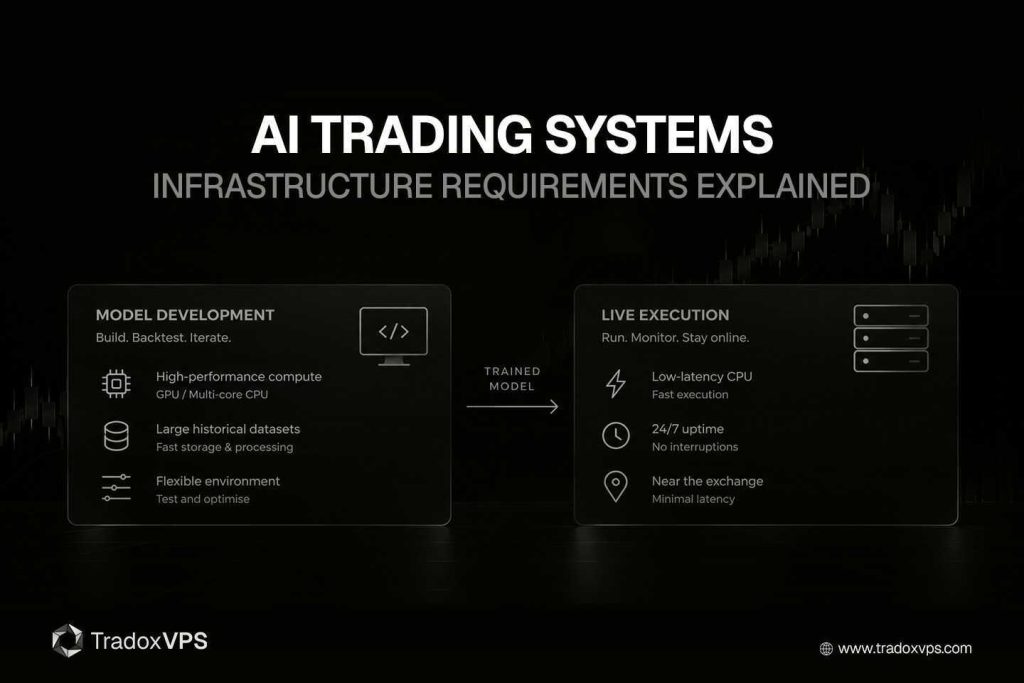
Most confusion about AI trading infrastructure comes from treating it as one thing. It is really two, with almost opposite requirements, and mixing them up leads to buying the wrong hardware, hosting in the wrong place, and spending money where it does not help. This guide separates them clearly, because once you see the split, every infrastructure decision gets simpler and cheaper.
The two jobs are training a model and deploying it to trade. Training is the compute-heavy, offline work of building a model from historical data. Deploying is running that finished model live, feeding it market data and turning its output into orders. Training wants raw parallel compute and does not care about latency. Deploying wants low, consistent latency and barely touches the kind of compute training needs. They run in different places, on different hardware, at different times. Nearly every mistake in AI trading infrastructure is really a failure to treat them separately, so that is where we start.
The split that changes everything: training vs deploying
Think of an AI trading system as a pipeline with a clear seam in the middle. On one side you build and refine the model. On the other you run it against the live market. The two sides have very different infrastructure needs:
| Training the model | Deploying and executing it | |
|---|---|---|
| What it does | Learns patterns from historical data | Makes live predictions and sends orders |
| Compute profile | Heavy, parallel, often GPU-accelerated | Light per prediction, mostly CPU |
| Latency sensitivity | None. It is offline batch work | High. Milliseconds affect fills |
| When it runs | Occasionally: retrain daily, weekly, or ad hoc | Continuously, 24/7, during market hours |
| Location that matters | Wherever the compute is cheap | Close, in network terms, to the exchange |
| Right home | Cloud GPU instance or a workstation | A low-latency VPS near the venue |
| Data it needs | Large historical datasets, in storage | A fast live market-data feed |
Read that table twice, because it dissolves the single biggest myth in this space: that “AI trading” requires a powerful GPU server sitting live in the market. It does not. The GPU-hungry part is training, which happens offline and can be done anywhere cheap. The part that actually trades is lightweight and latency-sensitive, and that is a completely different machine. Conflating the two is how people end up paying for expensive GPU cloud instances to run a model that would execute perfectly on a modest CPU near the exchange, while getting worse fills because that cloud instance sits far from the venue.
Why your deployed AI model probably does not need a GPU
This is the section that saves people the most money and corrects the most common error, so it is worth being precise.
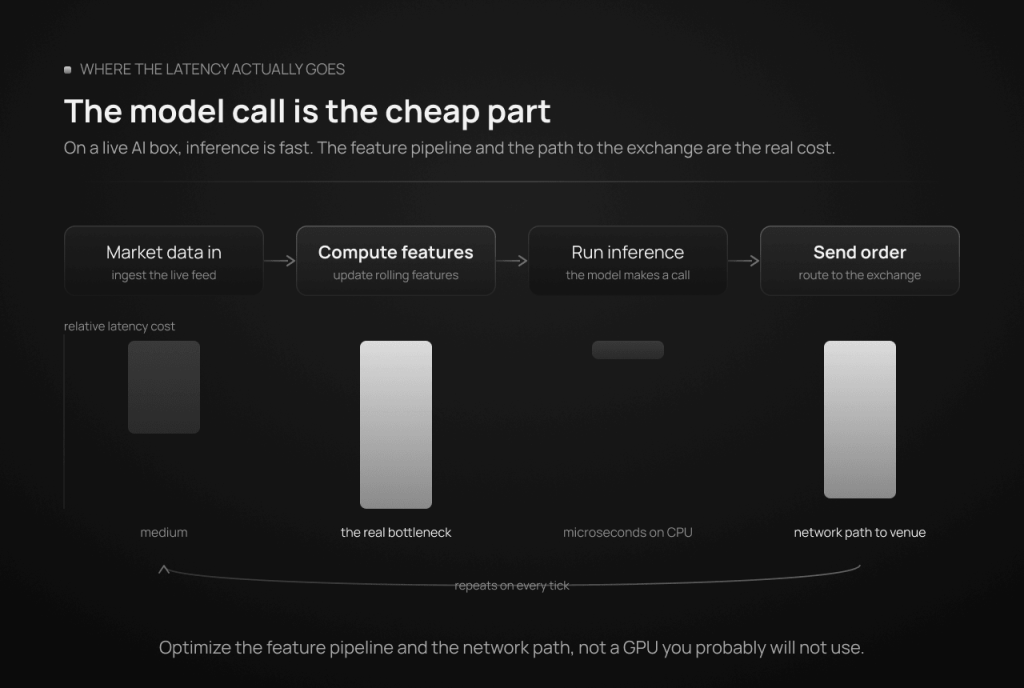
Training a model, especially a deep neural network, benefits enormously from a GPU, because training is thousands of parallel matrix operations repeated over a huge dataset. But inference, the act of a finished model making a single prediction on new data, is a tiny fraction of that work. For the model types most systematic and AI-driven trading actually uses in production, gradient-boosted trees (XGBoost, LightGBM), random forests, linear and logistic models, and modest neural networks, a single prediction takes microseconds to a few milliseconds on a modern CPU. No GPU required, and often no measurable benefit from one.
In fact, on a live trading box the model inference is usually not even the bottleneck. The real latency cost is elsewhere: ingesting the market-data stream, computing your features from it in real time, and getting the resulting order to the exchange. A well-built system spends far more time on the feature pipeline and the network path than on the model call itself. Optimizing for a GPU while ignoring feature-computation latency and distance to the exchange is optimizing the wrong thing.
When do you genuinely need a GPU in the live path? Only in specialized cases: running large deep-learning models (big transformers, large CNNs, or LLM-based systems) that must infer on the hot path at high throughput. That is a real but narrow use case, and it is honestly not what a standard trading VPS is built for, ours included. If your live strategy depends on heavy deep-learning inference every tick, you are in specialized-hardware territory, and you should know that going in. For the large majority of AI trading, the deployed model runs comfortably on a fast CPU, and the money and attention belong on execution, not on GPU compute you will not use.
What the execution layer actually needs
Here is the machine that does the trading, the one a VPS is for, and what actually makes it good. This is the deploy side of the seam, and it overlaps with general automated-trading tuning, which we cover in depth in our guide to optimizing a VPS for algorithmic trading. The AI-specific priorities:
Fast single-thread CPU for the hot path. The live loop, receive data, compute features, run inference, send order, is latency-sensitive and largely single-threaded. Per-core clock speed matters more than core count for this, which is why a high-clock chip like the Ryzen 9 9950X suits it (more on why single-core performance matters).
Low, consistent latency to the exchange or broker. Your model’s edge is worthless if the order arrives late. Host close, in network terms, to the venue, Chicago for CME futures, the matching metro for other markets, and judge the connection by its consistency (p95 and p99), not a single ping. Measure it yourself with our latency checker against your real endpoint.
A fast, low-jitter live data pipeline. This is the AI-specific bottleneck most guides ignore. Your model needs features computed from the live market feed in real time, and the latency and stability of that pipeline often matters more than the model itself. Ingesting ticks, updating rolling features, and handing them to the model on every update has to happen with low, predictable overhead. Design this path carefully; it is where deployed AI systems usually lose their milliseconds.
Dedicated RAM to hold the model and feature state. A loaded model plus its live feature state and any rolling windows need memory that is truly yours and does not get squeezed under load. This is the resource that actually is dedicated on a proper trading VPS.
Determinism and resilience. A deployed model is still a long-running process that must not die silently and must restart correctly. The same discipline as any trading bot applies with full force: auto-restart under a supervisor, and above all reconcile real positions on startup rather than assuming a clean slate. An AI model that restarts and re-enters a position it already holds is exactly as dangerous as any other bot doing so. The algorithmic trading optimization guide covers this resilience pattern in detail.
24/7 uptime near the venue, because markets and your model both run continuously, and the execution box has to be there when the model fires.
The data question: training data versus live features
Data confuses people in this space because, again, the two sides need completely different things.
Training needs volume: large historical datasets, cleaned and stored, often years of tick or bar data plus whatever alternative data your model uses. That is a storage and pipeline problem, and it lives wherever you train, typically cloud or a workstation with room for big datasets. It is not latency-sensitive; a training job reading from disk or object storage is fine.
Execution needs velocity, not volume: a fast, reliable live feed and the ability to compute your features from it in real time with minimal delay. The historical dataset is irrelevant to the running system except insofar as the model already learned from it. What the live box needs is the current data, now, with low jitter. Sizing your execution VPS as if it needs to hold your entire training corpus is a category error; it needs to hold the model and the live feature state, which is far smaller.
Keep the two data problems separate and each becomes tractable: big storage where you train, fast live feed where you deploy.
Security for AI trading systems
AI systems carry a specific asset worth protecting beyond the usual: the model itself. Your trained model is your edge, and in many cases your intellectual property, so it deserves the same care as an API key. The essentials for a deployed system: restrict inbound access and use key-based SSH only, run the process as a non-root user, protect the model and strategy files with tight permissions, and keep any exchange API keys withdrawal-disabled and IP-whitelisted to the VPS so a stolen key cannot drain the account.
That is the summary. Because a money-connected, IP-bearing machine deserves real depth, we wrote a full guide covering the threat model, remote-access hardening, API-key and credential protection, and an incident runbook: VPS security best practices for trading automation. Read it once your system touches real capital.
VPS vs cloud vs on-premise: the honest version
The old advice here usually collapses into “cloud is powerful, use cloud,” which ignores the split entirely. Mapped onto training versus deploying, the honest picture is clear:
Cloud (AWS, Azure, GCP) is for the training side. On-demand GPU instances, elastic scale for large models, and room for big datasets make cloud well-suited to training and research. It is a poor fit for execution: general cloud regions are not optimized for proximity to exchange matching engines, latency is variable, and running a always-on inference instance there is expensive and slow relative to a purpose-placed box. Use the cloud to build the model, not to trade it.
A VPS is for the execution side. A single-purpose, low-latency VPS near the exchange is the right and cost-effective place to deploy a trained model: consistent latency to the venue, 24/7 operation, dedicated RAM for the model and feature state, and a fast CPU for the inference-and-order hot path. This is where a provider like TradoxVPS fits, and it is precisely the layer the training-focused framing overlooks.
On-premise or colocation is for the microsecond tier. If your live AI strategy competes on the lowest possible latency (or truly needs heavy GPU inference on the hot path), dedicated hardware in the exchange’s facility is the tool. For most AI traders this is unnecessary.
The architecture that most successful AI traders actually run follows the seam exactly: train and backtest in the cloud or on a workstation with a GPU, then deploy the finished model to a low-latency VPS near the exchange to trade. Getting this division right is most of good AI trading infrastructure, and it is what the “you need a GPU server” framing gets wrong.
Common mistakes in AI trading infrastructure
- Treating training and execution as one machine. The single biggest error, and the source of most of the others.
- Paying for GPU compute to run a model that would infer fine on a CPU, while sitting far from the exchange and getting worse fills for the trouble.
- Ignoring the live feature pipeline, which is usually the real latency bottleneck, in favor of optimizing model inference that was never slow.
- Hosting execution on a general cloud region chosen for scale rather than proximity, then wondering why live latency is inconsistent.
- Forgetting that a deployed model is still a bot: no auto-restart, no state reconciliation, no monitoring, until it wakes up after a crash and doubles a position.
- Leaving the model and API keys unprotected on a reachable machine, forgetting the model is both your edge and an asset worth stealing.
Where TradoxVPS fits, honestly
TradoxVPS is built for the execution side of the seam, and it is worth being precise about that, because precision is what the original framing lacked. Our machines run the Ryzen 9 9950X with dedicated RAM and NVMe, which is exactly right for the deploy layer: high single-thread speed for the inference-and-order hot path, and exclusive memory to hold your model and live feature state. Our Chicago location sits near CME’s matching engines, so a deployed model trading futures is on a short, steady path to the venue, and you can verify that path to your own endpoint with the latency checker and benchmarks rather than trusting a number we printed.
Here is the honest boundary. We are CPU infrastructure, not GPU training rigs. If your workflow needs to train a model or run heavy deep-learning inference, that is a cloud-GPU or workstation job, and we would tell you to do it there and then deploy the trained model with us. RAM is dedicated; CPU is shared and dynamically allocated, so measure steal time under load and ask us our oversubscription ratio rather than take a figure on faith. We target 99.999% uptime with a live status page so you can check the real history, and Path.net handles DDoS at the edge. What we host is the place your AI trades, not the place it trains, and for the large majority of AI trading, the trading layer is a CPU-and-latency problem, which is exactly what we build for. See the infrastructure and Chicago VPS pages for the detail.
Final thoughts
AI trading infrastructure is not one system, it is two, and the whole discipline is treating them separately. Training is a compute problem: GPU, scale, big data, offline, best served by the cloud or a workstation. Execution is a latency problem: a fast CPU, dedicated memory, a low-jitter live data pipeline, and a short, consistent path to the exchange, best served by a purpose-placed VPS. The persistent myth that AI trading demands a GPU server sitting live in the market conflates the two and leads to overspending on compute while underinvesting in the execution layer that actually determines fills. Train where compute is cheap, deploy where latency is short, keep the deployed model resilient and secure like any other bot, and be honest about the rare cases that truly need specialized hardware. Get the split right, and the infrastructure decisions, and the costs, take care of themselves.
Frequently asked questions
For training a model, usually yes, especially deep learning, and that is best done on a cloud GPU instance or a workstation. For running a trained model live, usually no: inference for the model types most trading uses (gradient boosting, tree ensembles, small neural networks) takes microseconds to milliseconds on a modern CPU. Only heavy deep-learning inference on the hot path does need a GPU live, which is a specialized case.
Yes, and deployment is the ideal VPS use case. A low-latency VPS near the exchange is the right place to run a trained model live: it gives you consistent latency to the venue, 24/7 operation, dedicated RAM for the model, and a fast CPU for the execution hot path. Training the model is a separate job you would typically do in the cloud first.
Both, for different jobs. Use the cloud (with GPU instances) to train and backtest your model, then deploy the finished model on a VPS near the exchange to trade it. Cloud is built for scalable compute; a VPS is built for low-latency execution. Running live execution in a general cloud region usually means worse, less consistent latency to the venue.
For the execution layer, a fast single-thread CPU matters more than a high core count, and RAM should comfortably hold your loaded model plus live feature state, which is usually modest. For training, requirements are much higher (more RAM, GPU, storage for datasets), but that runs elsewhere. Do not size your execution box for the training workload.
It is as safe as you make the machine, and the model deserves protection because it is your edge and your intellectual property. Use key-based SSH, restrict access, run as a non-root user, protect the model files with tight permissions, and keep API keys withdrawal-disabled and IP-whitelisted. A dedicated guide covers the full security picture.
Two connected but distinct systems: a training environment (compute-heavy, GPU, big datasets, offline, typically cloud) and an execution environment (low-latency, mostly CPU, live data feed, 24/7, near the exchange, typically a VPS). Good infrastructure means building each for its own requirements and connecting them, training the model in one place and deploying it in the other.
Disclaimer: TradoxVPS provides infrastructure only and does not provide investment or trading advice. Trading involves substantial risk of loss. TradoxVPS provides CPU-based VPS hosting suited to deploying and executing trading systems; it does not provide GPU compute for model training. Actual latency, uptime, and execution depend on network conditions, broker and data-feed connectivity, exchange infrastructure, and user configuration.