

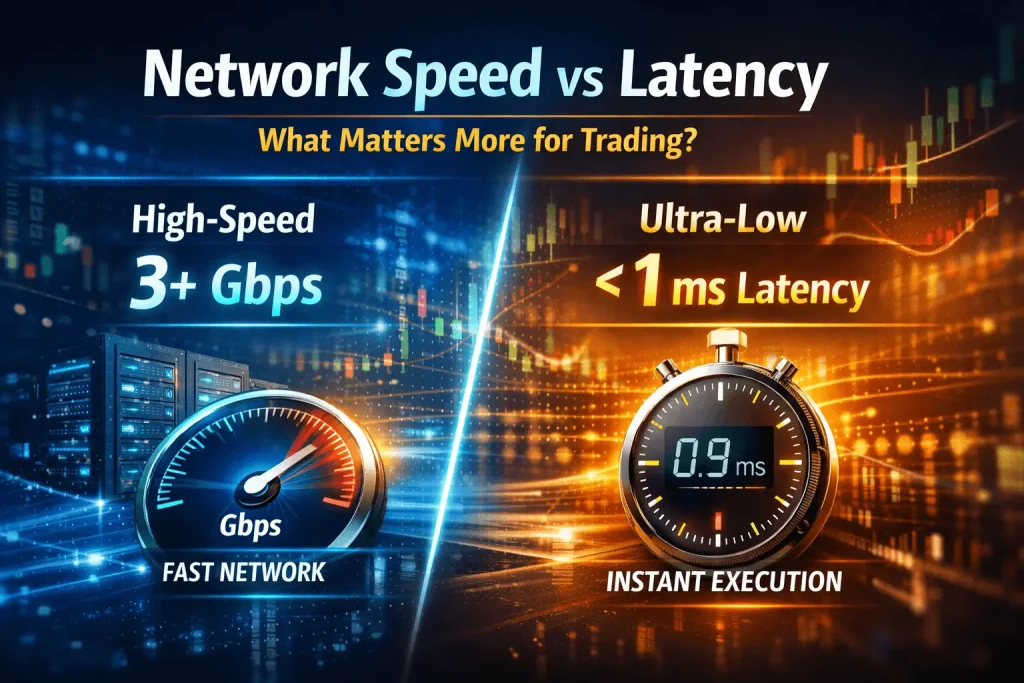
Trading performance depends heavily on network quality, yet many traders confuse network speed with latency. While both matter, they do not impact trading systems equally.
In this guide, we’ll break down trading VPS latency vs speed, explain how each affects trading execution, and clarify why a high-speed Gbps network combined with ultra-low latency delivers the best trading experience.
Understanding Network Speed in Trading
Network speed refers to how much data can be transmitted per second, typically measured in Mbps or Gbps.
As explained by Cloudflare’s bandwidth guide, bandwidth determines how much data can move at once — not how fast it responds.
Gbps vs Mbps: What’s the Real Difference?
While most traders only need a few Mbps, Gbps-level network capacity provides major advantages:
- More headroom during volatile market conditions
- Zero congestion even with multiple platforms running
- Consistent performance during news spikes
- Better stability for long-running trading bots
A 3+ Gbps network is not about using all that bandwidth — it’s about never competing for it.
How Much Network Speed Do Trading Platforms Use?
Popular platforms like MetaTrader 4, MetaTrader 5, NinjaTrader, and TradingView transmit very small data packets.
| Trading Activity | Bandwidth Usage |
|---|---|
| Manual trading | < 1 Mbps |
| Automated trading bots | 1–5 Mbps |
| Multiple platforms & feeds | 5–10 Mbps |
Key point: Even though trading does not consume high bandwidth, a Gbps-grade network ensures zero bottlenecks, especially during peak market hours.
What Is Network Latency?
Latency measures the time it takes for data to travel from your trading VPS to the broker’s server and back. It is measured in milliseconds (ms).
According to Cloudflare, latency reflects delay — not speed.
Latency directly affects:
- Order execution timing
- Slippage
- Fill quality
- Strategy accuracy
This is where professional trading VPS infrastructure makes the biggest difference.
Sub-1ms Latency: Why It Matters
Latency below 1 millisecond delivers near-instant communication with broker and exchange servers.
- < 1 ms → optimal execution
- 10 ms → acceptable for most strategies
- 50+ ms → high slippage risk
Sub-1ms latency is especially critical for:
- Scalping strategies
- High-frequency algorithmic trading
- News and volatility trading
Trading VPS Latency vs Speed: Which Matters More?
| Factor | Network Speed | Latency |
|---|---|---|
| Measured in | Mbps / Gbps | Milliseconds (ms) |
| Impact on execution | Low | Very High |
| Execution consistency | Medium | Critical |
| Scalping suitability | Low | Essential |
Why Gbps Network + Ultra-Low Latency Is the Ideal Combination
Many VPS providers offer either high speed or low latency — rarely both.
A 3+ Gbps trading network combined with <1 ms latency delivers:
- No bandwidth contention
- Stable execution during peak volatility
- Consistent order routing
- Enterprise-grade reliability
This infrastructure approach mirrors what professional trading firms use near exchanges like CME Group.
Does Higher Speed Reduce Latency?
Not directly.
As explained in Cloudflare’s throughput guide, bandwidth and latency are independent metrics.
However, a high-capacity Gbps network prevents congestion, which helps maintain consistently low latency under load.
Ideal Network Specs for a Professional Trading VPS
- Latency: < 1 ms
- Network speed: 3+ Gbps
- Enterprise routing & premium carriers
- Data center near broker or exchange
This combination ensures fast, stable, and predictable execution.
Final Verdict: Trading VPS Latency vs Speed
Latency determines execution quality. Speed ensures stability.
The best trading environment is not Mbps vs Gbps — it is:
- Sub-1ms latency
- High-capacity Gbps network
- Strategic server location
When speed and latency are optimized together, traders gain a real execution edge.
Key Takeaways
- Latency directly impacts order execution and slippage
- Gbps networks are superior to Mbps for stability
- Sub-1ms latency is ideal for serious traders
- Infrastructure quality affects profitability
Professional trading starts with professional infrastructure.