
Introduction
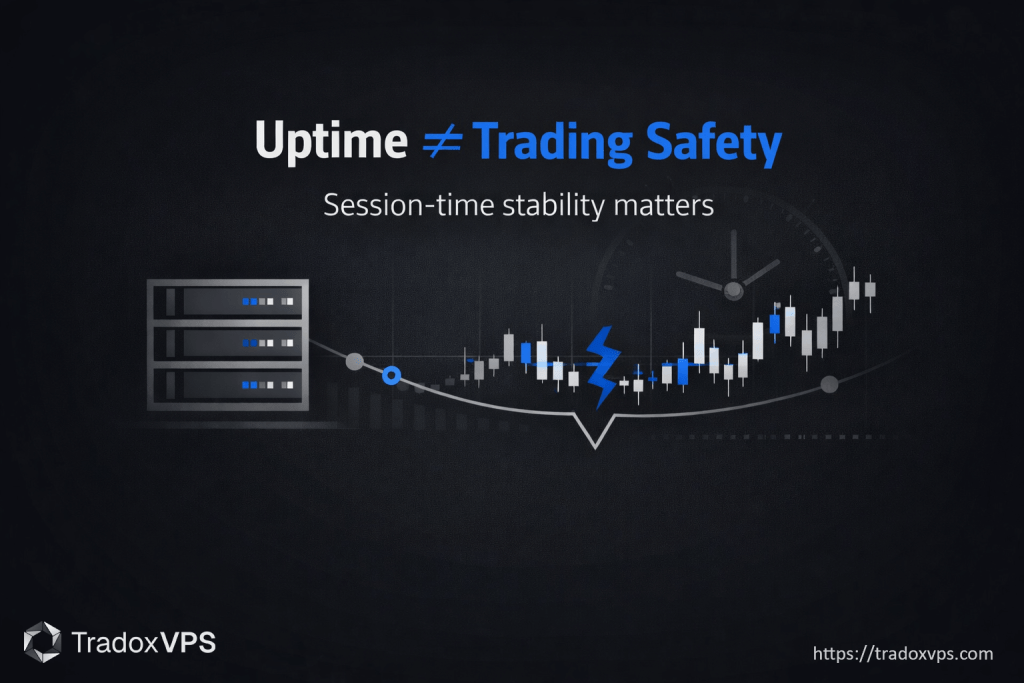
Many traders see “99.99% uptime” on a VPS provider’s website and assume their trading environment is safe.
In practice, uptime numbers alone say very little about actual trading risk, especially during:
- CME session opens
- High-impact economic releases
- Automated strategy execution windows
This article explains the real relationship between VPS uptime and trading session risk, based on how trading platforms, exchange connectivity, and data center infrastructure actually behave — not marketing definitions.
If you trade futures seriously, understanding this difference is essential.
1. What “Uptime” Actually Means in Hosting
The technical definition
In hosting, uptime typically means:
The VPS instance is powered on and reachable at the hypervisor level.
It does not guarantee:
- Network stability
- Platform connectivity
- Exchange session continuity
- Order routing availability
A VPS can be considered “up” while:
- Market data is frozen
- Order connections are flapping
- Your platform is repeatedly reconnecting
From a trader’s perspective, this distinction matters far more than the uptime percentage itself.
2. Why Trading Sessions Are the Real Risk Window
From real trading operations, most infrastructure failures occur during:
- CME Globex open
- US session open
- High-volume rollover periods
- Major economic announcements
These are the exact moments when:
- Network traffic spikes
- Order message rates increase
- Routing paths become congested
- Platform reconnect logic is stressed
A VPS that runs “fine” 23 hours a day can still fail during the only 30 minutes that matter.
3. Uptime Percentages vs Real Downtime Impact
Let’s put numbers into context.
What 99.9% uptime really allows
99.9% uptime permits:
- ~43 minutes of downtime per month
For a casual website, this is acceptable.
For a futures trader, 43 minutes during market open can be catastrophic.
Even:
- 30 seconds of disconnection
- 1–2 minutes of routing instability
can result in:
- Missed exits
- Unmanaged risk
- Strategy desynchronization
- Forced liquidation scenarios
Uptime percentages ignore when downtime occurs — traders cannot.
4. Platform Connectivity vs VPS Availability
Trading platforms rely on multiple simultaneous connections, including:
- Market data feeds
- Order gateways
- Broker authentication services
A VPS may remain reachable via:
- Remote Desktop
- SSH
while trading connections fail independently.
This is why traders sometimes report:
“My VPS was up, but my platform disconnected.”
This is not a contradiction — it’s an architectural reality.
5. The Hidden Risk of “Soft Downtime”
Most dangerous trading failures are not total outages.
They are:
- Micro-disconnects
- Packet loss bursts
- Route flapping
- Latency spikes
These events:
- Rarely show up in uptime reports
- Often resolve automatically
- Still cause execution problems
From experience, soft downtime causes more trading damage than full outages, because traders may not immediately notice it.
6. Why Automated Trading Amplifies Uptime Risk
For automated futures strategies:
- There is no human oversight
- Reaction time is zero
- Errors compound quickly
During instability, bots may:
- Miss protective stops
- Re-enter unexpectedly
- Fail to close positions
- Operate on stale data
This is why uptime alone is meaningless for automation — session continuity and network stability are what matter.
7. How Data Center Design Affects Trading Session Reliability
Professional trading-focused VPS environments differ from generic hosting in key ways:
- Redundant power feeds
- Redundant network paths
- Enterprise-grade routers
- Controlled oversubscription ratios
- CME-proximal routing optimization
These factors reduce:
- Session-time failures
- Peak-hour instability
- Cascading network issues
General cloud environments optimize for scale.
Trading environments must optimize for consistency during stress.
8. Why “High Availability” Marketing Often Misses the Point
Many providers advertise:
- High availability
- Redundancy
- Cloud resilience
But high availability systems are often designed for:
- Web apps
- Microservices
- Stateless workloads
Trading platforms are:
- Stateful
- Latency-sensitive
- Continuously connected
Failover events that are “invisible” to websites can still break trading sessions.
9. How Professional Traders Evaluate VPS Risk
Experienced traders don’t ask:
“What is your uptime?”
They ask:
- How stable is the network during CME open?
- How often do routing paths change?
- What happens during partial failures?
- Is performance consistent under load?
These questions reflect real trading risk, not abstract hosting metrics.
10. How TradoxVPS Approaches Uptime and Session Risk
Rather than focusing solely on uptime percentages, TradoxVPS emphasizes:
- Session-time stability
- CME-proximal infrastructure
- Predictable routing paths
- Minimal network jitter during peak hours
This approach comes from understanding how futures traders actually use VPS environments, not generic hosting assumptions.
11. Practical Risk-Reduction Checklist for Traders
To reduce uptime-related trading risk:
- Use VPS environments designed for trading, not general workloads
- Avoid over-optimized but unstable setups
- Monitor performance during market opens
- Test platform reconnect behavior before live trading
- Design automation with failure handling in mind
Infrastructure should reduce risk — not introduce hidden variables.
12. Common Misconceptions About VPS Uptime
“My VPS never went down, so I’m safe.”
Most trading failures happen without full downtime.
“Cloud providers are always reliable.”
Scale does not equal trading stability.
“Uptime guarantees protect my trades.”
Uptime guarantees protect SLAs — not positions.
Final Thoughts
For futures traders, uptime is a baseline requirement, not a safety guarantee.
True trading reliability depends on:
- Session-time stability
- Network consistency
- Infrastructure designed for stress, not averages
Understanding this distinction is what separates casual VPS users from traders who treat infrastructure as part of their risk management system.
To understand how professional futures traders minimize session-time risk, explore how CME-proximal Trading VPS infrastructure is built for consistency under peak market stress.