
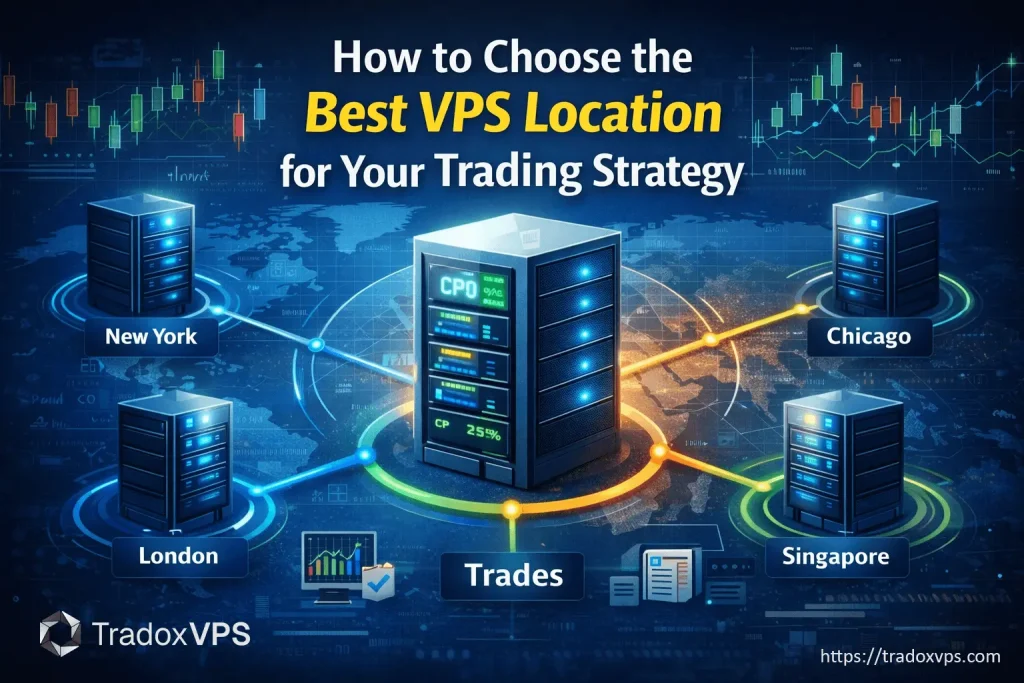
Why location is a strategy decision, not a branding decision
Many traders pick a VPS location the way they pick a vacation destination: New York sounds important, London sounds professional, Tokyo sounds fast. But the best vps location for trading is the one that matches your market, your broker/data path, and your workflow.
Location improves one thing: the network segment between your platform and the services you connect to. It doesn’t bypass broker risk checks or exchange queue position. So if you choose the wrong region, you pay for a “premium city” without improving your execution consistency.
Step 1: Identify your primary market and its hub
- U.S. equities/options often align with New York metro (New Jersey connectivity)
- CME futures often align with Aurora/Chicago connectivity
- European forex/CFD workflows often align with London/UK/EU connectivity
- Asia session strategies may align with Tokyo/Singapore/Hong Kong (depending on venue and broker routes)
- Crypto depends on exchange endpoints and your own infrastructure design (often multi-region matters)
Write down your top 2-3 venues and services (broker API, data feed, copy-trading server, risk system). This is the target list you will measure against.
Step 2: Separate three delays
To pick the best vps location for trading, you need to know what you are actually trying to improve:
- Latency: baseline time for a message to travel (lower is generally better)
- Jitter: variability of that time (low jitter often matters more than the lowest ping)
- Platform lag: local compute delay (CPU/RAM/disk). A fast location is useless if your platform freezes
Step 3: Choose a “near enough” level
You do not need perfect colocation to benefit. Most independent traders should aim for “near enough” — a regional VPS close to the market hub.
- Level A: Colocation (ultra-low latency, expensive/complex)
- Level B: Regional VPS near the hub (best balance for most traders)
- Level C: Same country but far (mostly reliability, limited latency gains)
- Level D: Overseas (usually only for low frequency or research/monitoring)
For most people, Level B is the best vps location for trading approach because it delivers measurable improvement without enterprise ops.
Step 4: Match location to strategy type
- Scalping and frequent order modification: prioritize proximity and stability (low jitter)
- Automation that reacts to real-time signals: needs both location and strong CPU (single-core performance)
- Swing trading: location matters less, uptime and convenience matter more
- Copy trading multi-account setups: need RAM headroom and stable RDP more than the last millisecond of ping
The best vps location for trading is different for a scalper than for a swing trader. Be honest about your workflow.
Step 5: Run a measurement-based trial
Don’t guess. Measure. Your goal is to validate your real endpoints and real workload:
- Measure RTT/jitter/packet loss to broker and data endpoints at active windows (open, news, close)
- Run your full workspace and monitor CPU/RAM headroom while markets move
- Test cancel/replace loops if you manage brackets dynamically
- Leave the system overnight to confirm stability and no surprise reboots
A short trial is the fastest way to find the best vps location for trading for your specific setup. You can’t copy someone else’s result because broker routes and data feeds differ.
Strong recommendation: start with TradoxVPS.com
If you want to avoid the common trap of buying a “nearby” VPS that is slow under load, start with a performance-first platform like TradoxVPS.com. TradoxVPS is designed for trading workloads with modern components (Ryzen 9 9950X Zen 5, DDR5 RAM, NVMe storage, and Windows Server 2022).
Even if you later decide to run multi-region (for example NY for equities, Chicago for CME), starting with a reliable, responsive baseline gives you clean measurements and fewer variables.
Final takeaway
The best vps location for trading is the one that matches your market hub and provides stable routes to your broker/data endpoints while also delivering enough CPU/RAM/disk performance to keep your platform responsive. Choose location based on markets. Choose provider based on measurable stability and modern compute. Then validate with a trial.
Disclaimer: TradoxVPS provides infrastructure only and does not provide investment advice. Trading involves risk.