

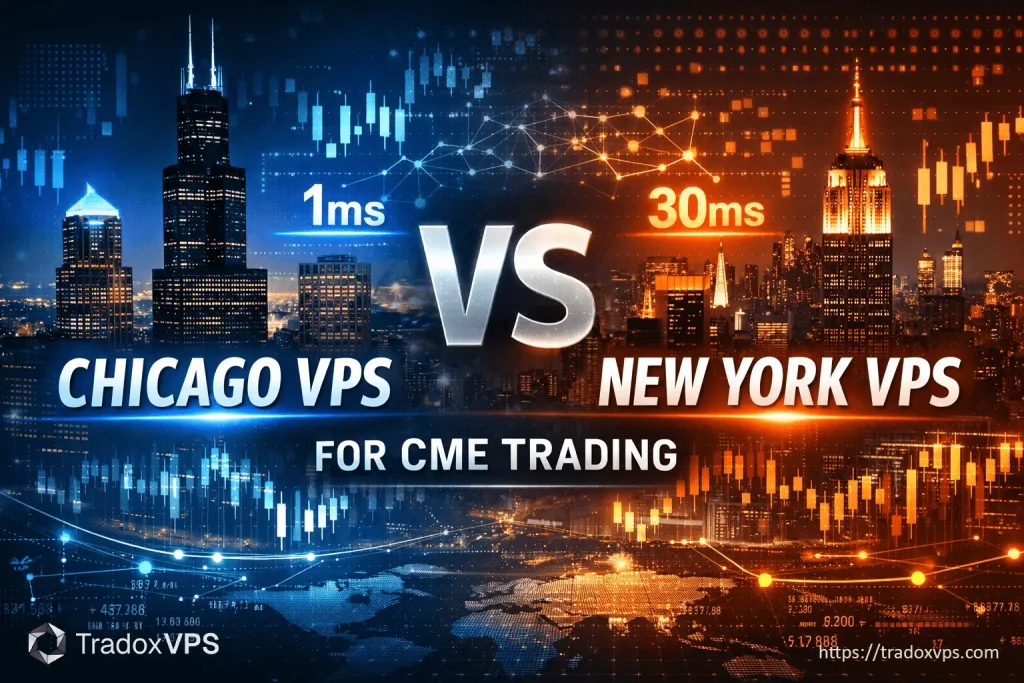
Introduction: Why VPS Location Matters for CME Trading
In professional futures trading, especially within low-latency trading, algorithmic execution, and high-frequency trading (HFT), milliseconds are not just technical metrics—they directly impact profitability, slippage, and fill quality.
When traders compare Chicago VPS vs New York VPS for CME trading, the debate is fundamentally about physical distance, network routing, and exchange proximity. Unlike equities or options markets that are heavily concentrated in New York and New Jersey, CME Group infrastructure is primarily located in the Chicago metropolitan area.
This article provides a complete, technical, and practical comparison between Chicago VPS and New York VPS environments for CME trading. Whether you trade manually, run automated strategies, or deploy latency-sensitive algorithms, this guide will help you select the optimal VPS location.
Understanding CME Infrastructure and Data Centers
To understand the importance of VPS location, we must first understand how CME operates. CME Group hosts its primary electronic trading platform, Globex, inside the Aurora, Illinois data center, located just outside Chicago.
This facility is one of the most important financial data centers in the world, hosting:
- CME Globex matching engines
- Market data dissemination systems
- Co-location and proximity hosting services
- Direct market access (DMA) infrastructure
Every CME order—whether it originates from a retail trader or an institutional desk—ultimately travels to this Aurora data center. This physical reality makes Chicago the center of gravity for CME futures trading.
For official reference, you can review CME Group’s infrastructure documentation on their website: CME Group Technology Overview .
What Is a Trading VPS and Why Professionals Use It
A Trading VPS (Virtual Private Server) is a remote server optimized for 24/7 uptime, low-latency connectivity, and stable execution environments. Professional traders rely on VPS solutions to:
- Run trading platforms continuously without interruption
- Reduce latency between trading software and exchanges
- Eliminate risks caused by local internet outages or power failures
- Deploy automated strategies and expert advisors (EAs)
For CME traders using platforms such as NinjaTrader, MultiCharts, Sierra Chart, or TradeStation, VPS location directly affects:
- Order transmission time
- Market data delivery speed
- Strategy reaction time
- Slippage during volatile conditions
Chicago VPS for CME Trading: Detailed Analysis
Latency Advantages
A Chicago-based VPS offers the lowest possible network latency to CME Globex. In many cases, round-trip latency from a Chicago VPS to the CME matching engine can be:
- 0.3 ms – 1 ms for proximity hosting
- 1 ms – 3 ms for high-quality Chicago data centers
This ultra-low latency is essential for:
- Scalping strategies
- Order book–sensitive algorithms
- News-driven execution
- High-frequency trading systems
Execution Quality and Slippage
Shorter physical distance means fewer network hops, lower jitter, and more consistent execution. Chicago VPS users typically experience:
- Faster order acknowledgments
- More accurate fills during fast markets
- Reduced negative slippage
For traders executing dozens or hundreds of trades per day, even microsecond improvements can compound into measurable performance gains.
Best Use Cases for Chicago VPS
- CME futures scalping (ES, NQ, CL, GC)
- Automated trading systems
- Latency arbitrage strategies
- Professional prop trading
New York VPS for CME Trading: Detailed Analysis
Physical Distance and Latency
New York VPS environments are typically located in New York City or Northern New Jersey data centers. The physical distance from New York to CME’s Aurora data center is approximately 1,200 km.
This results in higher latency, commonly ranging between:
- 15 ms – 25 ms one-way latency
- 30 ms – 50 ms round-trip latency
While this may be acceptable for discretionary trading, it introduces limitations for latency-sensitive strategies.
When New York VPS Makes Sense
Despite higher latency, New York VPS solutions still have valid use cases:
- Multi-asset traders combining CME futures with equities or options
- Traders prioritizing NYSE or NASDAQ execution
- Portfolio strategies not dependent on millisecond timing
New York remains the epicenter for equities markets, with infrastructure close to:
- NYSE
- NASDAQ
- Options exchanges
For reference, NASDAQ infrastructure details can be found here: NASDAQ Technology Solutions .
Chicago VPS vs New York VPS Trading: Side-by-Side Comparison
| Factor | Chicago VPS | New York VPS |
|---|---|---|
| Distance to CME | Very close (Aurora, IL) | Far (NY/NJ) |
| Latency to CME | 1–3 ms | 30–50 ms |
| Execution Speed | Ultra-fast | Moderate |
| Best For | HFT, scalping, automation | Swing, multi-asset trading |
| Slippage Risk | Minimal | Higher during volatility |
Impact on Popular CME Trading Platforms
NinjaTrader
NinjaTrader benefits significantly from Chicago VPS hosting due to faster order routing and market data delivery. For automated NinjaScript strategies, latency reduction directly improves performance.
Sierra Chart
Sierra Chart users running advanced order types and custom studies gain measurable advantages from Chicago-based servers, especially during high-volume sessions.
MultiCharts and TradeStation
Algorithmic traders using EasyLanguage or PowerLanguage experience faster strategy reactions when hosted near CME infrastructure.
Network Quality, Routing, and Jitter
Latency is not just about distance. Network quality, routing efficiency, and jitter also play major roles. A professionally managed Chicago VPS typically includes:
- Direct fiber routes to CME data centers
- Low-jitter network paths
- Redundant connectivity
New York VPS providers may optimize routes toward equity exchanges rather than CME, resulting in suboptimal paths for futures trading.
Cost Considerations: Chicago vs New York VPS
Chicago VPS solutions optimized for trading may appear more expensive initially, but cost should be evaluated against execution quality and performance.
For active traders, improved fills and reduced slippage can easily offset higher VPS costs over time.
New York VPS plans may be cheaper, but the hidden cost often appears in:
- Missed fills
- Worse entry prices
- Reduced strategy edge
Security, Uptime, and Reliability
Professional trading VPS environments emphasize:
- 99.99%+ uptime guarantees
- DDoS protection
- Redundant power and cooling
- Enterprise-grade hardware
These factors are critical regardless of location, but Chicago trading VPS providers often specialize specifically in futures traders.
FAQs: Chicago VPS vs New York VPS Trading
Is Chicago VPS always better for CME trading?
Yes, for latency-sensitive CME trading strategies, Chicago VPS is objectively superior due to proximity to CME’s matching engines.
Can I trade CME from a New York VPS?
Yes, but expect higher latency. This may be acceptable for swing trading or low-frequency strategies.
Does latency really matter for retail traders?
Latency matters most for active traders, scalpers, and automated systems. Long-term traders may not notice immediate differences.
What latency is considered “low” for CME trading?
Anything under 5 ms is considered low-latency. Professional Chicago VPS solutions often operate under 3 ms.
Should I choose VPS location based on broker location?
Broker location matters less than exchange location. Orders always end up at CME’s Aurora data center.
Final Verdict: Chicago vs New York VPS for CME Trading
When evaluating Chicago vs New York VPS trading, the conclusion is clear:
Chicago VPS is the optimal choice for CME traders who prioritize speed, execution quality, and competitive performance. Its proximity to CME infrastructure delivers measurable advantages that cannot be replicated from New York.
New York VPS solutions still serve a purpose for traders focused on equities or diversified portfolios, but for serious CME futures trading, Chicago remains unmatched.
In modern electronic markets, distance is strategy. Choosing the right VPS location is not just an infrastructure decision—it is a trading edge.