
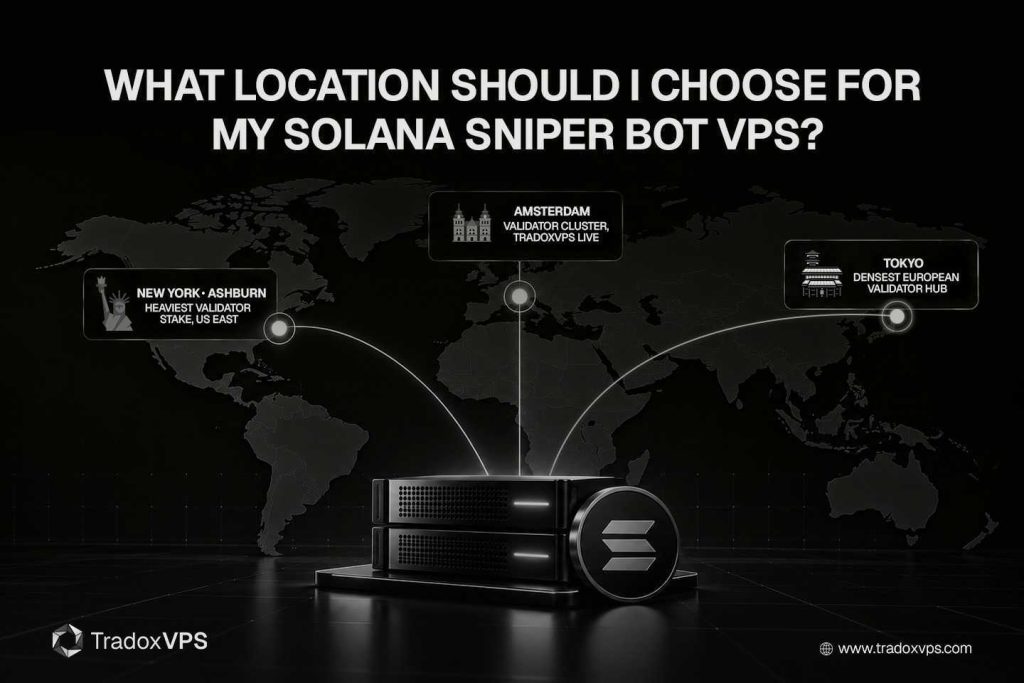
Short answer: for a Solana sniper bot, “location” is not really about being near “Solana,” and it is not only about low RPC jitter. Competitive sniping is a race to land your buy in the first block of a brand-new token, before 200-plus other bots do, and that race is decided by three things: how early you detect the launch, how fast your machine builds and signs the transaction, and how quickly it reaches the validator that is producing the block right now. Location matters because two of those three depend on where you sit relative to the current block leader, the Jito block engine, and your detection feed.
This guide covers what a sniper bot actually does under the hood in 2026, where Solana’s validators and stake concentrate, and how to choose a region, with an honest account of what a VPS can and cannot win. That honesty matters here more than in almost any other trading niche, because the gap between the marketing (“sub-50ms, always first in line”) and the reality is wide, and knowing the difference will save you money.
(For the related but different case of exploiting price gaps across existing pools, see our companion guide on Solana arbitrage bot hosting. Sniping and arbitrage share infrastructure but weight it differently.)
What a Solana sniper bot actually does in 2026
A sniper bot watches the chain for the exact moment a token becomes tradeable and fires a buy into the same block, aiming to enter before the price runs. In practice that is four steps, and all four have to finish in tens of milliseconds:
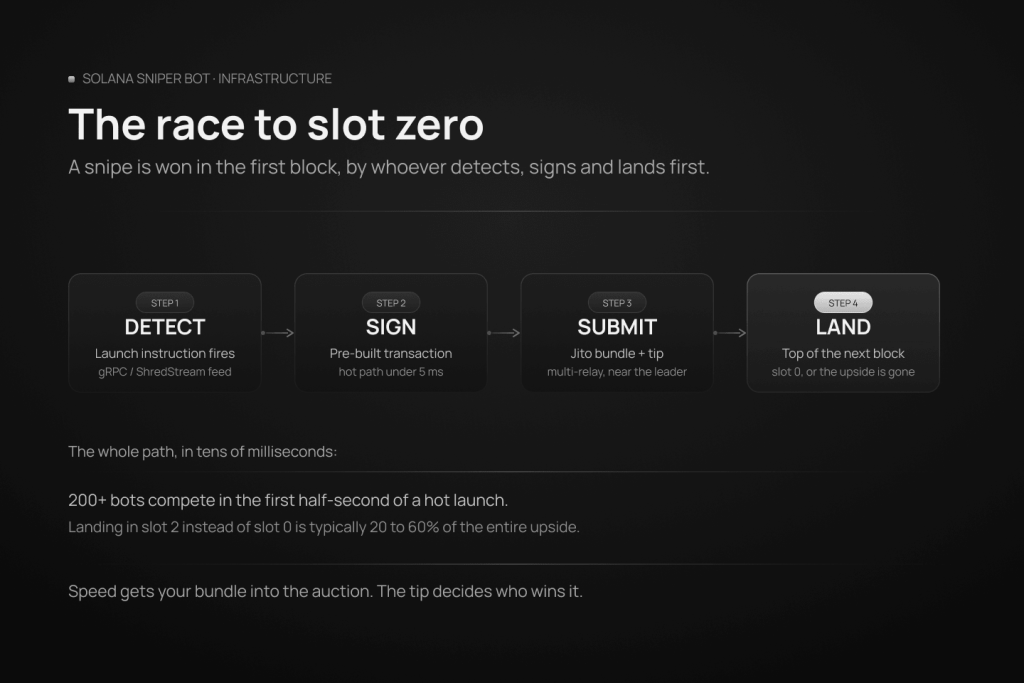
- Detect the launch. Bots do not wait for a Telegram post or a website. They watch validator transaction streams for the specific on-chain instruction that makes a token tradeable: on Pump.fun that is the
createorcreate_v2instruction, and on AMMs like Raydium or Orca it isInitializePoolorAddLiquidity. They decode the instruction with the program’s IDL and extract the mint in real time. There is effectively zero delay between a token becoming tradeable and a well-built bot knowing about it. - Build and sign the transaction. The fastest bots do not build the transaction at runtime. They pre-sign templates with address lookup tables and pre-loaded keypairs so the buy is ready before the launch fires. The target for this local “hot path” is under 5 milliseconds.
- Submit for inclusion. The transaction goes through the Jito block engine as a bundle (often in parallel across Jito plus alternate relays), with a tip, aiming to land at the top of the very next block.
- Manage the position. Take-profit, stop-loss, and rug detection after the buy lands.
Here is the number that frames everything: an amateur pipeline (detect over WebSocket, build on a public RPC, send with a generic call) runs roughly 430 to 680 milliseconds end to end. A production pipeline (gRPC detection, pre-signed template, multi-relay Jito bundle) runs around 50 milliseconds. On a hot launch that difference is not “slightly worse fills.” Landing in slot 2 instead of slot 0 is frequently 20 to 60 percent of the entire upside, and sometimes all of it.
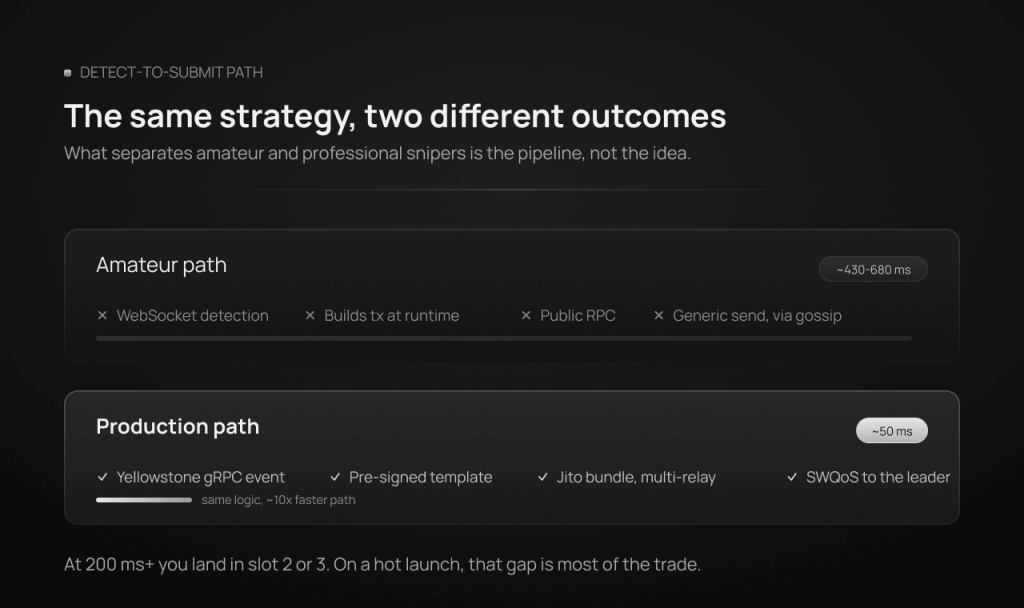
So the old advice, “your bot just talks to an RPC, pick the region with the lowest jitter to it,” is only a small corner of the real picture. Jitter to a public RPC matters for a hobby setup. Competitive sniping is about the whole path from launch instruction to included transaction.
Where Solana’s stake actually concentrates
Because slot-0 landing means reaching whoever is producing the current block, being near the validators that produce most blocks is a real advantage. The leader rotates every four slots (about every 1.6 seconds), so no single spot is perfect, but sitting inside a major cluster puts you near the leader far more often than sitting outside one.
The current picture (mid-2026): by stake weight, the heaviest concentration of high-stake validators sits on the US East Coast, in Ashburn, Virginia and the New York metro, followed by Frankfurt and Amsterdam in Europe, with growing clusters in Tokyo and Seoul. By raw validator count Europe leads, and Frankfurt has been the densest single city for years. This is not a guess about where to host; independent infrastructure guides name Frankfurt plus Ashburn as the baseline locations for competitive Pump.fun sniping specifically.
| Region | Role in the Solana network | Relevance to sniping |
|---|---|---|
| Ashburn, VA (US East) | Highest concentration of high-stake validators | Cited as a baseline colocation site for competitive sniping |
| New York (US East) | Second major high-stake US cluster | Common Jito block engine endpoint; strong US base |
| Frankfurt | Densest European validator hub, major stake cluster | The other baseline colocation site for serious sniping |
| Amsterdam | Major European cluster, AMS-IX peering | Strong, well-peered European metro; a live VPS base |
| Tokyo / Seoul | Growing Asian clusters | Relevant for Asia-based operations |
Treat this as “where the gravity is today.” The network deliberately works to reduce concentration, so verify current data before you commit hardware.
Detection and submission: the parts that actually decide it
Two pieces of the pipeline matter more than raw distance, and both have a location component.
Detection feed. For anything execution-critical, competitive bots do not use WebSocket subscriptions or a polled public RPC. They use a Yellowstone gRPC stream subscribed to the specific accounts and program events that signal a launch, with server-side filters, and many add Jito ShredStream, which delivers raw block shreds from the leader 50 to 200 milliseconds before normal propagation. If you are polling a public RPC every few seconds, you are not sniping. Your VPS should sit close to where that feed terminates.
Submission path. Around 92 percent of Solana validators by stake weight run the Jito client, so a Jito bundle is the standard way to land a snipe at the top of a block with MEV protection (rather than exposing your buy in the public path where it can be front-run). Serious operations submit in parallel across Jito and alternates and use anti-front-running bundle accounts. You submit to the regional Jito endpoint nearest the current leader, which is another reason metro placement matters.
Tips: why you cannot simply out-run the competition
This is the honest point that “fastest VPS” pages skip. Landing a snipe is not purely a speed race, it is a speed-and-tip auction. The Jito block engine includes the highest-tipping bundles at the top of the block, so if a competing bot detects the same launch and bids a higher tip, being a few milliseconds faster will not put you ahead. On Pump.fun specifically the tip floor is not stable; it moves with how fast the bonding curve is filling, so hardcoded tips fail on viral launches and the competitive bots calibrate tips dynamically against live block telemetry.
The practical meaning: location and a fast pipeline get your bundle into the auction in time to compete. They do not let you win an auction against someone bidding more. Realistically you aim to be consistently in the race, then compete on tip strategy, token selection, and risk management.
The honest tier truth: what a VPS can and cannot win
This is where trustworthy advice separates hard from marketing, and for sniping the gap is bigger than anywhere else.
The documented floor for consistently landing slot 0 on contested Pump.fun launches looks like this: dedicated bare-metal, co-located in the same facilities as high-stake validators (Frankfurt and Ashburn are the named baseline), running your own RPC node, a Yellowstone gRPC subscription plus Jito ShredStream, pre-signed templates with a sub-5-millisecond hot path, and multi-relay bundle submission with dynamic tips. On a major launch, 200-plus bots are competing in the first half second, and a large share of them are running exactly that stack.
A shared VPS, however good, is not that stack. So the honest version of “which VPS location wins Solana snipes” is: on the most contested viral launches, a VPS is not the winning tier at all. That is bare-metal colocation territory, and any page telling you a $39 VPS will make you “first in line” on Pump.fun is selling you something that will not survive contact with the trenches.
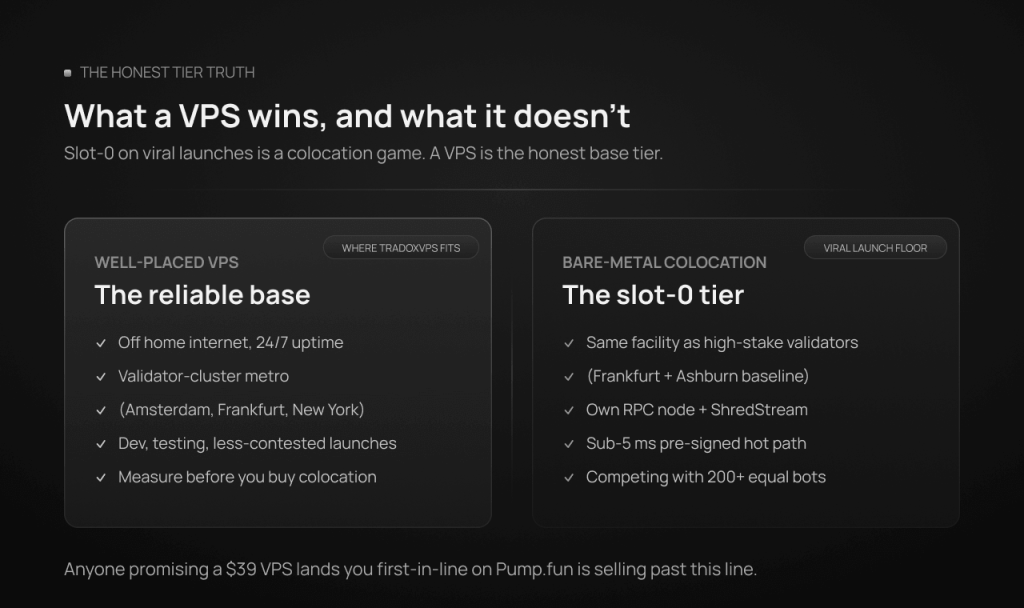
What a well-placed VPS is genuinely good for:
- Getting off your home connection. A VPS removes the single biggest and cheapest source of losing: a home internet drop, a Windows update, or a sleeping laptop killing your bot mid-launch. That alone is worth doing.
- Sitting in the right metro on a fast feed. A VPS in Amsterdam or Frankfurt, reading a gRPC feed and submitting through Jito, is a large upgrade over a random cheap cloud box in the wrong region.
- Developing, testing, and running less hyper-contested strategies. Not every strategy is a slot-0 knife fight on a viral launch. Longer-tail launches, copy-trade snipes, migration plays with wider windows, and simply learning the pipeline are all reasonable on a VPS.
- A base while you decide whether the edge justifies colocation. Start here, measure your real detection-to-land latency, and only move to bare-metal if your results say the top tier is worth the cost.
Being straight about this protects you. Competitive memecoin sniping is close to the hardest, most adversarial game on Solana, and most participants lose money to faster bots, rugs, and honeypots. A VPS is a sensible, honest starting point and a reliable home for many strategies. It is not a shortcut to beating co-located professionals on the launches everyone is fighting over.
A serious word on risk
Sniping new Solana tokens is extremely high risk, and the honest guide says so plainly. On the majority of unprotected launches the pattern is a fast pump then a dump, and the token reads as a rug. Only about 1 in 100 Pump.fun tokens ever graduates to PumpSwap, so the upside concentrates on a small minority of launches while the rest bleed. Honeypots and contracts that block selling are common, and even good anti-rug tooling only fronts a rug transaction perhaps 80 to 85 percent of the time. Infrastructure decides whether you are in the race; it does nothing to change whether a given token is a scam. Size accordingly, and never deploy capital you cannot lose.
Compute: what the box itself needs
Location gets your packets to the right place. The machine still has to detect, decide, and sign without stalling, and for sniping that local hot path is measured in single-digit milliseconds.
- Fast single-thread CPU. Decoding the launch instruction, evaluating filters, and signing a pre-built transaction are latency-critical and largely single-threaded. A high-clock, desktop-class chip such as the Ryzen 9 9950X (Zen 5, boosting to 5.7 GHz, with AVX-512 and SHA acceleration that help signing) suits this well. (Running your own validator or full RPC node is a separate, heavier spec, that is a colocation decision.)
- Enough dedicated RAM for an in-memory or Redis state cache so reaction logic never waits on disk.
- NVMe storage so logging never stalls the hot path during a burst of launches.
- Burst network headroom for firing bundles across multiple relays at once.
- Linux, not Windows. Most Solana sniper stacks (Rust, or TypeScript with a Rust backend) run on Linux. You will want Ubuntu 24.04, which TradoxVPS offers, rather than the Windows Server the old version of this page suggested.
Where TradoxVPS fits, honestly
TradoxVPS is a good fit as a reliable, well-placed base for Solana bot workloads, and a poor fit if your goal is to out-run co-located professionals on viral launches. Both halves of that sentence are true, and we would rather say so.
Amsterdam is live, and it is a real validator cluster on AMS-IX with strong European peering, which makes it a sound metro for a Solana bot reading a gRPC feed and submitting through Jito’s Amsterdam endpoint. Frankfurt and New York are on the roadmap (marked “coming soon”), and both map onto the clusters that matter most for this workload: Frankfurt is the European sniping hub named in the infrastructure guides, and New York sits in the highest-stake US region. We do not offer Ashburn or same-facility validator colocation, so if consistent slot-0 on contested Pump.fun launches is your requirement, that is bare-metal territory and we are not that product.
On the box itself, every plan runs the Ryzen 9 9950X with DDR5 and NVMe, which covers the sub-5-millisecond hot path and cache needs, on Ubuntu 24.04 with dedicated RAM. What we will not do is print a “sub-50ms to Solana” number on our page, because your real detection-to-land latency depends on your feed, your code, your tips, and the leader of the moment, and the only honest number is the one you measure yourself. Use the latency checker and the trial to measure the path to your own gRPC and Jito endpoints before you commit. You can read more about the Amsterdam node, the hardware benchmarks, and the full Solana VPS overview.
A practical framework for choosing your region
- Decide what you are actually running. Slot-0 sniping on viral Pump.fun launches is a colocation game; if that is your goal, plan for bare-metal in Frankfurt or Ashburn. If you are running less-contested launches, copy-trade snipes, migration plays, or you are still developing, a well-placed VPS is the right tool.
- Pick a validator-cluster metro. For a VPS, that means Frankfurt or Amsterdam in Europe, or New York for US-East stake. These put you near the leaders, the Jito endpoints, and most gRPC/ShredStream points of presence.
- Measure the full path, not ping. From each candidate region, measure p50, p95, and p99 to your gRPC feed and your Jito submission endpoint during live launch activity, not at 3 a.m. Record timeouts and retries.
- Watch slot lag. If your feed falls even one or two slots behind, you are detecting launches late and your snipes are landing in slot 3.
- Keep a fallback feed, region, or fast redeploy path. Downtime during a hot launch window costs more than months of hosting.
Final takeaway
For a Solana sniper bot, the right location keeps you close to the current block leader, the Jito endpoint, and a fast gRPC or shred detection feed, on a Linux box that signs a pre-built transaction without stalling. In practice that means a validator-cluster metro (Frankfurt or Amsterdam in Europe, New York for US-East stake). But the most important thing an honest guide can tell you is this: winning slot 0 on contested launches is a bare-metal colocation game, and a VPS is the right tool for reliable hosting in the right metro, development, and less-hyper-contested strategies, not a shortcut to beating co-located professionals. Start on a well-placed VPS like TradoxVPS Amsterdam, measure your real detect-to-land latency against your own endpoints, size for the very real risk of rugs, and move up a tier only if your results say the edge is worth it.
Frequently asked questions
Yes, indirectly. You are getting closer to the current block leader, the Jito endpoint, and your detection feed, all of which shorten the detect-to-land path. Sitting in a stake cluster (Ashburn or New York, Frankfurt, Amsterdam) keeps you near the rotating leader more of the time.
On the most contested viral launches, usually not. Consistently landing slot 0 there is a bare-metal, validator-colocation game (Frankfurt and Ashburn are the named baseline), competing against 200-plus similarly equipped bots. A VPS is a strong base for less-contested launches, copy-trade snipes, development, and getting off home internet, and an honest starting point before deciding whether colocation is worth it.
By stake, the heaviest concentration is US East Coast (Ashburn and New York metro), then Frankfurt and Amsterdam, then Tokyo and Seoul. By raw count, Europe (Frankfurt especially) leads. Verify current data before deciding, since the network works to reduce concentration.
For execution-critical events, a Yellowstone gRPC stream subscribed to the launch accounts and instructions, ideally paired with Jito ShredStream for 50 to 200 milliseconds of earlier visibility. WebSocket subscriptions and polled public RPCs are fine for development but too slow to compete.
Amsterdam today, if your setup is Europe-centred; it is a live, well-peered node in a real validator cluster. Frankfurt and New York are coming and map onto the strongest European and US-East clusters. Run Ubuntu 24.04, and measure the path to your own gRPC and Jito endpoints from a trial box first.
Disclaimer: TradoxVPS provides infrastructure only and does not provide investment or trading advice. Sniping newly launched tokens is extremely high risk, and most participants lose money. Never deploy capital you cannot afford to lose.