
Short answer: for a Solana arbitrage bot, “location” is not about sitting near “Solana.” Solana runs on roughly 800 validators spread across 39 countries, so there is no single building to sit next to. Location matters for two very specific reasons: how fast you can see an opportunity, and how fast you can land the transaction that captures it before the next bot does. Both are decided in tens of milliseconds, and both depend on where you sit relative to the current block leader, the Jito block engine, and your data feed.
This guide covers where Solana’s stake actually concentrates, why the modern data path matters more than raw ping, and how to choose a region for your specific arbitrage style. We will also be straight about what a VPS can and cannot do here, because the accurate version of this answer is more useful than the marketing version.
(For the related but different case of reacting to brand-new token launches, see our companion guide on Solana sniper bot hosting. Sniping and arbitrage share infrastructure but weight it differently.)
Arbitrage on Solana is two races, not one
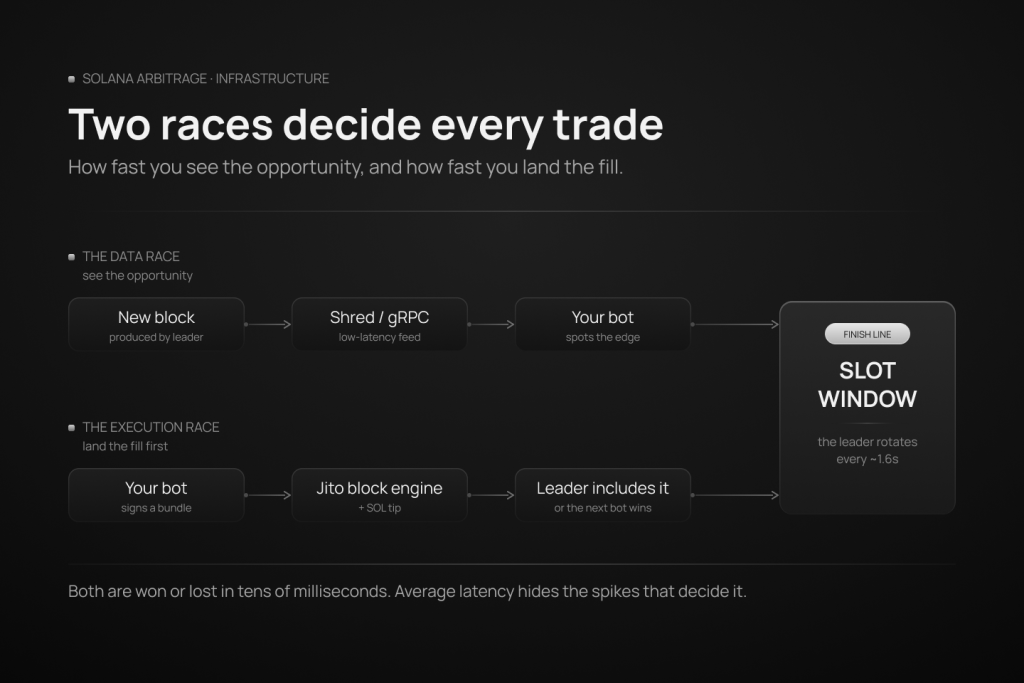
Every arbitrage trade is really two timing problems stacked on top of each other.
The data race: seeing the opportunity. Your bot has to know a price is out of line (across two DEX pools, an aggregator route, or a centralized-exchange-versus-DEX gap) before everyone else does. On Solana that means reading chain state as early as physically possible.
The execution race: landing the fill. Once you have found the edge, your transaction has to reach the validator currently producing blocks and be included, before a competing bot’s transaction gets there. On Solana the block leader rotates every four slots, about every 1.6 seconds, so the finish line physically moves around the world continuously.
Two things follow from this, and they shape every location decision below:
- Average latency lies. A VPS that shows 40 ms average response can spike to 800 ms at the 99th percentile during a busy election night or a token frenzy, which is exactly when the money is on the table. You miss the contested slot and the loss never shows up on a latency dashboard. Track p50, p95 and p99 separately. Tail latency is what actually kills arbitrage bots.
- Being inside a validator cluster beats being outside one. Because the leader rotates globally, no location is optimal all the time. But sitting in a region where high-stake validators concentrate means you are near the leader a large fraction of the time, instead of far from it always.
A useful framing from people who do this at scale: the searchers who capture most of the profit are usually not running more clever strategies than their competitors. They are running better infrastructure. Location is one layer of that.
Where Solana’s stake actually concentrates
This is the part most “best VPS location” articles get wrong, so here is the current picture (mid-2026). It is worth separating two different things: where the most validators run, and where the most stake runs. Stake is what matters for arbitrage, because leaders are chosen in proportion to stake.
By raw validator count, Europe dominates, and Frankfurt has been the single densest city for years (low-latency European routes made even ordinary setups perform well there). By stake weight, the heaviest concentration of high-stake validators sits on the US East Coast, in Ashburn, Virginia and the New York metro, followed by Frankfurt and Amsterdam in Europe, with growing clusters in Tokyo and Seoul.
| Region | Role in the Solana network | Best suited for |
|---|---|---|
| Ashburn, VA (US East) | Highest concentration of high-stake validators | Top-tier searchers who can colocate bare-metal near a validator |
| New York (US East) | Second major high-stake US cluster | US-centred bots; strong for CEX-to-DEX arbitrage near US venues |
| Frankfurt | Densest European validator hub, major stake cluster | Europe-centred bots wanting the strongest EU leader proximity |
| Amsterdam | Major European cluster with AMS-IX peering | Europe-centred bots; well-peered, Linux-friendly VPS base |
| Tokyo | Growing Asian clusters | Asia-centred setups and Asian CEX-to-DEX arbitrage |
A few honest caveats on that table. The network is deliberately pushing against concentration (the Solana Foundation now caps data-center and ASN stake share for its delegation program, and the hosting Nakamoto coefficient is around 6), so these clusters shift over time. Treat the table as “where the gravity is today,” not a permanent map, and measure before you commit.
The data path matters more than raw ping
Here is the counter-intuitive part: two bots in the same city can have very different real-world latency, because the bottleneck is usually the data feed, not the distance.
In 2026 a competitive Solana setup is a stack, not a single RPC URL:
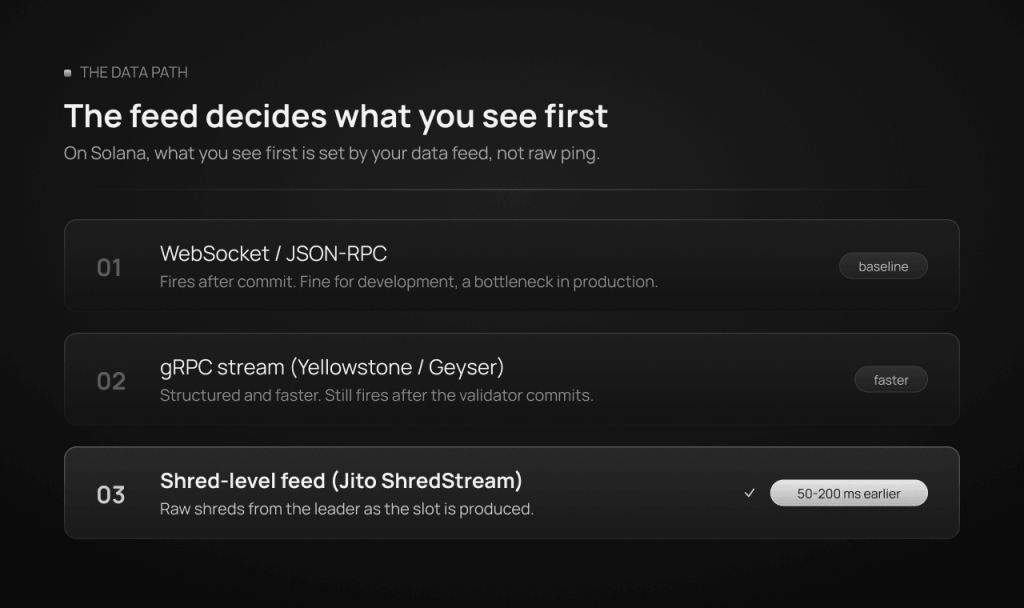
- Plain JSON-RPC and WebSocket subscriptions. Fine for development and slow strategies. For competitive arbitrage, WebSocket state updates are a real bottleneck.
- gRPC streams (Yellowstone / Geyser). Much faster structured streaming of account and transaction updates. The catch: Geyser fires after the validator commits the transaction.
- Shred-level feeds (Jito ShredStream and similar). These deliver raw block fragments (“shreds”) straight from the leader as it produces them, giving you state 50 to 200 ms before normal gossip propagation finishes. For sub-slot arbitrage, that window is often the whole edge.
- Stake-weighted submission (SWQoS). During congestion, transactions forwarded through highly-staked nodes are less likely to be dropped. Providers that run their own staked validators can pass your transaction that priority.
The practical implication for location: your VPS should sit close to where your data feed terminates and where the leaders are, at the same time. A fast feed into a badly placed box, or a well-placed box on a slow feed, both leave money on the table. This is why “just pick where your RPC provider has a node” is only half the answer. You are optimizing the whole path, from shred, to signed transaction, to leader.
The execution path: Jito, bundles and tips
On the landing side, one piece of infrastructure dominates. Around 92% of Solana validators by stake weight run the Jito-Solana client, so submitting through the Jito block engine gives your transaction the highest probability of reaching whoever is currently leading. Jito lets you send a “bundle” of up to five transactions that execute atomically (all of them, or none) with a SOL tip attached. The leader includes the highest-tipping bundles at the top of the block. Jito runs block engine endpoints in several regions, Amsterdam and Frankfurt among them, so you submit to the one nearest the current and upcoming leaders.
This leads to a point that pure “low latency VPS” marketing skips: for atomic on-chain arbitrage, latency gets you into the auction, but the tip often wins it. If another searcher spots the same two-pool imbalance and bids a higher tip, being 3 ms faster will not save you. Your bundle simply loses the auction. Location and latency get your bundle to the leader in time to compete. They do not let you outrun economics. The realistic goal is to be consistently in the contest, then compete on tip strategy and opportunity selection.
For CEX-to-DEX arbitrage the calculus shifts: you are also racing your latency to the centralized exchange’s matching engine, so the best region is the one that balances proximity to both the exchange venue and a Solana validator cluster. That is a genuinely harder placement problem, and it is worth measuring both legs separately.
The honest tiers: what a VPS can and cannot do
This is where trustworthy advice diverges from a sales pitch. There are, roughly, two tiers of Solana arbitrage infrastructure, and they are not the same product.
Tier one: the well-placed VPS. A modern VPS in a validator-cluster metro (Amsterdam or Frankfurt in Europe, New York for the US East cluster), running your bot on a fast single-thread CPU, connected to a good gRPC or shred feed, submitting through Jito, is a large upgrade over a home connection or a random cheap cloud box. For most independent and mid-tier arbitrage operators, this is the correct setup, and it is where a provider like TradoxVPS fits.
Tier two: bare-metal colocation. The top searchers go further. They rent bare-metal in the same physical data center, ideally the same LAN segment, as a high-stake validator, run their own RPC node next to the bot, and often pay for premium or self-hosted shred streaming. Published benchmarks put the latency improvement of that same-facility setup at roughly 5 to 10 times versus a remote cloud instance, with LAN-local state reads dropping from the 20 to 100 ms range down to under 1 ms. Most VPS products, including a standard TradoxVPS plan, do not put you on a validator’s LAN. If you are operating at the level where that last layer of latency is the difference, you need colocation, and you should know that going in.
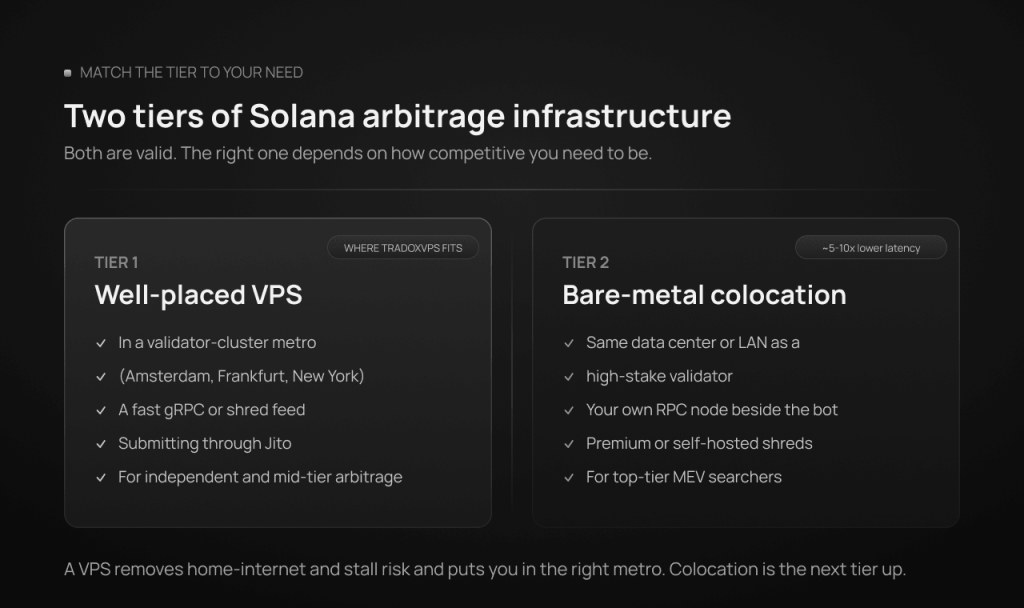
Being clear about this is the point. A VPS will not turn a hobby bot into a top-five searcher. What it will do is remove the two biggest and cheapest sources of losing, unreliable home internet and a machine that stalls under load, and put you in the right metro on a fast path. That is a real and worthwhile edge for the large middle of the market, and it is fair to say it is not the whole game.
A practical framework for choosing your region
- Name your strategy sub-type first. Atomic DEX-to-DEX arbitrage (single-chain, Jito-bundle-driven) points you toward a validator cluster and a Jito endpoint. CEX-to-DEX arbitrage adds a second constraint: proximity to the centralized exchange. Decide which one you are actually running before you pick a city.
- Shortlist regions where the gravity is. In practice that means Frankfurt or Amsterdam for a Europe-centred setup, and New York for the US East stake cluster. Ashburn is the densest high-stake location if you can get bare metal there.
- Measure the whole path, not just ping. From each candidate region, measure p50, p95 and p99 to your RPC or shred feed, and to your Jito submission endpoint, for at least an hour during live market activity, not at 3 a.m. Record timeouts and retries, not just averages.
- Watch slot lag. If your node or feed falls even one or two slots behind the cluster, your state is stale and you are pricing opportunities on old data. This matters more than a few milliseconds of ping.
- Keep a fallback. A second feed, a second region, or a fast redeploy path. Outages during volatile events cost more than months of hosting.
Compute: what the box itself needs
Location gets your packets to the right place. The machine still has to make a decision and sign a transaction without stalling, and that local step is a surprisingly common hidden bottleneck.
- Fast single-thread CPU for the hot path. Parsing the feed, computing the arbitrage, and signing and serializing the transaction are latency-sensitive and largely single-threaded. A high-clock, desktop-class chip such as the Ryzen 9 9950X (Zen 5, boosting to 5.7 GHz, with AVX-512 and SHA acceleration that help transaction signing) does this well. (Separate case: running your own validator or a heavy RPC node is a different, heavier spec, often high-frequency EPYC with large cache. That is a colocation decision, not a bot-hosting one.)
- Enough dedicated RAM to hold your caches (pool state, routing tables) without swapping under burst load.
- NVMe storage so logging and metrics never stall the runtime during a spike.
- Burst network headroom for the moment prices move and you fire a cluster of quotes and submissions at once.
Where TradoxVPS fits, honestly
TradoxVPS is a good fit for tier-one Solana arbitrage, and here is the straight version of why.
Amsterdam is live, and it is a real validator cluster, not a marketing location. It sits on AMS-IX (one of the world’s largest internet exchanges) with strong European peering, which makes it a sound base for a Europe-centred Solana bot reading a gRPC or shred feed and submitting through Jito’s Amsterdam endpoint. Frankfurt and New York are on the roadmap (marked “coming soon”), and both map directly onto the clusters that matter: Frankfurt is the densest European validator hub, and New York sits in the highest-stake US region. We do not currently offer Ashburn, so if same-facility Ashburn colocation is your requirement, we are not that product, and we would rather tell you than pretend.
On the box itself, every plan runs the Ryzen 9 9950X with DDR5 and NVMe, which covers the single-thread hot path and cache needs above, and Solana bots (typically Linux) can run on Ubuntu 24.04. Dedicated RAM keeps your state caches stable under load. What we will not do is print a latency number to Polygon or to a validator on our page, because the only number that matters is the one measured from a live box to your feed and your Jito endpoint. Use the latency checker and the trial to measure it yourself before you commit a dollar. You can read more about the Amsterdam node and the hardware benchmarks, and see the full Solana VPS overview.
Final takeaway
For a Solana arbitrage bot, the right location is the one that keeps you close to the rotating block leader and to a fast data feed, on a machine that will not stall when it counts. In practice that means a validator-cluster metro (Frankfurt or Amsterdam in Europe, New York for US-East stake), a gRPC or shred-level feed rather than plain WebSocket, and Jito for submission. A well-placed VPS such as TradoxVPS Amsterdam is the correct, honest starting point for the large middle of the market, and bare-metal colocation is the next tier up if and when your strategy truly needs it. Whatever you choose, measure p50, p95 and p99 to your own endpoints during live activity before you commit, because on Solana the averages hide exactly the spikes that decide whether an arbitrage bot makes money.
Frequently asked questions
Yes, but indirectly. You are not getting closer to “Solana”; you are getting closer to the current block leader and to a fast data feed. Sitting in a high-stake validator cluster (Ashburn or New York, Frankfurt, Amsterdam) keeps you near the rotating leader a large share of the time, which shortens both the data and the execution legs.
By stake, the heaviest concentration is US East Coast (Ashburn, Virginia and New York metro), then Frankfurt and Amsterdam, then Tokyo and Seoul. By raw count, Europe (Frankfurt especially) leads. The network is actively working to reduce this concentration, so verify current data before deciding.
For independent and mid-tier arbitrage, a well-placed VPS on a fast feed, submitting through Jito, is the right and cost-effective setup. For top-tier MEV searching, you will eventually want bare-metal colocation on a validator’s LAN with your own RPC node, which is a different tier that most VPS providers, including a standard TradoxVPS plan, do not offer.
For competitive work, a gRPC (Yellowstone or Geyser) stream at minimum, and ideally a shred-level feed (such as Jito ShredStream) that hands you state 50 to 200 ms before normal propagation. Plain WebSocket subscriptions are fine for development but a bottleneck in production.
Today, Amsterdam, if your setup is Europe-centred. It is a live, well-peered node in a genuine validator cluster. Frankfurt and New York are coming and map onto the strongest European and US-East clusters respectively. Measure the path to your own feed and Jito endpoint from a trial box before committing.
Disclaimer: TradoxVPS provides infrastructure only and does not provide investment or trading advice. Trading and running automated strategies involve risk.