
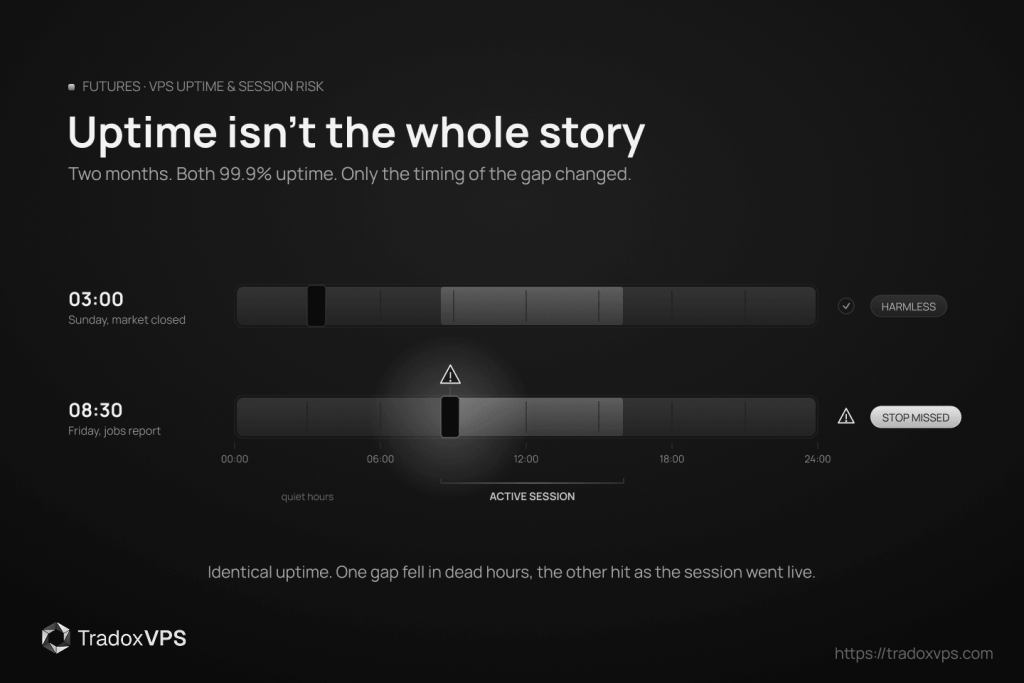
Almost every trading VPS page leads with a number: 99.9%, 99.99%, five nines. It looks like a guarantee of safety, and traders reasonably read it that way. But an uptime percentage answers a question most traders are not actually asking. It tells you roughly how much of the month the server was powered on and reachable. It tells you nothing about whether your platform stayed connected to the exchange during the eight-thirty jobs report, or whether your data feed flickered for ninety seconds at the CME open while your bot held a position.
For a futures trader, that gap is the whole story. A server can be “up” the entire time your trade goes wrong. This guide explains the real relationship between VPS uptime and trading risk: what the percentage actually measures, why the timing of downtime matters more than the amount, the quiet failures that never show up in an uptime report, and how to evaluate a trading VPS by the thing that actually protects your positions rather than the number on the sales page.
What “uptime” actually measures, and what it does not
In hosting, uptime almost always means one specific thing: the VPS instance is powered on and reachable at the hypervisor level. The virtual machine exists, the host can see it, you can open a remote desktop session. That is the number providers report, and by that definition a server can be “up” continuously while your ability to trade on it is broken.
Being reachable does not guarantee any of the things a trader actually depends on: a stable network path to your broker and data feed, live market data, a working order gateway, or a platform session that has not silently dropped. All of these sit above the “is the box on” layer, and any of them can fail while the box stays technically up.
That is why the most common support message in this whole category is some version of “my VPS was up, but my platform disconnected.” It sounds like a contradiction. It is not. It is the difference between the machine being on and the machine being useful for trading in that moment, and the second is the only one that protects a position.
The math nobody puts in context
Uptime percentages feel precise, so it is worth seeing what they actually permit. Here is what each “number of nines” allows as maximum downtime, and this is the part that reframes everything:
| Uptime | Downtime per year | Downtime per month |
|---|---|---|
| 99% | about 3.65 days | about 7.3 hours |
| 99.9% (“three nines”) | about 8.8 hours | about 44 minutes |
| 99.99% (“four nines”) | about 53 minutes | about 4.4 minutes |
| 99.999% (“five nines”) | about 5.3 minutes | about 26 seconds |
| 99.9999% (“six nines”) | about 32 seconds | about 2.6 seconds |
Now the point that the percentage hides completely: the number says nothing about when the downtime happens. Forty-four minutes a month at 99.9% is a rounding error if it falls at 3 a.m. on a Sunday when the futures market is closed. The identical forty-four minutes is a disaster if it lands at 8:30 on the first Friday of the month while your automated strategy is live into the jobs report. Two providers can report the exact same uptime and deliver completely different trading outcomes, because uptime is an average across the whole month and trading risk is concentrated in a handful of specific minutes.
This is the core mistake in reading uptime as a safety guarantee. It measures quantity of availability. Trading cares about timing of availability, and the two are not the same measurement at all. Even thirty seconds of disconnection or a minute of routing instability, if it happens at the wrong moment, can mean a missed exit, an unmanaged position, a strategy that desynchronizes from the market, or a stop that does not fire when you need it.
Why the trading session is the real risk window
If downtime were randomly distributed, timing would be a coin flip. It is not. Infrastructure stress and trading risk peak at the same moments, which is what makes those moments doubly dangerous.
The high-risk windows are predictable: the CME Globex and US cash session opens, the quarterly contract rollover, and scheduled economic releases like NFP, CPI, and FOMC. In each of these, several things happen at once. Order message rates across the whole market surge. Network paths carry far more traffic. Platform reconnect logic gets exercised under load. And your own automation is most active and most exposed, precisely because those are the moments it was built to trade.
So the danger is not just that a failure is more likely during a session peak (though congestion makes it so). It is that a failure during a session peak is far more costly, because it coincides with the exact minutes your capital is most at risk. A VPS that runs flawlessly for twenty-three hours and fifty minutes a day can still fail during the only ten minutes that decide your month. Averages forgive that. Traders cannot.
The disconnect that is not downtime: soft failures
Here is the part most uptime discussions miss entirely, and it is the one that does the most real damage. The failures that hurt traders are usually not clean, total outages that a monitoring system flags and a provider reports. They are small, brief, and invisible to uptime math.
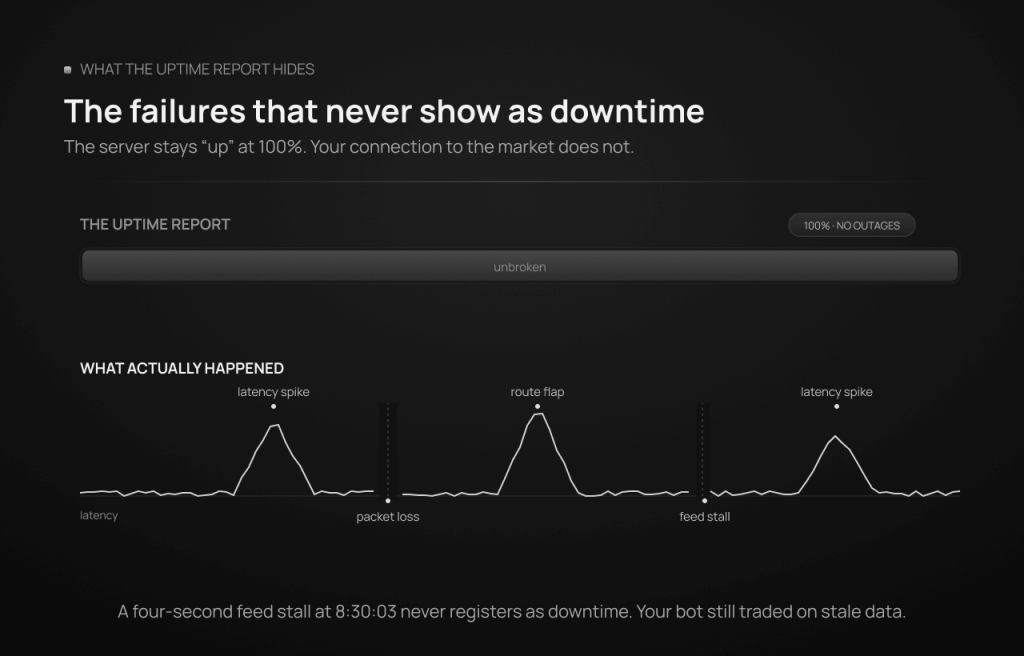
Soft downtime looks like this: a burst of packet loss that lasts four seconds, a routing path that flaps and re-converges, a latency spike that pushes your round-trip from two milliseconds to two hundred for half a minute, a data feed that stalls and then catches up. In your platform, it shows up as a “connection lost, connection restored” pair in the NinjaTrader log, a Rithmic or CQG feed that reconnects, a chart that freezes and then jumps, or a few seconds where the DOM stops updating. None of these register as “downtime.” The server never went off. The uptime report stays a perfect 100%. And yet during any one of them, an automated strategy can act on stale data, a stop can sit unconfirmed, or an order can leave late.
Soft downtime is more dangerous than a full outage for a specific reason: a full outage is obvious, so you notice it and react. A four-second feed stall at 8:30:03 you may never see at all, until you are reconciling a fill that makes no sense. This is why “we had 100% uptime” and “a trader lost money to an infrastructure hiccup” are not contradictory statements. The hiccups that matter live below the resolution of an uptime percentage.
Why “my VPS was up but my platform disconnected” is normal, and partly beyond any host
A trading platform is not one connection. It maintains several at once: a market data feed, one or more order-routing gateways, and broker or exchange authentication sessions. Each of these is a separate link that can fail on its own while the others, and the underlying VPS, stay perfectly healthy. Your remote desktop works, the box is reachable, and yet the data feed has dropped. That is the architecture behaving exactly as designed, not a malfunction.
And this leads to an honest point that a VPS provider should make plainly: not all of those links are the VPS provider’s to control. A trading VPS provider is responsible for its own layer, the power, the network inside and out of the data center, the routing quality, and the stability of the machine. It is not responsible for your broker’s gateway going down, your data feed vendor having an incident, or the exchange itself halting or throttling. When your platform disconnects, the cause can be any link in that chain, and several of them sit entirely outside your hosting.
The practical consequence is that no provider, ours included, can honestly promise your platform session will never be interrupted, because a provider does not own the whole chain. What a good trading VPS can promise is that its link, the part it does control, is built to stay stable during the session peaks when the other links are also under the most stress. That distinction is the honest version of “reliability,” and it is worth understanding before you evaluate anyone’s uptime claim, including ours.
Why automation raises the stakes
Everything above is worse when there is no human in the loop. A discretionary trader who sees a feed reconnect can pause, check positions, and wait for stability before acting. An automated strategy has no such judgment. Its reaction time to bad data is effectively zero, and its mistakes compound in the direction of whatever the market is doing.
During a period of instability, a bot can act on stale prices, miss a protective stop because the order did not confirm, re-enter a position it should have stayed out of, or fail to close on time. None of these require the VPS to actually go down. They only require a few seconds of degraded connectivity at the wrong moment, arriving faster than any monitoring alert could reach you. This is why, for automated futures trading specifically, session continuity and network consistency matter far more than a headline uptime figure, and why building failure handling into the automation itself (sane behavior on disconnect, reconnection logic, server-side stops where the platform supports them) is part of the job that no amount of provider uptime can do for you.
What actually reduces session-time risk
If the uptime percentage is the wrong thing to optimize, what is the right thing? On the infrastructure side, the qualities that genuinely reduce session-time failures are less marketable than a number but far more relevant:
Redundant power and multiple independent network paths, so a single feed or circuit failure does not take the machine or its connectivity down. Enterprise-grade routing and a short, predictable path to the exchange, so that during a session-open traffic surge your route stays stable rather than re-converging at the worst moment. Low and consistent network jitter under load, because a path that is fast at noon but erratic at the open is exactly the failure mode traders feel. For CME futures, proximity to the exchange in Chicago shortens and steadies that path, which matters most precisely during the peak windows.
There is also an honesty point that belongs here, because it is where a lot of “reliability” marketing quietly misleads. Every shared VPS oversubscribes some resources; the honest questions are which, and by how much. On a proper trading VPS, RAM is dedicated to your instance, while CPU is shared across the host and allocated dynamically. That is normal and works well for trading, but it means the useful thing to ask any provider, including us, is their CPU oversubscription ratio, and then to test “steal time” yourself under load during a session peak. A provider that is straight with you about that is telling you more about your real session-time risk than one advertising a bigger uptime number.
How to evaluate a trading VPS for real
Experienced traders do not choose infrastructure by asking “what is your uptime percentage.” They ask questions the percentage cannot answer, and then they verify:
How stable is the network specifically during the CME and US session opens, not on a quiet afternoon? How often do routing paths change under load? What actually happens during a partial failure, when one feed drops but the box stays up? Is latency consistent, or just occasionally low? And crucially, is there a way to see the provider’s real history rather than trust a marketing figure?
The verification is something you can do yourself, and should, before you trust real capital to any host. Run a trial instance and watch it during an actual session open, not at 2 a.m. Monitor round-trip latency and jitter to your own feed during the peak, not the average across the day. Deliberately test your platform’s reconnect behavior, kill the connection and confirm the platform and your automation recover the way you expect. And look at the provider’s live status and incident history rather than the headline number. A provider that publishes a real status page is giving you something an uptime percentage never can: the actual record, including the bad days.
Where TradoxVPS fits, honestly
We could put a five-nines badge at the top of this page and leave it there. Given everything above, that would be missing our own point. Here is the straight version.
TradoxVPS targets 99.999% uptime, and we treat that as a target backed by redundant power and networking, not as a guaranteed SLA that magically protects your trades. More useful than the number: we publish a live status and reliability page so you can see the actual history, including any incidents, rather than take a marketing figure on faith. On the part we control, our Chicago infrastructure sits near CME’s matching engines in Aurora with enterprise routing built for a short, predictable path and low jitter during session peaks, which is the layer that actually reduces session-time risk. Path.net handles DDoS at the network edge so an attack during a volatile open does not become your outage.
And here is the part most providers leave out. We cannot promise your platform session will never be interrupted, because we do not own your broker’s gateway, your data feed, or the exchange, and any of those can drop while our machine stays perfectly up. What we can do is make our link in that chain as stable as it can be during the minutes that matter, and give you the tools to verify it yourself: the live status page, the latency checker to measure the real path to your feed, and a trial so you can watch it through a session open before you commit. That is a more honest picture of reliability than a number, and it is the picture a serious futures trader should be evaluating. You can read more about how the infrastructure is built, and the platform-specific detail on the NinjaTrader VPS and Rithmic VPS pages.
Final takeaway
For a futures trader, an uptime percentage is a floor, not a safety net. It measures how much of the month the server was on, while your real risk lives in the specific minutes around session opens, rollovers, and news, where infrastructure stress and trading exposure peak together. The failures that actually cost money are often the ones a percentage cannot see: the brief disconnects, the route flaps, the feed stalls that never register as downtime. Evaluate a trading VPS by its stability during those windows, verify it yourself through a session open, and understand that no provider owns your entire connection chain. Choose infrastructure that is honest about what it controls, stable when it counts, and transparent enough to let you check, and treat uptime as one input to your risk management rather than a guarantee that replaces it.
Frequently asked questions
Uptime is a baseline requirement, not a measure of trading safety. It tells you how much of the month the server was reachable, but not whether your platform stayed connected during the session opens and news releases when your risk is concentrated. Two VPS with identical uptime can produce very different trading outcomes depending on when their downtime and instability occur. Session-time stability matters far more than the headline percentage.
Higher is better, but chasing an extra nine is the wrong focus. The difference between 99.9% and 99.99% is roughly forty minutes versus four minutes of allowed downtime a month, which matters, but neither number tells you whether that downtime lands at 3 a.m. or at the CME open. Prioritize a provider whose network is stable and consistent during session peaks and who publishes a real status history, over one simply advertising more nines.
Because “up” only means the server is powered on and reachable. Your platform runs several separate connections (market data, order gateway, broker authentication), and any of those can fail while the VPS itself stays healthy. Often the cause is on the broker, data-feed, or exchange side rather than the VPS, and those links are not something any hosting provider controls.
It permits about 44 minutes of downtime a month, which is fine if it never coincides with a session you trade and potentially costly if it does. More important than the raw figure is whether the provider is stable during peak windows and whether soft failures (brief disconnects, packet loss, latency spikes that do not count as “downtime”) are common on their network. Those are what actually damage trades, and they hide below the uptime number.
No, and be cautious of anyone implying it can. A VPS provider controls its own layer (power, network, routing, machine stability) and can make that layer very reliable, especially during session peaks. It does not control your broker’s gateway, your data feed, or the exchange, any of which can interrupt your session while the VPS stays up. Honest reliability means making the controllable link stable and giving you tools to verify it, not promising an unbroken chain no host owns.
Soft downtime is brief, partial degradation: a few seconds of packet loss, a route that flaps, a latency spike, a feed that stalls and recovers. It rarely shows up in uptime reports because the server never goes off, yet it can cause an automated strategy to act on stale data or an order to leave late. It is more dangerous than a full outage because it is easy to miss, so you may not notice it until you are reconciling a fill that does not make sense.
Disclaimer: TradoxVPS provides infrastructure only and does not provide investment or trading advice. Trading futures involves substantial risk of loss and is not suitable for all investors. Uptime figures are targets, not guaranteed SLAs; actual availability, latency, and execution depend on network conditions, broker and data-feed connectivity, exchange infrastructure, and user configuration.