
We make TradoxVPS, so take this for what it is, but a comparison that just declares us the winner of everything wouldn’t help you decide, and you’d see through it anyway. So here’s the straight version, with ChartVPS’s details taken from their own live site (June 2026).
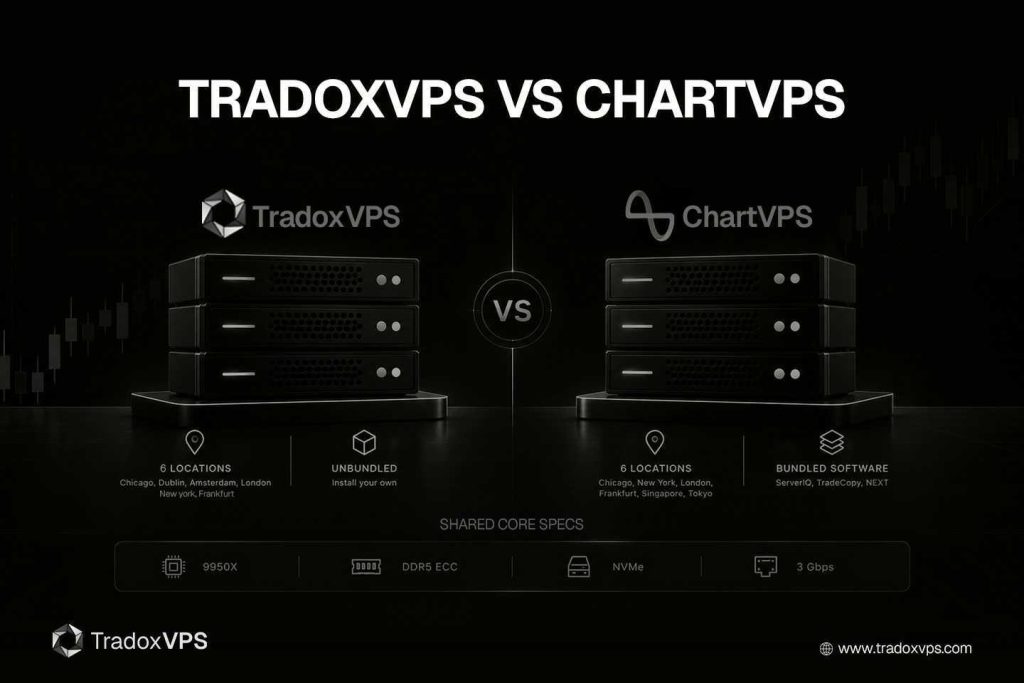
The honest summary is simple: the VPS hardware is basically identical. Both run the same AMD Ryzen 9 9950X, the same DDR5 ECC memory, the same NVMe storage, and the same 3 Gbps network, with five-nines uptime on both sides. The real differences come down to three things:
- Price: TradoxVPS is cheaper, plan for plan.
- What’s bundled: ChartVPS folds extra software into its price; we keep plans lean, so you pay for the machine, not a software suite.
- Locations: ChartVPS has more of them, but we have Dublin for Polymarket, which they don’t.
If you want low-cost Chicago futures hosting or a Polymarket box, that’s us. If you want a bundled toolkit and a wider map of locations, ChartVPS is a fair choice. Details below.
Quick comparison
| Feature | TradoxVPS | ChartVPS (Alpha) |
|---|---|---|
| CPU | Ryzen 9 9950X (up to 5.7 GHz) | Ryzen 9 9950X (up to 5.7 GHz) |
| Memory | DDR5 ECC | DDR5 ECC |
| Storage | NVMe SSD | NVMe SSD |
| Network | 3 Gbps | 3 Gbps |
| Uptime | 99.999% target | ~99.999% (100% SLA) |
| “Latency” to CME | Sub-ms ping to the Aurora DC* | 0–1 ms ping advertised* |
| Data centers | 4 – Chicago, Dublin, Amsterdam, London | 6 – Chicago, New York, London, Frankfurt, Singapore, Tokyo |
| Polymarket (Dublin) | Yes | No |
| Bundled software | Unbundled, install your own | ServerIQ, TradeCopy, NEXT |
| Entry price | From $39/mo | Alpha Mark-1 from $50/mo |
*Both figures are network ping to the data center, not order-execution time. See the latency section.
Hardware: the same machine
Let’s not pretend there’s a gap that isn’t there. Both providers build their Chicago futures VPS on the AMD Ryzen 9 9950X Zen 5, 16 cores, up to 5.7 GHz. It’s the right chip for trading: 16 identical high-clock cores, no P-core/E-core split to cause jitter, which keeps single-threaded platforms like NinjaTrader and Sierra Chart steady. Both use DDR5 ECC memory and NVMe SSDs. On the core hardware, it’s a wash and that’s the honest answer, not a dodge.
“Latency”: read the fine print
This is the number every VPS page advertises, and it’s the one worth slowing down on.
ChartVPS advertises “0–1 ms to CME” from Chicago. We see roughly sub-millisecond ping from our Chicago hub. Both are real, and both mean less than they look because that’s network ping (ICMP) to the data center, not how long your order takes to reach the matching engine and return.
Your actual order round-trip goes through your broker’s gateway (Rithmic, CQG), their risk checks, and the exchange. That’s a few milliseconds in practice, and it depends on your broker, order type and liquidity far more than on whether a server pings the building in 0.4 or 0.8 ms. A sub-millisecond badge is a wire measurement; it is not “instant fills.”
Practically, you can’t separate two good Chicago hosts on speed from their marketing numbers, both sit in the same metro and ping the CME’s Aurora data center in a similar range. So measure it yourself: we publish a live latency checker you can run from your own machine. Treat latency as a tie and decide on what actually differs.
Network and uptime
Both run 3 Gbps networking, which is far more than a trading workload needs, even several data feeds plus Bookmap and a couple of NinjaTrader instances use a fraction of it. Not a differentiator.
On uptime, both are five-nines in practice, roughly five minutes of downtime a year. We publish a 99.999% uptime target with a public status page; ChartVPS advertises a 100% SLA. For day-to-day reliability, call it even.
Price: where they actually differ
This is the real reason to pick one over the other.
Same class of box, different sticker. TradoxVPS’s entry Chicago plan (Starter) is $39/mo. ChartVPS’s entry Alpha plan (Mark-1) starts at $50/mo, and the same pattern holds as you move up the tiers, ChartVPS sits higher at every step.
| TradoxVPS Starter | ChartVPS Alpha Mark-1 | |
|---|---|---|
| CPU | Ryzen 9 9950X | Ryzen 9 9950X |
| Memory | DDR5 ECC | DDR5 ECC |
| Storage | NVMe SSD | NVMe SSD |
| Network | 3 Gbps | 3 Gbps |
| Price | $39/mo | from $50/mo |
(ChartVPS pricing from their site, June 2026. TradoxVPS plan details: pricing page.)
Our full Chicago ladder runs from $39 to $249/mo across six tiers, with a separate Dublin/Polymarket line from $44.90/mo; quarterly and annual billing and a new-user first-month discount are on the pricing page.
So why does the same hardware cost more on ChartVPS? Mostly because of what’s baked into the price, which is the next section.
Software: bundled vs lean
This is ChartVPS’s actual pitch, and it explains the price gap. They bundle their own software into the subscription:
- ServerIQ : monitoring for CPU/RAM/storage and Windows processes, with email alerts.
- NEXT : an in-house algo framework (signals via Discord plus TradingView scripts).
- TradeCopy : a trade-copying tool (paid add-on).
If you want monitoring, copy-trading and an algo framework handed to you in one bill, that bundle has real value.
TradoxVPS does the opposite on purpose. You get a fast, stable Chicago or Dublin box with full admin access, and you install the stack you already trust: NinjaTrader, Sierra Chart, your own bots, without paying for a bundled suite. If you already have your tools, that’s the point: a lower bill, and no software you won’t use. It’s the main reason our prices sit below ChartVPS’s.
Locations
ChartVPS has six data centers: Chicago, New York, London, Frankfurt, Singapore and Tokyo. If you trade US equities, the DAX, SGX or the TSE and want a server near those venues, that’s real coverage we don’t have yet.
TradoxVPS has four: Chicago (CME/CBOT), London (forex), Amsterdam (EU crypto) and Dublin. New York and Frankfurt are on the roadmap.
The one that matters if it’s your market: Dublin for Polymarket. We run an eu-west-1 region positioned for Polymarket, the closest non-geo-restricted setup for those bots. ChartVPS isn’t built for prediction markets, so if you trade Polymarket, this is the deciding factor.
Which should you choose?
TradoxVPS if you want the same Ryzen 9 9950X hardware for less, you bring your own platform and tools, or you trade Polymarket. Start with our plans, or run the latency checker first.
ChartVPS if you want their bundled software (ServerIQ, NEXT, TradeCopy) in one subscription, or you need a server in New York, Frankfurt, Singapore or Tokyo.
Same hardware on both sides so it really comes down to price, what you want bundled, and where you need to be.
Frequently Asked Questions
TradoxVPS, at every tier. Our entry Chicago plan is $39/mo; ChartVPS’s entry Alpha Mark-1 starts at $50/mo, and the gap holds as you scale up. The hardware is the same class, so you’re mostly paying ChartVPS extra for its bundled software.
Not really. Both run the AMD Ryzen 9 9950X (up to 5.7 GHz), DDR5 ECC memory, NVMe storage and a 3 Gbps network. On core specs they’re effectively the same.
Treat them as equal. Both host in the Chicago metro and both quote sub-millisecond ping to the CME’s Aurora data center but ping isn’t order-execution time. Real fills depend on your broker, order type and liquidity. Measure ping yourself with our latency checker instead of trusting a headline number.
This is the clear split. TradoxVPS runs a Dublin region positioned for Polymarket; it’s a core use case for us. ChartVPS focuses on futures, stocks and forex and isn’t built for prediction markets.
Mainly the bundle. ChartVPS includes its own software, ServerIQ monitoring, the NEXT algo framework, and an optional TradeCopy tool in the subscription. TradoxVPS keeps plans lean so you install your own stack and pay less.
A 99.999% target, about five minutes a year with redundant hardware and a public status page. ChartVPS advertises a 100% SLA with real-world figures around 99.999%. Both are five-nines in practice.
TradoxVPS plans are usually provisioned within a few minutes of signup; you connect over RDP and install your platform.
ChartVPS pricing and specs reflect their public site as of June 2026 and may change, verify before buying. TradoxVPS provides VPS hosting only and does not give financial or trading advice.