
The Fed rate decision dropped at 2:00 PM ET. Within 400 milliseconds, the YES contracts on Kalshi’s “Will the Fed hold rates at the March meeting?” market moved from 72¢ to 91¢. A market maker running Python bots from a residential connection in Dallas updated their quotes 340 milliseconds later. By then the opportunity was gone — taken by bots that sit close to Kalshi’s trading engine and repriced in a fraction of the time.
That gap — 340 milliseconds — is not a rounding error. With Kalshi reportedly processing several billion dollars in monthly volume as of late 2025, the order book on high-liquidity markets refreshes continuously. Arbitrage spreads between Kalshi and Polymarket that look exploitable at 3¢ per contract vanish in under a second. Market-making bots competing for the spread have to cancel and reprice stale orders before someone else fills them at unfavorable prices. Traders running automated strategies on a dedicated Kalshi VPS close that structural gap before a single line of strategy code is written.
But “close to Kalshi” is not where most guides — including, until recently, this one — say it is. Kalshi’s matching engine does not run in Chicago, and no VPS gives you 1 ms to it. This guide explains where Kalshi actually runs, what latency you can really expect, why a Chicago VPS is still the strongest setup we offer for Kalshi bots, and how to size hardware and uptime so your strategy isn’t quietly losing money to infrastructure it never measured.
Where Kalshi Actually Runs — and Why the “1 ms” Number Is a Mirage
Here is the single most important fact for anyone building Kalshi infrastructure, and the one almost every “Kalshi VPS” article gets wrong:
Kalshi’s order-matching engine runs in AWS us-east-2 — the Ohio region (Columbus / New Albany metro), in the Midwest. It is not in Chicago, and it is not in New York.
That matters because of where the latency really comes from. When you ping Kalshi’s public REST host (api.elections.kalshi.com) or its WebSocket host and see a number close to 1 ms, you are not measuring the trading engine. Those public endpoints sit behind Amazon CloudFront, Amazon’s content-delivery network. CloudFront terminates your connection at the edge location nearest you — which is why the same “1 ms” appears from a dozen different cities. The matching engine is still hundreds of miles away in Ohio.
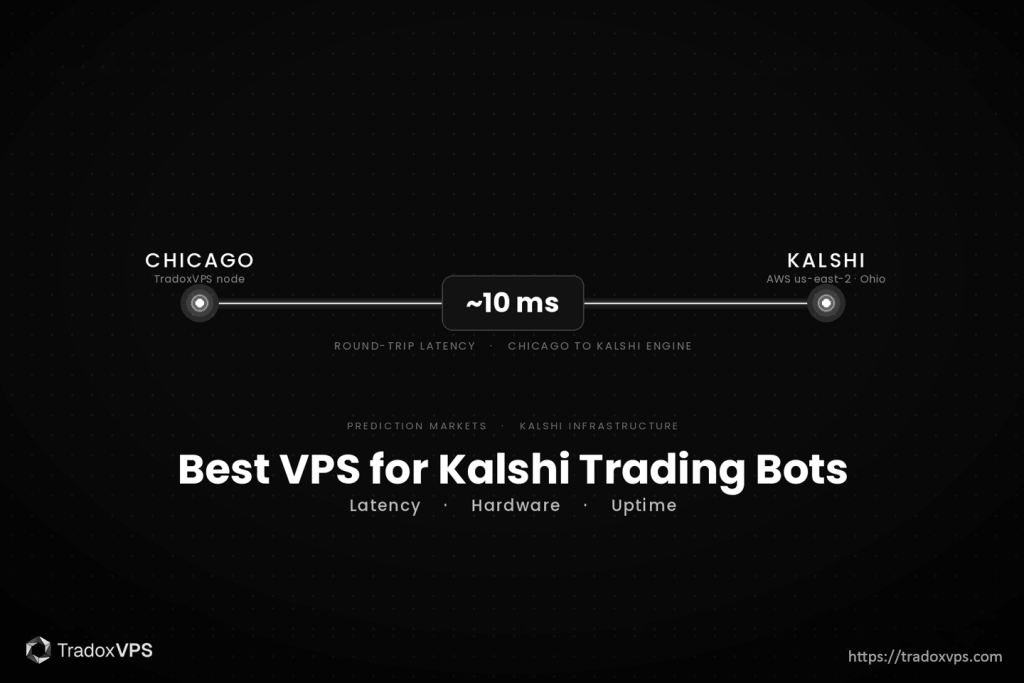
The only way to measure the real round-trip to the engine is a path that doesn’t touch the CDN — and that’s FIX, Kalshi’s institutional order-entry protocol. We benchmarked it from our own Chicago VPS:
- Chicago → Kalshi FIX engine (AWS us-east-2): ~10 ms round-trip, with very low jitter (sub-millisecond standard deviation).
- The public REST/WebSocket hosts answered in ~1 ms from the same box — because that’s a CloudFront edge, not the engine.
So the honest number from Chicago to Kalshi is roughly 10 milliseconds, not one. (For context: Kalshi’s engine isn’t in the Chicago suburbs the way CME’s Aurora data center is, so any Chicago-to-CME figure doesn’t transfer to Kalshi.)
None of this makes a Chicago VPS the wrong choice. It makes it the right choice for the right reasons — which we’ll get to. But it does mean you should ignore anyone promising sub-millisecond latency to Kalshi from a Chicago server. The physics don’t allow it.
What Kalshi Is — and Why Its Architecture Still Rewards Low Latency
Kalshi operates as a CFTC-designated contract market (DCM) for event-based trading in the United States. Unlike crypto-based prediction markets, Kalshi runs on centralized, off-chain order matching with fiat USD settlement — the same broad regulatory architecture that governs CME futures. That matters for infrastructure because Kalshi’s order book behaves like a traditional financial exchange, not a blockchain protocol.
The Order Book Structure
Every Kalshi market is a Central Limit Order Book (CLOB) where makers post YES or NO offers ranging from $0.01 to $0.99, and takers fill against them. Prices reflect real-time crowd probability — not a smart-contract AMM curve. When the underlying event’s likelihood shifts — a CPI print, a Fed statement, a breaking headline — the order book reprices immediately. The traders who reprice first capture the spread; everyone else pays it.
Kalshi’s matching engine processes order submissions in single-digit milliseconds. That’s fast — but it means there’s no buffer for a slow network path on your side. A WebSocket subscription delivers order-book deltas continuously. If your bot sits ~80 ms from Ohio (roughly where a European server lands), you’re reading a book that’s already 80 ms stale before your logic even starts, and your order takes another ~80 ms to travel back — about 160 ms behind the market. From Chicago at ~10 ms, that same loop is roughly 16× tighter. The advantage is real; it’s just measured in single-digit-to-low-double-digit milliseconds, not microseconds.
Three Integration Paths and What They Actually Imply
Kalshi exposes three integration paths. The key insight: the latency floor is set by your distance to AWS us-east-2 (Ohio), not by the protocol label on the box.
| Protocol | Primary use case | Latency reality | Best for |
|---|---|---|---|
| REST API v2 | Order placement, account data, market metadata | Bounded by your round-trip to Ohio; some public reads hit a CloudFront edge and return faster than the engine | Low-frequency bots, portfolio monitoring |
| WebSocket API | Real-time order-book, price, and fill streaming | Persistent stream that rides a CloudFront edge near you; excellent for live data | Market making, news trading, book monitoring |
| FIX (FIXT 1.1 / FIX 5.0 SP2) | Institutional order entry and management | True engine round-trip — no CDN in the path. ~10 ms from Chicago; sub-ms only from inside us-east-2 | High-frequency market making, arbitrage execution |
Two practical notes. First, Kalshi’s FIX is FIX 5.0 SP2 over the FIXT 1.1 transport — not FIX 4.4 (that’s CME’s vintage). Confirm the exact session details on Kalshi’s FIX connectivity docs before you build. Second, FIX is the clearest signal Kalshi is built for serious algorithmic participants: it’s the lowest-latency order path on the platform, and because it skips the CDN, it’s also the only way to honestly measure how far you really are from the engine.
Why Chicago Is Still the Right VPS for Kalshi Bots
If Kalshi is in Ohio, why not just tell everyone to go to Ohio? Because for a TradoxVPS customer, Chicago is the closest and best-connected location we offer to that engine — and the gap over the alternatives is enormous:
- Chicago → Kalshi engine: ~10 ms.
- Dublin / Amsterdam / London → Kalshi engine: ~80 ms or more (it’s a transatlantic hop to the US Midwest).
That’s roughly an 8× difference between our US node and our European nodes for the exact same strategy. For anything automated on Kalshi — arbitrage, market making, news trading — Chicago is the obvious pick within our footprint. And ~10 ms with sub-millisecond jitter is genuinely excellent for the overwhelming majority of Kalshi automated strategies; you do not need to be sub-millisecond to be competitive in these markets.
The one thing a Chicago VPS can’t do is beat the speed of light to Ohio. Materially lower latency than ~10 ms requires an instance running physically inside AWS us-east-2 (or reaching it over AWS PrivateLink) — a different class of deployment that sits outside our current footprint. If your edge genuinely depends on shaving those last few milliseconds, that’s the honest answer. For everyone else, Chicago is the right call.
The Physics, Stated Correctly
Milliseconds aren’t abstract: one millisecond of network latency corresponds to roughly 124 miles of fiber, and no software optimization eliminates the speed-of-light constraint. Chicago to Columbus is on the order of 300 miles, and over AWS’s network that lands at about 10 ms round-trip — which is exactly what we measured. A server in Los Angeles or Miami connecting to Ohio carries an irreducible disadvantage of tens of additional milliseconds on top of that.
What Residential Connections Actually Do to Your Bot
Consider a Kalshi market maker running a Python bot from home. It monitors the book via WebSocket, calculates fair value, and sends REST calls to update limit orders when its estimate moves by more than 1¢. On paper it’s clean. In execution, three things happen that the backtest never modeled:
- During high-activity windows — FOMC, CPI, NFP — residential ISP congestion spikes. The WebSocket feed stutters and the bot makes pricing decisions on a snapshot that’s 300 ms stale.
- The order submission travels the same congested last mile. A 50 ms REST call becomes a 400 ms call. The order lands 400 ms after the decision fired.
- Bots positioned near the engine have already repriced — or filled against the home bot’s stale quotes at prices that are now unfavorable.
This isn’t theoretical. Arbitrage windows in liquid Kalshi markets close in well under a second, and the documented prediction-market arbitrage profits of recent years went disproportionately to participants with professional infrastructure — not those with the best models.
The Jitter Problem Nobody Talks About
Average latency is misleading without variance. A connection averaging 80 ms that spikes to 400 ms during congestion is functionally worse than a stable 10 ms connection with sub-millisecond standard deviation. Market-making bots quote continuously; a single latency spike during a volatile print can leave a limit order sitting unmodified while the market moves through it — an adverse fill, not a captured spread. Enterprise data-center networking is engineered to remove the sources of residential jitter (shared last-mile, distance to the nearest exchange point, home-router instability, bandwidth caps). The result isn’t just lower average latency — it’s predictably low latency, which matters more for automated execution than the headline average.
The Five Kalshi Strategies Where Latency Directly Determines Profitability
Not every strategy is latency-sensitive — a discretionary trader holding a two-week position on a Fed outcome doesn’t need fast execution. But for the automated strategies that now dominate Kalshi’s most liquid markets, latency is a prerequisite for positive expectancy.
1. Cross-Platform Arbitrage (Kalshi vs Polymarket)
Kalshi and Polymarket frequently price the same event differently. When YES on one plus NO on the other costs less than $1.00, a risk-free profit exists on paper — if you can execute both legs before the spread closes. Those windows are measured in seconds, sometimes less. A bot with ~10 ms access to Kalshi from Chicago and optimized connectivity to Polymarket’s CLOB can execute both legs quickly; a bot on a congested residential link consistently arrives after the spread has closed. As liquid-market spreads have compressed toward 1–2 cents, the margin for execution delay has shrunk with them.
2. Market Making
Market makers quote simultaneous YES and NO sides across many markets, earning the spread while managing inventory. The core loop — receive book update, recalculate fair value, cancel stale quotes, post new quotes — has to complete faster than competitors running the same loop. Kalshi’s FIX path (FIX 5.0 SP2 over FIXT 1.1) exists precisely for this: it’s the lowest-latency order management on the platform. A maker posting 50 quotes across 25 markets runs this loop hundreds of times per minute on busy days, and a few milliseconds saved per iteration compounds across a session — especially during event windows when the book reprices fastest.
3. News-Driven Event Trading
The highest-velocity moments on Kalshi are binary: the number prints, the result is confirmed. In the 200–500 ms after a high-impact event, the book reprices dramatically — prices can move 20¢+ in seconds. Traders on low-latency infrastructure with a live WebSocket feed see those moves as they happen; traders refreshing a browser or polling a slow connection see the aftermath.
4. Same-Platform Arbitrage (Kalshi–Kalshi)
Kalshi lists correlated and mutually exclusive markets simultaneously. When related contracts misprice against each other — for example, two mutually exclusive markets whose combined YES prices briefly exceed $1.00 — the same execution logic applies. These edges are typically smaller and shorter-lived, so they demand fast, reliable execution to capture.
5. Sustained 24/7 Bot Operation
Kalshi markets run continuously — economic, political, and sports events don’t keep a 9:30-to-4:00 schedule. A bot on a home PC can’t sustain reliable 24/7 uptime: power blips, sleep mode, router reboots, and ISP outages each open a window where the bot is offline. If it has resting limit orders and an event moves the market while it’s down, those orders fill at adversely stale prices. A VPS engineered to a 99.999% uptime target removes this entire class of risk.
Hardware: Why CPU and RAM Type Matter as Much as the Network
Latency has two components: network latency (data traveling between your server and the engine) and compute latency (your code processing incoming data and generating orders). Most guides obsess over the first and ignore the second. At high frequency they matter equally — and compute latency is the part a Chicago VPS can actually win outright.
Single-Core Performance for Trading Logic
A trading bot’s critical path — order-book processing, signal generation, order submission — runs primarily on a single thread. Multi-threading offloads ancillary work (logging, monitoring), but the hot path stays sequential, which makes single-core clock speed the hardware metric that most directly affects compute latency. The AMD Ryzen 9 9950X (Zen 5) runs a 4.3 GHz base and 5.7 GHz boost clock. For a bot processing a WebSocket delta and emitting an order, the difference between ~3.0 GHz (typical cloud VPS) and 5.7 GHz is a large reduction in hot-path processing time — and that time adds directly to, or subtracts from, your network latency.
DDR5 RAM and NVMe Storage in Context
DDR5 bandwidth is roughly 1.5–2× DDR4. For a maker holding live book state across 50+ markets, memory speed governs how fast the in-memory representation updates on each delta — with DDR5, memory stops being the bottleneck and the CPU and network become the constraints, as they should be. Enterprise NVMe (Gen4, 3,500+ MB/s) ensures logging, backtest reads, and model loads complete in microseconds, so an always-on logging layer doesn’t slow the critical path.
| Hardware | Generic cloud VPS | TradoxVPS | Impact on a Kalshi bot |
|---|---|---|---|
| CPU | Intel Xeon E5 / older EPYC, 2.0–3.2 GHz | AMD Ryzen 9 9950X, 4.3–5.7 GHz (Zen 5) | ~40–60% faster single-thread hot path |
| RAM | DDR4, 2666–3200 MHz | DDR5, 4800–6400 MHz | ~50% higher bandwidth for book state |
| Storage | SATA SSD or HDD | NVMe SSD (Gen4) | Logging / data ops 10–20× faster |
| Network | 1 Gbps shared | 3 Gbps | No saturation during volatile events |
| DDoS protection | Basic / optional add-on | Path.net — always on | Bot stays online during targeted attacks |
| Uptime SLA | 99.9% typical (~8.7 hrs/yr) | 99.999% target (~5 min/yr) | Bot runs continuously; no missed events |
The Uptime Number That Actually Matters
The gap between 99.9% and 99.999% is bigger than it reads. At 99.9%, a VPS can be offline up to ~8.7 hours a year — unscheduled, potentially during a major event window. At 99.999%, allowable downtime is ~5 minutes a year. For a bot holding resting orders on Kalshi, eight hours of unexpected downtime isn’t recoverable: positions sit unmanaged and risk accumulates without oversight. The cost difference between those tiers is trivial next to a single adverse event-driven fill on an unmonitored position.
The Technical Setup: Running a Kalshi Bot on a Chicago VPS
Connecting to Kalshi’s API From a VPS
Kalshi’s production Trade API is served from https://external-api.kalshi.com/trade-api/v2 (the host recommended for API traders) and the still-supported https://api.elections.kalshi.com/trade-api/v2. The demo environment lives at https://demo-api.kalshi.co/trade-api/v2 (note the .co TLD). Despite the “elections” subdomain, the production API covers all Kalshi markets, not just election contracts.
Authentication uses RSA-PSS signing: each request carries KALSHI-ACCESS-KEY, KALSHI-ACCESS-TIMESTAMP (Unix milliseconds), and KALSHI-ACCESS-SIGNATURE headers, where the signature is generated from a private key tied to your account. You sign the string timestamp + METHOD + path, using the path without query parameters. On a VPS, that private key lives on the server (file permissions 600) and is used programmatically by your bot. Always validate against the demo environment before going live.
For real-time data, the WebSocket endpoint (wss://api.elections.kalshi.com/trade-api/ws/v2) streams order-book deltas, tickers, trades, and fills over a persistent connection — far better than repeated REST polling, which Kalshi’s own docs describe as offering no freshness guarantee.
Language Choice and Its Latency Implications
The compute-critical path runs in whatever language your strategy is written in. Python is common for development but carries interpreter overhead; Rust has become a favored choice among serious prediction-market arbitrage operators specifically to eliminate that overhead on the order-submission path. On a Ryzen 9950X at 5.7 GHz, even Python bots run their hot path meaningfully faster than on a 2 GHz cloud server — the hardware partially compensates for interpreter overhead, though not completely.
Deployment Checklist for Kalshi Algo Traders
- API credentials: generate an RSA key pair, store the private key securely (permissions
600), register the public key in Kalshi account settings. - Environment: Python 3.11+ or Rust; pin dependencies with reproducible lock files so a version drift can’t break a live bot.
- Endpoints & region: confirm you’re pointed at the current production host and that your bot reaches the Ohio engine, not just a CDN edge (measure with FIX if latency is part of your edge).
- WebSocket management: implement automatic reconnection with exponential backoff; a bot that freezes on a dropped socket is a liability.
- Circuit breakers: set hard daily-loss limits in code — an unattended bot needs a stop before uptime becomes a liability in the other direction.
- Logging: log every book update, signal, submission, fill, and rejection with millisecond timestamps; NVMe keeps this always-on without hot-path cost.
- Monitoring: run an external health check (not on the same VPS) to alert when the bot process dies.
- Rate limits: Kalshi enforces tiered REST limits (Basic tier around 20 reads / 10 writes per second); apply for elevated limits if you run aggressive quote-update strategies.
Kalshi’s Growth — and Why Infrastructure Requirements Keep Rising
The infrastructure argument gets stronger as Kalshi scales. Reported monthly volume has grown sharply, combined Kalshi-plus-Polymarket volume has approached the tens of billions, and a large late-2025 funding round put substantial institutional backing behind the platform. A 2025 Robinhood integration widened retail access, and continued FIX development signals investment in institutional-grade connectivity. (Treat the specific figures as directional and verify current numbers before citing them.)
Higher volume means more participants, more competing bots, and tighter spreads. Markets that once showed spreads wide enough for manual liquidity provision have compressed to 1–2 cents — profitability that now requires automated execution. When spreads are tight and making is automated, execution speed becomes the differentiator: all bots with the same model get the same signal, and the first to act captures the opportunity. That’s already how Kalshi’s most active markets function. Traders running manual or semi-automated strategies from home connections aren’t on a level field — the infrastructure gap is structural, not situational.
Kalshi’s status as a CFTC-designated contract market also gives it regulatory durability that blockchain-based alternatives lack. While legal questions around certain sports contracts continue in some states, the core economic and political markets operate under established federal authority — a materially different risk environment for anyone deploying capital and infrastructure long-term.
Home vs Generic Cloud vs Chicago VPS: A Direct Comparison
| Dimension | Home setup | Generic cloud VPS | Chicago VPS (TradoxVPS) |
|---|---|---|---|
| Round-trip latency to Kalshi engine | 50–200 ms; 300–500 ms during congestion | 10–50 ms depending on region | ~10 ms to the Ohio engine (FIX-measured); CDN edge pings read ~1 ms but aren’t the engine |
| Latency jitter (std dev) | High — 20–100 ms swings | Moderate — 2–15 ms swings | Low — sub-millisecond on the ~10 ms path |
| CPU single-core | Consumer CPU, 3.0–4.5 GHz | Server Xeon/EPYC, 2.0–3.4 GHz | Ryzen 9 9950X, 4.3–5.7 GHz (Zen 5) |
| Uptime | ~99% — power, ISP, hardware failures | 99.9% typical (~8.7 hrs/yr) | 99.999% target (~5 min/yr) |
| 24/7 operation | Machine must stay on; manual restarts | Continuous, limited monitoring | Continuous + DDoS protection + monitoring |
| Bandwidth during events | Shared residential — degrades under load | Shared datacenter — may degrade | 3 Gbps guaranteed / 10 Gbps burst |
| DDoS protection | None | Basic / inconsistent | Path.net — enterprise-grade, always on |
| Monthly cost | $0 (electricity + depreciation) | $10–$40 | $39–$249 depending on plan |
A note on cost. A maker earning 1¢ spread on 500 contracts a day generates about $5 gross daily — roughly $150/month before fees. A single adverse fill during a 300 ms lag event, taking 100 contracts 3¢ worse than intended, costs $3; two such events a week exceed the VPS subscription. The infrastructure isn’t overhead — it’s a line item in the strategy’s expectancy.
Sizing the VPS for Your Kalshi Strategy
The right plan depends on the strategy’s compute profile, the number of markets monitored, and whether the bot shares the box with other platforms. Full specs and pricing live on the TradoxVPS pricing page.
Light bots — single-market arbitrage scanners. Monitoring one to three markets for cross-platform arbitrage on Python with WebSocket + REST runs comfortably on 2 cores and 4 GB DDR5. The Starter Trader VPS ($39/mo) fits. Same Ryzen 9950X as higher tiers — the difference is core/RAM allocation, not hardware quality.
Active makers — multi-market quoting. Quoting across 10–30 markets with live book state and a real-time fair-value model needs more headroom: 4–6 cores and 8–12 GB DDR5 handle it without CPU contention on the critical path. The Active Trader ($69/mo) and Advanced Trader ($99/mo) are the natural fit.
High-frequency and multi-bot. FIX-based execution, several concurrent bots, or Kalshi combined with CME futures needs more headroom, so your hot path is never waiting on your own other workloads. The High Performance ($129/mo), Ultra Low Latency ($179/mo), and Max Performance ($249/mo) plans provide it.
| Plan | Cores | RAM | Storage | Price | Best Kalshi use case |
|---|---|---|---|---|---|
| Starter Trader | 2 | 4 GB DDR5 | 75 GB NVMe | $39/mo | Single-market arb scanner, basic bots |
| Active Trader | 4 | 8 GB DDR5 | 150 GB NVMe | $69/mo | Multi-market making, moderate-frequency bots |
| Advanced Trader | 6 | 12 GB DDR5 | 250 GB NVMe | $99/mo | Active making, cross-platform arb bots |
| High Performance | 8 | 16 GB DDR5 | 300 GB NVMe | $129/mo | High-frequency making, FIX integration |
| Ultra Low Latency | 12 | 24 GB DDR5 | 500 GB NVMe | $179/mo | Institutional-grade strategies, multi-bot |
| Max Performance | 16 | 32 GB DDR5 | 750 GB NVMe | $249/mo | Full quant operation, FIX + CME hybrid |
DDoS Protection: The Risk Algo Traders Rarely Plan For
As prediction markets grow and the stakes attached to specific outcomes rise, disrupting a competitor’s automated system becomes an incentive. A DDoS attack on a market-maker’s IP during a high-activity window doesn’t need to be large — just large enough to degrade the bot-to-Kalshi connection for 30 seconds at the right moment.
On an unprotected IP during a volumetric attack, WebSocket connections drop, reconnection attempts compete with attack traffic, and REST calls time out — while the bot still holds active orders it can’t update or cancel. If the underlying event is resolving, those unmanaged positions accumulate risk with no oversight. The Path.net DDoS protection TradoxVPS uses identifies and filters attack traffic at the network edge, before it saturates the connection, leaving the bot’s WebSocket and REST sessions intact. It’s not a feature that matters on quiet days — it matters precisely during the high-volatility moments when the bot is most actively managing risk.
Kalshi’s markets reward automated traders around the clock, and the participants competing for those opportunities run professional-grade infrastructure. TradoxVPS runs AMD Ryzen 9 9950X hardware with DDR5 and NVMe in Chicago — the closest of our locations to Kalshi’s Ohio engine at roughly 10 ms round-trip (versus 80 ms+ from our European nodes), with low jitter, a 99.999% uptime SLA, and Path.net DDoS protection. If your Kalshi strategy depends on being faster and more reliable than the next bot, the question isn’t whether a Chicago VPS helps — it’s which plan matches your compute needs. View TradoxVPS Kalshi VPS plans and specifications here.
Frequently Asked Questions
Kalshi’s order-matching engine runs in AWS us-east-2 — the Ohio region (Columbus / New Albany metro). Its public REST and WebSocket endpoints sit behind Amazon CloudFront, so a naive ping to api.elections.kalshi.com answers from a CDN edge near you, not from the engine. The true round-trip to the engine — measured over FIX, which bypasses the CDN — is about 10 ms from a Chicago VPS.
Because that ~1 ms is a CloudFront edge location near you terminating the connection — not Kalshi’s matching engine in Ohio. CDNs are designed to answer from the closest edge, which is why the same low number appears from many cities. To measure real engine latency, use the FIX path (no CDN); from Chicago that’s ~10 ms.
Among our locations, Chicago is the closest and best-connected to Kalshi’s Ohio engine — roughly 10 ms round-trip, versus 80 ms or more from Dublin, Amsterdam, or London. That ~8× advantage, plus low jitter, a 5.7 GHz single-core Ryzen, and a 99.999% uptime target, makes it the strongest Kalshi-bot setup we offer. The only way materially lower is an instance physically inside AWS us-east-2, which is outside our current footprint.
A home connection in a major US city typically measures 50–200 ms round-trip to Kalshi under normal conditions, spiking to 300–500 ms during ISP congestion. A Chicago VPS reaches Kalshi’s engine in about 10 ms with sub-millisecond jitter. In practice, a well-positioned VPS responds to an order-book update and submits an order while a home connection is still finishing the receive — and it stays stable when residential links get noisy during big prints.
Often, yes — for two reasons that have nothing to do with raw speed. First, 24/7 uptime removes the risk of missed fills and unmanaged resting orders during unexpected downtime. Second, eliminating network jitter makes execution timing predictable, which matters for news-driven strategies that depend on speed during a specific event window.
Yes. Windows Server 2022 supports Python 3.11+, Rust, Node.js, and any other runtime a Kalshi bot needs. Full administrator access lets you install dependencies, set environment variables for API credentials, and configure a service or scheduled task so the bot restarts automatically on an unexpected exit.
For making, combine WebSocket (real-time order-book data) with FIX (order submission and management) for the lowest achievable latency — Kalshi’s FIX is FIX 5.0 SP2 over FIXT 1.1, offered to institutional participants, so contact Kalshi about eligibility. REST plus WebSocket data is the standard starting point for most algorithmic traders and performs well from a Chicago VPS. Use FIX when you specifically need the tightest order path.
Resting limit orders stay live on Kalshi’s order book regardless of your bot’s connectivity. If the VPS goes offline and the bot can’t cancel or modify them, they remain exposed to fills at potentially stale prices until it reconnects — which is why uptime matters. At 99.999%, expected downtime is under 5 minutes a year; at 99.9%, it’s ~8.7 hours, potentially during a high-volatility window.
Evaluate the cost against the strategy’s expected performance differential, not absolute account size. A bot doing 500 contracts a day at 1¢ average capture earns ~$150/month gross; the $39/mo Starter plan is justified if better, more predictable execution lifts fill quality even modestly. More directly: the risk of a single adverse fill during a home-connection outage or congestion spike often exceeds a month’s VPS cost.