

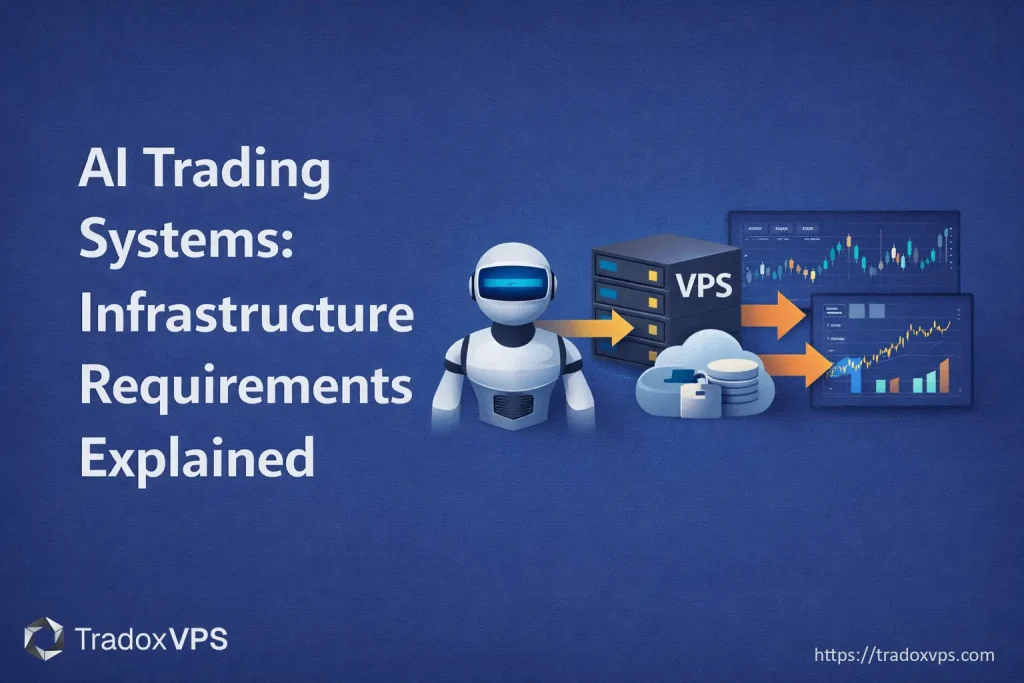
Artificial Intelligence (AI) is reshaping financial markets. From predictive analytics to algorithmic decision-making, AI trading systems are capable of executing complex strategies faster than any human trader. But to unlock their full potential, a robust and optimized AI trading infrastructure is essential.
This guide explores the critical components of AI trading infrastructure, including hardware, networking, security, and cloud/VPS considerations, ensuring your AI trading systems perform reliably, securely, and efficiently.
What Is AI Trading Infrastructure?
AI trading infrastructure refers to the combination of hardware, software, and network systems that support AI-based trading strategies. Unlike traditional algorithmic trading, AI models require:
- High computational power for model training and inference
- Low-latency execution to process market data in real-time
- Secure environments for sensitive data, credentials, and algorithms
In short, your infrastructure is the backbone of AI trading, determining how fast and accurately your models can analyze data and place orders.
Key Components of AI Trading Infrastructure
1. High-Performance Computing
AI trading relies on machine learning and deep learning models that require significant computing power:
- Multi-core CPUs for parallel processing
- High-end GPUs for model training and inference
- Ample RAM (32GB+) for large datasets
- Fast storage (NVMe SSDs) for data retrieval
Cloud services and VPS providers often offer GPU-enabled servers suitable for AI workloads. For high-frequency AI trading, consider colocated servers near exchange data centers.
2. Low-Latency Network Connectivity
AI trading models are only as effective as the speed of execution. Low-latency connectivity ensures minimal delay between your system’s signals and order execution. This includes:
- Proximity to exchange matching engines
- Optimized network routing and fiber connections
- Redundant network paths for uninterrupted connectivity
CME Group Network Access Overview
3. Data Acquisition & Storage
AI models require massive datasets from multiple sources, such as market data feeds, news APIs, sentiment analysis, and historical trading data. Your infrastructure must support:
- High-speed ingestion pipelines
- Reliable and redundant storage systems
- Scalable databases for large datasets
4. Security & Compliance
AI trading infrastructure deals with sensitive data, including trading algorithms, API keys, and market positions. Security is crucial:
- Firewalls and VPNs to protect network access
- Encryption for data at rest and in transit
- Multi-factor authentication for system access
- Compliance with financial regulations (SEC, MiFID II, etc.)
5. AI & Trading Software Stack
An AI trading system is not just hardware. Your software stack should include:
- Python or R for model development
- Deep learning frameworks (TensorFlow, PyTorch)
- Trading platforms or APIs (NinjaTrader, Interactive Brokers TWS, Rithmic, CQG)
- Real-time analytics and monitoring tools
VPS vs Cloud vs On-Premise for AI Trading
VPS for AI Trading
A VPS provides dedicated computing resources in a virtualized environment. Benefits include:
- 24/7 uptime for continuous model execution
- Low-latency connections when located near exchanges
- Secure isolated environment for AI models
Cloud Computing
Cloud providers like AWS, Azure, or Google Cloud offer GPU instances and scalability. Ideal for:
- Training large models
- On-demand resource scaling
- Global infrastructure for distributed trading
On-Premise Infrastructure
On-premise servers give you full control over your hardware and network but require high upfront costs and ongoing maintenance. Suitable for:
- High-frequency AI trading requiring microsecond latency
- Data-sensitive strategies
AI Trading Infrastructure Architecture
A well-designed architecture connects data pipelines, AI models, VPS/cloud servers, and exchange execution in a seamless workflow. Key design principles include:
- Low-latency paths between market data and execution engines
- Redundancy to prevent single points of failure
- Monitoring and logging to detect anomalies in real-time
Common Mistakes in AI Trading Infrastructure
- Underestimating computing power required for model inference
- Ignoring latency when selecting server locations
- Skipping security hardening and encryption
- Failing to monitor system performance and failures
- Using generic cloud servers without trading optimization
FAQs – AI Trading Infrastructure
What is the minimum hardware for an AI trading system?
For small-scale AI strategies, a multi-core CPU, 16–32GB RAM, and an NVMe SSD can suffice. Large-scale deep learning requires GPUs and more RAM.
Should I use VPS or cloud for AI trading?
VPS is ideal for low-latency execution near exchanges. Cloud is great for training large AI models or distributed trading, but may have higher latency.
How do I secure my AI trading infrastructure?
Use firewalls, VPNs, encrypted storage, secure access keys, and multi-factor authentication. Always separate production trading systems from development environments.
Can AI trading be run 24/7?
Yes, with a reliable VPS or cloud server, your AI bots can trade continuously without interruption, ensuring strategies remain active at all times.
Which trading platforms support AI integration?
Major platforms include NinjaTrader, TradeStation, MultiCharts, Interactive Brokers TWS, CQG, and Rithmic. Most allow API access for AI systems.
Final Thoughts
AI trading systems require more than sophisticated models—they demand a solid AI trading infrastructure. Hardware, low-latency network, secure VPS/cloud servers, and proper software stack all contribute to consistent, profitable, and safe automated trading.
Investing in the right infrastructure is investing in execution speed, reliability, and long-term success. Whether you choose a specialized VPS like TradoxVPS or a cloud environment, infrastructure planning is the foundation of every successful AI trading system.